How to Read a Soil Test: 6 Easy Steps and Real Lab Results
Learning how to read a soil test takes about ten minutes. Start with the pH, then the organic matter, then the phosphorus and potassium ratings, and finish with the recommendation line that tells you what to add and how much. The rest of the page is detail you can ignore until those four things make sense.
Plenty of gardeners get stuck anyway. The lab report arrives as a grid of numbers, abbreviations and bar charts. Some values are flagged high, which sounds like good news but often is not. And the recommendation is written in pounds per 1,000 square feet, when your raised bed is 4 feet by 8.
Below are real gardeners in Colorado, Oregon, Minnesota, Michigan and Tennessee who sent their reports to Extension experts and asked what they meant. Their cases show the patterns that turn up again and again, and the last sections walk through the math for a small garden.
Key takeaways
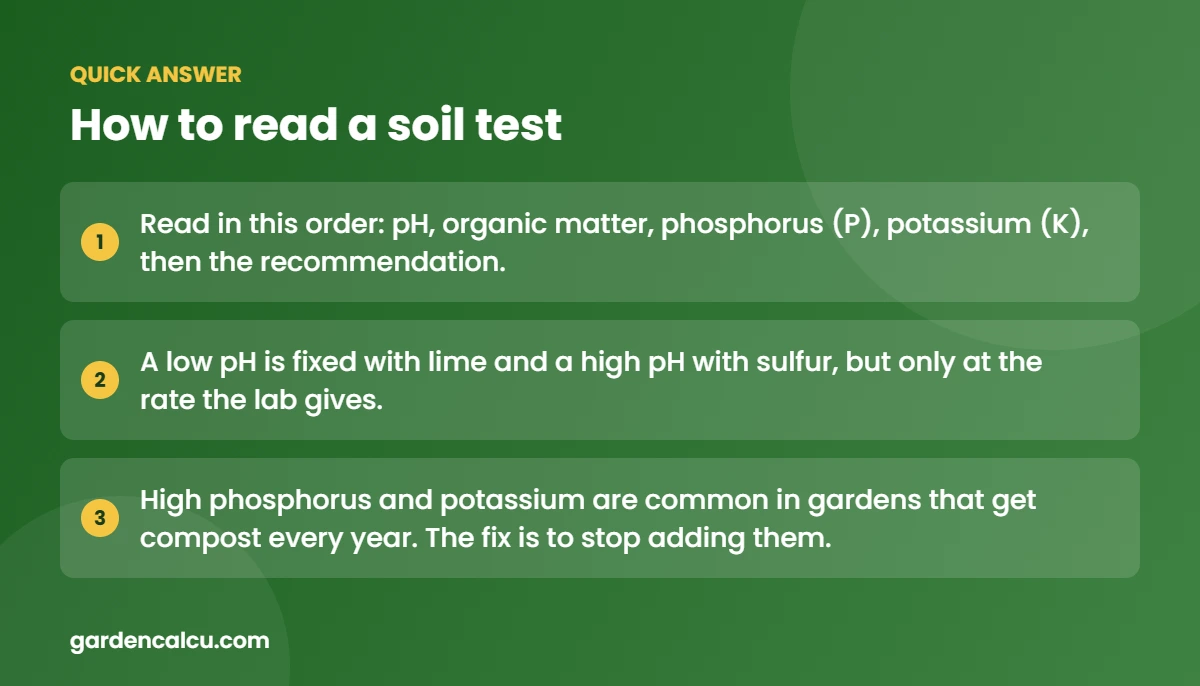
Quick answer to “how to read a soil test” in three points.
Real questions gardeners asked
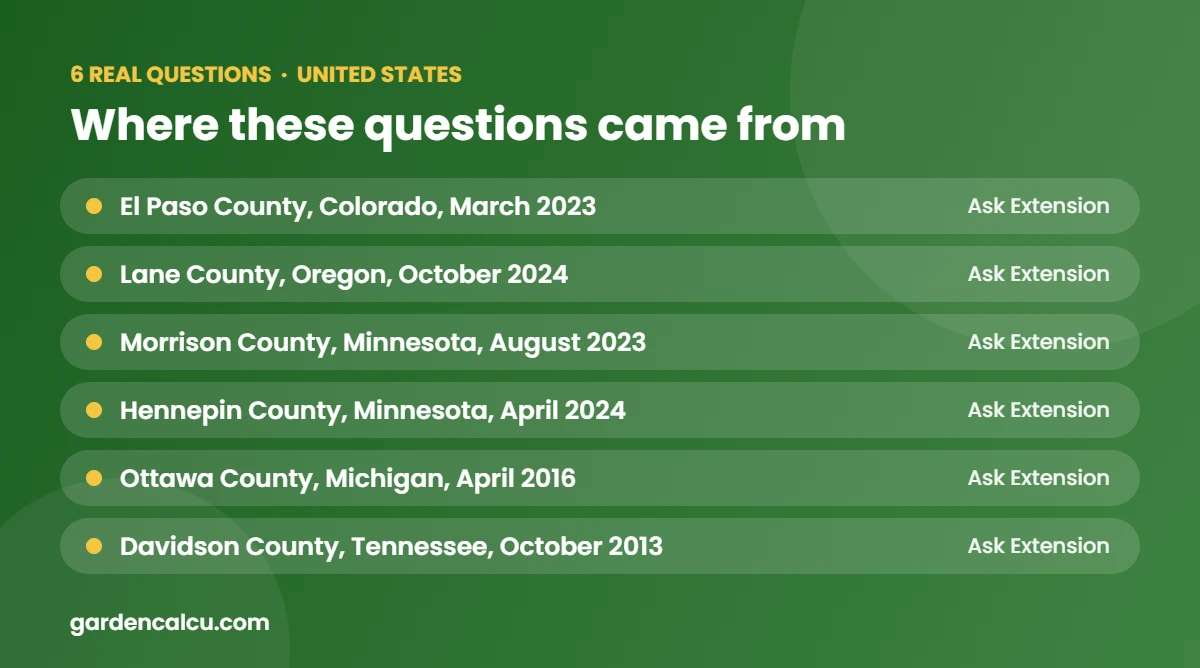
These are real questions sent to Ask Extension, the free service run by US land-grant universities. Each card shows where and when the gardener asked, and links to the full answer.
“How do I read the soil test I got from the CSU lab?”
The question: I got the results of my soil test which I sent in to the CSU soil, water and plant testing lab. It gives a lot of information but I don’t know what it means. I have grown vegetables somewhat successfully in my garden beds, but I’d like to be more successful and I can’t read what it means.
What the expert said: The expert picked out two findings: organic matter at 8.5 percent, which is on the high side, and a sandy texture. The lab’s recommendation was to apply 0.8 lb of nitrogen per 1,000 sq ft three times during the growing season, with phosphorus, potassium and sulfur at adequate levels or above. Colorado soils typically have about 3 percent organic matter, and the advice was not to go above 5.
“Help interpreting results from the OSU soil lab”
The question: I was wondering if you provide any assistance with soil sample result interpretation from the OSU soil lab for gardening? I have reviewed the available online resources to interpret the labs and am familiar with them but would love additional assistance by an expert.
What the expert said: An Oregon State University faculty research assistant flagged the pH of 5.1 as well below the lowest value you might wish for a vegetable garden, and recommended 150 to 250 lb of lime per 1,000 sq ft, applied in fall so it has all winter to react. Potassium was high, so none was needed. With organic matter at 7.8 percent, the advice was to ease back to about 1 inch of compost a year.
“Everything tested very high, so why are plants struggling?”
The question: I had a soil test done expecting the garden had a nutrient deficiency because the plants aren’t growing well at all. I was surprised to see that most of the levels are considered very high. I am not sure if I should add any fertilizer with the very high levels but I was confused why the plants aren’t growing well.
What the expert said: The expert explained that soil nutrients are only one part of whether a plant will thrive. Water, soil texture, and whether the plant suits the site all matter too. A good soil test will not test for nitrogen, because nitrogen moves through the soil quickly. The University of Minnesota test covers phosphorus, potassium and pH.
“Soil test results for a home vegetable garden”
The question: I got the following soil tests for my home veggie garden. Any recommendations for amendments this spring based on the results?
What the expert said: Both samples showed medium texture and high organic matter, at 9.8 and 13.2 percent. The advice: add no more compost, use no fertilizer containing phosphate or potassium, and apply ammonium sulfate (21-0-0) at about 0.7 pounds per 100 square feet, a week or two before seeding, watered in well. The gardener was also told to stop piling fall leaves on the beds.
“Fertilizing questions (math?)”
The question: A homeowner with a 10,000 square foot lawn had a soil test recommending 3 to 4 lb of nitrogen per 1,000 sq ft and 0.9 lb of potassium. After spreading one 50 lb bag of 18-0-9, the question was whether that covered it.
What the expert said: The expert explained that 3 to 4 lb of nitrogen per 1,000 sq ft is the total for the whole season, split over three or four applications. One application of the 18-0-9 should give about one pound of actual nitrogen per 1,000 sq ft. The advice was to follow the label and spread applications across the season, not all at once.
“Nitrogen depleted, phosphorus way too high”
The question: I recently tested my soil and the result shows: depleted nitrogen, deficient potash, phosphorus way too high, pH test 7 to 7.5. Can you please tell me what fertilizer formula I should use? And can I apply it in the fall?
What the expert said: The expert said a pH of 7 to 7.5 is generally satisfactory for most plants, and that low nitrogen is typical because plants use it heavily and soil loses it. With phosphorus already high, the suggestion was a fertilizer with a 1-0-2 ratio, meaning no phosphorus at all.
How to Read a Soil Test in 6 Easy Steps
Every lab lays out its report a little differently, but the same pieces are always there. Work through them in this order.
If the report only shows numbers with no ratings or recommendation, it is less useful. That is the main reason Extension experts point people to a university or commercial lab. In one Colorado answer about failing beans, the expert warned that home soil test kits are not always reliable in their results.
Step 1: Soil pH
Soil pH runs from acidic (low numbers) to alkaline (high numbers), with 7 as neutral. Most vegetables and lawn grasses do best slightly acidic to neutral, and your report will show the target range for the crop you named on the form.
Two of the real reports show both ends of the scale. In Oregon, a pH of 5.1 was called well below the lowest value you might wish for a vegetable garden. In Tennessee, a pH of 7 to 7.5 was called generally satisfactory for most plants.
Reading | What it means | Usual fix |
|---|---|---|
Below the target range | Too acidic; some nutrients lock up | Lime, at the rate on the report |
Within the target range | Nothing to do | Leave it alone |
Above the target range | Too alkaline; iron and others become less available | Elemental sulfur, or choose tolerant plants |
Never guess the rate. The Oregon recommendation of 150 to 250 lb of lime per 1,000 sq ft was specific to that soil. For the details on each direction, see how much lime for a lawn and how to lower soil pH.
Tip: Fall is the best time to act on a low pH. The Oregon expert was emphatic that fall is the time to apply lime, because it then has all winter to react with the soil.
Step 2: Organic Matter
Organic matter is the decomposed plant and animal material in soil. It holds water and feeds soil life, so gardeners are taught to keep adding compost. The real reports above show what happens when that advice is followed for years without a test.
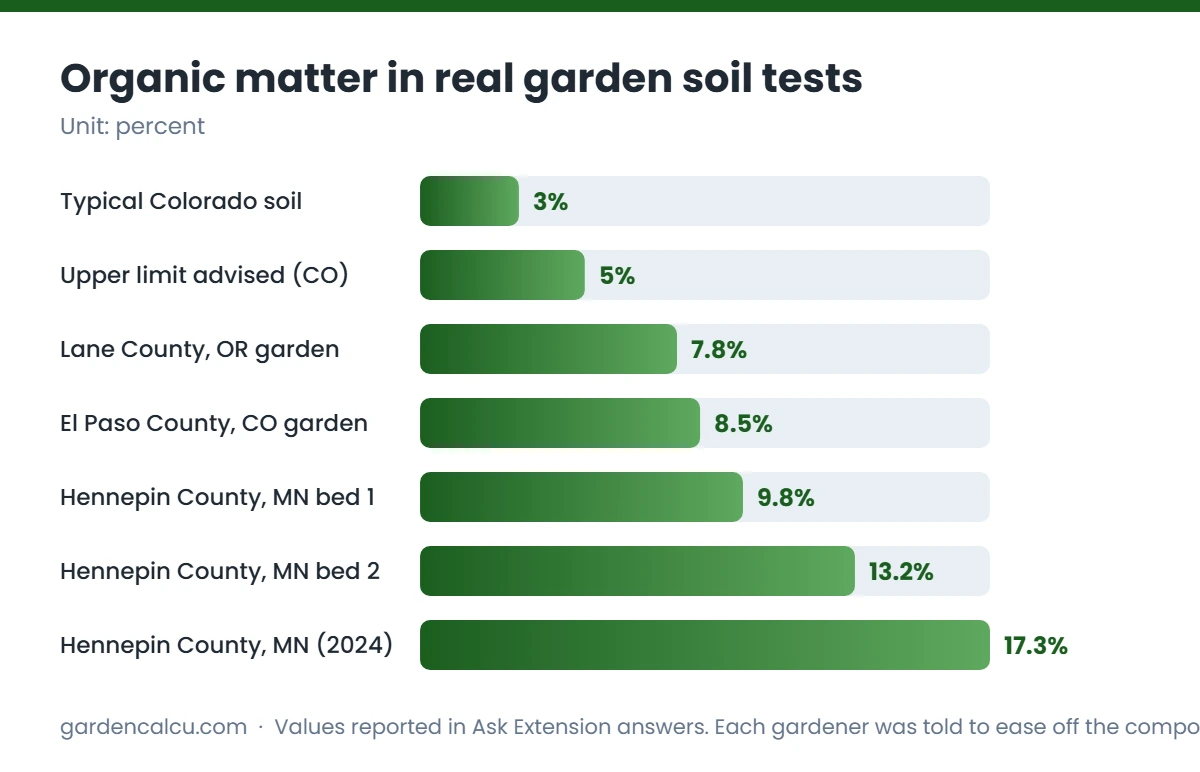
Organic matter percentages from real soil test reports discussed in Ask Extension answers, compared with the typical level and upper limit a Colorado expert cited.
Every one of these gardens was well above the range the experts considered ideal. In Colorado, where soils typically hold about 3 percent, the expert suggested not exceeding 5. In Oregon, at 7.8 percent, the advice was to ease back on the dose to about an inch of compost a year. In Minnesota, at 9.8 and 13.2 percent, it was no more compost for now.
Why does too much matter? Compost carries phosphorus. In another Minnesota case, an expert explained that the high organic content, 17.3 percent, was partly responsible for the elevated phosphorus level in the soil. Our guide on how much compost to add to a garden covers sensible yearly amounts.
Step 3: Phosphorus and Potassium
These are the P and K in fertilizer numbers. The lab reports each as a number, often in parts per million, with a rating beside it. The rating is what you act on.
Rating on the report | What to do |
|---|---|
Low | Add that nutrient at the recommended rate |
Medium or optimum | Add a maintenance amount, or none |
High or very high | Add none, and avoid fertilizers and composts that contain it |
High readings are far more common in home gardens than low ones. The Morrison County gardener expected a deficiency and found most levels very high. The Hennepin County gardener was told not to use fertilizers containing phosphate or potassium. The Oregon gardener was told to make no potassium additions and to limit phosphorus to no more than 5 lb per 1,000 sq ft.
When P or K is high, choose a fertilizer with a zero in that position. The Tennessee expert’s suggestion of a 1-0-2 ratio is an example: nitrogen and potassium, no phosphorus. If the three numbers on the bag are new to you, read what do fertilizer numbers mean.
Step 4: Nitrogen
Gardeners often search the page for a nitrogen value and cannot find one. That is normal. As the Minnesota expert put it, a good soil test will not test for nitrogen because nitrogen moves through the soil quickly. A reading taken in March says little about June.
Labs give a seasonal recommendation instead. The Colorado report said 0.8 lb of nitrogen per 1,000 sq ft, three times during the growing season. The Oregon expert added a timing rule: do not apply nitrogen until planting time, because fall-applied nitrogen will soon be washed below the rooting zone.
Rich soil supplies some of its own. In a Maryland case, an expert told a gardener with fertile, high organic matter soil to expect a release of 3 to 6 lb of nitrogen per 1,000 sq ft from the organic matter over the growing season.
Step 5: Micronutrients
Iron, zinc, manganese, copper and boron are needed in tiny amounts. Unless the report flags one as deficient, leave them alone. The Oregon expert explained why: micronutrients are metals, and the difference between enough and too much is not very big at all. All-in-one products with long lists of trace elements are more likely to cause a problem than to solve one.
Watch out: Do not add Epsom salt, sulfur, lime or micronutrient mixes just in case. Each one changes the soil chemistry. Add only what the report asks for.
Turn Your Soil Test Into Pounds and Ounces
Enter your bed size and the numbers on the bag. The free Fertilizer Calculator converts a soil test recommendation into the exact amount to spread.
Step 6: Turn the Recommendation Into Real Amounts
Recommendations are written for 1,000 or 100 square feet. Here is the math for a home garden.
Worked Examples From the Real Reports
Recommendation | Product | Per 1,000 sq ft | For a 4 x 8 bed (32 sq ft) |
|---|---|---|---|
0.8 lb N, three times a season (Colorado) | 21-0-0 | About 3.8 lb each time | About 2 ounces each time |
150 to 250 lb lime (Oregon) | Garden lime | 150 to 250 lb | About 5 to 8 lb |
0.7 lb of 21-0-0 per 100 sq ft (Minnesota) | 21-0-0 | 7 lb | About 3.5 ounces |
1 lb N per application (Michigan lawn) | 18-0-9 | About 5.6 lb | Not applicable (lawn) |
The Michigan lawn question is a good check on the method. One 50 lb bag of 18-0-9 holds 9 lb of nitrogen, since 50 times 0.18 is 9. Spread over 10,000 square feet, that is 0.9 lb per 1,000, which matches the expert’s estimate of about one pound. It also shows the most common misreading. The 3 to 4 lb on the report was the total for the season, to be split over three or four applications, not a single dose.
The Fertilizer Calculator does this conversion for any bag and any bed size.
What a Soil Test Cannot Tell You
The Morrison County gardener’s puzzle is common: the numbers look fine, even high, and the plants still struggle. The expert’s answer is worth keeping in mind. Soil nutrients are only one part of whether a plant thrives. Others include:
A standard test also does not screen for herbicide residue, diseases or most contaminants. If you suspect lead in an urban garden, ask the lab for that test specifically.
When and How to Test Again
Test every few years, or sooner if you made a big change such as liming. The Oregon expert gave a tip that most gardeners have never heard: collect your soil sample during about the same week of the year each time, because soil pH cycles through an annual pattern. A spring result and a fall result from the same bed are not directly comparable.
Costs are modest. One Minnesota expert put the University of Minnesota test at $19, with results back in two to three weeks. Another quoted about $17. That is less than a bag of the fertilizer you might not need.
Frequently asked questions
Short answers to the questions that come up most often.
Quick recap
Once you know how to read a soil test, the report stops being a wall of numbers. Check the pH against the target range, check whether organic matter is already high, act on the ratings for phosphorus and potassium, and follow the nitrogen recommendation for the season. Then scale the rate to your own square footage.
The real reports in this article share a lesson. Most home gardens are not short of nutrients. They are overloaded with compost, phosphorus and potassium, and short only of nitrogen. A soil test costing under $20 is what tells you to stop adding the things you do not need.
Get your exact number
Convert your soil test recommendation into exact amounts with the free Fertilizer Calculator.
Related guides
Sources
The facts in this guide to “how to read a soil test” come from these university Extension pages and public questions: