Treated Wood for Raised Beds: Is It Safe? 6 Expert Answers
Treated wood for raised beds made since 2004 no longer contains arsenic, and Extension experts in Oregon, Texas and Minnesota consider it safe for vegetable gardens. Old treated lumber is a different matter. Wood from before 2004 may contain arsenic and should not be reused for growing food.
Not every expert gives the same answer, which is why the question keeps being asked. One Ohio volunteer still advises lining treated boards with plastic. Others say plainly that current lumber is fine. The difference comes down to how much caution each person applies to small amounts of copper.
This guide is built from six real questions sent to university Extension services in Oregon, Ohio, Minnesota, Texas and New York. We set the answers side by side so you can see where they agree, where they differ and what the alternatives cost you in durability.
Key takeaways
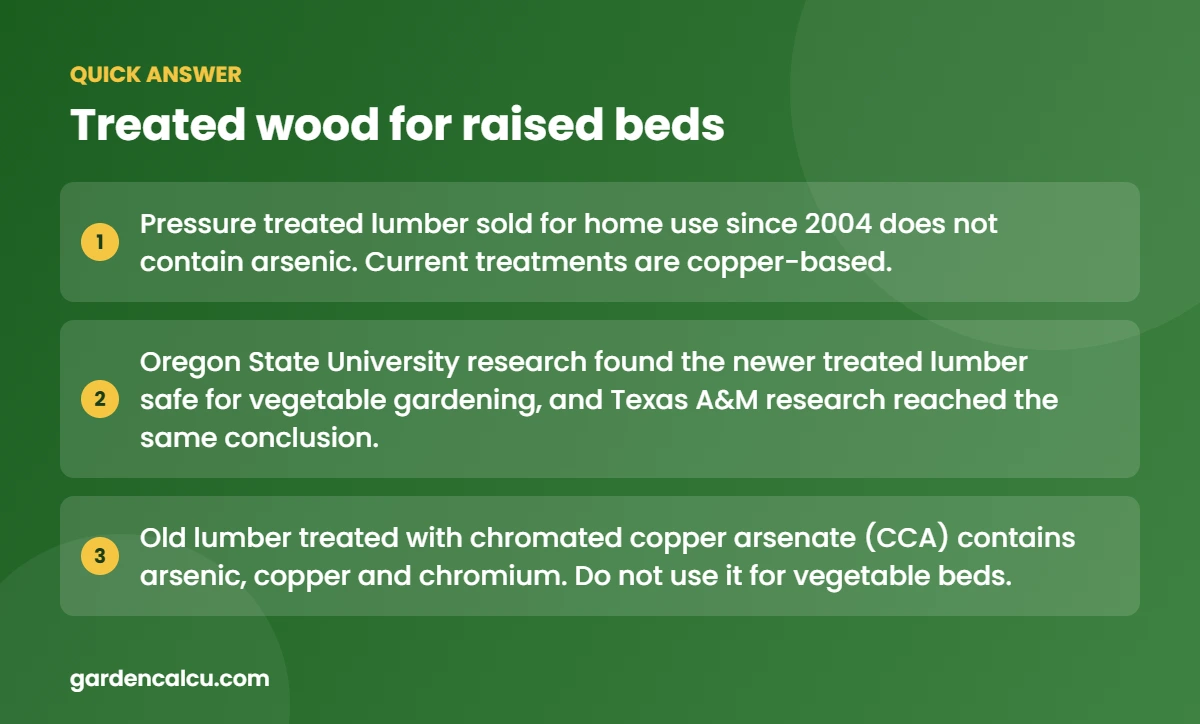
Quick answer to “treated wood for raised beds” in three points.
Real questions gardeners asked
Whether to use treated wood for raised beds is asked every spring by people standing in a lumber aisle comparing prices. We read six real questions and the experts’ replies. Here is each one in our own words, with a link to the original.
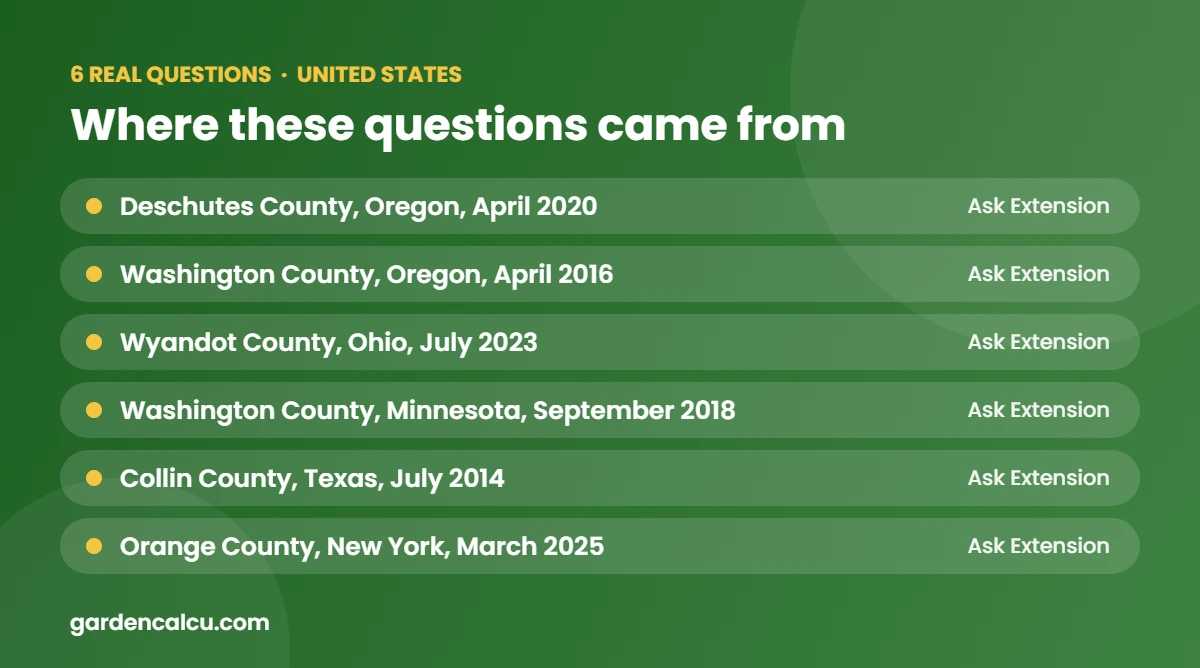
“Raised Garden Bed Materials”
The question: A gardener building raised beds had heard the new pressure treated wood was non-toxic and asked if that was right, and what cheaper untreated wood to use since redwood and cedar were out of budget.
What the expert said: Oregon State University has researched the new type of pressure treated lumber and found it safe for vegetable gardening, the expert said. The original treatment used arsenic. The newer treatment used since 2004, alkaline copper quaternary or ACQ, is safe for use in raised beds.
“Lumber for raised vegetable beds”
The question: A gardener building beds from untreated cedar asked if pressure treated posts could be used at the corners, set about 4 inches into the ground.
What the expert said: Cedar is a good choice, the expert said, and the new ACQ treated lumber is safe for the corner posts. Anyone still concerned can use 4×4 cedar or juniper posts, which last for many years untreated.
“Raised bed gardens”
The question: A gardener asked if the treated lumber sold at any lumberyard today can be used, having heard that older treated wood bled harmful chemicals.
What the expert said: The volunteer said it is generally not recommended without a plastic lining to keep soil from direct contact with the wood. Arsenic is no longer used, but other metals and chemicals may leach. Cedar is the most durable wood. Untreated lumber works too, and her own untreated 2×8 bed had lasted about 5 to 10 years. Composite products are another option.
“Lumber for Raised Beds”
The question: Someone applying for a community garden grant wanted low-cost lumber that would not leach toxic substances, and asked about a treated product described as suitable for vegetable gardens.
What the expert said: That copper-based treated lumber is what is currently considered a safe pressure treated wood for gardens, the volunteer said. Cedar resists decay naturally but costs more. If the beds do not need to be raised, mound the soil higher in the middle, or frame with rocks or concrete blocks.
“Raised vegetable gardens using pressure treated wood”
The question: A gardener had used pressure treated landscape timbers for a couple of years and was growing cantaloupes. Were they safe to eat and share?
What the expert said: Yes, it is safe, the expert said. Research by Texas A&M has shown that treated lumber is safe for raised bed vegetable gardens, and the newer treated lumber should be even safer since it contains no arsenic.
“25 old treated lumber for raised bed”
The question: A gardener wanted to build a vegetable bed from treated lumber that was 25 years old and asked about the actual chances of problems.
What the expert said: Old treated wood may be more likely to contain harmful chemicals than new, the expert said, quoting University of Maryland Extension. Micronized copper azole, or MCA, is now the most widely available preservative for residential use. It has no arsenic and is considered low in toxicity. The older chromated copper arsenate, CCA, contained arsenic, copper and chromium.
Is treated wood for raised beds safe? New versus old
The whole question turns on a date. Around 2004, the lumber industry stopped selling arsenic-treated wood for residential use. Everything sold for home projects since then uses copper-based preservatives.
Treatment | When | Contains | For vegetable beds |
|---|---|---|---|
CCA (chromated copper arsenate) | Before about 2004 | Arsenic, copper, chromium | Do not use |
ACQ (alkaline copper quaternary) | Since 2004 | Copper and a quaternary compound | Found safe by Oregon State University research |
MCA (micronized copper azole) | Current, most common | Copper and an azole fungicide | Considered low in toxicity |
CA (copper azole) | Since 2004 | Copper and an azole fungicide | Same family as MCA |
The Texas answer from 2014 makes an interesting point. Texas A&M research had found even the older treated lumber safe in raised beds, and the expert reasoned that the newer lumber, without arsenic, should be safer still.
So why does one expert still say no?
The Ohio answer is the cautious one. Arsenic is gone, the volunteer agreed, but copper and other compounds can still leach in small amounts, so line the boards with plastic.
Copper is a nutrient that plants need in tiny quantities and is toxic to them at high levels, which limits how much they take up. The studies cited by Oregon and Texas found the amounts moving from new lumber into soil to be small. That is the basis for “safe”. The Ohio position is simply an extra margin.
Both views lead to workable options. Use new treated lumber as it is, or add a liner if you want to be more careful.
Rule 1: never reuse old treated lumber for food beds
The New York gardener’s 25-year-old boards date from around 2000, which puts them in the CCA era. The expert’s answer was that old treated wood is more likely to contain harmful chemicals than new.
Signs that lumber may be CCA:
Railroad ties are a separate hazard. They are treated with creosote and should not be used around vegetables either.
Watch out: Do not burn old treated wood, and do not sand or saw it without a dust mask. Arsenic ends up in the ash and dust. Dispose of it with household trash according to local rules.
Rule 2: how to line a treated bed
If you choose the cautious route, the Ohio method is simple.
Do not run plastic across the bottom. A lined floor turns the bed into a bathtub.
You can also simply plant the hungriest and leafiest crops a few inches in from the boards. Whatever moves out of the wood stays within the first inch or two of soil beside it.
Rule 3: know the untreated options and how long they last
Material | Durability | Notes from the Extension answers |
|---|---|---|
Cedar | Best of the natural woods | Recommended in Oregon, Ohio and Minnesota answers. Expensive. |
Juniper | Lasts many years | Suggested for posts by an Oregon expert |
Untreated pine or fir | About 5 to 10 years in one Ohio garden | Cheapest. Plan to replace. |
Composite boards | Long | Costs more |
Concrete blocks or stone | Permanent | Suggested in the Minnesota answer |
No frame, mounded soil | Rebuild yearly | Free |
The Ohio volunteer’s own bed is a useful benchmark. Untreated 2×8 boards had been in use for somewhere between 5 and 10 years and were still in good condition. Thicker boards last longer than thin ones, and wood lasts longer in dry climates than wet ones.
Tip: If budget rules out cedar for the whole bed, use it or new treated lumber only for the corner posts, which sit in the ground and rot first, and use untreated boards for the sides. That was the Washington County gardener’s design in reverse, and the expert approved.
How much lumber does a raised bed take?
The perimeter of a 4 x 8 ft bed is 24 feet. Each course of boards needs 24 linear feet, which is three 8-foot boards with one cut in half.
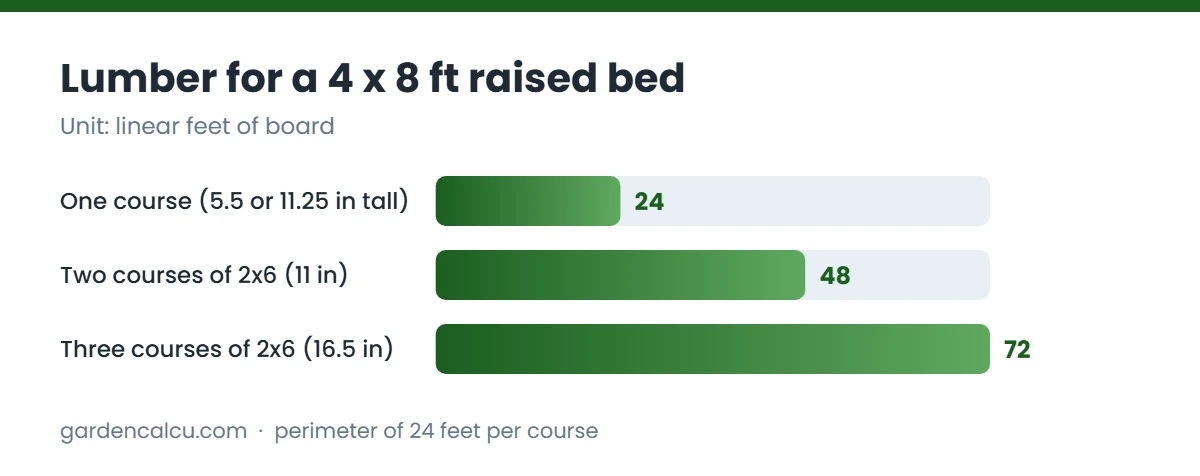
Chart for “treated wood for raised beds”: linear feet of board needed for a 4 x 8 ft bed at each height.
Bed height | Boards | Linear feet | 8 ft boards to buy |
|---|---|---|---|
5.5 in (one 2×6 course) | 2×6 | 24 | 3 |
11 in (two 2×6 courses) | 2×6 | 48 | 6 |
11.25 in (one 2×12 course) | 2×12 | 24 | 3 |
16.5 in (three 2×6 courses) | 2×6 | 72 | 9 |
Add a 4×4 post for the corners, cut into four pieces a little longer than the bed is tall.
Height drives the soil bill more than the lumber bill. See how deep should a raised bed be before choosing, and use the Raised Bed Soil Calculator to see what each height costs to fill.
How much soil will your bed need?
Enter the length, width and height of the bed you are building. The calculator gives the cubic feet, cubic yards and bags of soil to fill it.
What about stains, sealers and paint?
Coating untreated wood to make it last is the natural next idea. Keep any finish on the outside faces only, and let it cure fully before filling the bed. Raw linseed oil and similar plant-based oils are commonly used on the inside of beds. Avoid used motor oil and old creosote products entirely.
A plastic liner on the inside, as in Rule 2, also slows rot in untreated wood by keeping wet soil off the boards.
Which should you choose?
Your priority | Good choice |
|---|---|
Lowest cost, do not mind rebuilding | Untreated pine or fir |
Low cost and long life | New treated lumber, lined if you prefer |
No treatment at all, long life | Cedar or juniper |
Permanent, no wood | Concrete blocks, stone or metal |
Certified organic production | Check your certifier’s rules. Treated wood is generally not allowed in contact with soil. |
Once the frame is built, the soil matters far more to your harvest than the boards. See how much soil for a raised bed and best soil for vegetable gardens.
Common mistakes
Frequently asked questions
Short answers to the questions that come up most often.
Quick recap
Treated wood for raised beds is a different product from what it was before 2004. New copper-treated lumber has no arsenic and is considered safe by several university Extension services. Old treated lumber should stay out of vegetable gardens.
If you want more margin, line the inside walls with plastic or choose cedar, untreated boards or masonry. Then put your effort into the soil.
Get your exact number
Enter your bed dimensions and the calculator turns them into cubic feet, cubic yards and bags of soil.
Related guides
Sources
The facts in this guide to “treated wood for raised beds” come from these university Extension pages and public questions: