How to Lower Soil pH: Sulfur Rates and 5 Easy Rules
How to lower soil pH: work elemental sulfur into the top 6 inches of soil, well before planting, at a rate set by a soil test. Extension figures range from about 0.8 to 2.4 pounds per 100 square feet to drop pH by one unit, and more on heavy or organic soils. Then wait. Sulfur takes months, sometimes a year or two, to act.
Nearly everyone who asks is trying to grow blueberries, which want a pH of 4.5 to 5.5. The hard truth in the Extension answers is that soil starting above 7 is very difficult to bring down that far, and one expert called it a monumental task.
This guide is built from five real questions sent to university Extension services in Minnesota, Oregon and Maryland. The rates are theirs. We have set them side by side, worked out the amounts for small beds and listed the alternatives for soil that will not cooperate.
Key takeaways
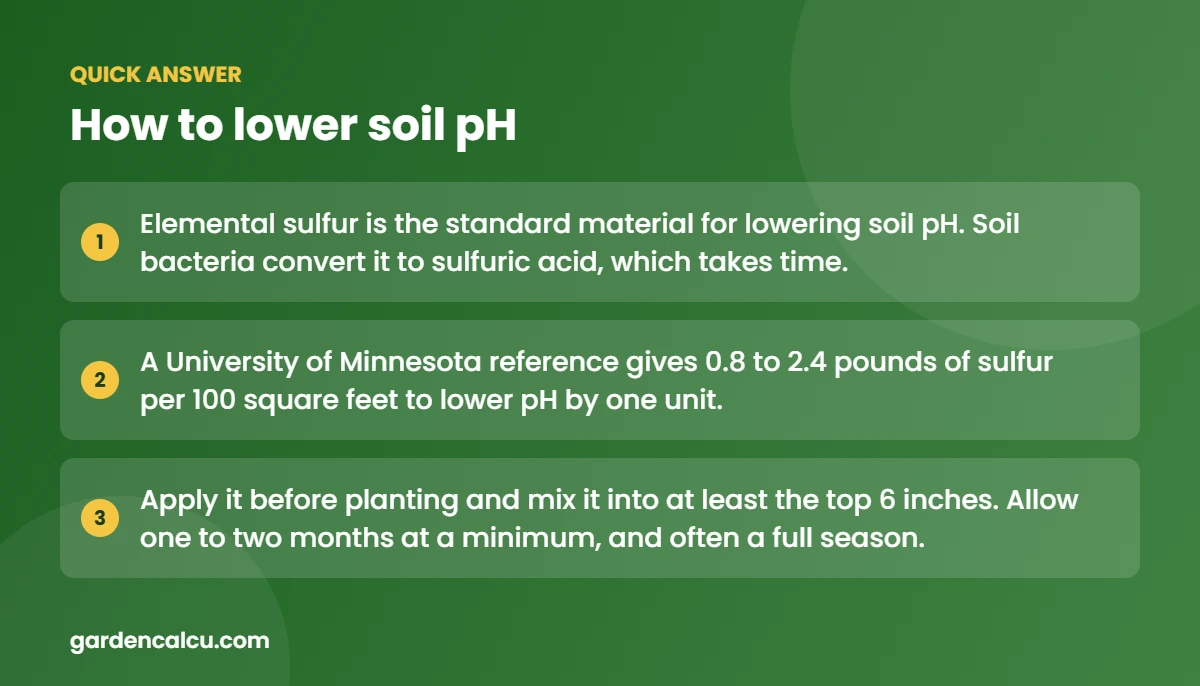
Quick answer to “how to lower soil pH” in three points.
Real questions gardeners asked
Search for how to lower soil pH and most results skip the two things that matter: how much and how long. We read five real questions sent to Extension experts, most from blueberry growers, and summarized each in our own words with a link to the original.

“90% sulfur vs iron sulfate”
The question: A soil test showed a planned blueberry bed at pH 7.5. The gardener had been given a bag of 90 percent sulfur and wanted to know how much to use, hoping not to wait another 6 to 8 weeks.
What the expert said: The best pH for blueberries is 4.5 to 5.5, the expert said, and getting from 7.5 down to that range is a monumental task that cannot be done in 6 to 8 weeks. The two realistic choices are a different location where pH is already below 6.0, or removing the soil to a depth of a foot or more and replacing it with soil at pH 5.0. From a University of Wisconsin table, lowering pH one unit takes roughly 24 pounds of elemental sulfur per 1,000 square feet, which is 2.4 pounds per 100.
“How to acidify soil to grow blueberries”
The question: After planting five blueberries, a gardener tested the soil at pH 7.1 and added sulfur at 1.9 pounds per 100 square feet as recommended. A year later it tested 7.6, and the lab said acidifying was not recommended for that soil.
What the expert said: The volunteer explained that the lab does not recommend blueberries where pH is above 7, because acidifying becomes extreme and many people do not follow through. It can be done. The reference gives 0.8 to 2.4 pounds of sulfur per 100 square feet to lower pH one unit, and this soil needed a drop of 2.5 to 3 units. Sulfur acts slowly, taking at least one season, and should be mixed in at least 6 inches deep. In her own garden, starting at 7.5, it took two full years.
“Acidifying soil for new blueberry plants”
The question: A lab test showed pH 5.9 in a new 375 square foot blueberry bed and recommended elemental sulfur at 40 to 50 pounds per 1,000 square feet, about 18 pounds. Planting was a month away. Could the sulfur go in the planting holes?
What the expert said: The rate seems reasonable, the expert said, but there is not much time for it to react. Elemental sulfur relies on soil bacteria to convert it to sulfuric acid, which usually takes 1 to 2 months. Apply it as soon as possible and mix it in well with the soil to avoid injuring the plants.
“lowering pH around existing blueberry plants”
The question: A gardener planted blueberries in soil at pH 6.5 before learning that pH should be lowered 6 to 12 months ahead. How should sulfur be applied around plants already in the ground, and how much?
What the expert said: Pull back the mulch and broadcast the sulfur as evenly as possible across the whole bed, around and between plants, the expert said. Apply 4 pounds of elemental sulfur per 100 square feet. Rake it lightly into the top few inches, water it in and replace the mulch. Blueberries in soil high in organic matter can grow acceptably at pH 6.0 to 7.0, but lowering it is very beneficial.
“Lowering PH with Sulfur in Fall”
The question: About 60 square feet of raised vegetable beds tested at pH 8.2. The gardener had bought sulfur, hoped to reach about 7, and had read conflicting advice about applying it in fall.
What the expert said: Before advising, the expert asked what pH was wanted, what was being grown and for a copy of the soil test, since the amount depends on all three.
First: do you need to lower it at all?
Most vegetables, lawns and flowers grow well between pH 6.0 and 7.0. If your soil tests in that range, leave it alone.
Plants | Preferred pH | Lower the pH? |
|---|---|---|
Blueberries | 4.5 to 5.5 | Yes, if above about 5.5 |
Azaleas, rhododendrons | About 4.5 to 6.0 | If above 6.0 and leaves yellow |
Potatoes | About 5.0 to 6.0 | Sometimes, to limit scab |
Most vegetables and lawns | 6.0 to 7.0 | Only if well above 7.5 |
The Hennepin County beds at 8.2 | Target about 7 | Worth trying, with a soil test |
Always start with a laboratory soil test. Home kits are too coarse for this job, and the amount of sulfur depends on the starting pH and the soil type. The Hennepin County expert would not give a number without the report.
Rule 1: use elemental sulfur
Elemental sulfur, sold as soil sulfur or 90 percent sulfur, is what Extension answers recommend. It is not acidic itself. The Oregon expert explained that soil bacteria convert it to sulfuric acid, and that is why it takes time and warm, moist soil.
Material | Speed | Notes |
|---|---|---|
Elemental sulfur | Slow, months to years | Most acidifying per pound. The standard choice. |
Iron sulfate | Faster | Needs several times as much by weight |
Ammonium sulfate fertilizer | Gradual | Acidifies as it feeds. Useful for maintenance. |
Aluminum sulfate | Fast | Easy to overdo. Aluminum can harm plants. |
Peat moss | Mild | Helps in planting holes and mixes, not a whole-bed fix |
Coffee grounds, pine needles | Negligible | Do not rely on them |
Rule 2: get the rate right
This is where the answers look inconsistent, so here they are together.
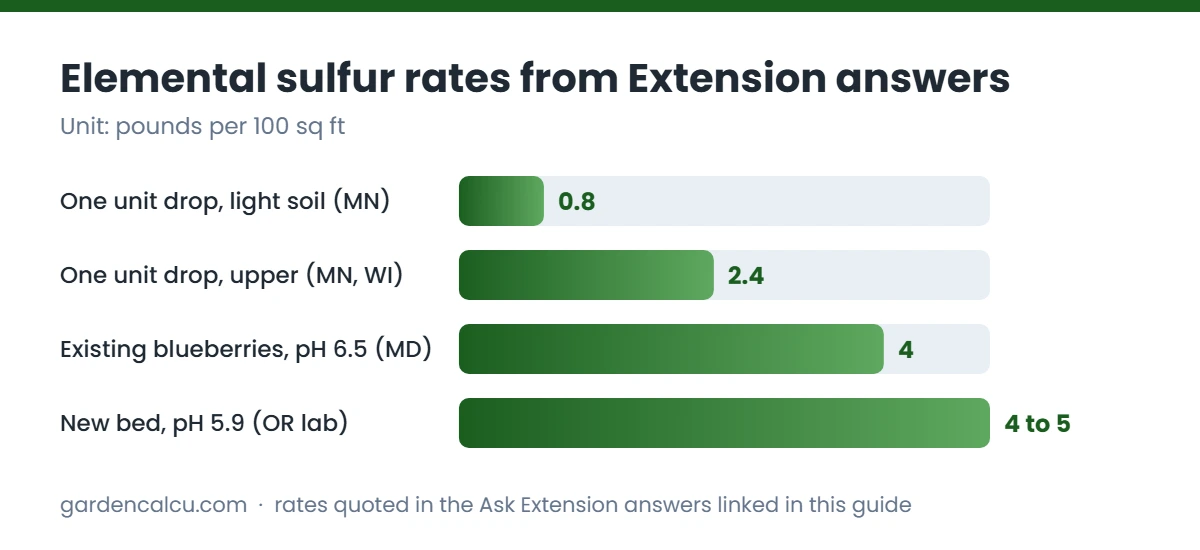
Chart for “how to lower soil pH”: pounds of elemental sulfur per 100 square feet in four Extension answers.
Situation | Elemental sulfur per 100 sq ft | Source |
|---|---|---|
Lower pH one unit, lightest soils | 0.8 lb | University of Minnesota reference |
Lower pH one unit, upper figure | 2.4 lb | Minnesota reference and Wisconsin table |
Existing blueberries at pH 6.5 | 4 lb | Maryland answer, 2023 |
New bed, pH 5.9 to about 5.0 | 4 to 5 lb | Oregon lab recommendation, 2021 |
The spread comes from soil type. Sandy soil with little organic matter changes pH easily and needs the low end. Clay and soils rich in organic matter resist change, which is called buffering, and need much more. Western Oregon and Maryland soils are heavier than the sandy Ramsey County soil the Minnesota expert assumed.
Worked example: a 4 x 12 ft blueberry bed is 48 square feet. To lower sandy soil from 6.5 to 5.0, a drop of 1.5 units, at 2.4 pounds per 100 square feet per unit: 0.48 x 2.4 x 1.5 = 1.7 pounds of sulfur. At the Maryland rate of 4 pounds per 100 square feet, the same bed takes 0.48 x 4 = 1.9 pounds.
Bed | Area | At 2.4 lb per 100 sq ft | At 4 lb per 100 sq ft |
|---|---|---|---|
4 x 8 ft | 32 sq ft | 0.8 lb | 1.3 lb |
4 x 12 ft | 48 sq ft | 1.2 lb | 1.9 lb |
100 sq ft | 100 sq ft | 2.4 lb | 4 lb |
375 sq ft (Oregon bed) | 375 sq ft | 9 lb | 15 lb |
The Fertilizer Calculator scales any rate per 100 or 1,000 square feet to your bed.
Watch out: Do not apply more than a soil test recommends in the hope of speeding things up. Large single doses can injure roots. Where a big drop is needed, split the sulfur into two or more applications several months apart and retest between them.
Rule 3: mix it in, before planting
The Oregon gardener asked about putting sulfur in the planting hole. The expert’s answer was to mix it well with the soil to avoid injuring the plants. Concentrated sulfur against roots burns them, and a pocket of acid soil in a neutral bed does not last.
Around plants already in the ground
The Maryland method works without digging up roots.
Rule 4: be patient
Three answers give a time, and they get longer as the starting pH rises.
Sulfur works only when the soil is warm and moist, since the conversion is done by bacteria. Applied in late fall in a cold climate, it mostly waits until spring. That is still fine, because it is in place when the soil warms.
Tip: Retest every year. Soil drifts back toward its natural pH, especially where irrigation water is alkaline. A light yearly application or an acidifying fertilizer such as ammonium sulfate helps hold the level.
Rule 5: know when not to fight the soil
The 2018 Minnesota case is a warning. A year after applying sulfur, the pH had gone up, from 7.1 to 7.6, and the lab advised against acidifying that soil at all.
Soils that contain free lime, common in the Midwest and West, neutralize acid as fast as it forms. The pH barely moves until all the lime is used up, which can take far more sulfur than is practical. The 2025 Minnesota answer offered two alternatives, and there are others.
Scale the rate to your bed
Enter your bed area and the rate from your soil test. The calculator gives the total pounds to apply.
Lowering pH for vegetables and lawns
For a vegetable bed at 8.2, like the Hennepin County one, the goal is modest. Getting to the low 7s helps with iron and manganese, which are locked up at high pH.
For 60 square feet and a one-unit drop, the Minnesota range works out to 0.6 x 0.8 = 0.5 pound up to 0.6 x 2.4 = 1.4 pounds of sulfur. Compost and other organic matter help too, by buffering the soil and supplying nutrients in forms plants can use.
This is the opposite problem to an acid lawn. If your pH is too low, see how much lime for lawn. And avoid adding wood ash in garden beds that are already alkaline.
Common mistakes
Frequently asked questions
Short answers to the questions that come up most often.
Quick recap
How to lower soil pH: test first, then mix elemental sulfur into the top 6 inches at the rate the test gives, several months before planting, and retest. Expect 0.8 to 2.4 pounds per 100 square feet per unit on light soil and 4 to 5 pounds on heavier soil.
If the soil starts above 7 or contains free lime, save the sulfur and grow acid-loving plants in a raised bed or containers instead.
Get your exact number
Enter the bed size and the soil test rate, and the calculator gives the pounds of sulfur or fertilizer to apply.
Related guides
Sources
The facts in this guide to “how to lower soil pH” come from these university Extension pages and public questions: