How to Improve Clay Soil: 5 Easy Fixes That Really Work
How to improve clay soil comes down to one material: organic matter, especially compost. Add it every year, work the soil only when it is dry, mulch the surface and raise the bed a few inches where water still sits. Do not add sand, and in most soils do not bother with gypsum.
Clay is frustrating because the obvious fixes make it worse. Sand seems logical and produces something close to concrete. Gravel in the planting hole seems like drainage and creates a pool. One Oregon gardener had already bought three yards of sand before asking an Extension expert, who answered with the words “please do not”.
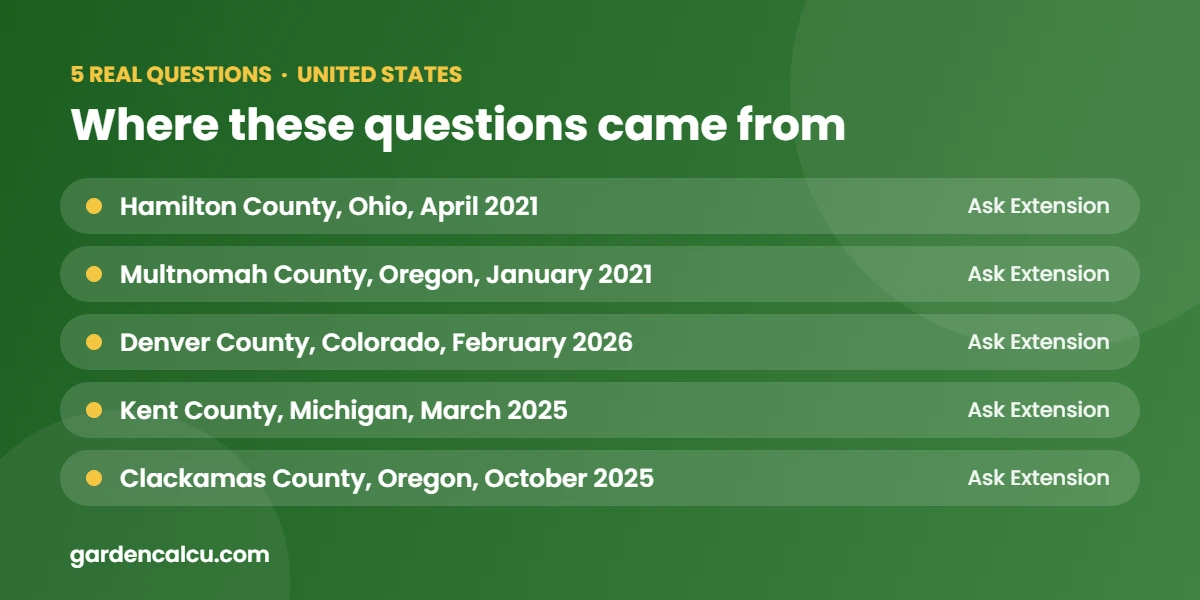
This guide is built from five real questions sent to university Extension services in Ohio, Oregon, Colorado and Michigan. The experts explain what clay actually is, why the popular amendments fail and what improves it over time.
Key takeaways
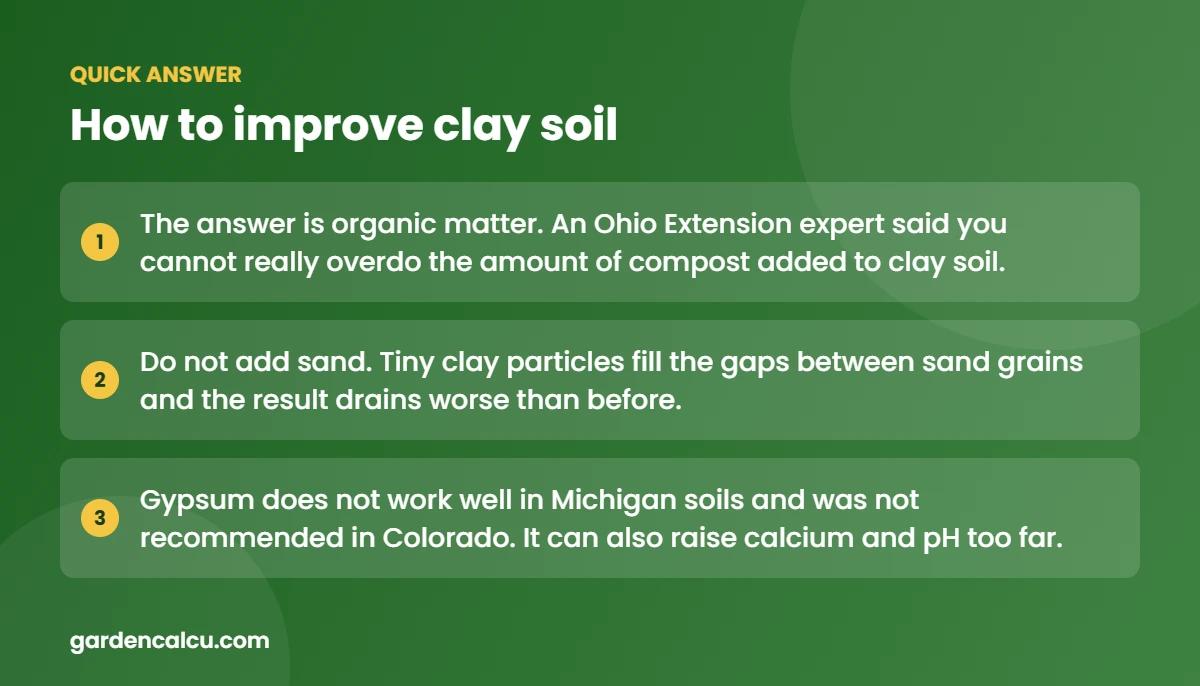
Quick answer to “how to improve clay soil” in three points.
Real questions gardeners asked
People looking up how to improve clay soil have usually just broken a shovel handle or lost a round of plants. We read five real questions and the experts’ replies, and summarized each in our own words with a link to the original.
“How to tend to clay soil”
The question: A Cincinnati gardener with a clay backyard asked what soil is best for the area and how to help plants grow in it.
What the expert said: The short answer is to add more organic material, particularly compost, the expert said. Clay particles are the smallest of all and plate-like, stacked like a deck of cards, so they trap water and leave little room for air. Sand makes things worse unless it is coarse and added at about 3 parts to 1. Gravel in a planting hole raises the water level. Gypsum may push calcium and pH too high. Add compost when the clay is dry. You cannot really overdo the amount.
“adding sand to clay soil”
The question: A dahlia grower had bought 3 yards of sand, a yard of compost and 2 yards of peat moss and planned to rototill 4 inches of sand into the top of heavy clay beds.
What the expert said: Please do not add sand to your clay soil, the expert said. Clay particles are so much smaller than sand that they sift into the spaces between the grains and fill them. Then you have pretty much a solid, with worse drainage than you started with. Organic matter works its way between clay particles and feeds the microbes that glue them into larger crumbs. If soil is soggy even in summer, raise the bed. Four inches higher makes a difference.
“Working with heavy and dense clay soil”
The question: In 200 square feet of beds, sticky when wet and brick-hard when dry, most perennials had died in three years. The gardener asked whether to till in compost or gypsum, amend large planting holes, or dig out 12 to 18 inches and replace it.
What the expert said: Get the soil tested first, the Master Gardener said. Colorado soils are typically nutrient-rich but low in organic matter with poor drainage, so compost helps. For small beds, till and add compost, not gypsum. Removing the top 18 inches and replacing it is not recommended. To work around existing plants, scratch handfuls of compost into the soil around them every year, and mulch the whole bed.
“Amending Clay Soil”
The question: A shady, compacted suburban lawn over clay, used by kids and a dog, was getting worse despite aeration twice a year. Would gypsum or mycorrhizal fungi break up the clay?
What the expert said: Adding gypsum does not work well in Michigan soils, the expert said. Start with a soil test. Then core aerate and topdress with compost and a seed mix, raked over the surface, best done in early fall. Keep traffic off the seeded area until it is established.
“How to improve drainage for heavy clay soil”
The question: A gardener with clay heavy enough to make pots from wanted to plant a tree that needs sharp drainage, and had read not to amend with sand, gypsum or compost. What options were left?
What the expert said: The expert, who has gardened on 65 percent clay for almost 40 years, was frank. Like diamonds, clay soils are forever. You cannot change the texture of the soil. You can only work with it and choose plants that suit it.
What clay soil is
The Ohio answer is the clearest short explanation. Soil is made of mineral particles in three size classes. Sand is the largest, silt is in the middle and clay is the smallest by far.
So clay is not bad soil. It is rich soil with a structure problem. You cannot change the particles, as the Clackamas County expert said. What you can change is how they clump together.
Fix 1: add compost, and keep adding it
Organic matter improves clay in two ways, both described in the Extension answers.
The Ohio expert said you cannot really overdo the compost on clay. In practice, spread 2 to 3 inches over the bed and work it into the top 6 to 8 inches when starting a new bed, then add an inch or two each year.
Worked example: the Denver gardener’s beds were 200 square feet. A 3-inch layer of compost is 200 x 3 ÷ 12 = 50 cubic feet, or 1.85 cubic yards. A yearly 1-inch top-up is 16.7 cubic feet.
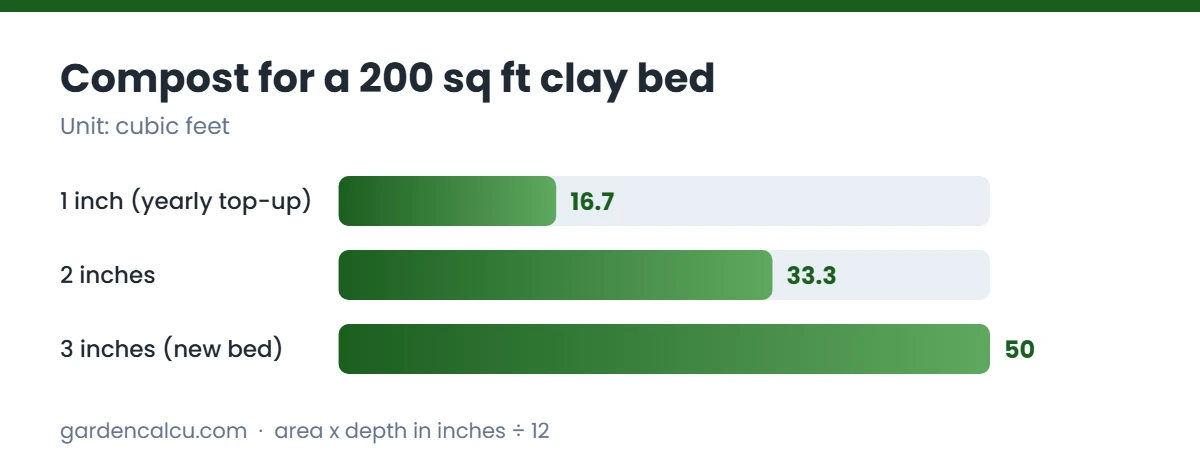
Chart for “how to improve clay soil”: cubic feet of compost for a 200 square foot bed at each depth.
Bed area | 1 in (yearly top-up) | 2 in | 3 in (new bed) |
|---|---|---|---|
32 sq ft (4 x 8 bed) | 2.7 cu ft | 5.3 cu ft | 8 cu ft |
100 sq ft | 8.3 cu ft | 16.7 cu ft | 25 cu ft |
200 sq ft | 16.7 cu ft | 33.3 cu ft | 50 cu ft (1.85 cu yd) |
500 sq ft | 41.7 cu ft | 83.3 cu ft | 125 cu ft (4.6 cu yd) |
The Raised Bed Soil Calculator gives the volume for any area and depth. For yearly amounts, see how much compost to add to garden.
Around established plants, the Denver Master Gardener’s method avoids digging. Spread handfuls of compost and gently scratch it into the surface. Repeat every year. Improvement is gradual and real.
Fix 2: do not add sand
Two experts in two states gave the same warning. The Oregon answer explains the mechanism. Clay particles are so much smaller than sand grains that they fill every gap between them. The mixture sets into something close to a solid.
The Ohio answer gives the number that shows why. To make a real difference you would need coarse sand at about 3 parts sand to 1 part clay soil. That means replacing most of the soil. Adding a few inches of sand to a bed of clay does the opposite of what you want.
Watch out: Do not put gravel in the bottom of a planting hole either. The Ohio expert explained that it raises the water level and creates a perched water table. Water sits in the fine soil above the gravel instead of draining into it.
Fix 3: skip the gypsum, in most places
Gypsum is sold as a clay breaker. Three of the five answers advise against it.
Expert | What they said about gypsum |
|---|---|
Ohio, 2021 | May raise calcium and pH too high. Clay soils tend to be alkaline. |
Colorado, 2026 | Add compost, not gypsum. |
Michigan, 2025 | Does not work well in Michigan soils. |
Gypsum helps one specific kind of soil, called sodic, which is high in sodium. That is rare in home gardens. On ordinary clay it changes little. A soil test will tell you whether sodium is an issue.
Peat moss came up too. The Ohio expert said it breaks down quickly in wet clay and can create a bog. Compost is the better choice.
Fix 4: work it only when dry
Clay is easily ruined by working it at the wrong time. Digging, tilling or even walking on wet clay presses the particles together and destroys the crumb structure you are trying to build. The Ohio expert said to add compost when the clay is dry, since working wet clay compacts it further.
Stay off the beds. Make them narrow enough to reach from the sides, and use paths. Wood chips on the paths spread your weight and keep your boots clean. See wood chips in vegetable garden.
Tip: Fall is a good time to add compost to clay. The soil is often drier than in spring, and freezing and thawing over winter help break up clods. See how to prepare garden for winter.
Fix 5: raise the bed and mulch the surface
When clay stays soggy even in summer, the Oregon expert’s advice was to go up instead of trying to dig down. Pile organic matter and soil into a low mound. It does not need sides. Even 4 inches higher makes a difference, because roots sit above the wet zone.
A framed raised bed takes that further. See how deep should a raised bed be.
Then cover the surface. The Denver Master Gardener highly recommended mulching the entire bed after planting. Mulch stops clay from baking into a crust, keeps moisture even and adds organic matter as it rots.
How much compost for your bed?
Enter the bed length and width and use the compost depth as the depth. The calculator gives cubic feet, cubic yards and bags.
What not to do: dig it out and replace it
The Denver gardener’s third option was to excavate 12 to 18 inches and bring in new soil. The Master Gardener did not recommend it. Apart from the cost, a bed of loose soil set into a clay basin behaves like a bathtub. Water flows into the soft fill and has nowhere to go.
The same thing happens on a small scale when one planting hole is filled with rich potting mix. Roots stay in the comfortable hole and the hole fills with water. Amend the whole bed, or plant in the native soil and mulch.
Clay under a lawn
You cannot till compost into an established lawn, so the Michigan expert’s approach is different.
Repeat yearly. Our guides on how to level a bumpy lawn and when to plant grass seed in fall cover the topdressing depth and timing.
Choose plants that like clay
The Clackamas County answer is the realistic one. Clay is forever, so match the plant to the soil. Many trees, shrubs and perennials thrive in heavy soil once established. Plants that demand sharp drainage, such as lavender, many Mediterranean herbs and the manzanita that gardener wanted, will struggle no matter how much you amend.
For vegetables, raised or mounded beds with plenty of compost get around the problem. See best soil for vegetable gardens.
Common mistakes
Frequently asked questions
Short answers to the questions that come up most often.
Quick recap
How to improve clay soil: add compost every year, never sand, and not gypsum unless a soil test calls for it. Work the soil only when it crumbles, keep feet off the beds and mulch the surface.
Where it still stays wet, raise the bed by 4 inches or more and choose plants that suit heavy ground. Clay does not go away, but it becomes very good soil.
Get your exact number
Enter your bed size and the depth of compost you plan to add, and the calculator converts it to cubic feet and bags.
Related guides
Sources
The facts in this guide to “how to improve clay soil” come from these university Extension pages and public questions: