When to Harvest Sweet Potatoes: 5 Easy Signs and Curing Tips
Wondering when to harvest sweet potatoes? Most varieties are ready 85 to 120 days after planting. Dig when the roots have reached eating size, when the leaves start to yellow, or as soon as frost touches the vines, whichever comes first. Do not leave them in cold ground, because soil below 50 degrees F can injure the roots.
Sweet potatoes give you very few clues. The crop is underground, the vines stay green and vigorous right up to frost, and there is no flower or dried top to signal the finish as there is with onions or regular potatoes. First-time growers are left looking at a jungle of leaves in September and wondering whether there is anything under it.
Gardeners in Michigan, Ohio, Minnesota and Maryland have asked Extension experts exactly that. Their questions are below, along with harvest and curing figures from the University of Maryland, the University of Illinois and Cornell. The curing step matters as much as the digging. It is what turns a starchy root into a sweet one.
Key takeaways
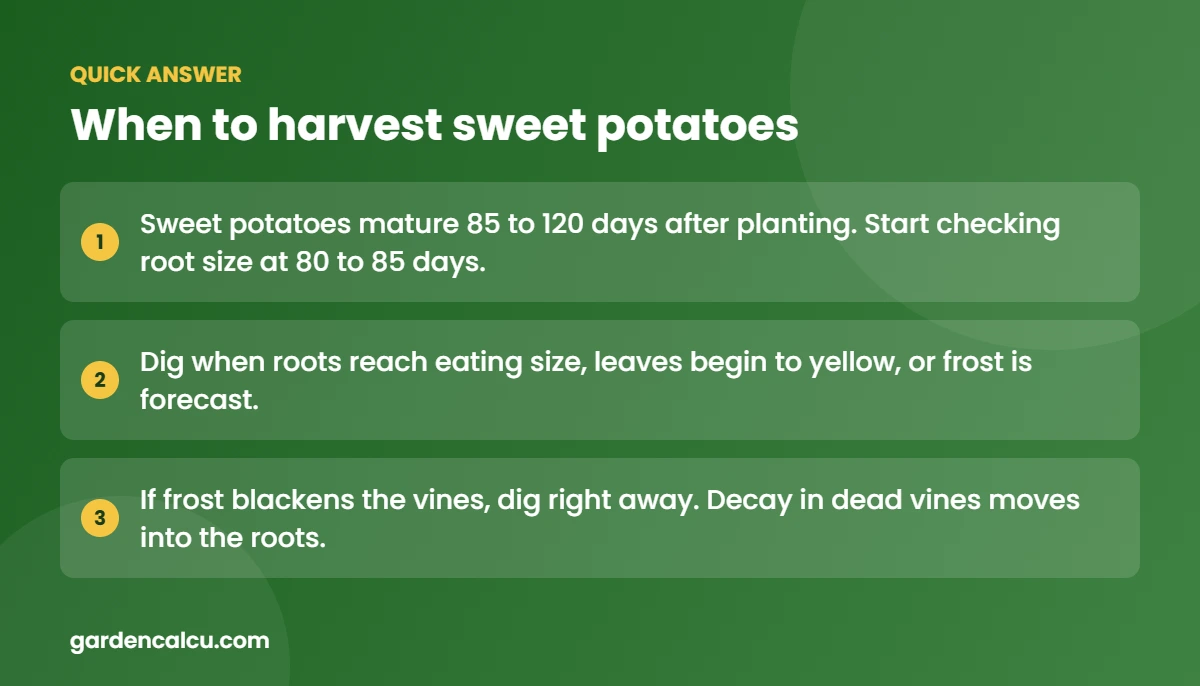
Quick answer to “when to harvest sweet potatoes” in three points.
Real questions gardeners asked
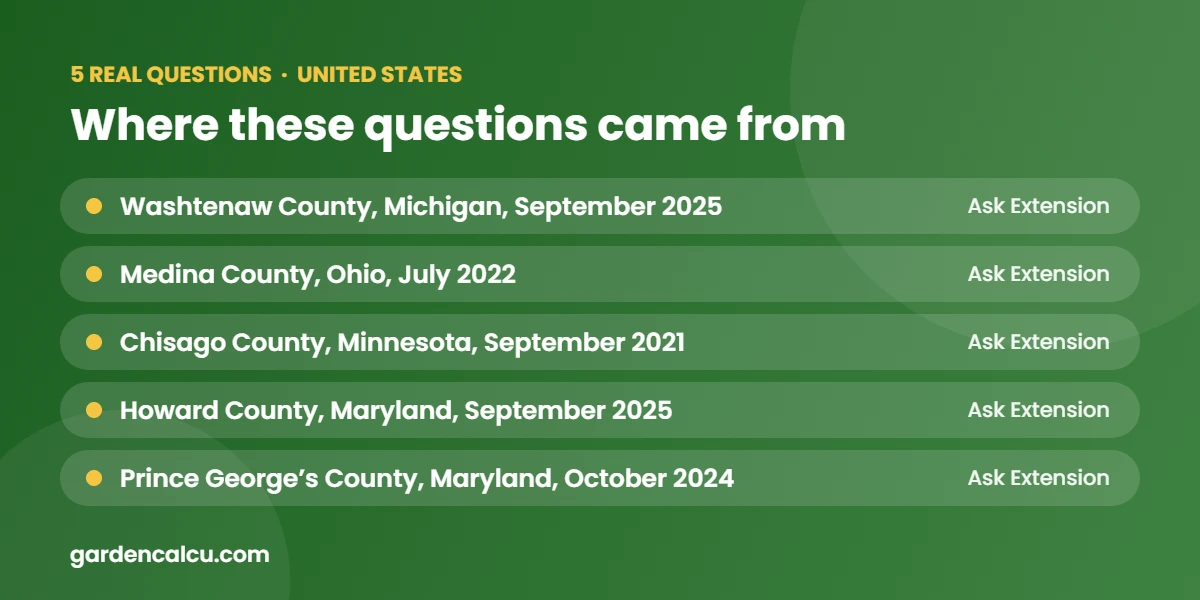
These are real questions sent to Ask Extension, the free service run by US land-grant universities. Each card shows where and when the gardener asked, and links to the full answer.
“Beauregard planted in early June: when to dig?”
The question: Planted Beauregard early June. Nights in the 40’s this week. Plants look great and thriving. Haven’t dug any yet. When about should I dig them?
What the expert said: A Michigan State University Extension Master Gardener said Beauregard is a 90 to 120 day variety and is usually ready in late September to early October when planted in early June. Cooler nights in the 40s slow growth but will not hurt them yet. The best indicator is when the leaves start to turn yellow or the vines begin to die back, and they should be dug before the first frost because cold soil can damage the roots.
“New to Ohio and new to gardening”
The question: My family and I are new to Ohio and new to gardening. When do I start to harvest the sweet potatoes I planted, and how do I harvest them?
What the expert said: The expert replied that sweet potatoes should be harvested when the leaves start turning yellow. However, in Ohio a frost might occur before they turn yellow, and they should be harvested before a deep frost. The reply also suggested not eating them straight away, since they improve with time after harvest.
“Cured for 10 days but still not sweet”
The question: What should I do with my sweet potatoes after harvesting? Last year I tried to cure them for 10 days by keeping them warm with a heater on in a small building on our property, but I don’t think it was warm enough because they were not very sweet.
What the expert said: A Minnesota Master Gardener advised raising the humidity. Sweet potatoes should be cured in a warm place, 85 degrees F and 90 percent relative humidity, for about four to six days to increase sugar content. Store them at 55 to 60 degrees F, and do not refrigerate them. Stored well, they can keep for 6 to 10 months.
“Sweet potatoes poking out of the ground”
The question: I am growing sweet potatoes for the first time. I have several sweet potatoes whose tops are visible. They are under a lot of leaves, but do get some sun. Do they develop a poison like non-sweet potatoes?
What the expert said: The expert said this is not uncommon. The portion exposed to the sun is edible, and no toxins are formed. Dig your sweet potatoes if they are full-size, because they will continue to grow, which leads to splitting. Check sizing around the maturity date, typically in the 85 to 110 day range.
“Discolored patches on exposed roots”
The question: A gardener dug four large sweet potatoes that had been partly exposed above ground. The skin showed patches from paler orange to slightly gray-green, and he asked whether sun exposure had made them unsafe, and whether they could still be cured and used to grow slips.
What the expert said: The University of Maryland’s Home and Garden Information Center explained that sweet potatoes are botanically unrelated to potatoes, so the greening concern does not carry over. Pale patches were likely skin abrasion, and darker areas may be scurf, a fungal blemish that does not affect eating quality. Curing first was fine, including for roots kept to start slips.
When to Harvest Sweet Potatoes: The Short Answer
Count the days first. University of Maryland Extension says sweet potatoes generally mature 85 to 120 days after planting, and the experts quoted above gave ranges that fit inside that window.
Source | Days from planting to harvest |
|---|---|
University of Maryland Extension | 85 to 120 days |
Ask Extension, Michigan (Beauregard) | 90 to 120 days |
Ask Extension, Maryland | Typically 85 to 110 days |
University of Illinois Extension | 100 to 110 days, depending on variety |
Then use the calendar to plan your first check. Maryland’s advice is to check the root size after 80 to 85 days, because the roots do not stop growing and can start to split when overgrown.
Slips planted | First check (about day 85) | Latest harvest (day 120) |
|---|---|---|
May 15 | August 8 | September 12 |
June 1 | August 25 | September 29 |
June 15 | September 8 | October 13 |
In northern states the back end of that window runs into frost. That is why the Michigan gardener, with Beauregard planted in early June and nights already in the 40s, was told to expect a late September to early October harvest and to dig before the first frost. Look up your own first frost date and work backward.
5 Easy Signs Sweet Potatoes Are Ready
You do not need all five. Size plus days is enough. And in short-season areas, as the Ohio expert pointed out, frost may arrive before the leaves ever turn yellow.
How to Do a Test Dig
The Michigan expert’s suggestion is the simplest check there is: pull one up to see the root size, and if it is still too slim, you probably have another 2 to 4 weeks. Pick a plant at the end of a row. Slide a hand or a trowel in near the crown and feel for the biggest root without lifting the whole plant. If it is as thick as a store sweet potato, start harvesting. If it is the width of a carrot, push the soil back and wait.
Tip: Write the planting date on a stake at the end of the row. In September you will want that number, and nobody remembers it.
Frost, Cold Soil and the Latest Safe Date
Sweet potatoes are a tropical crop. The vines die at the first touch of frost, and the roots are damaged by cold well before the ground freezes.
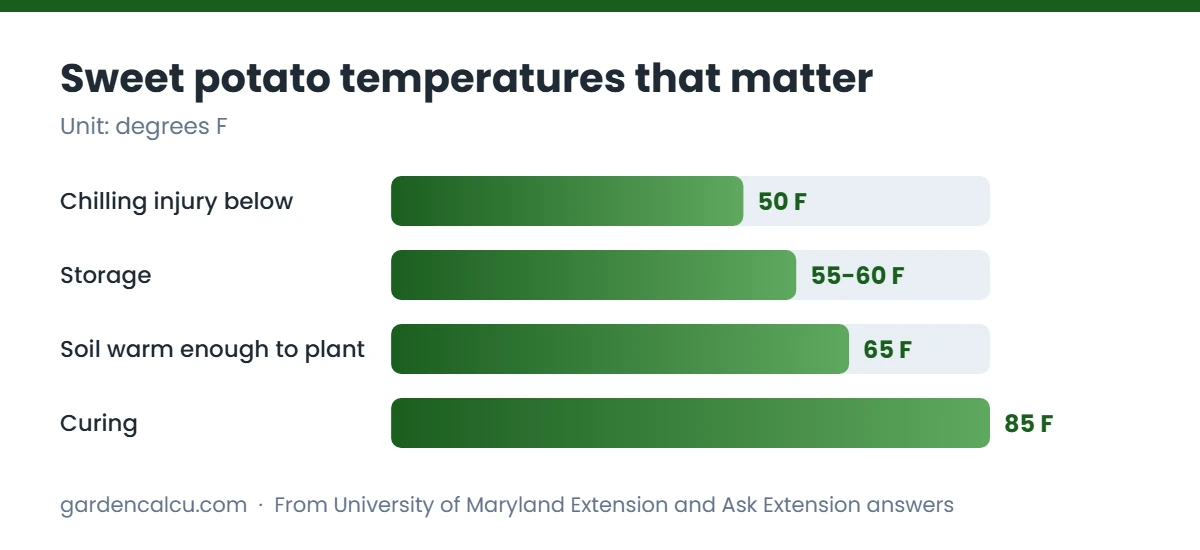
Key temperatures for harvesting, curing and storing sweet potatoes, from University of Maryland Extension and Ask Extension answers.
University of Maryland Extension states that soil temperatures below 50 degrees F can cause chilling injury. Chilled roots may look fine at harvest and then develop hard spots or rot in storage. That is the reason for the Michigan expert’s warning that cold soil can damage the roots.
So should you dig before the first frost or right after it? The experts differ a little, and it is worth being honest about that.
Source | Advice |
|---|---|
University of Maryland Extension | Harvest roots as soon as they reach eating size and before a frost |
Ask Extension, Michigan | Dig them up before the first frost |
Ask Extension, Ohio | Harvest before a deep frost |
University of Illinois Extension | Wait until after the first frost, which concentrates the sugars, then harvest immediately |
All four agree on the part that matters. Once frost has hit the vines, you are out of time. Maryland explains why: dig the roots immediately, because decay in dead vines moves into the roots. Illinois says the same, to harvest immediately to keep decay from spreading.
For most home gardeners the safe plan is to dig in the week before the first expected frost. If a surprise frost blackens the vines overnight, cut the vines off at the soil line that morning and dig the same day or the next.
Watch out: Do not leave sweet potatoes in the ground to store them, the way some people do with carrots. Cold, wet soil ruins them.
How to Dig Without Damage
Sweet potato skin is thin and bruises easily at harvest. Every cut and scrape is a place for rot to start, so go slowly.
Choose a dry day if you can. Set aside any root you speared with the fork and eat those first, since they will not store.
Estimate Your Harvest
Use the free Harvest Yield Calculator to estimate how many pounds your sweet potato rows and other crops should produce, so you can plan storage space.
Curing Sweet Potatoes: The Step That Makes Them Sweet
Freshly dug sweet potatoes are starchy and bland. Curing is a short spell of warmth and humidity that heals skin wounds and converts starch to sugar. The Minnesota Master Gardener said curing increases sugar content and deepens the orange color of the flesh.
Source | Temperature | Humidity | Time |
|---|---|---|---|
Ask Extension, Minnesota | 85 degrees F | 90 percent | About 4 to 6 days |
University of Maryland Extension | 85 degrees F | 80 to 90 percent | 5 to 10 days |
University of Illinois Extension | 85 degrees F | 85 percent | 10 to 14 days |
The temperature is the same everywhere: 85 degrees F. The time varies with how close you get to ideal conditions. A home setup that is a bit cooler or drier simply needs longer.
The Chisago County gardener’s story shows what goes wrong. Ten days in a small heated building gave sweet potatoes that were not very sweet. The expert’s first suggestion was to increase the humidity. Dry heat alone does not do the job.
Easy Ways to Cure at Home
After curing, give them more time if you can. The Ohio answer mentioned a suggestion to wait several weeks before eating. Flavor keeps improving in storage.
Storing Sweet Potatoes Through Winter
The storage numbers are just as consistent as the curing ones. The Minnesota expert said to store at 55 to 60 degrees F and 95 percent relative humidity. Maryland gives 55 to 60 degrees F at 85 to 90 percent humidity, in boxes, bins or baskets. Illinois says a cool 55 degree location, and notes that basements work well.
Are Exposed or Blemished Sweet Potatoes Safe?
Two Maryland gardeners worried that sweet potatoes showing above the soil had turned toxic the way green potatoes do. They had not. As the Howard County answer put it, the portion exposed to the sun is edible and no toxins are formed. The second answer explained that sweet potatoes are botanically unrelated to regular potatoes.
Exposed roots do have two real problems. They can be damaged by wildlife and weather, and they are a sign the roots are big enough to split. If you see shoulders at the surface, pull soil or mulch over them and plan to dig soon. Patchy dark skin may be scurf, a fungal blemish that the Maryland experts said does not affect eating quality.
How Many Sweet Potatoes Per Plant?
Source | Expected yield |
|---|---|
Cornell Cooperative Extension | About 2 lb per plant; 15 to 20 lb per 10 ft of row |
University of Illinois Extension | At least 2 lb per plant |
University of Maryland Extension | 15 to 30 lb per 10 ft of row |
Plants are usually spaced about 12 inches apart, so a 10 foot row holds roughly ten slips. A 4 by 8 foot bed with two rows could reasonably give 30 to 50 pounds in a good year. If you are also bringing in other fall crops, see when to harvest winter squash, which has its own frost rules.
Frequently asked questions
Short answers to the questions that come up most often.
Quick recap
Knowing when to harvest sweet potatoes is a matter of days, size and frost. Count 85 to 120 days from planting, test dig from day 80 or so, and take the crop when roots are eating size or the leaves begin to yellow. Whatever else happens, get them out before the soil turns cold, and dig at once if frost blackens the vines.
Then finish the job. Dig gently, do not wash, cure for about a week at 85 degrees F with plenty of humidity, and store at 55 to 60 degrees F. Those few steps are the difference between bland roots that rot by Thanksgiving and sweet ones that last until spring.
Get your exact number
Estimate your harvest in pounds with the free Harvest Yield Calculator.
Related guides
Sources
The facts in this guide to “when to harvest sweet potatoes” come from these university Extension pages and public questions: