How Much Mulch Do I Need? Easy Formula, Bags and Cubic Yards
To answer “how much mulch do I need”, multiply the area of the bed in square feet by the depth you want in inches, then multiply by 0.0031. The result is cubic yards. A 200 square foot bed mulched 3 inches deep needs 1.85 cubic yards, or 25 bags of the 2-cubic-foot size.
That one line of arithmetic covers every bed, border and tree ring. The parts that trip people up are different: how deep to go in the first place, whether old mulch counts toward the total, and when bags stop making sense and a bulk delivery is cheaper.
This guide is built from five real questions that homeowners sent to university Extension services in Maryland, Colorado, Ohio and Michigan. The depths come from those answers, and every example shows the sum so you can check it against your own beds.
Key takeaways
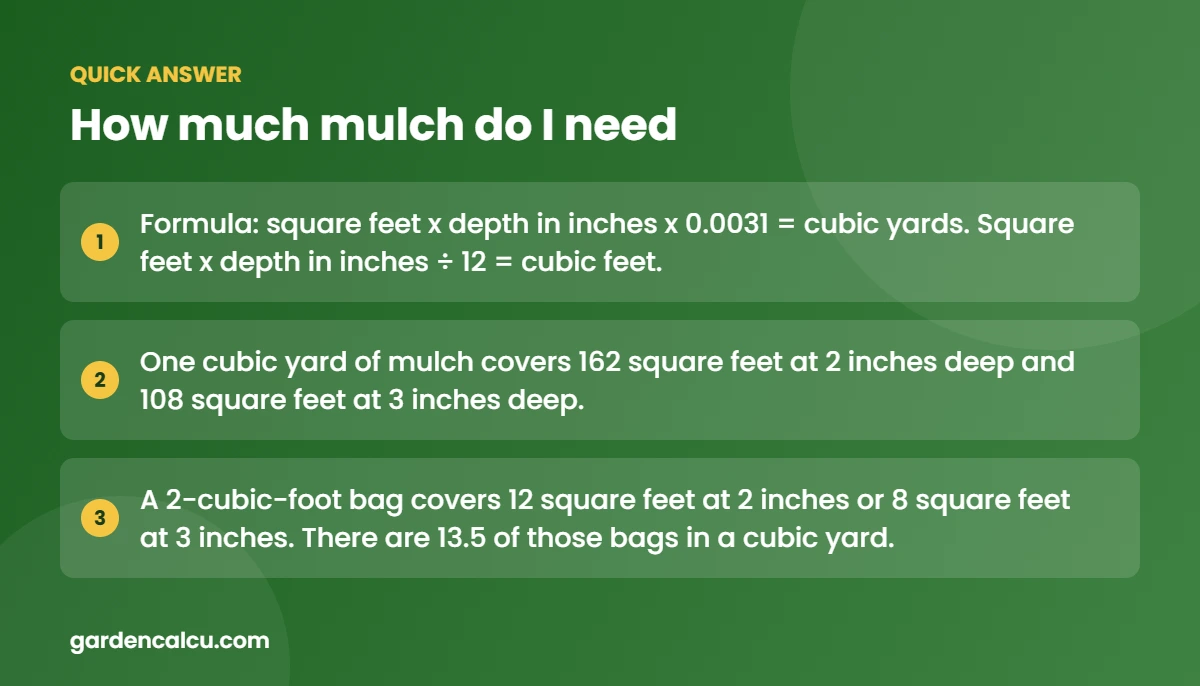
Quick answer to “how much mulch do I need” in three points.
Real questions gardeners asked
“How much mulch do I need” sounds like a math question, but the real questions people send to Extension offices are about depth and top-ups. We read five of them. Here is each one in our own words, with the expert’s reply and a link to the original.
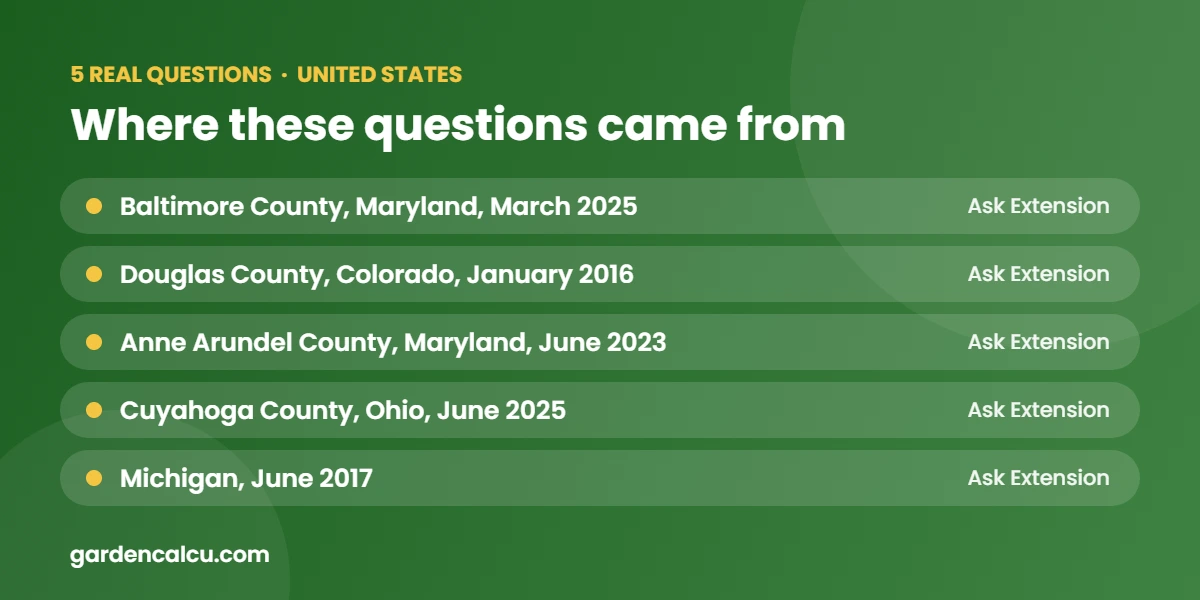
“need new mulch every year?”
The question: A homeowner had put a fresh coat of mulch around the shrubs every year for more than 15 years. The mulch had built up and faded, and they asked if another coat was needed this year.
What the expert said: The Maryland Extension expert said the total thickness of mulch on the soil, whatever its age, should generally be no greater than 2 to 3 inches. Shallow-rooted shrubs such as boxwood and mountain laurel prefer closer to 1 inch. Bark mulch thins as it breaks down, so top-dress only enough to bring the layer back to that depth.
“Adding new mulch on top of old mulch with newspaper in between”
The question: A gardener planned to lay newspaper over the old mulch to choke out weeds and grass, then add new mulch on top. They asked what depth the new mulch should be.
What the expert said: The expert said the right amount depends on the garden, the soil, wind and slope. She advised raking up the old mulch first and not putting newspaper over it. Use newspaper one to two sheets thick, then cover it soon so it does not blow away. For bark mulch, the usual depth is 3 to 4 inches.
“How often to mulch?”
The question: A homeowner had turned part of the front yard into a native garden with 3 inches of mulch. After a season of weeding and planting, the mulch looked tired. Was it too early to mulch again, and how often is right?
What the expert said: People tend to apply fresh mulch once a year, the expert said, but only add enough to replace what has gone, up to a depth of 3 inches. Too much buries the plants. Once a bed fills in you may not need to add any. The expert mulches every other year in her own garden.
“Mulch to keep out weeds”
The question: A gardener asked one direct question: how high should fresh mulch be to help keep weeds out of the garden?
What the expert said: The volunteer pointed to a Clemson Cooperative Extension fact sheet on controlling weeds by cultivating and mulching, which explains how a mulch layer blocks the light that weed seeds need to sprout.
“Amount of top soil to purchase”
The question: A homeowner needed to cover 830 square feet one foot deep and asked how many cubic feet, cubic yards and 40-pound bags that would take.
What the expert said: The MSU Extension expert showed the working: 830 square feet x 1 foot = 830 cubic feet, and 830 x 12 inches x 0.0031 = 30.88 cubic yards. For that much material, the team suggested buying in bulk from a landscape supplier instead of in bags. The same formula works for mulch.
How much mulch do I need? The formula
Mulch is sold by volume, so you need three measurements: length, width and depth. The only trap is that depth is in inches while the bed is in feet.
Worked example: a border 20 feet long and 10 feet wide is 200 square feet. At 3 inches deep: 200 x 3 ÷ 12 = 50 cubic feet. 200 x 3 x 0.0031 = 1.86 cubic yards. In 2-cubic-foot bags, 50 ÷ 2 = 25 bags.
Where does 0.0031 come from? A cubic yard is 27 cubic feet. Spread 1 inch deep, it covers 324 square feet. One divided by 324 is 0.0031.
Tip: Skip the sums. Type the length, width and depth into the Mulch Calculator and it returns cubic feet, cubic yards and bags in one step.
Odd-shaped beds
Break a curved or L-shaped bed into rectangles, work out each one and add them up. For a round bed or a ring around a tree, the area is 3.14 x radius x radius.
Tree ring example: a mulch circle reaching 3 feet out from the trunk has an area of 3.14 x 3 x 3 = 28 square feet. At 3 inches deep that is 7 cubic feet, or four 2-cubic-foot bags. Keep the mulch pulled back from the trunk itself.
How much one cubic yard of mulch covers
If you are ordering in bulk, it helps to think the other way round: how far will one yard go?
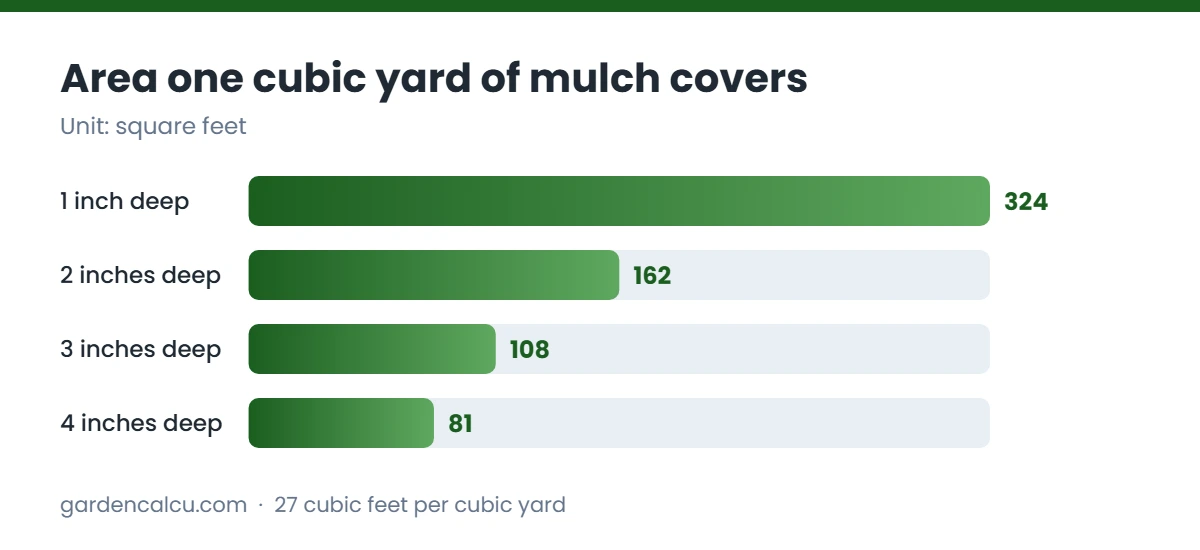
Chart for “how much mulch do I need”: the area one cubic yard of mulch covers at each depth.
Depth | 1 cubic yard covers | 2 cu ft bag covers | 3 cu ft bag covers |
|---|---|---|---|
1 inch | 324 sq ft | 24 sq ft | 36 sq ft |
2 inches | 162 sq ft | 12 sq ft | 18 sq ft |
3 inches | 108 sq ft | 8 sq ft | 12 sq ft |
4 inches | 81 sq ft | 6 sq ft | 9 sq ft |
A quick way to remember it: at 3 inches deep, one cubic yard covers a bed about 10 feet by 11 feet.
Mulch needed for common bed sizes
Bed area | 2 in deep (cu ft) | 3 in deep (cu ft) | 3 in deep (cu yd) | 2 cu ft bags at 3 in |
|---|---|---|---|---|
50 sq ft | 8.3 | 12.5 | 0.46 | 7 |
100 sq ft | 16.7 | 25 | 0.93 | 13 |
200 sq ft | 33.3 | 50 | 1.85 | 25 |
500 sq ft | 83.3 | 125 | 4.63 | 63 |
1,000 sq ft | 166.7 | 250 | 9.26 | 125 |
Bag counts are rounded up to the next whole bag. If you are a bag short you will notice, and a spare bag is useful for touch-ups later in the season.
How deep should the mulch be?
Depth changes the answer more than anything else. Going from 2 inches to 4 inches doubles the mulch you buy.
The Extension answers give a clear range. The Maryland expert put the total at 2 to 3 inches for most beds and about 1 inch for shallow-rooted shrubs such as boxwood and mountain laurel, whose roots need plenty of oxygen. The Colorado expert said 3 to 4 inches is usual for bark mulch, which is chunkier and lets more air through.
Situation | Total depth | Source |
|---|---|---|
Most shrub and flower beds | 2 to 3 inches | Maryland Extension answer, 2025 |
Boxwood, mountain laurel | About 1 inch | Maryland Extension answer, 2025 |
Coarse bark mulch | 3 to 4 inches | Colorado Extension answer, 2016 |
Annual top-up | Only to restore 3 inches | Maryland Extension answer, 2023 |
Watch out: More is not better. A thick layer keeps air and water from the roots, and mulch heaped against a trunk or stem holds moisture on the bark. If 15 years of mulch has built up, as it had for the Baltimore County homeowner, the answer may be to add none this year.
Topping up: count the mulch you already have
This is where most people overbuy. If last year’s layer has settled to 1 inch and you want 3 inches in total, you need 2 inches of new mulch, not 3.
Worked example: the 200 square foot border has 1 inch of old mulch left and the target is 3 inches. 200 x 2 x 0.0031 = 1.24 cubic yards, or 17 bags. A full 3-inch layer would have been 25 bags, so measuring first saves 8 bags.
The Anne Arundel County answer makes the same point from the other side. Once plants fill in, you may not need to top up every year at all. If you have trees, free leaves as mulch can cover part of the gap.
Get your mulch number in seconds
Enter the length, width and depth of your bed and the calculator works out the cubic feet, cubic yards and bags of mulch to buy.
Bags or bulk: which should you buy?
Small jobs are simpler with bags. They are clean, easy to carry and you can buy exactly what you need. Past a certain size, bulk mulch delivered by the cubic yard usually costs less per cubic foot, and it saves dozens of trips to the car.
There are 13.5 two-cubic-foot bags in a cubic yard, or 9 three-cubic-foot bags. To compare prices, turn the bag price into a price per cubic yard.
Example with made-up prices: if a 2-cubic-foot bag costs $4, a cubic yard in bags costs 13.5 x $4 = $54. If a supplier charges $35 per cubic yard plus a $60 delivery fee, three yards cost $165 delivered, against $162 in bags. At five yards, bulk is $235 and bags are $270. Your local prices will differ, so run the same sum with real quotes.
The Michigan team gave the same advice for a 30-yard soil order: at that volume, buy in bulk from a landscape company. Our guide to how much soil for a raised bed walks through the same bags versus bulk choice for soil.
Common mistakes when buying mulch
Frequently asked questions
Short answers to the questions that come up most often.
Quick recap
The answer to “how much mulch do I need” is always area times depth. Multiply square feet by inches and by 0.0031 for cubic yards, or divide square feet times inches by 12 for cubic feet.
Keep the total layer at 2 to 3 inches, subtract the mulch that is already there, and round the bag count up. For big orders, price a bulk delivery before filling the car with bags.
Get your exact number
Measure your beds, choose a depth and let the calculator turn it into cubic yards and bags.
Related guides
Sources
The facts in this guide to “how much mulch do I need” come from these university Extension pages and public questions: