Heirloom vs Hybrid Seeds: 6 Easy Facts Before You Buy
The heirloom vs hybrid question comes down to one practical difference. Heirloom seeds are open-pollinated, so seed you save from them grows into plants like the parent. Hybrid seeds come from a deliberate cross of two different parent lines, so the plants are vigorous and uniform, but seed saved from them does not reliably come true.
Everything else on the seed rack is built on that. It explains why some packets say F1, why your neighbor swears by saved tomato seed, and why a volunteer plant in the compost pile gives fruit nothing like the tomato it came from. It also explains a few myths, including the idea that anything not labeled heirloom must be genetically modified.
Gardeners in Oregon, Michigan, Colorado and Minnesota have asked Extension experts to untangle this. Their questions and the answers are below, with definitions from the University of Illinois and Penn State, a side-by-side comparison, and a guide to which seeds are worth saving.
Key takeaways
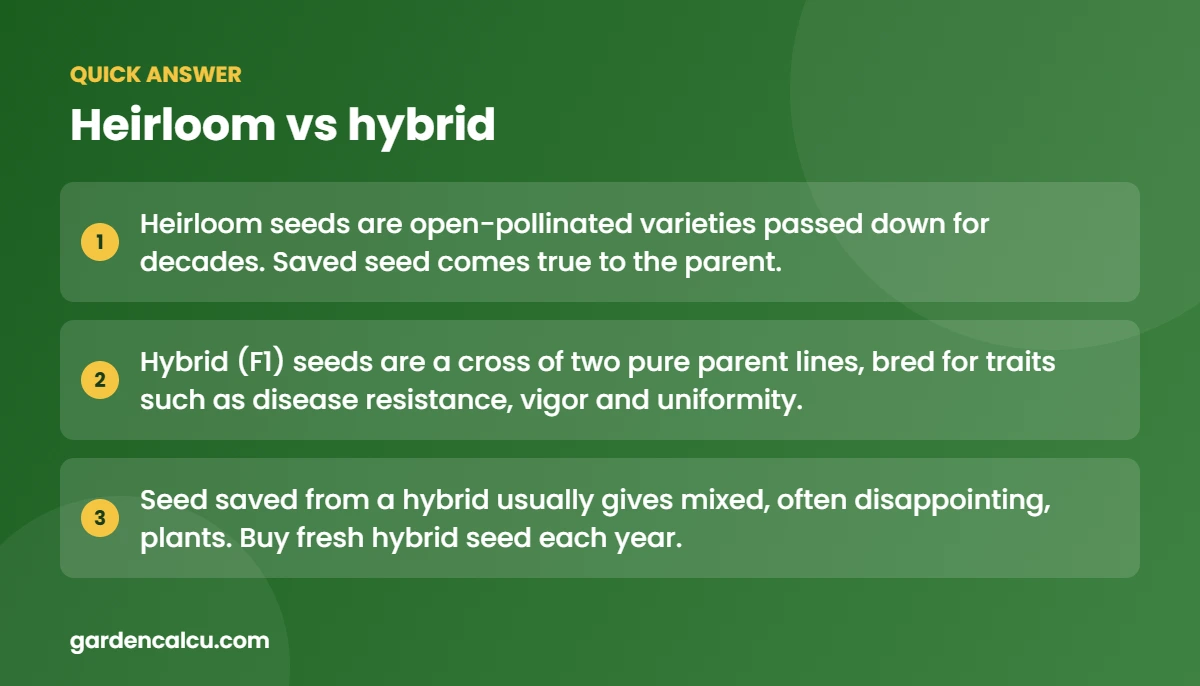
Quick answer to “heirloom vs hybrid” in three points.
Real questions gardeners asked
These are real questions sent to Ask Extension, the free service run by US land-grant universities. Each card shows where and when the gardener asked, and links to the full answer.
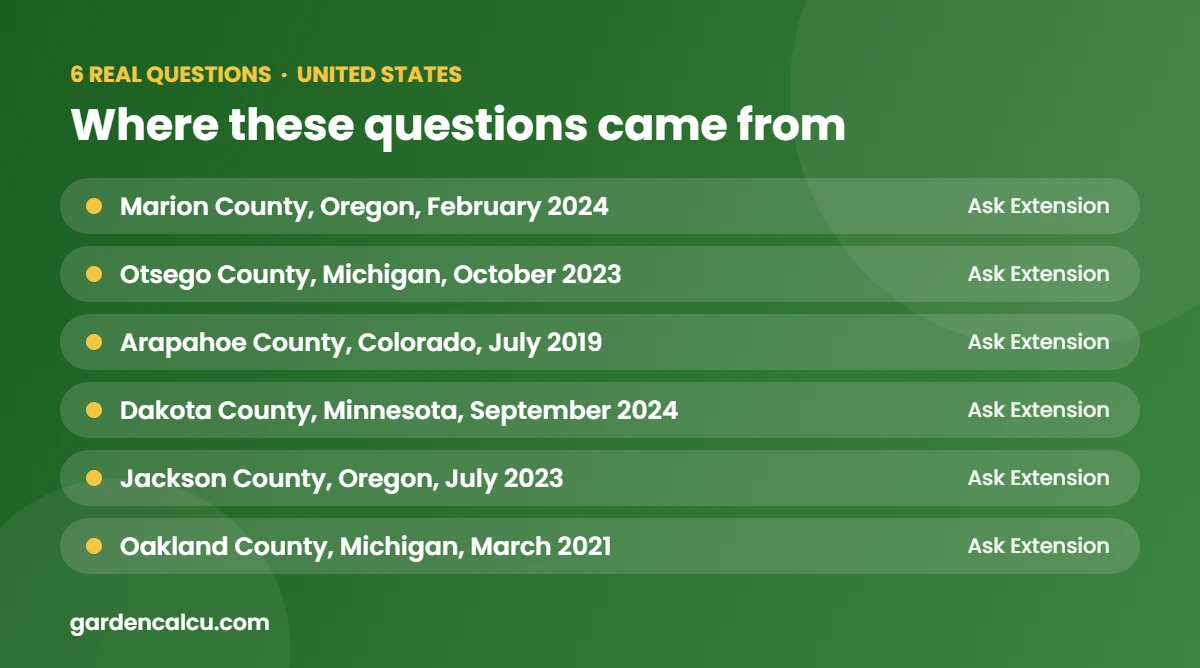
“Telling GMO, non-GMO and heirloom seeds apart”
The question: My husband says that if it isn’t labeled as Heirloom seeds, the fruit/veg produced seeds won’t be what they should be. Some seeds are labeled very small that they are Non-GMO and I saw a very few labeled as heirloom. I would very much like a definition of the three terms. Basically, if I grow tomatoes and keep the seeds from what I grow, will those seeds produce the same tomato they came from?
What the expert said: The expert explained that GMO seeds are sold only to commercial growers, so home gardeners are choosing between open-pollinated seeds (heirlooms) and hybrid seeds. The fruit of hybrid seeds often does not reliably produce a plant of like kind. Heirlooms have been grown for decades or more. Both types may be grown organically or conventionally.
“Is saving tomato seeds difficult?”
The question: I have been told that I can save tomato seeds from the tomatoes off my plant to use next year. Is it difficult? How do I do this?
What the expert said: The expert said saving tomato seeds is not particularly difficult, but gave two cautions. Not all tomatoes will breed true, F1 hybrids for example, and cross pollination can yield mixed results. Some diseases can also be seed borne unless the seed is treated.
“Can tomatoes be cross pollinated?”
The question: Can tomatoes be cross pollinated? We have beefsteak and cherry tomato plants growing side by side. What kind of fruit will we get?
What the expert said: A Colorado Master Gardener answered that tomato varieties will produce fruit consistent with the varieties planted. Tomato flowers have both male and female parts and largely pollinate themselves. If a cross does happen, it will only affect the seed and not the fruit, taste or texture of the current year’s produce.
“A volunteer tomato in last year’s pot”
The question: This plant grew in a pot from last year. I hadn’t planted any seeds. I was told it was a volunteer tomato. Could you give me any more information?
What the expert said: A Minnesota Master Gardener replied that tomato seeds germinate easily and often survive the winter in a pot, compost or a garden bed. Volunteers are almost always cherry tomatoes, because cherry tomatoes are often one of the parents of a garden tomato hybrid. Heirloom tomato seeds will be just like their parents.
“Should I save seed from my biggest tomato?”
The question: Does the size of the fruit (e.g. tomato) indicate the potential size of the next generation? In other words, should I save seeds from the largest tomato on the bush (or vine) in order to get larger fruit next year?
What the expert said: The gardener had one Amish Paste plant, an heirloom. An Oregon State University Extension Master Gardener advised saving the best looking tomato in terms of color, shape and size and seeing what happens, while warning that there is some risk in saving seed from any present-day variety, because strains change over time.
“An heirloom cucumber sold as seedless”
The question: The Boston Pickling Cucumber’s description states it is an heirloom that is seedless. My question is how to grow it the following year if there are no seeds to save?
What the expert said: The expert explained that seedless cucumbers set fruit without pollination. If they are pollinated by another variety, seeds form, but plants grown from that seed will be a genetic mix with unpredictable results. To keep a consistent seedless crop, buy new seed each year and isolate the plants from varieties that produce male flowers.
Heirloom vs Hybrid: What the Words Mean
Seed catalogs use four terms that get mixed up constantly. Here they are side by side, using definitions from University of Illinois Extension and Penn State Extension.
Term | What it means | Does saved seed come true? |
|---|---|---|
Open-pollinated | Pollinated naturally by wind, insects or the plant itself, within one stable variety | Yes, if it has not crossed with another variety |
Heirloom | An open-pollinated variety passed down through the years by saving seed | Yes |
Hybrid (F1) | First-generation seed from crossing two different pure parent lines | No, the next generation is a mix |
GMO | Genes altered in a laboratory | Not sold to home gardeners |
University of Illinois Extension puts the heirloom definition plainly: varieties that have been passed down through the years by saving seeds from fruits of non-hybrid varieties. They are also known as open-pollinated plants.
A hybrid is a planned cross. Penn State Extension describes hybrid plants as grown from seeds of two pure parent lines that are not similar and are combined to create desirable traits, such as disease resistance, increased vigor and uniformity. The F1 on a packet stands for first filial generation, meaning the first offspring of that cross.
Fact 1: Hybrid Does Not Mean GMO
This is the most common mix-up, and the Marion County, Oregon gardener ran straight into it at the seed rack. Some packets said Non-GMO in small print. A few said heirloom. Her husband assumed anything else was suspect.
The expert’s answer clears it up. GMO seeds are sold only to commercial growers, who are contractually prohibited from propagating them. Home gardeners are choosing between open-pollinated seeds and hybrid seeds, and that is all.
A hybrid is made the old-fashioned way, by moving pollen from one parent plant to another. No laboratory gene work is involved. So a Non-GMO label on a packet of home garden seed is true, but it is true of every other packet on the rack as well. The same expert noted that both conventionally grown seeds and hybrid varieties are considered safe by the USDA.
Tip: Organic is a separate question too. The Oregon expert pointed out that both heirloom and hybrid seed may be produced organically or with conventional fertilizers and pesticides. Look for the organic seal if that matters to you.
Fact 2: You Can Save Seeds From Heirlooms, Not Hybrids
Penn State Extension explains the heirloom side: heirloom plants have been open-pollinated over time, and fruit from the seeds you save should have most of the characteristics of the parent.
With a hybrid, the special combination holds for one generation only. In Penn State’s words, the result of these crosses usually only lasts one generation, so the seeds harvested from hybrids may produce disappointing results. The traits of the two original parents reshuffle, and each seedling draws a different hand.
That is why the Michigan expert told the gardener in Otsego County that saving tomato seeds is not particularly difficult, then added that not all tomatoes will breed true, naming F1 hybrids. It is also why the Minnesota volunteer tomato was probably a cherry type. As that Master Gardener explained, cherry tomatoes are often one of the parents of a garden tomato hybrid, so their traits resurface in the offspring.
You can still plant seed saved from a hybrid. It will grow and it will fruit. You just cannot predict what you will get, and it is rarely as good as the plant you started with.
Fact 3: Hybrids Bring Vigor and Disease Resistance
Breeders make hybrids for practical reasons, and Penn State’s list names the big three: disease resistance, increased vigor and uniformity. Uniform plants ripen together and reach the same size, which matters if you are canning a batch or filling a bed evenly.
Disease resistance is often printed right on the packet or plant tag as a string of letters after the variety name. University of Illinois Extension lists the tomato codes:
Code | Resistance to |
|---|---|
V | Verticillium wilt |
F | Fusarium wilt |
N | Nematodes |
T | Tobacco mosaic virus |
A | Alternaria |
The same source adds an honest limit: the letters mean the plants are less likely to get that disease. They are not immune. But if your tomatoes wilted and died early last year, a variety with VF or VFN after its name is a sensible next step, and most of those are hybrids.
Fact 4: Heirlooms Bring Variety and Independence
Heirlooms earn their place for different reasons. They come in shapes, colors and flavors that never made it into commercial breeding. They carry stories, like the Amish Paste tomato the Oregon gardener was growing. And once you own an heirloom, you never have to buy it again.
They can ask more of the gardener. Many are less uniform, and some take longer to ripen. A Minnesota expert advising a gardener frustrated by late harvests suggested choosing shorter-season tomato varieties of 65 to 70 days to maturity instead of heirlooms that need 80 days or more. In a short northern summer, that gap decides whether you pick ripe fruit or green.
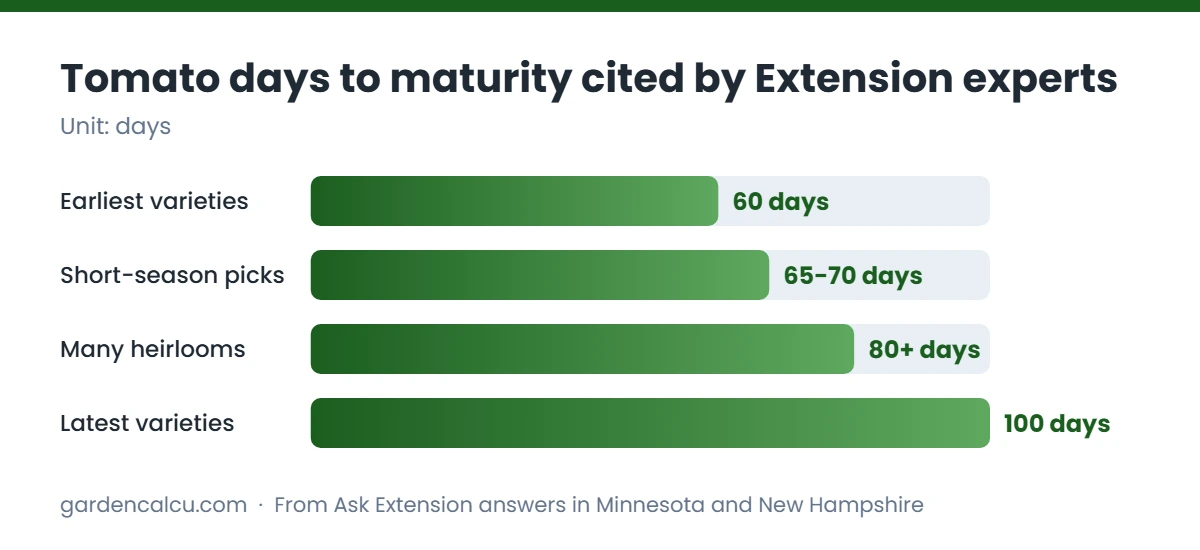
Days to maturity for tomatoes as described in two Ask Extension answers: a 60 to 100 day range overall, 65 to 70 days for short-season varieties and 80 or more for many heirlooms.
Days to maturity is printed on every packet, heirloom or hybrid. A New Hampshire Extension answer gives the full spread for tomatoes: each variety has a different expected number of days to harvest, ranging from 60 to 100 days. Check that number against your season before you fall for a catalog photo. Our guide to what hardiness zone you are in and your first frost date will tell you how long your season really is.
Heirloom vs Hybrid at a Glance
Question | Heirloom (open-pollinated) | Hybrid (F1) |
|---|---|---|
Saved seed comes true? | Yes | No |
Uniform plants and ripening? | Less so | Yes |
Disease resistance bred in? | Sometimes | Often, shown by letter codes |
Seed cost over time | Buy once, then save | Buy every year |
Range of unusual types | Very wide | Narrower |
Best for | Seed savers, flavor hunters, variety | Problem soils, short seasons, reliable yield |
Plan How Many Seeds to Buy
Heirloom or hybrid, do not overbuy. Use the free Seed Calculator to work out how many seeds or packets your rows and beds need.
Fact 5: Tomatoes Rarely Cross, but Squash and Cucumbers Do
The Colorado gardener with beefsteak and cherry tomatoes growing side by side wanted to know what kind of fruit to expect. The answer: exactly what was planted. Tomato flowers are complete, with male and female parts in the same flower, and mostly pollinate themselves.
Even when an insect does carry pollen across, the Master Gardener explained, the cross will only affect the seed and not the fruit, taste or texture of the current year’s produce. This is true of every crop. This year’s fruit is set by the mother plant. Only the seeds inside carry the mix.
So crossing matters only if you save seed, and how much it matters depends on the crop:
Fact 6: Seed Saving Is Easy if You Follow Three Rules
If the heirloom vs hybrid choice is leaning toward heirlooms because you want to save seed, Penn State Extension offers simple safeguards.
Dry the seed fully, label it with the variety and year, and store it cool and dry. How long do seeds last covers storage life by crop and a quick germination test.
Watch out: Do not save seed from a plant that was clearly diseased, however good the fruit looked. Start clean seed in clean mix. See seed starting mix vs potting soil.
Which Should You Buy?
Most experienced gardeners grow both, and that is the sensible answer to heirloom vs hybrid.
Whichever you choose, sow on time. When to start seeds indoors gives the count-back dates.
Frequently asked questions
Short answers to the questions that come up most often.
Quick recap
In the heirloom vs hybrid debate there is no wrong side, only different jobs. Heirlooms are open-pollinated, come true from saved seed and offer endless variety. Hybrids are a first-generation cross that brings vigor, uniformity and built-in disease resistance, at the price of buying seed again each year.
Neither is GMO, and either can be organic. Read the packet for three things: whether it says F1, the disease resistance letters, and the days to maturity. Then grow a mix that suits your season and your soil, and save seed from the open-pollinated ones you love.
Get your exact number
Work out how many seeds and packets you need with the free Seed Calculator.
Related guides
Sources
The facts in this guide to “heirloom vs hybrid” come from these university Extension pages and public questions: