How Deep Should a Raised Bed Be? 12 Inches and 5 Easy Rules
How deep should a raised bed be? For most vegetables, at least 12 inches. Leafy greens and cucumbers manage with 8 inches, and tomatoes, peppers and squash do best with 12 to 24 inches. If the bed sits on open ground, roots can also use the soil beneath it.
Depth is the decision that fixes everything else about a raised bed: the lumber you buy, the soil bill and how far you bend. Doubling the depth doubles the soil. So it is worth knowing what the plants actually need before building a 3-foot box.
This guide is built from six real questions sent to university Extension services in Minnesota, Alaska, Oregon, Ohio and New York. The depths are theirs. The soil volumes for each depth are worked out so you can see the cost of going deeper.
Key takeaways
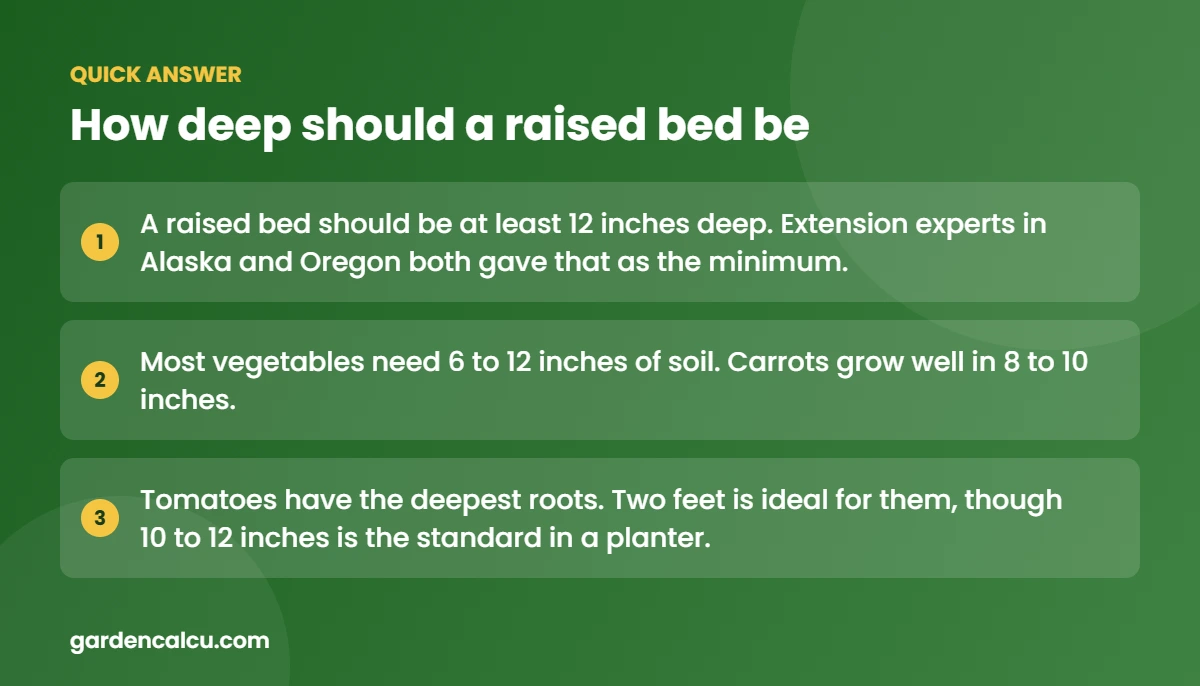
Quick answer to “how deep should a raised bed be” in three points.
Real questions gardeners asked
How deep should a raised bed be is usually asked before the first board is cut. We read six real questions from people at that stage and summarized each in our own words, with what the expert said and a link to the original.
“Raised Bed Depths”
The question: A gardener planning beds for next year asked how deep they should be for tall vegetables, and whether tomatoes should go in a bed 24 inches deep.
What the expert said: Tomatoes will probably have the deepest roots of any vegetable in a raised bed, the expert said, and a two-foot-deep bed would be ideal for them. Think of your own needs too. If bending is an issue, go three feet high. Fill with a soil mix made for raised beds, since garden soil drains poorly in a bed. Keep the bed no more than three to four feet wide so you can reach the middle.
“Depth of raised beds”
The question: At a cabin where the ground never seems to warm up enough to grow anything, a new gardener asked how deep to build raised beds for raspberries, potatoes and flowers.
What the expert said: The deeper the raised bed the better, the expert said, with 12 inches as the minimum. The gardener built them 16 inches deep, and the expert thought that would work well.
“starting raised garden”
The question: A rural gardener planning beds for tomatoes, cucumbers, squash and beans had heard both 12 inches and 36 inches and asked about the pros and cons.
What the expert said: A raised bed should be at least 12 inches deep, the expert said, with the ideal depending on what is grown. On bare ground the frame can sit directly on the soil. Over weeds or grass, put down cardboard first to smother them.
“How deep should soil be in a planter”
The question: A gardener wanted to grow carrots in a waist-high planter box and asked how deep the soil should be.
What the expert said: Recommended soil depth for most vegetables is 6 to 12 inches depending on the crop, the expert said. For carrots, 8 to 10 inches of potting mix should be enough, depending on variety. In a very deep container, put lightweight filler in the bottom, lay landscape fabric over it and fill the top foot with soil.
“soil depth for growing tomatoes”
The question: A gardener growing full-size and cherry tomatoes in a planter asked how deep the soil should be. The lower leaves were yellowing.
What the expert said: The standard advice is 10 to 12 inches, the expert said. Tomatoes are heavy feeders and need fertilizer regularly.
“Raised Beds for the first time!”
The question: A new gardener had bought three galvanized beds 17 inches deep and asked whether the full depth needed to be soil.
What the expert said: The expert said the soil layer should be at least 8 inches deep for leafy greens and cucumbers and 12 to 24 inches for peppers, tomatoes and squash. Logs and branches can fill the space below.
How deep should a raised bed be for each crop?
Combine the six answers and you get a depth chart by crop.
Crop | Soil depth | Source |
|---|---|---|
Lettuce, spinach and other leafy greens | At least 8 inches | Ohio answer, 2025 |
Cucumbers | At least 8 inches | Ohio answer, 2025 |
Most vegetables | 6 to 12 inches | Alaska answer, 2019 |
Carrots | 8 to 10 inches | Alaska answer, 2019 |
Tomatoes in a planter | 10 to 12 inches | New York answer, 2020 |
Peppers, tomatoes, squash | 12 to 24 inches | Ohio answer, 2025 |
Tomatoes, ideal | 24 inches | Minnesota answer, 2023 |
Any raised bed, minimum | 12 inches | Alaska and Oregon answers |
Twelve inches comes up again and again because it covers nearly everything. A 12-inch bed grows greens, roots, beans, peppers and tomatoes. Deeper is better for the biggest plants, but it is not required.
Rule 1: 12 inches is the practical minimum
Two experts, in Alaska and Oregon, independently gave 12 inches as the least a raised bed should be. Standard lumber makes this easy. Two stacked 2×6 boards give 11 inches, and a single 2×12 gives 11.25.
Shallower beds work for salad crops, but they dry out faster and leave little room for roots in a hot summer. If you already have a 6 or 8 inch bed on open ground, loosen the soil underneath with a fork so roots can keep going down.
Rule 2: on open ground, the soil below counts
A raised bed with no bottom, sitting on soil, is deeper than its walls. Roots grow through the bed and into the ground. That is why an 11-inch bed on decent soil grows tomatoes perfectly well.
This changes if the bed sits on something roots cannot enter.
Bed sits on | Effective depth | Build it |
|---|---|---|
Loosened garden soil | Bed depth plus the soil below | 12 inches is plenty |
Hard clay or compacted fill | Mostly the bed itself | 12 to 18 inches |
Concrete, paving or a deck | Only the bed | 18 to 24 inches for large crops |
Legs (a planter box) | Only the box | 8 to 12 inches of soil, as in the Alaska answer |
Cold ground that never warms | Only the bed | 12 inches minimum, 16 worked in Alaska |
The Alaska cabin question shows another reason for depth. Where the native soil stays too cold to grow in, the bed is the entire root zone, and the soil in a taller bed warms up faster in spring.
Tip: Over lawn or weeds, lay plain cardboard on the ground before filling, as the Oregon expert suggested. It smothers what is underneath and rots away in a season, after which roots pass straight through.
Rule 3: go taller for your back, not for the plants
The Minnesota expert made a useful distinction. Two feet is ideal for tomato roots. Three feet is for the gardener. If bending is difficult, build to the height that suits you.
A tall bed does not need to be full of soil. The Anchorage expert described the method for deep containers.
For large beds on the ground, logs, branches and leaves serve as the filler. Our guide on how much soil for a raised bed covers that method and what it saves.
Rule 4: check what each depth costs in soil
Soil volume is length x width x depth, all in feet.
Worked example: a 4 x 8 ft bed at 12 inches deep is 4 x 8 x 1 = 32 cubic feet, or 1.19 cubic yards. The same bed at 24 inches is 64 cubic feet, 2.37 cubic yards. Going from 12 to 24 inches doubles the soil.
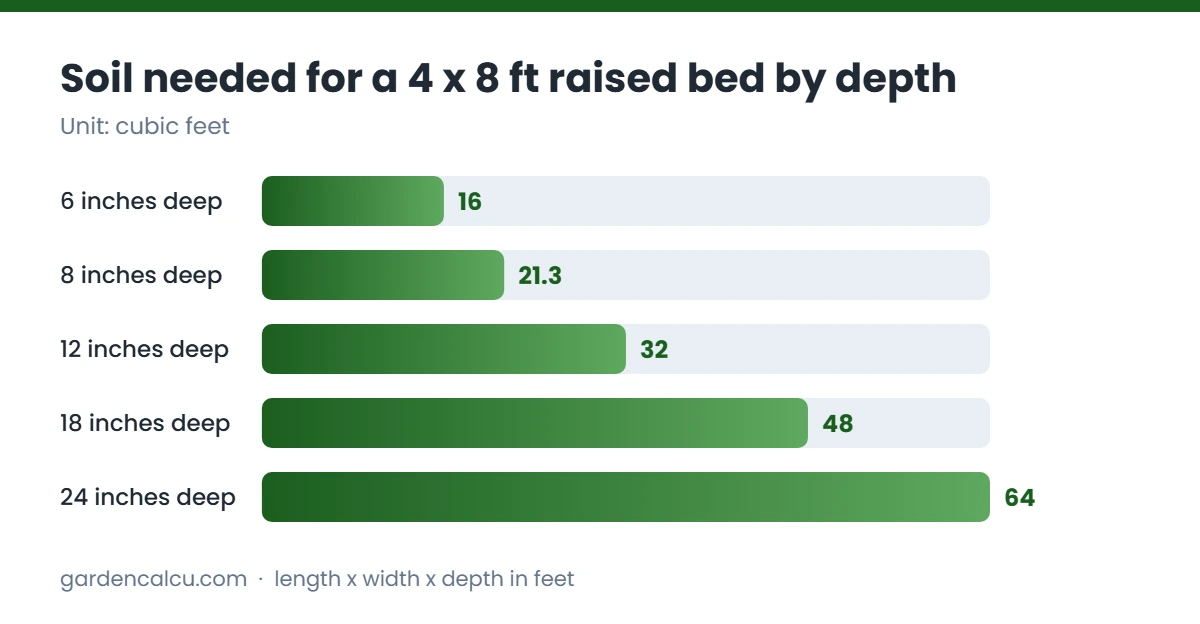
Chart for “how deep should a raised bed be”: cubic feet of soil a 4 x 8 ft bed needs at each depth.
Bed depth | 4 x 4 ft bed | 4 x 8 ft bed | 4 x 8 in cubic yards | 2 cu ft bags for 4 x 8 |
|---|---|---|---|---|
6 inches | 8 cu ft | 16 cu ft | 0.59 | 8 |
8 inches | 10.7 cu ft | 21.3 cu ft | 0.79 | 11 |
12 inches | 16 cu ft | 32 cu ft | 1.19 | 16 |
18 inches | 24 cu ft | 48 cu ft | 1.78 | 24 |
24 inches | 32 cu ft | 64 cu ft | 2.37 | 32 |
The Raised Bed Soil Calculator gives the volume and bag count for any size and depth.
This is the real argument for 12 inches. It is deep enough for almost every crop and half the cost of 24.
How much soil for your depth?
Enter the length, width and depth of your raised bed. The calculator gives cubic feet, cubic yards and bags of soil.
Rule 5: fill it with the right soil
Depth only helps if roots can use it. The Minnesota expert warned that garden soil shoveled into a raised bed drains poorly and can set like concrete. Use a mix made for raised beds, which drains well and stays crumbly.
The Ohio expert gave a simple ratio for the growing layer: about 70 percent soil and 30 percent compost. See best soil for vegetable gardens for more on mixes, and how much compost to add to garden for yearly top-ups.
Watch out: Soil settles. A bed filled to the brim in spring can be 2 or 3 inches lower by fall as the compost breaks down. Plan to top up each year, or the 12 inches you built becomes 9.
Width and length matter too
The Minnesota answer included the other dimension people get wrong. Do not make the bed so wide you cannot reach the middle. Three to four feet is as wide as you want if you can reach from both sides, and about two feet if it stands against a fence or wall.
Length is up to you. Longer beds need bracing in the middle so the sides do not bow under the weight of wet soil, and deeper beds need it more.
Which depth should you choose?
Your situation | Recommended depth |
|---|---|
Salad greens and herbs on good ground | 8 inches |
A general vegetable bed on soil | 12 inches |
Tomatoes, peppers, squash on poor or hard ground | 18 inches |
A bed on concrete or a deck | 18 to 24 inches |
Gardening without bending | 24 to 36 inches, bottom filled with filler |
Carrots in a planter on legs | 8 to 10 inches of mix |
Common mistakes
Frequently asked questions
Short answers to the questions that come up most often.
Quick recap
How deep should a raised bed be? Twelve inches suits almost everything and is the minimum two Extension experts recommended. Use 8 inches only for greens on good ground, and 18 to 24 inches for big crops on hard surfaces.
Build taller for comfort if you need to, but fill the bottom with filler. Every extra inch of soil in a 4 x 8 bed is another 2.7 cubic feet to buy.
Get your exact number
Enter your bed size and depth, and the calculator turns it into cubic feet, cubic yards and bags.
Related guides
Sources
The facts in this guide to “how deep should a raised bed be” come from these university Extension pages and public questions: