
Plant Grass Seed in Fall: Best Dates and 6 Late-Season Rules
The best time to plant grass seed in fall is late August through September, and in milder states the window stays open until about mid-October. After that, seed may sprout but the young grass often does not have time to root before hard frost.
That is the short version. The question people actually send to Extension offices is more specific: “It is October 3rd, am I too late?” or “Can I still seed on November 8th?” The answer changes with the date, the state and the kind of grass.
This guide is built from five real questions sent to university Extension services in Maryland, Michigan and Minnesota, each with a date attached. Read them in order and you can see exactly where the fall seeding window closes.
Key takeaways
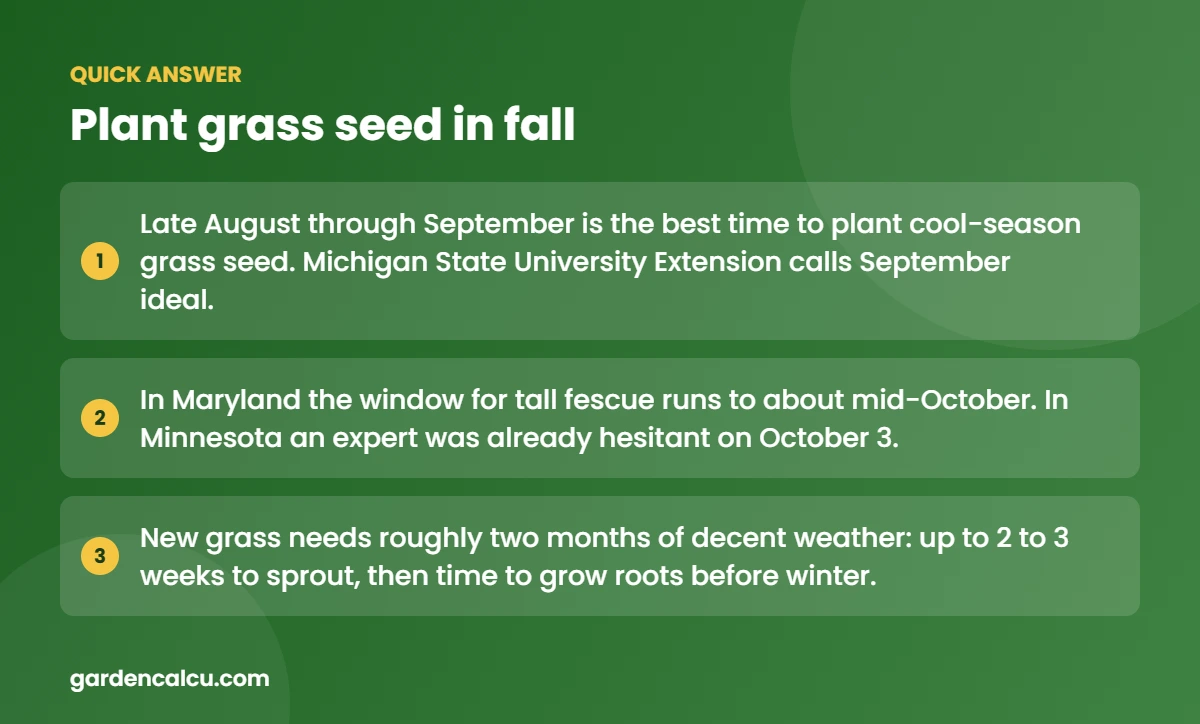
Quick answer to “plant grass seed in fall” in three points.
Real questions gardeners asked
Every autumn people ask if they can still plant grass seed in fall or if they have missed their chance. These five questions were asked on five different dates, from mid-September to mid-November. Here is each one in our own words, with what the expert replied and a link to the original.
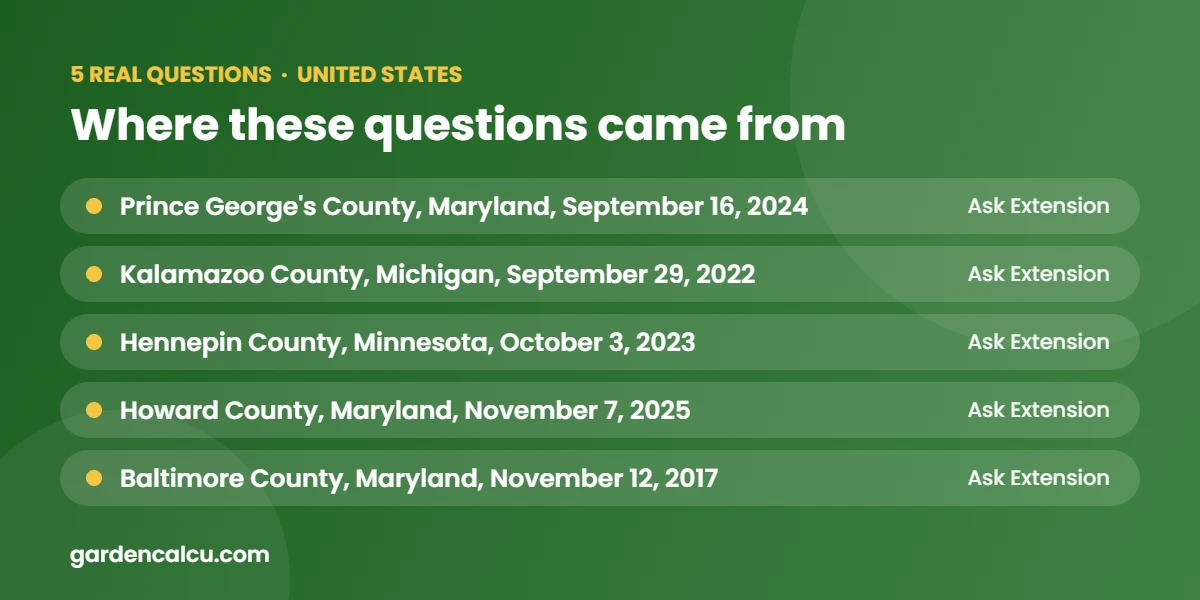
“Is it too late to both kill weeds and plant grass seeds this fall”
The question: A homeowner had not yet put down weed killer or seed by September 16. He asked how late he could seed and which job to pick if he could only do one.
What the expert said: Not too late. The Maryland Extension expert said the window for cool-season grasses like tall fescue runs through about mid-October, the sooner the better. If you must choose, seed now and leave weed control until spring. Some pre-emergent weed products would also stop the grass seed from sprouting.
“Too late to seed lawn?”
The question: With highs forecast in the 60s for the next week, a homeowner wondered if it was still possible to seed bare spots.
What the expert said: The expert said late August through September is the best time in Michigan. Many turf varieties take 2 to 3 weeks to sprout, so new grass needs upwards of two months of favorable weather to be mature enough for winter. Seeding in October is more hit-or-miss and depends on the weather that year.
“Too late to plant turf grass?”
The question: After a hard year of road work, grubs and drought, a homeowner asked if sowing fescue on October 3 and watering until frost would help, or if it was simply too late.
What the expert said: The expert was hesitant. Fescue would take a week to 10 days to sprout, which meant mid-October, and then at least another couple of weeks to form roots. Night temperatures were already heading for the high 30s, and first frost in the Twin Cities usually comes before mid-October. He suggested aerating instead.
“Planting grass seed at this point in year”
The question: Drilling for a geothermal system tore up about 2,500 square feet of sloping lawn. The owner asked if he could seed tall fescue on November 8 or should wait for spring, and he was worried about erosion over winter.
What the expert said: Too late for tall fescue. Even if soil temperatures are fine, the expert said the days are too short for the seed to sprout. To hold the soil, use wood chips or mulch, or straw and burlap pinned down, and remove them before planting in spring. Sod is possible but may not root.
“Planting grass seed mid-November”
The question: A homeowner had bought seed in October and never planted it. With nights near freezing, should it go down now or wait in the shed until spring?
What the expert said: Too late. The Home and Garden Information Center said the best time to sow is late August through mid-October. Later than that you are taking a chance, because young turf-type tall fescue is very easily damaged by frost. The second best time is early March through April. Sod can go down as long as the soil is not frozen.
When to plant grass seed in fall: the dates that work
Put the five answers on a calendar and a pattern appears. The yes turns into a maybe at the end of September and into a no by early November. How fast it turns depends on how far north you live.
Date asked | State | Expert verdict |
|---|---|---|
September 16 | Maryland | Not too late. Window runs to about mid-October. |
September 29 | Michigan | Still possible. October is hit-or-miss. |
October 3 | Minnesota | Hesitant. Frost is too close. |
November 7 | Maryland | Too late. Days are too short. |
November 12 | Maryland | Too late. Wait for March or April. |
This applies to cool-season grasses: tall fescue, Kentucky bluegrass, fine fescue and perennial ryegrass. They grow best in the cool weather of fall and spring. Warm-season grasses such as bermudagrass and zoysiagrass are a different story and are planted when the soil is warm, in late spring and early summer.
Northern states
In Minnesota, Michigan and states with similar winters, aim for mid-August to mid-September. The Minnesota expert turned down an October 3 seeding because the first frost there usually arrives before the middle of the month.
Mid-Atlantic and transition states
Maryland experts gave the same range in two answers eight years apart: late August through mid-October. The earlier half of that range is safer. As the 2024 answer put it, the sooner the better.
Tip: Not sure about your own frost timing? Check the Planting Calendar for your area, then count back about eight weeks. That is your target seeding date.
Why fall beats spring for grass seed
Fall hands a new lawn three things at once. The soil is still warm from summer, so seed sprouts quickly. The air is cooler, so seedlings do not dry out by lunchtime. And most annual weeds, crabgrass above all, are finishing their life cycle and not starting it.
Spring-sown grass has the opposite problem. It sprouts into a rising tide of weeds and then faces its first summer with shallow roots. That is why the Maryland center calls early March through April only the second best time. A Minnesota expert told another homeowner on May 21 that it was too late for spring seeding, because the grass would hit summer heat before its roots matured.
How long new grass needs before winter
The cut-off dates are not arbitrary. They come from counting backwards from frost.
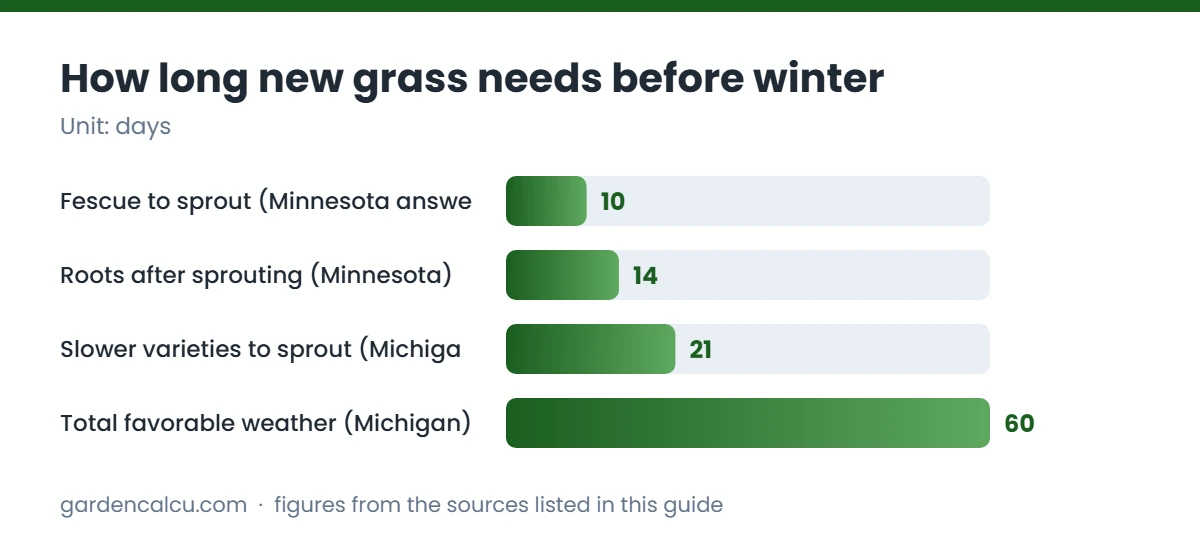
Chart for “plant grass seed in fall”: the days of growing weather new grass needs, from the Extension answers above.
The Michigan answer spelled out the reasoning. Seed has to sprout, grow stems and leaves, and build a root system that can store sugars to survive winter. With some varieties taking 2 to 3 weeks just to germinate, the whole job needs upwards of two months of favorable weather.
Worked example: if your first frost usually comes around October 15, eight weeks back is August 20. Seeding in late August gives the best odds. Seeding on October 3, as the Minnesota homeowner planned, leaves 12 days.
Is it too late to plant grass seed? Three signs
Watch out: Seed that sprouts just before a hard freeze is the worst outcome. You lose the seed and the bare spot is still bare in spring. If you are in doubt, wait.
What to do if you missed the window
Missing the fall window is not a disaster. The experts suggested several ways to get through winter.
Protect bare soil
For a torn-up slope, the Maryland expert recommended wood chips or mulch, or straw with burlap pinned over it. The cover stops erosion and blocks weed seeds from blowing in or sprouting. Pull it off before you seed in spring. Our guide to using leaves as mulch covers a free option for flat areas.
Lay sod
Sod can be laid much later than seed. The Maryland center said it can go down as long as the soil is not frozen. In late fall it may not root well until spring, so keep traffic off it.
Aerate and wait
The Minnesota expert’s first suggestion to the October homeowner was to aerate the lawn if it had not been done in three years, since fall is the ideal time for it.
Try dormant seeding
Dormant seeding means sowing after the ground is too cold for seed to sprout, so it waits under the snow and comes up in spring. University of Minnesota Extension notes it works best on bare soil or thin lawns, where seed can touch the soil. An Ohio expert warned one homeowner that winters with warm spells followed by deep cold can hurt the results.
How much grass seed do you need?
Enter the size of your lawn and the calculator works out how many pounds of seed to buy for a new lawn or for overseeding.
How to plant grass seed in fall, step by step
Hold off on weed killer. The Maryland answer explained that pre-emergent products made to stop weed seeds can stop grass seed too. If you have to pick one job this fall, the expert’s advice was clear: plant the grass seed and deal with weeds in spring.
Tip: Fallen leaves can smother seedlings. Blow or rake them off new grass gently every few days instead of letting them pile up.
Common mistakes with fall seeding
Frequently asked questions
Short answers to the questions that come up most often.
Quick recap
To plant grass seed in fall with good odds, get it down between late August and the end of September, and no later than mid-October in milder states. New grass needs about two months before winter.
If the calendar already says November, protect bare soil, consider sod, and plan to seed in early spring. Either way, measure the area first so you buy the right amount of seed.
Get your exact number
Measure your lawn, pick new lawn or overseeding, and the calculator shows how many pounds of grass seed to buy.
Related guides
Sources
The facts in this guide to “plant grass seed in fall” come from these university Extension pages and public questions: