
Winter Burn on Evergreens: 5 Easy Ways to Prevent It
Winter burn on evergreens is drying damage. Needles lose water to winter sun and wind while the roots sit in frozen ground and cannot replace it. The best prevention is to water evergreens well through fall, right up until the ground freezes, then mulch the roots and shade exposed plants.
The damage shows up in early spring as brown or rust-colored foliage, usually on the south or southwest side or at the top. By then it is months too late to do anything about the cause, which is why the Extension answers on this topic all point back to the previous fall.
This guide is built from five real questions sent to university Extension services in Minnesota, Colorado, Michigan and Pennsylvania. Most involve arborvitae, the most commonly burned evergreen, but the advice applies to yew, boxwood, hemlock and young pines and spruces as well.
Key takeaways
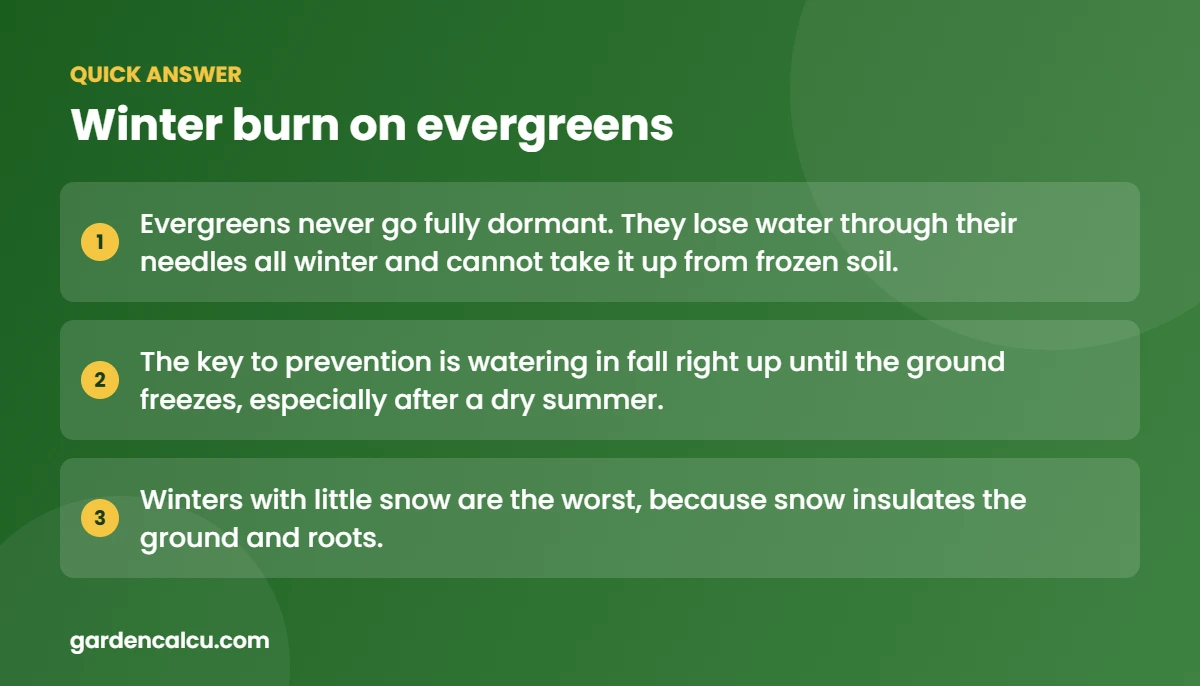
Quick answer to “winter burn on evergreens” in three points.
Real questions gardeners asked
Questions about winter burn on evergreens arrive in April, when the snow melts and the hedge is brown. We read five real ones and the replies, including a gardener who lost a quarter of a new arborvitae planting and asked how to stop it happening again. Here is each in our own words, with a link to the original.

“Winter Burn Arbor Vitaes”
The question: A homeowner covers the arborvitae every winter but found the tops more badly burned than in any previous year, and asked about fertilizing, watering and pruning to fix it.
What the expert said: This looks like winter burn, the Master Gardener said. Evergreens never really go dormant, and drying winter winds can desiccate arborvitae branches enough that they die back. It is worse in nearly snowless winters, since snow insulates the ground and roots. The key to avoiding it is watering in fall right up until the ground freezes, especially after a dry summer. The rust-colored growth is dead.
“Arborvitaes & Winter Burn – When to put up the snow fencing?”
The question: After losing 25 percent of a first-year arborvitae planting to winter burn, a gardener had replaced them, mulched deeper and wider and bought posts and fabric for a sun and wind barrier. When exactly should the barrier go up?
What the expert said: Winter burn is caused by sunlight reflecting strongly off snow onto evergreen leaves, the expert said. They lose moisture that cannot be replaced because the roots are frozen in the ground. The barrier shades the plants and works best on the south and southwest side, a few inches away. Get the stakes in before the ground freezes. The fabric only needs to be up before there is snow cover, and it comes down after the snow melts.
“arborvitae and winter kill”
The question: Nine arborvitae grown from one-gallon pots into a five-foot screen came through winter mostly brown. The owner asked whether to pull them out.
What the expert said: There may be hope, the expert said. It looked like winter burn after a sudden freeze the previous October and a late spring freeze. If that is the cause, no treatment is needed other than regular water in the growing season and monthly water in fall and winter during dry spells. Some pruning may be needed.
“Watering a tree.”
The question: A homeowner with a newly planted street tree asked when to stop watering for the season.
What the expert said: The expert said to ease off in September and early October, then resume after leaf drop and water deeply once a week until the ground freezes. That gives trees, including evergreens, a reserve of water for coming out of dormancy.
“Green Giant Thuja Evergreen watering”
The question: A homeowner was watering new Green Giant arborvitae with two gallons every three days from a bucket with small holes drilled in the side.
What the expert said: The slow-release method is fine, the expert said, but the amount should depend on rainfall and drainage. Normally 1 inch of water per week is recommended for established trees and perhaps twice that for newly planted ones. Only add water when the soil has dried out a bit, since too much for too long causes problems.
What winter burn is, and is not
Winter burn looks like cold damage, but it is closer to drought. Three things combine.
When the foliage loses more water than it holds in reserve, it dries out and dies. The brown shows weeks later, when temperatures rise.
Which plants and which sides
More at risk | Less at risk |
|---|---|
Arborvitae, yew, boxwood, hemlock, rhododendron | Established native pines and spruces |
Plants in their first few winters | Plants in the ground many years |
South and southwest sides, and exposed tops | North and east sides |
Windy, open or sloped sites | Sheltered spots |
Dry fall, little snow | Moist fall, steady snow cover |
The Dakota County gardener’s loss of a quarter of a first-year planting fits the pattern. New plants have small root systems and little stored water.
Way 1: water in fall until the ground freezes
This is the single most important step, and three of the five answers say so.
How much? The Pennsylvania expert gave the general figure of 1 inch of water per week for established trees and perhaps twice that for new ones, counting rain.
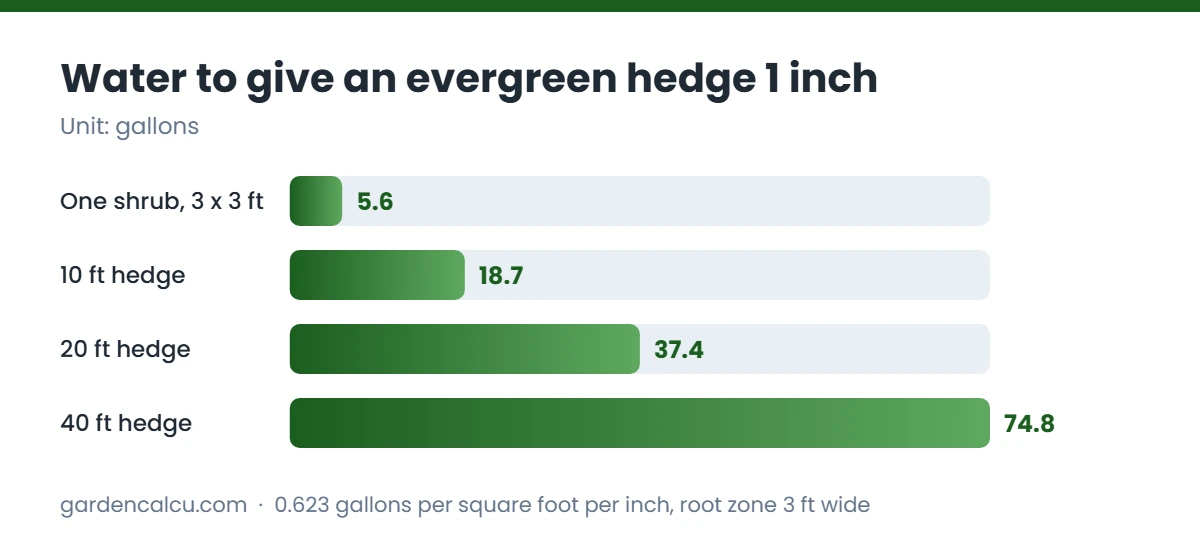
Chart for “winter burn on evergreens”: gallons needed to apply 1 inch of water to the root zone of a hedge.
Worked example: a hedge 20 feet long with a root zone about 3 feet wide covers 60 square feet. One inch of water over that area is 60 x 0.623 = 37 gallons. A newly planted hedge at twice that needs about 75 gallons a week in dry weather.
Planting | Root zone area | Gallons for 1 inch | Gallons for 2 inches (new plants) |
|---|---|---|---|
One shrub, 3 x 3 ft | 9 sq ft | 5.6 | 11.2 |
10 ft hedge, 3 ft wide | 30 sq ft | 18.7 | 37.4 |
20 ft hedge, 3 ft wide | 60 sq ft | 37.4 | 74.8 |
40 ft hedge, 3 ft wide | 120 sq ft | 74.8 | 149.5 |
The Water Calculator converts inches of water to gallons for any area. For individual new trees, see how often to water new trees.
Watch out: Do not overdo it. The Pennsylvania expert warned that too much water for too long causes its own problems, and a Maryland answer notes that arborvitae do not tolerate saturated soil. Water when the top few inches have dried a little, and stop once the ground is frozen.
Way 2: mulch the root zone
Mulch slows the freezing of the soil and holds moisture, so roots stay active later into winter. The Dakota County gardener had mulched deeper and wider as recommended.
Spread 2 to 4 inches of wood chips or shredded bark over the root zone, out past the edge of the branches, and keep it off the trunk. See mulch around trees for the details and leaves as mulch for a free option.
Way 3: put up a sun and wind barrier
For exposed plants, a simple screen makes a big difference. The Dakota County answer gives the full method.
A screen works better than wrapping the plant tightly. The Ramsey County homeowner covered the arborvitae every year and still had burned tops, which suggests the tops were exposed or the plants went into winter dry.
Tip: Do not use plastic. It heats up in sun and makes the temperature swings worse. Burlap and woven shade fabric breathe.
Way 4: plant in the right place
If you are planning a hedge or screen, site matters as much as care.
Way 5: go into winter healthy
A stressed plant has less in reserve. Keep evergreens watered in summer, do not fertilize late in the season, and avoid pruning after midsummer, since both push soft growth that is easily damaged.
What to do with a burned evergreen in spring
The Ramsey County and Jefferson County questions were both about plants already damaged. The advice is patient.
The Colorado expert’s verdict on nine mostly brown arborvitae was that there might be hope. Plants with some green often recover over a season or two, though they may need shaping. Do not fertilize heavily to force recovery. Regular water is the treatment.
How many gallons does your hedge need?
Enter the length and width of the root zone and the inches of water to apply. The calculator converts it to gallons.
A fall checklist
When | Job |
|---|---|
Late summer | Water deeply in dry spells |
September to October | Keep watering evergreens. Top up mulch to 2 to 4 inches. |
After leaf drop | Water deeply once a week |
Before the ground freezes | Drive stakes for barriers. Give a final deep soak. |
Before snow cover | Attach burlap on the south and southwest side |
Winter thaws, dry climates | Water monthly if there is no snow or rain |
After snowmelt | Remove barriers. Wait before pruning. |
To time the last watering, find your first frost date. The ground usually freezes several weeks after the first frost.
Common mistakes
Frequently asked questions
Short answers to the questions that come up most often.
Quick recap
Winter burn on evergreens is prevented in fall, not treated in spring. Water deeply until the ground freezes, mulch the roots and screen exposed plants from south and southwest sun.
If damage has already happened, wait for new growth before pruning, keep the plants watered and give them a season to recover.
Get your exact number
Measure the root zone of your hedge and the calculator shows the gallons for each inch of water.
Related guides
Sources
The facts in this guide to “winter burn on evergreens” come from these university Extension pages and public questions: