Wood Ash in Garden Soil: 5 Rules and Easy Safe Amounts
You can use wood ash in garden soil, sparingly. It supplies potassium and acts like lime, raising soil pH quickly. An Oregon State University expert’s limit is no more than 5 to 10 pounds per 100 square feet per year, spread thinly and mixed in, with a pH test each year you use it.
A winter of fires leaves a lot of ash, and the garden seems like the natural place for it. In small amounts it is useful. In large amounts it does real damage. The same Oregon expert has seen a raised bed so overloaded with ash that not even radishes would germinate.
This guide is built from five real questions sent to university Extension services in Oregon, Michigan and Minnesota. Their answers set out how much is safe, which plants and soils should never get ash and what to do with the rest of the bucket.
Key takeaways
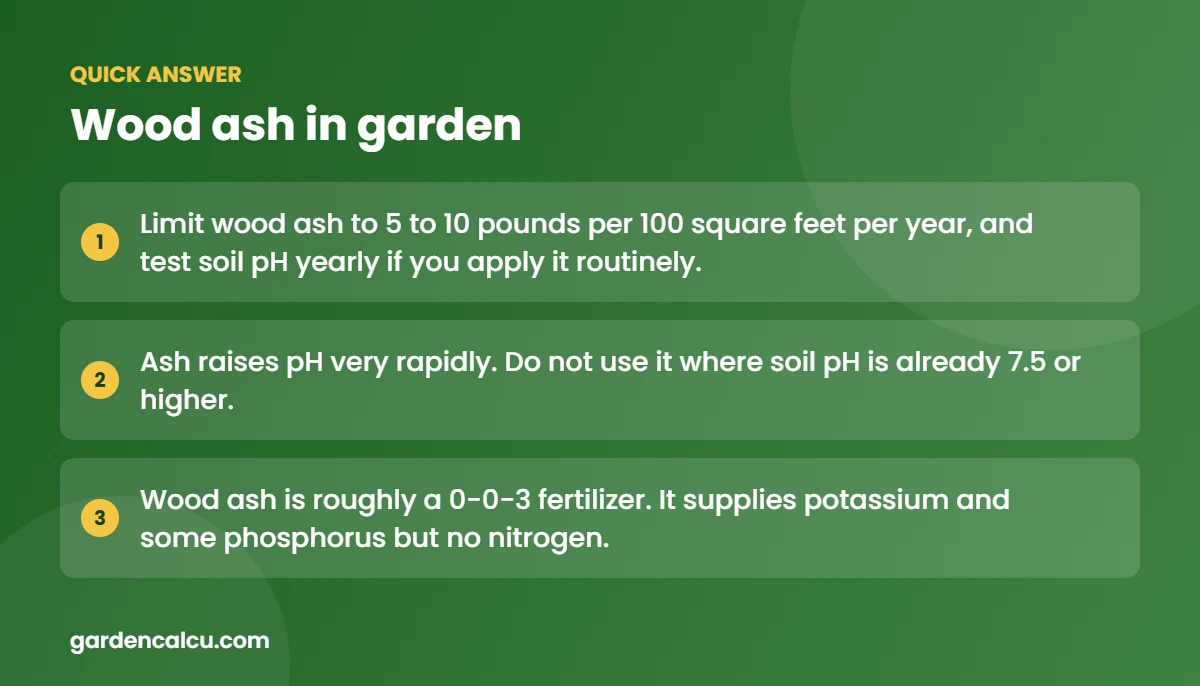
Quick answer to “wood ash in garden” in three points.
Real questions gardeners asked
Questions about wood ash in garden beds come in two kinds: people asking before they spread it, and people asking what went wrong after. We read five real ones and the replies. Here is each in our own words, with a link to the original.
“Fireplace ashes in raised bed”
The question: A gardener spread fireplace ashes on a raised bed in January. By April that bed was very wet and impossible to turn over, while beds without ash were easy to work. Had the ash caused it?
What the expert said: The Oregon State University expert had not heard of that effect but urged care with ash. Her recommendation is no more than 5 to 10 pounds of wood ash per 100 square feet per year, with a soil pH test each year for anyone who applies it routinely. She has seen a raised bed completely sterilized by excess wood ash. Ash is highly soluble, supplies readily available potassium and phosphorus and raises soil pH very rapidly.
“Fire pit ashes in garden soil”
The question: A gardener asked if it is safe to use ashes from the fire pit to amend garden soil.
What the expert said: It depends on what was burned, the potassium already in the soil and the soil pH, the expert said. Ash raises pH, and if the soil is already 7.5 or higher it is not recommended. Use it sparingly, apply evenly and mix it into the soil. Never leave it in lumps or piles, where salts concentrate. Keep it off acid-loving plants and potato beds, do not apply it to newly germinated seeds, and never use ash from coal, painted or treated wood or burned trash.
“Ashes for potassium?”
The question: A soil test said a vegetable garden needed 4 pounds of potassium. The gardener asked if hardwood ashes could supply it, and how much that would take.
What the expert said: Too much ash changes the pH, the expert said, so it is important not to add too much. Wood ashes are about 0-0-3 as a fertilizer. A 5-gallon bucket holds roughly 20 pounds. If there is not enough ash, a fertilizer can make up the rest.
“Fireplace ashes in soil”
The question: A homeowner who burns only fallen branches from deciduous trees asked if the ashes could go on flower or vegetable beds or under shade trees and shrubs.
What the expert said: You can use ashes, the Master Gardener said, but sprinkle them thinly. Oaks, maples and birch do not like them, and neither do acid-loving shrubs. Do not use them around berry plants.
“Fireplace wood ash in compost”
The question: A gardener with a large compost pile turned by tractor asked about adding fireplace ash to it.
What the expert said: In small quantities ash is acceptable, the expert said, no more than a sprinkling here and there. In large quantities it can cake up and act as a binding agent, and it may throw off the pH of the pile over time. Consider spreading extra ash in the woods instead.
What wood ash does to soil
Wood ash is what is left of the minerals a tree took up over its life. Burning removes the carbon, nitrogen and sulfur. What remains is mostly calcium, with potassium, some phosphorus and magnesium, and traces of other elements.
Whether any of this helps depends on your soil. On acidic soil that is low in potassium, a little ash is a free amendment. On neutral or alkaline soil, it pushes pH the wrong way.
Rule 1: stay under 5 to 10 pounds per 100 square feet a year
This is the Oregon State University expert’s limit. It is not much ash.
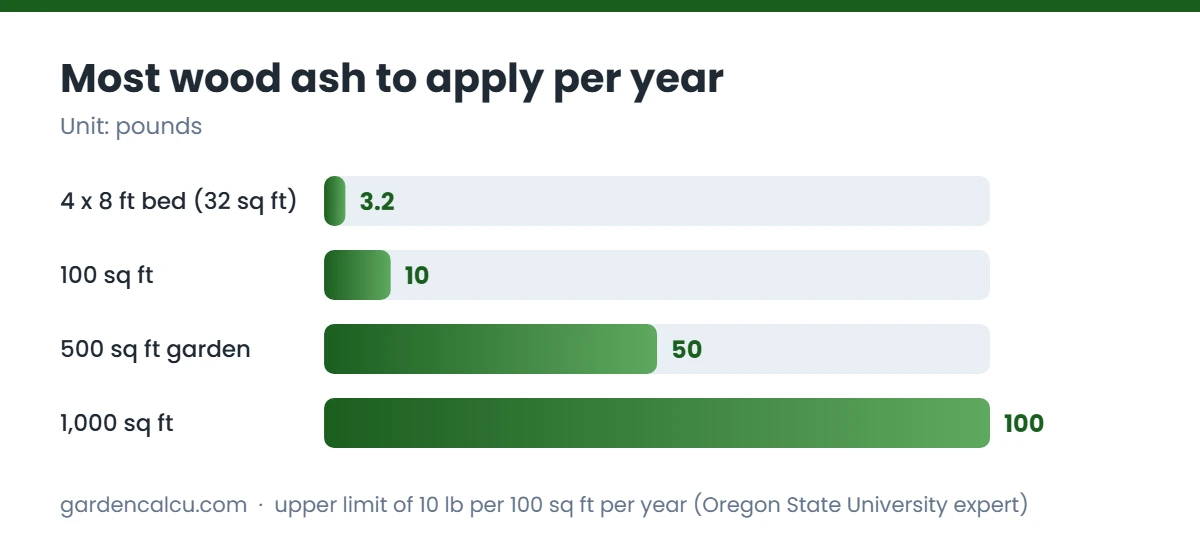
Chart for “wood ash in garden”: the most wood ash to apply in a year at 10 pounds per 100 square feet.
Bed or area | Square feet | Low rate (5 lb per 100 sq ft) | Maximum (10 lb per 100 sq ft) |
|---|---|---|---|
4 x 4 ft bed | 16 | 0.8 lb | 1.6 lb |
4 x 8 ft bed | 32 | 1.6 lb | 3.2 lb |
100 sq ft | 100 | 5 lb | 10 lb |
500 sq ft garden | 500 | 25 lb | 50 lb |
1,000 sq ft | 1,000 | 50 lb | 100 lb |
Worked example: a 4 x 8 ft raised bed is 32 square feet. At the maximum rate, 32 ÷ 100 x 10 = 3.2 pounds of ash for the whole year. The Michigan expert said a 5-gallon bucket holds about 20 pounds, so that bed gets less than a sixth of a bucket.
This is where raised bed gardeners go wrong. A bucket of ash tipped onto one small bed can be five or six times the yearly limit. The Oregon gardener’s sodden, unworkable bed and the sterilized one the expert described both fit that picture.
Can ash supply all the potassium a soil test asks for?
Usually not, and the Luce County question shows why. The test called for 4 pounds of potash per 1,000 square feet. At 3 percent, that takes 4 ÷ 0.03 = 133 pounds of ash per 1,000 square feet, or 13 pounds per 100. That is over the yearly limit, and it would raise pH sharply.
Use ash for part of the potassium and a fertilizer for the rest. The Fertilizer Calculator works out product amounts, and what do fertilizer numbers mean explains how to read a grade such as 0-0-60.
Rule 2: check the pH first
The Oakland County answer gives the cut-off. If soil pH is already 7.5 or higher, adding ash is not recommended. It also says not to use ash where soils are naturally high in potassium and pH.
Soil pH | Use wood ash? |
|---|---|
Below 6.0 | Yes, at the rates above. It will help. |
6.0 to 7.0 | A light sprinkling at most. Most vegetables are already happy here. |
7.0 to 7.5 | Avoid in the garden. |
7.5 or higher | No. |
If you have not tested in three years, test before spreading. In much of the western United States soils are naturally alkaline and ash should not go on gardens at all. If your lawn or garden needs lime, ash can replace part of it. See how much lime for lawn for how lime rates are set.
Watch out: The damage from too much ash is slow to undo. High pH locks up iron, manganese and phosphorus, and plants yellow and stall. Lowering pH again takes sulfur and many months.
Rule 3: keep it off these plants
Every answer has a list of plants that should not get ash.
Vegetables that prefer near-neutral soil, such as the cabbage family, onions, garlic, asparagus and beans, are the best candidates in an acidic garden.
Rule 4: spread it thin and mix it in
The Michigan answer is emphatic about lumps and piles. Where ash is concentrated in one place, excessive salt leaches into the soil and creates a harmful environment for plants.
It adds one more caution. Do not apply nitrogen fertilizer in the ammonium form right after ash. The high pH turns the ammonium to ammonia gas and the nitrogen is lost. Leave a few weeks between them.
Tip: Spreading ash in a thin layer over the lawn is safer than using it in the garden, the Michigan answer says, because it is less likely to be concentrated. A lawn on acidic soil can take the same light rate.
Rule 5: only burn clean wood
What went into the fire decides whether the ash is usable.
Source | Safe for soil? |
|---|---|
Untreated firewood, branches, brush | Yes |
Hardwood ash | Yes. Hardwoods yield more ash per pound of wood than softwoods. |
Charcoal briquettes and coal | No |
Painted, stained or pressure treated wood | No |
Cardboard, trash, glossy paper | No |
Fire pit with mixed burning | Only if you know nothing else went in |
Treated lumber is the one to watch. Ash from old treated wood concentrates the preservative metals. See treated wood for raised beds.
Work out your fertilizer needs
Enter your garden area and the nutrients your soil test recommends. The calculator shows how much fertilizer product makes up what wood ash cannot.
Wood ash in compost
A light sprinkling between layers is fine, the Emmet County expert said. More than that causes two problems. Ash cakes into a dense layer that binds the pile, and it raises the pH, which slows the organisms doing the composting and drives off nitrogen.
If you add ash to compost, count that compost as already limed. Do not add more ash to beds where it is used.
What to do with the rest
A wood stove produces far more ash in a winter than a garden can take. Options for the surplus:
Common mistakes
Frequently asked questions
Short answers to the questions that come up most often.
Quick recap
Wood ash in garden soil is a fast-acting lime with some potassium. Keep it under 5 to 10 pounds per 100 square feet a year, spread it thinly, mix it in and test pH before and after.
Keep it away from acid-loving plants, potatoes and seedlings, use only ash from clean wood, and find another home for the surplus.
Get your exact number
Enter your area and soil test recommendation, and the calculator shows the fertilizer needed alongside any ash you use.
Related guides
Sources
The facts in this guide to “wood ash in garden” come from these university Extension pages and public questions: