Mulch Around Trees: 5 Easy Rules to Avoid a Mulch Volcano
The right way to mulch around trees is a wide, flat ring 2 to 4 inches deep, with a clear gap of several inches between the mulch and the trunk. Think of a donut, not a volcano.
Mulch is one of the best things you can give a tree and one of the easiest to get wrong. Drive through almost any subdivision and you will see cones of mulch piled a foot high against trunks. Those piles hold moisture on the bark and slowly damage the tree they are meant to help.
This guide is built from six real questions that homeowners sent to university Extension services in Texas, Michigan, Colorado and Minnesota. The experts agree closely on depth, width and the gap at the trunk, and we have worked out how much mulch a ring of each size takes.
Key takeaways
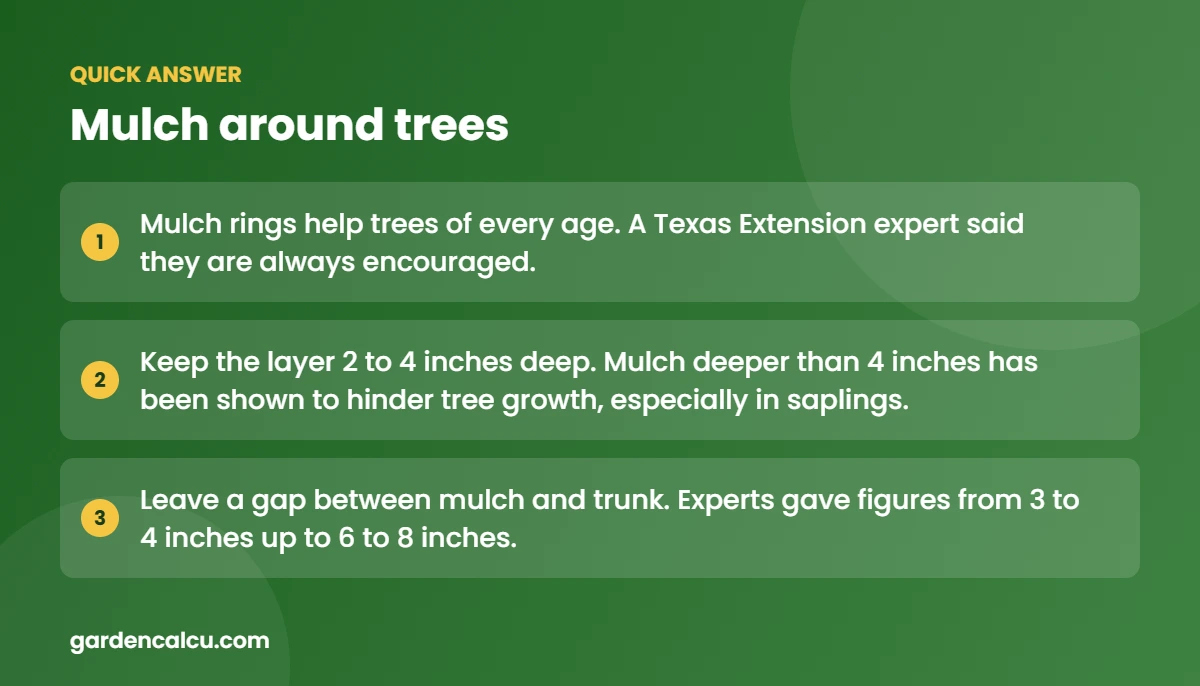
Quick answer to “mulch around trees” in three points.
Real questions gardeners asked
Questions about mulch around trees usually start with a neighbor doing it differently. We read six real ones sent to Extension, including a whole subdivision trying to settle an argument. Here is each in our own words, with a link to the original.

“Mulch for trees”
The question: Neighbors in a subdivision agreed that volcano mulching is bad but could not agree whether a 2-inch ring helps trees, or whether only young trees need it.
What the expert said: The expert said mulch rings are always encouraged, whatever the age of the tree. Mulch controls weeds, holds moisture and cools the soil. The common mistakes are piling it too high and making the ring too small. It should be 3 to 4 inches deep, tapered toward the trunk so none touches it. Mulch against the trunk creates a moist environment that encourages disease and pests.
“Tree mulching”
The question: One line: what is the proper way to mulch trees?
What the expert said: Not too thick, because roots need air. A 2 to 4 inch layer is enough. Apply it in a donut shape about three feet across, leaving 6 to 8 inches clear between the trunk and the inner edge of the mulch. Absolutely avoid the mulch volcano, which injures the tree.
“mulching around trees”
The question: A homeowner had noticed mulch around trees on several properties and asked if it is good practice, which mulch is best and whether tree age matters.
What the expert said: Yes, for trees of any age, the expert said. Wood chip mulch from chipped trees is best. Stringy bark products that mat together are not recommended because they keep water out of the soil. Apply mulch 4 inches deep to suppress weeds, with no fabric underneath. Deeper than 4 inches has been shown to hinder tree growth, particularly of saplings.
“Mulch over exposed tree roots”
The question: A homeowner with a maple whose roots were showing wanted to replace the grass under it with mulch, and wondered whether to level the ground with soil first or use extra mulch.
What the expert said: Ideally mulch is spread around a tree out to the drip line, the Master Gardener said. It protects exposed roots and the trunk from lawn equipment and keeps shallow maple roots cool and moist. The important thing is that it be no deeper than 3 inches and not piled against the trunk at all.
“Mulch around maple tree surface roots?”
The question: A gardener planning a pollinator bed under a large silver maple had read that more than 2 inches of mulch would smother the roots, and worried that 2 inches would not keep grass out.
What the expert said: Two inches is a great plan and perfect for the tree, the expert said. Keep it away from the trunk. Kill the grass first with cardboard or clear plastic instead of digging, and covering the exposed roots with mulch is preferred.
“mulching around mature trees (one maple and one ash)”
The question: After a scare with a girdling root, a homeowner was nervous about mulching around a 20-year-old maple and an ash.
What the expert said: The tree would be happy not to compete with grass, the volunteer said. Lay several layers of wet newspaper over the grass, then a thin layer of mulch to hold it down. Keep the mulch 3 to 4 inches away from the trunk. Each year, rake the mulch and add a little to freshen it.
How to mulch around trees: the 5 rules
Each rule comes straight from the Extension answers. The sections below explain the reasoning and the numbers.
Rule 1: how deep
The six answers give slightly different figures, and they overlap neatly.
Expert | Depth | Note |
|---|---|---|
Michigan, 2025 | 2 to 4 inches | Roots need air |
Texas, 2024 | 3 to 4 inches | Tapered down toward the trunk |
Colorado, 2023 | 4 inches | Deeper hinders growth, especially saplings |
Colorado, 2024 | No deeper than 3 inches | Over exposed maple roots |
Minnesota, 2025 | 2 inches | Under a silver maple with surface roots |
Taken together: 2 to 4 inches, toward the low end for shallow-rooted trees such as maples and for fine-textured mulch, and toward the high end for coarse wood chips where weeds are the main concern. Nobody recommended more than 4.
Rule 2: keep mulch off the trunk
This is the rule that separates a helpful ring from a harmful one. Bark is built to be dry and exposed to air. Mulch piled against it stays wet. The Texas expert explained that this moist environment encourages disease and pests. Rodents also tunnel in deep mulch and chew bark over winter.
How big a gap? The Minnesota volunteer said 3 to 4 inches. The Michigan expert said 6 to 8 inches. Either way, you should be able to see the root flare, the place where the trunk widens at the ground.
Watch out: A mulch volcano does damage slowly. The tree can look fine for years while the buried bark decays and roots grow up into the pile and circle the trunk. If your trees have volcanoes now, pull the mulch back by hand until the root flare shows, and spread the extra outward.
Rule 3: go wide
The Texas expert named two common mistakes. Piling mulch too high was one. Making the ring too small was the other.
A tree’s feeding roots spread well beyond the trunk, mostly in the top foot of soil. A ring the size of a dinner plate does little for them. The Michigan expert gave a 3-foot donut as the basic size. The Denver Master Gardener said the ideal is out to the drip line, the edge of the branches.
A wide ring has a second benefit. It keeps mowers and string trimmers away from the trunk. Bark wounds from lawn equipment are one of the most common injuries to yard trees.
How much mulch does a tree ring take?
A ring is a circle with a hole in the middle. Its area is 3.14 x (outer radius squared minus the gap radius squared). Multiply by the depth in feet for cubic feet.
Worked example: a ring 6 feet across has a 3-foot radius. Leave a 6-inch gap around the trunk, which is 0.5 foot. Area = 3.14 x (9 – 0.25) = 27.5 square feet. At 3 inches deep: 27.5 x 0.25 = 6.9 cubic feet, or four 2-cubic-foot bags.
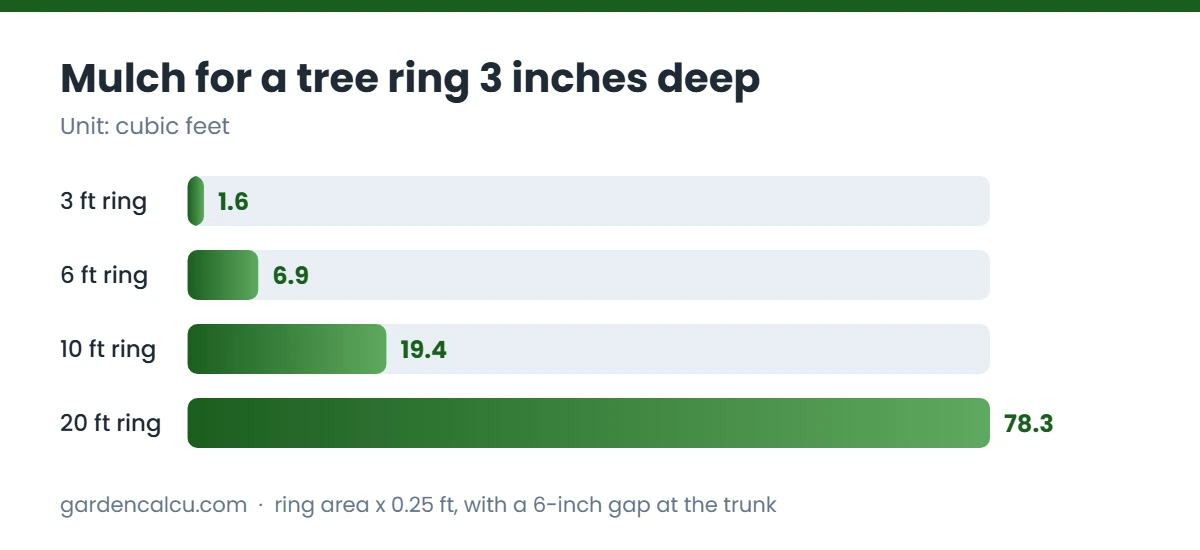
Chart for “mulch around trees”: cubic feet of mulch for a ring of each diameter at 3 inches deep.
Ring diameter | Area | 2 in deep | 3 in deep | 2 cu ft bags at 3 in |
|---|---|---|---|---|
3 ft | 6.3 sq ft | 1 cu ft | 1.6 cu ft | 1 |
6 ft | 27.5 sq ft | 4.6 cu ft | 6.9 cu ft | 4 |
10 ft | 77.7 sq ft | 13 cu ft | 19.4 cu ft | 10 |
20 ft | 313 sq ft | 52 cu ft | 78 cu ft (2.9 cu yd) | 40 |
For a large, mature tree, mulching to the drip line is a bulk order, not a few bags. The Denver Master Gardener admitted as much: for a big tree, that is a lot of mulch. It is fine to start with a 6 to 10 foot ring and widen it over time.
Tip: Enter the area and depth into the Mulch Calculator to get cubic feet, cubic yards and bags. Our guide how much mulch do I need covers the formula for beds of any shape.
Rule 4: which mulch to use
The Colorado expert was specific. Wood chips, the kind produced when tree crews chip branches, are best. They are coarse, they let water and air through, and they break down slowly into the kind of soil trees grow in naturally.
Free leaves as mulch work under trees too. A Minnesota answer in that guide confirms that oak leaves can simply be raked under the trees.
How much mulch for your trees?
Enter the area of your tree ring and the depth you want. The calculator gives cubic feet, cubic yards and bags of mulch.
Mulching over grass and exposed roots
Three of the six questions involved replacing lawn under a tree. Grass struggles in the shade and competes with the tree for water, so swapping it for mulch helps both.
Do not dig the grass out. Digging cuts feeding roots. The Minnesota experts gave two gentle methods instead.
The paper smothers the grass and rots away within a season.
Exposed surface roots, common on maples, can be covered with mulch. The Minnesota and Colorado answers both prefer that to leaving them bare, because mulch protects the roots from mower damage and summer heat. Do not cover them with soil. Even a few inches of added soil can suffocate roots, which is why the Denver homeowner was right to be cautious about leveling with fill dirt.
Rule 5: topping up without building a volcano
Most volcanoes are not built in a day. They grow a few inches each spring when fresh mulch is laid over the old.
A Maryland Extension answer in our mulch quantity guide makes the same point about beds in general. The total thickness, old and new together, is what counts.
Does a newly planted tree need mulch?
Yes, and it benefits more than an old one. Mulch keeps the root ball from drying out and stops grass from competing while the tree establishes. The Colorado caution applies with extra force here: more than 4 inches hinders the growth of saplings in particular. For a young tree, a ring 3 to 4 feet across and 2 to 3 inches deep, with the trunk clear, is plenty.
Common mistakes
Frequently asked questions
Short answers to the questions that come up most often.
Quick recap
To mulch around trees properly, spread a wide ring 2 to 4 inches deep, keep it several inches back from the trunk and use coarse wood chips with no fabric below. Check the depth before topping up.
A 6-foot ring takes about four bags. A mature tree mulched to the drip line can take several cubic yards, so measure first and build the ring outward over time.
Get your exact number
Measure the ring, choose 2 to 4 inches and the calculator turns it into bags or cubic yards.
Related guides
Sources
The facts in this guide to “mulch around trees” come from these university Extension pages and public questions: