How Far to Plant a Tree From a House: 5 Easy Distance Rules
How far to plant a tree from a house depends on how big it will get. The working rule from Extension experts is at least half of the tree’s mature spread, which comes to 15 to 20 feet for most yard trees and 40 to 50 feet for the largest shade trees.
The mistake is easy to make because a new tree is small. A spruce in a 5-gallon pot looks lost 15 feet from the wall, so it goes in at 6. Twenty years later the branches are on the roof and the owner is writing to Extension asking whether to cut it down.
This guide is built from five real questions like that, sent to university Extension services in Michigan, Minnesota and Colorado. The experts give actual distances, explain what roots and branches do to a house and say what to do with a tree that is already too close.
Key takeaways
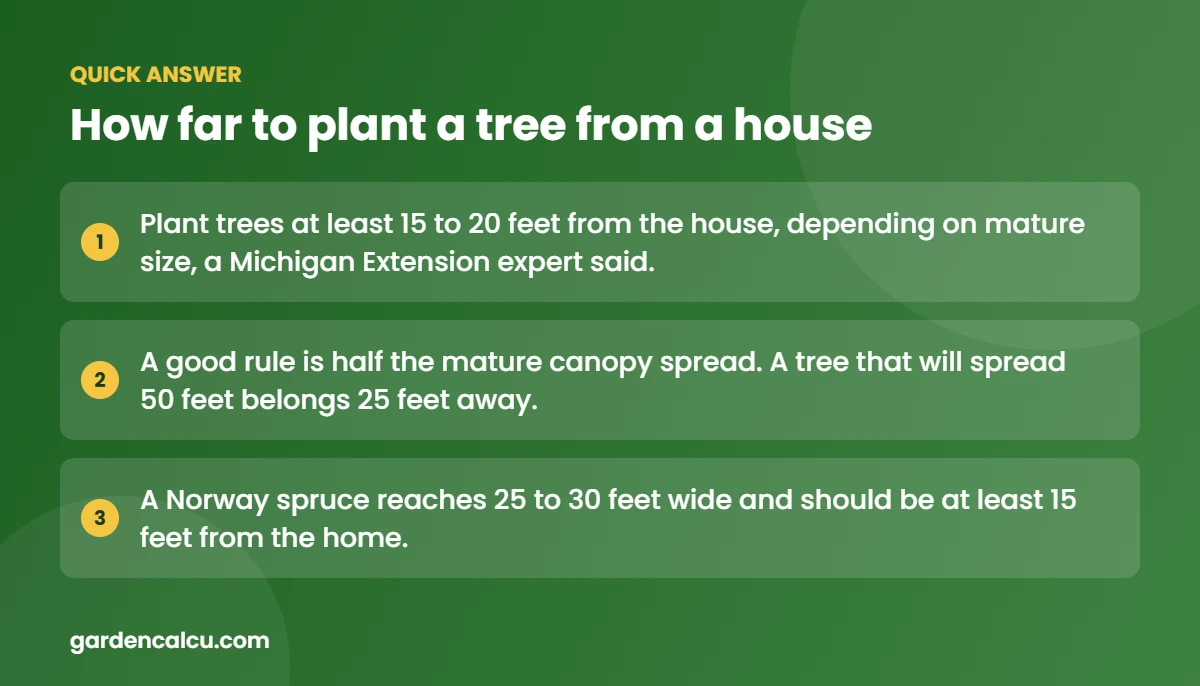
Quick answer to “how far to plant a tree from a house” in three points.
Real questions gardeners asked
Most people look up how far to plant a tree from a house after someone else has already planted one too close. We read five real questions and the experts’ replies. Here is each in our own words, with a link to the original.

“Tree growing close to house”
The question: Trees had sprung up on their own a few feet from the foundation. The homeowner asked whether that is a problem.
What the expert said: Planting trees too close to a house is discouraged, the expert said, because roots and branches can cause structural damage to the foundation, plumbing and sewer systems. Overhanging branches can damage the roof, block gutters and create points where pests can enter. Trees should be planted at least 15 to 20 feet from the house, depending on the mature size of the tree.
“Distance of tree from home or foundation”
The question: A homeowner asked how far a walnut and an ash should be from a house foundation, with root damage and the canopy rubbing on the house both in mind.
What the expert said: A good rule of thumb is to think about how large a canopy the tree can reach at full size, the volunteer said. A black walnut can reach 75 to 100 feet in height and width, which suggests planting it roughly 40 to 50 feet from the home. As an example, an elm about 25 feet from her own house, with a spread of about 50 feet, is at the perfect distance.
“How close should spruce/pine be planted from house foundation”
The question: A neighboring subdivision was planting spruces and pines very close together and only 6 feet from a homeowner’s foundation. Should she worry about her basement?
What the expert said: The distance depends on the species and its mature size, the expert said. A Norway spruce can get 25 to 30 feet wide, so it should be at least 15 feet from the home. That leaves room to reach full size without becoming a nuisance or damaging structures. Also consider power lines, utility lines and septic systems.
“Tree proximity to home”
The question: A homeowner worried that a spruce was planted too close and asked about effects on the foundation and a recommended distance for large evergreens.
What the expert said: Spruces in general have a fairly shallow root system, less than 2 feet deep, which can make them a bit unstable in wind, the Master Gardeners said. They should be no closer than 2 feet to pipes or structures as an absolute minimum, but at maturity the tree may be up to 25 feet across, and the distance to a house wall should take that into account. Roots may affect pipes within their growing area.
“Distance of white pine from home”
The question: A white pine planted 22 years earlier, about 4 feet from the corner of a brick house, was now 30 to 35 feet tall with branches over the roof. The owner asked whether to cut it down to protect the foundation and drain tiles.
What the expert said: The tree is too close to the home, the expert agreed. Its shade and the nearness of the branches were helping moss establish on the roof. Whether to remove it needs an on-site assessment by a certified arborist, since a tree service wants the business and may not be unbiased. The roof condition and the incorrect placement are two good reasons if the owner wants it gone.
Rule 1: use half the mature spread
The Ramsey County answer gives the simplest rule to apply. Find the mature spread of the tree, meaning how wide the canopy gets, and plant it at least half that distance from the house. At that distance, the fully grown tree just reaches the wall and no further.
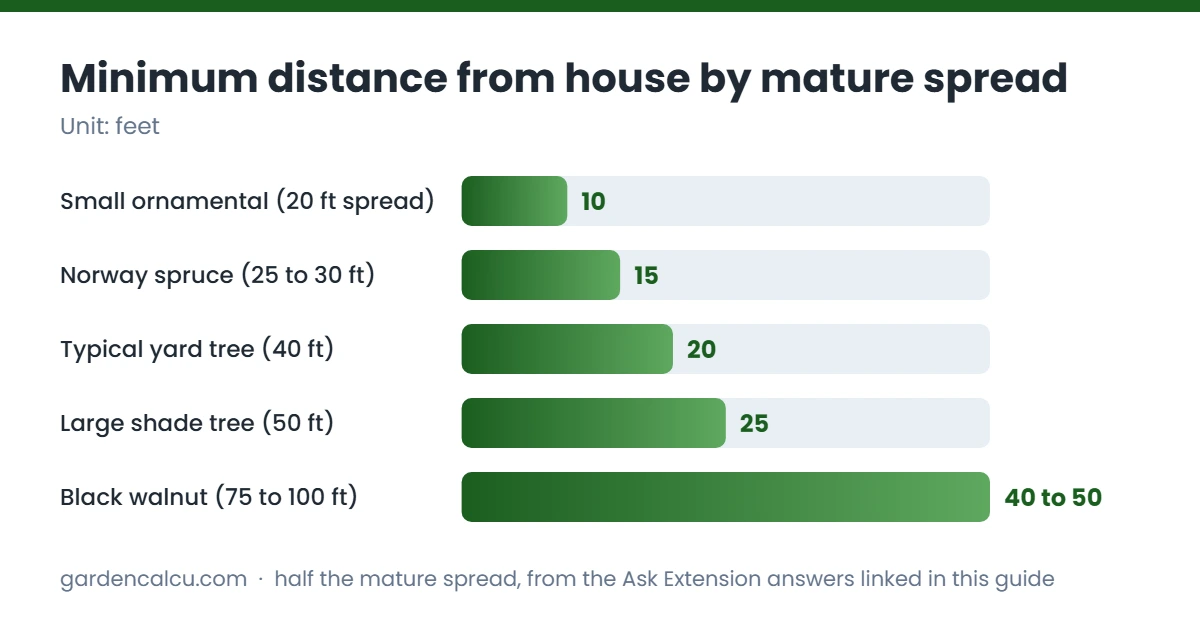
Chart for “how far to plant a tree from a house”: minimum planting distance for trees of each mature spread.
Tree | Mature spread | Minimum distance from house | Source |
|---|---|---|---|
Small ornamental (crabapple, redbud, Japanese maple) | About 20 ft | 10 ft | Half-spread rule |
Norway spruce | 25 to 30 ft | 15 ft | Michigan answer, 2024 |
Most yard trees | 30 to 40 ft | 15 to 20 ft | Michigan answer, 2025 |
Large shade tree (elm in the Minnesota example) | About 50 ft | 25 ft | Minnesota answer, 2018 |
Black walnut and other giants | 75 to 100 ft | 40 to 50 ft | Minnesota answer, 2018 |
The mature size is on the nursery tag or in any tree guide. Use the larger figure if a range is given. A tree in good soil with regular water usually reaches it.
Worked example: a red maple is listed at 40 feet wide. Half of 40 is 20, so plant it at least 20 feet from the nearest wall. A river birch listed at 35 feet wide goes at least 17.5 feet away.
Tip: Stand where you plan to plant, with the tag in hand, and pace out half the mature spread toward the house. If you reach the wall first, move the tree.
Rule 2: 15 to 20 feet is the working minimum
If you do not know the species, the Oakland County answer gives a floor: at least 15 to 20 feet from the house, depending on mature size. Small ornamental trees can go closer, at around 10 feet. Nothing that will become a real tree belongs at 4 or 6 feet, the distances in two of these questions.
The Boulder answer mentions 2 feet as the closest a spruce should ever be to pipes or structures. That is an absolute limit for roots against a pipe, not a planting distance, and the same answer goes on to say the mature width of up to 25 feet has to be taken into account.
What happens when a tree is too close
People worry about roots cracking the foundation. The Extension answers describe a wider set of problems, and several of them are above ground.
Problem | Cause |
|---|---|
Roof damage and wear | Branches rubbing and dropping on shingles |
Blocked gutters | Leaves and needles |
Moss and damp on roof and walls | Shade and trapped humidity, as with the Oakland County white pine |
Pests getting in | Branches touching the house are a bridge for squirrels, ants and others |
Plumbing and sewer trouble | Roots follow moisture into leaking or cracked pipes |
Foundation pressure or settling | Large roots against walls, or roots drying clay soil under footings |
Storm risk | Shallow-rooted trees such as spruce can blow over |
Roots do not usually break into a sound foundation. They exploit existing cracks and leaking pipes. But a trunk and root flare expanding against a wall for decades can do damage, and a Maryland Extension answer in our stump guide describes trees that grew into a foundation and cracked the concrete.
Rule 3: look up, down and sideways
The house is not the only thing to stay clear of. The Macomb County expert listed power lines, utility lines and septic systems.
The Plant Spacing Calculator helps lay out a row of trees or a hedge at a chosen spacing once you know the mature width.
Rule 4: match the tree to the space you have
If the only available spot is 10 feet from the house, choose a tree that fits it instead of forcing a big one.
Distance available | Choose |
|---|---|
Under 10 ft | Shrubs or a narrow, columnar variety |
10 to 15 ft | Small ornamental trees under about 25 ft tall |
15 to 25 ft | Medium trees with a 30 to 40 ft spread |
25 to 50 ft | Large shade trees |
50 ft or more | Anything, including walnut, large oaks and big conifers |
A deciduous shade tree placed 20 to 25 feet to the south or west of a house also shades the walls and roof in summer and lets the sun through in winter. That is a good reason to give it the full distance instead of crowding it in.
For timing and method, see the best time to plant trees.
Plan your spacing
Enter the length of the area and the spacing you want. The calculator shows how many trees or shrubs fit, so nothing ends up crowded.
Rule 5: what to do with a tree that is already too close
The white pine 4 feet from a corner and the volunteer seedlings a few feet from a foundation are two different cases.
If removal is the answer, the Tree Removal Cost Calculator gives a cost range. Trees close to buildings cost more to take down because they have to be dismantled in pieces. Afterwards, see tree stump removal. Where a stump is too close to the house for a grinder to reach, Maryland Extension advises removing as much as possible because decaying stumps can attract termites.
Watch out: Do not cut large roots on the house side to protect the foundation. Severing major roots can destabilize the tree and send it toward the building. Root pruning and root barriers are jobs to discuss with an arborist.
Do root barriers work?
A root barrier is a panel set vertically in the soil to turn roots away from a structure. Barriers can deflect roots near the surface, but they do not shrink the tree or keep branches off the roof, and installing one beside an established tree means cutting roots. They are a tool for particular situations, not a way to make a too-close planting safe. Distance is the reliable solution.
Common mistakes
Frequently asked questions
Short answers to the questions that come up most often.
Quick recap
How far to plant a tree from a house: half its mature spread, with 15 to 20 feet as the minimum for ordinary yard trees and 40 to 50 feet for the largest. Check for wires, pipes and septic lines as well.
Pull volunteer seedlings near the foundation now, and have a certified arborist assess any mature tree that is already too close before you decide to prune or remove it.
Get your exact number
Enter the area and spacing, and the calculator shows how many plants fit at their mature width.
Related guides
Sources
The facts in this guide to “how far to plant a tree from a house” come from these university Extension pages and public questions: