First Frost Date: 5 Easy Ways to Find Yours and What to Do
Your first frost date is the average date of the first fall night that drops to 32°F where you live. It is the single most useful number for a fall garden, because it tells you when tender crops will die and how many growing days are left.
It is also a number that causes a lot of confusion. Look it up on three websites and you may get three answers. One gardener in Cleveland put it well when he asked an Extension expert: will the real frost date please stand up?
This guide is built from five real questions sent to university Extension services in Oregon, Michigan, Ohio and Maryland. The experts explain what the date means, why sources disagree and what to do about it. We have added a simple way to count back from your date so you know what still fits this season.
Key takeaways
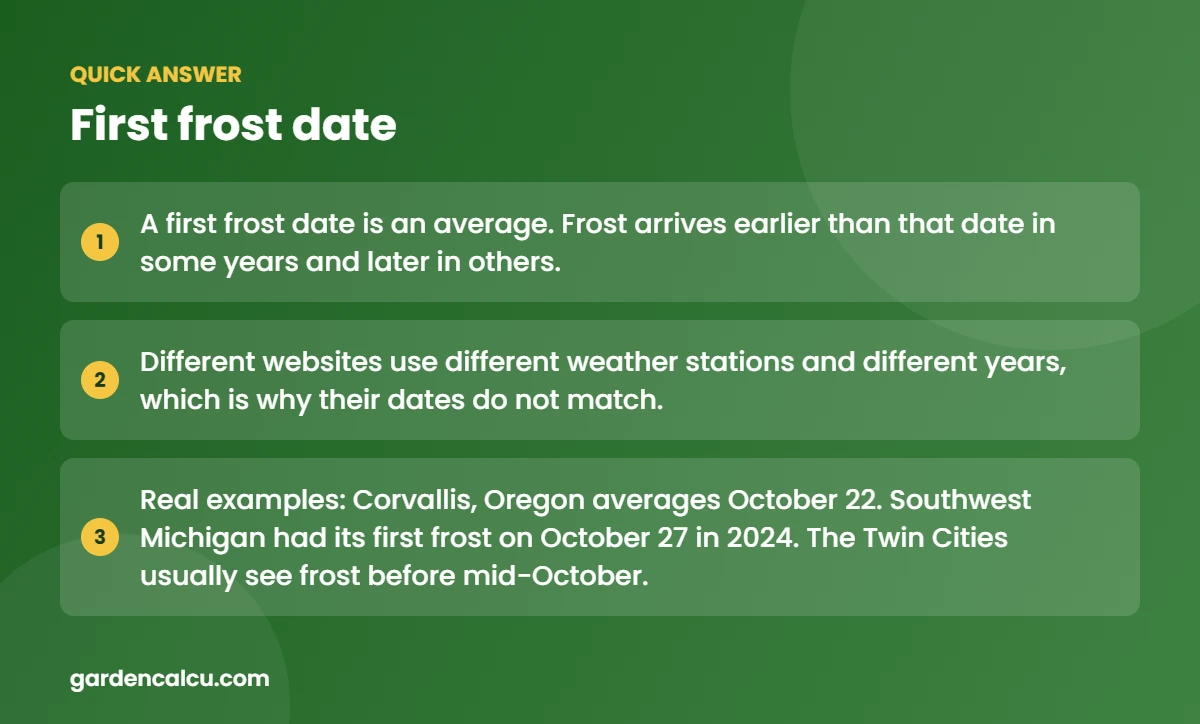
Quick answer to “first frost date” in three points.
Real questions gardeners asked
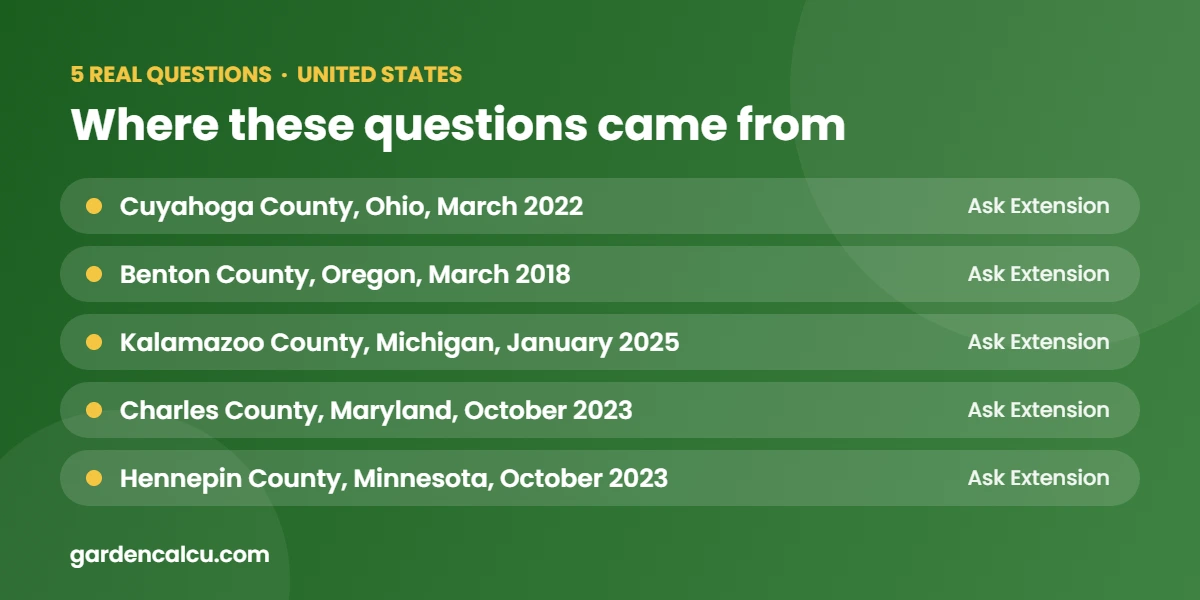
People look up their first frost date every fall, then write to Extension when the numbers do not agree. We read five of those questions and the replies. Here is each one in our own words, with a link to the original.
“Last spring / first fall frost dates”
The question: A Cleveland gardener had checked several websites and found a different frost date on each. He asked which one was real.
What the expert said: The Ohio State volunteer said it is a hard question, because a frost date is predicted from averages of past years and nature often delivers an unexpected cold snap. Two sites gave dates almost two weeks apart for the same city. Her advice was to take the middle, watch the forecast carefully and cover seedlings with a sheet if a cold night is coming.
“First and last frost date for Corvallis”
The question: A community gardener said the dates online were all over the place and asked for the approximate first and last frost dates for her part of Corvallis.
What the expert said: The expert gave April 28 as the average last frost and October 22 as the average first frost, and stressed the word average. Frost can come before the October date. Pay attention to local weather reports, keep row covers ready and keep plants watered, since dry roots are more easily hurt by cold.
“Frost Dates and Precipitation in Kalamazoo County”
The question: A gardener had found a sheet of last frost dates and asked when to expect the first fall frosts, and whether frost data for the last five years was available.
What the expert said: The expert said working out frost dates has become a guessing game as the climate shifts. In 2024 the last spring frost in southwest Michigan was around April 25 and the first fall frost was October 27. The dates are a predictor, not an exact day. She pointed to National Weather Service climate records for year-by-year data.
“Brussel Sprout transplants in October”
The question: A gardener with seedlings in the garage had looked up a first frost of November 1 and asked on October 19 whether to plant them out or give up until spring.
What the expert said: The expert said Brussels sprouts would not make a crop that late, but kale, spinach, arugula, hardy lettuces and Asian greens reliably overwinter under a floating row cover and regrow in spring.
“Too late to plant turf grass?”
The question: A homeowner asked on October 3 whether grass seed sown that week would have time to grow before frost.
What the expert said: The expert was hesitant. Over the years, he said, the first frost in the Twin Cities metro has come some time before mid-October, and nights in the high 30s were already forecast.
What a first frost date really means
A frost date is not a prediction for this year. It is the average of many past years at one weather station. In roughly half of all years, the first frost comes before that date, and in the other half it comes after.
That is why every expert above used the same word. The Oregon expert put average in capital letters. The Michigan expert called the dates a predictor of future frost conditions and not an exact date when the growing season is over.
Frost is also not one event. Gardeners usually talk about two thresholds:
A light frost can be survived with a cover. A hard freeze usually cannot. When you look up your first frost date, check which threshold the source is using.
Why websites give different frost dates
The Cleveland gardener found one site saying May 18 for the last spring frost and another giving May 21 to May 31. Fall dates vary in the same way. There are three reasons.
None of the sites is lying. They are answering slightly different questions. The Ohio volunteer’s advice is the practical one: take a date in the middle and watch the forecast.
5 ways to find your first frost date
Tip: Your yard has its own microclimate. Low spots where cold air settles frost first. Beds against a south-facing wall or under tree cover can stay frost-free a week or two longer.
First frost dates from real answers
These are the dates that came up in the Extension answers above. They show how much the date moves from one place to the next.
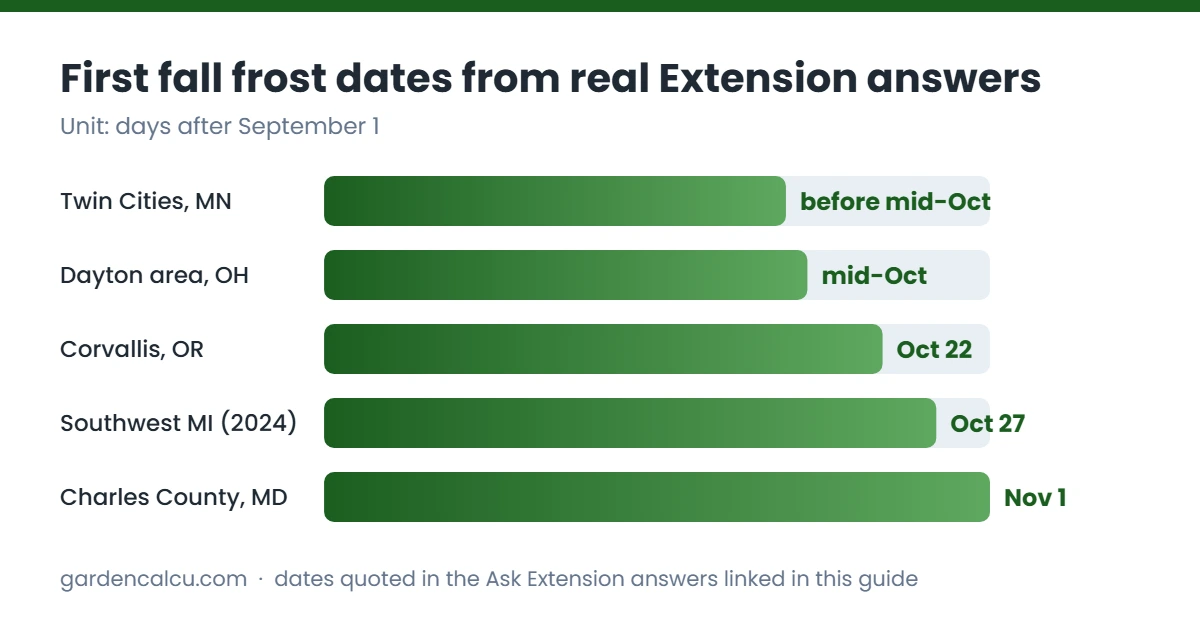
Chart for “first frost date”: first fall frost dates mentioned in the Extension answers above. Longer bars mean a later frost.
Place | First fall frost | Source |
|---|---|---|
Twin Cities, Minnesota | Before mid-October | Ask Extension, 2023 |
Dayton area, Ohio | Typically mid-October | Ask Extension, 2021 |
Corvallis, Oregon | October 22 (average) | Ask Extension, 2018 |
Southwest Michigan | October 27 (actual, 2024) | Ask Extension, 2025 |
Charles County, Maryland | About November 1 | Ask Extension, 2023 |
The Corvallis and Michigan answers also gave spring dates, which lets you measure the frost-free season. Corvallis runs from April 28 to October 22, about 177 days. Southwest Michigan in 2024 ran from April 25 to October 27, about 185 days.
How to use your first frost date to plan
The date is most useful when you count backwards from it. Every fall crop needs a certain number of days to mature, and those days have to fit before the frost for tender crops, or before a hard freeze for hardy ones.
Worked example: your first frost date is October 22 and you want a fall crop of spinach that takes 45 days. 45 + 14 = 59 days. Counting back 59 days from October 22 gives August 24. Sow by then.
The same sum explains the Maryland answer. With frost expected November 1 and seedlings just emerging on October 19, there were 13 days left. Brussels sprouts need months. The expert steered the gardener to hardy greens under cover.
If you are deciding what to plant in October, this countdown is the first thing to do. It also sets the cut-off when you plant grass seed in fall, since new grass needs about two months before winter.
Find your frost dates and planting windows
Open the planting calendar to see when frost usually arrives in your area and count back to find your last sowing dates.
What to do before the first frost
When the forecast shows a night near freezing, you have a day or two to act.
Watch out: A cover is not a guarantee. One Extension answer describes a gardener who lost covered tomatoes when the temperature fell to a record 22°F with wind for several hours. Covers help with a light frost. They do not save tender plants from a hard freeze.
Which crops survive a frost?
Crop | Reaction to a light frost | What to do |
|---|---|---|
Tomatoes, peppers, eggplant | Killed | Harvest or cover |
Beans, cucumbers, squash, basil | Killed | Harvest before frost |
Lettuce, Swiss chard | Some damage | Cover on cold nights |
Broccoli, cabbage | Tolerant once established | Leave in place |
Kale, spinach, arugula | Hardy, overwinter under cover in Maryland | Row cover for winter |
Carrots, parsnips, garlic | Hardy | Mulch the bed |
After the frost has taken the summer crops, clear the dead plants and cover bare soil. Shredded leaves as mulch are free at exactly this time of year.
Common mistakes with frost dates
Frequently asked questions
Short answers to the questions that come up most often.
Quick recap
Your first frost date is an average, so treat it as the middle of a window. Find it from the planting calendar, your state Extension or weather service records, and expect frost a week or two either side.
Count back from the date to set your last sowing days, harvest tender crops when a cold night is forecast, and keep a row cover handy for the plants you want to carry further into fall.
Plan around your frost date
Check the planting calendar for frost timing and planting windows, then work back from your first frost to see what still fits.
Related guides
Sources
The facts in this guide to “first frost date” come from these university Extension pages and public questions: