Protect Plants From Frost: 7 Easy Ways That Really Work
To protect plants from frost, cover them in the late afternoon before the temperature falls to about 30°F, make sure the cover reaches the ground and does not press on the leaves, and take it off the next morning after sunrise. Water the soil the day before, and bring pots indoors.
That routine saves tender plants from a light frost almost every time. It does not always save them from a hard freeze, and gardeners find that out the painful way. One Michigan gardener covered tomatoes with fabric rated to 20°F and found every plant dead the next morning.
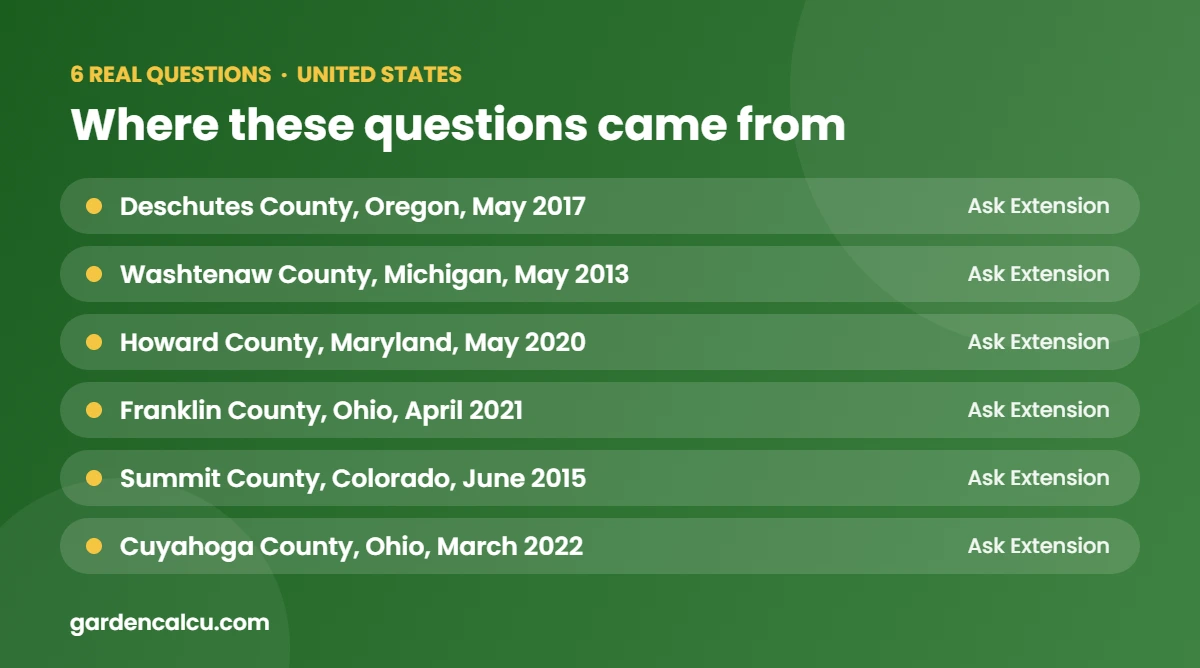
This guide is built from six real questions sent to university Extension services in Oregon, Michigan, Maryland, Ohio and Colorado. The experts explain what a cover can and cannot do, which crops need help and which can be left alone.
Key takeaways
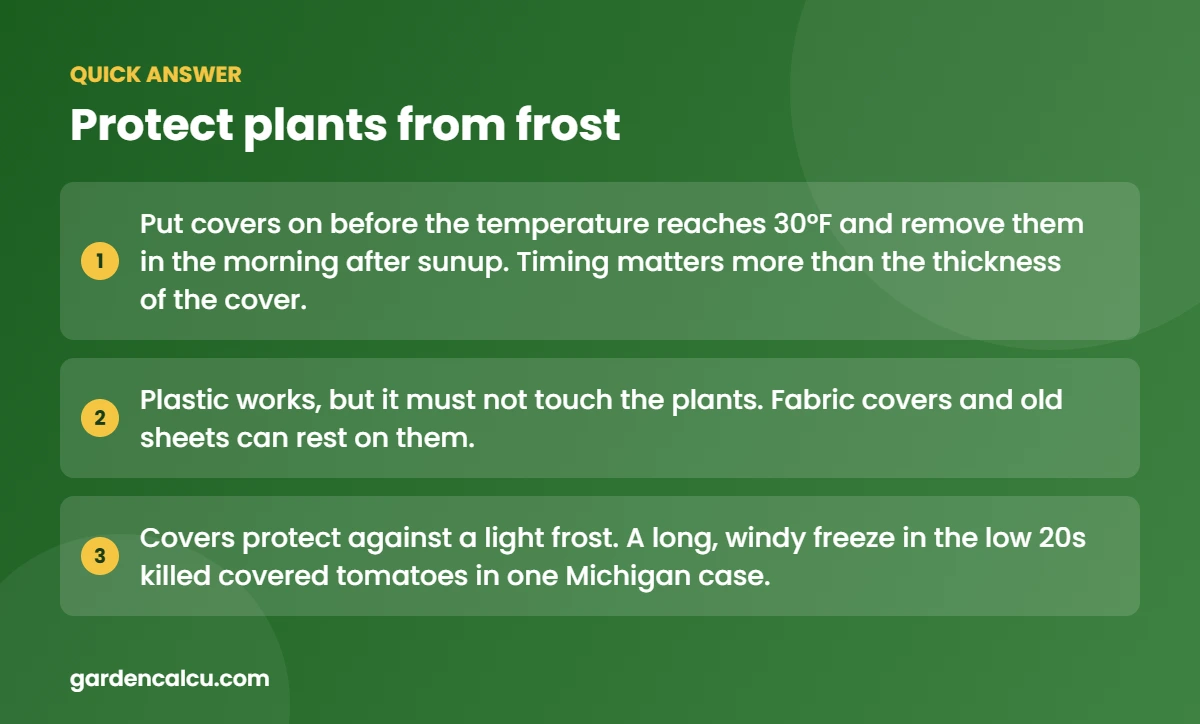
Quick answer to “protect plants from frost” in three points.
Real questions gardeners asked
People search for how to protect plants from frost twice a year, on the first cold night of fall and after planting too early in spring. We read six real questions asked on nights like those. Here is each one in our own words, with a link to the original.
“Tomato frost cover”
The question: A gardener in Bend, where it can freeze on summer nights, asked how to build a dome to protect tomatoes and how thick the plastic should be, or whether a freeze blanket is better.
What the expert said: The expert said the thickness of the plastic is less important than the timing. Put it over the plants before the temperature gets to 30 degrees and remove it in the morning after sunup. Do not let the plastic touch the plants. Commercial covers work, but cheap plastic does too. Weigh it down so it does not blow off overnight.
“Frost killed covered tomatoes”
The question: A gardener covered newly planted tomatoes with garden fabric said to protect to about 20 degrees, and kept more in a closed cold frame. By morning every plant was dead. Why?
What the expert said: The expert explained that the fabric’s rating was probably for ideal conditions. That night the freeze lasted several hours with winds over 10 miles an hour, and the airport recorded a record 22 degrees. Tomatoes and peppers are very sensitive to cold, and the weather had a lot to do with the failure.
“Late Frost Protection”
The question: With a forecast dip below freezing for a few hours and a “feels like” temperature of 26, a gardener asked what needed covering: young stone fruit trees that had set fruit, plus beets, broccoli, strawberries, lettuce, carrots, bush beans and garlic.
What the expert said: Cover the strawberry and bean plants, the expert said. The other crops should survive without protection, though with some cold injury, and younger plants are at greater risk. Small peach, apricot and plum fruits are injured below 32°F. The “feels like” temperature does not matter if the actual temperature is above 32°F. Cloud cover and a breeze can help limit injury.
“Fruit tree frost protection”
The question: With lows in the mid to low 20s forecast, a homeowner asked how to protect a sour cherry tree whose buds were just showing green.
What the expert said: The volunteer said the tree may come through without much damage while the buds are still tightly wrapped. According to a Michigan State University fact sheet, temperatures would need to drop into the teens for significant damage at that stage. Damage depends on how far the buds have opened.
“outdoor plant temperature”
The question: At 9,500 feet, with nights of 34 to 43 degrees, a gardener asked when new hanging baskets and annuals could stay out overnight.
What the expert said: The local rule is around mid-June, the expert said. If it gets cold enough to freeze the plant’s tissues, they rupture and the plant dies. Options are to harden plants off with a few cold hours at a time, cover them with plastic to create a greenhouse effect, or keep them inside until nights are warmer.
“Last spring / first fall frost dates”
The question: A Cleveland gardener asked how to deal with frost dates that differ from one website to the next.
What the expert said: Watch the forecast carefully, the volunteer said, and if seedlings are planted and a cold snap arrives, cover them with a sheet.
How frost damages plants
Frost injury is simple. Water inside the plant freezes, the ice crystals rupture the cells, and the tissue collapses when it thaws. The Colorado expert described it as the plant’s vascular system freezing and rupturing.
Plants from warm climates, such as tomatoes, peppers, beans, squash and basil, have no defence. Plants from cool climates, such as kale and spinach, have natural antifreeze and can survive ice on their leaves.
Covers work because the soil is a heat store. It warms during the day and releases heat at night. A cover that reaches the ground traps that heat around the plant. This is why a cover tied around the stem like a lollipop does nothing. It has to form a tent down to the soil.
7 ways to protect plants from frost
Fabric or plastic?
Cover | Good points | Watch out for |
|---|---|---|
Floating row cover (garden fabric) | Light, breathable, can stay on for days | Rated protection assumes calm conditions |
Bed sheets, blankets | Free, can rest on plants | Heavy when wet. Remove in the morning. |
Plastic sheeting | Cheap, blocks wind | Must not touch leaves. Remove after sunup. |
Buckets, pots, cloches | Quick for single plants | Take off in the morning |
Cold frame | Good for seedlings | Can still freeze inside on a very cold night |
The Oregon expert was firm that plastic must not touch the plants. Wherever plastic touches a leaf, cold passes straight through and the leaf freezes. Hold it up with hoops, stakes or tomato cages.
Tip: Double up on the coldest nights. A sheet directly over the plants with plastic over that, held off by hoops, traps more heat than either alone.
Which plants need covering?
You do not have to cover everything. The Maryland answer sorted a whole garden in two sentences: cover the strawberries and the beans, and leave the rest.
Plant | Light frost (29 to 32°F) | Action |
|---|---|---|
Tomatoes, peppers, eggplant, basil | Killed or badly damaged | Cover or harvest |
Beans, cucumbers, squash | Killed | Cover or harvest |
Strawberries in flower | Flowers damaged | Cover |
Annual flowers and hanging baskets | Damaged | Cover or bring in |
Peach, plum, apricot with small fruit | Fruit injured below 32°F | Cover small trees if possible |
Lettuce | Some injury | Cover if convenient |
Beets, broccoli, carrots, garlic | Usually fine | Leave |
Kale, spinach, Brussels sprouts | Hardy | Leave |
Age matters too. The Maryland expert said the younger and less established a plant is, the greater the risk. Seedlings set out last week are far more vulnerable than the same crop a month on.
Temperatures that matter
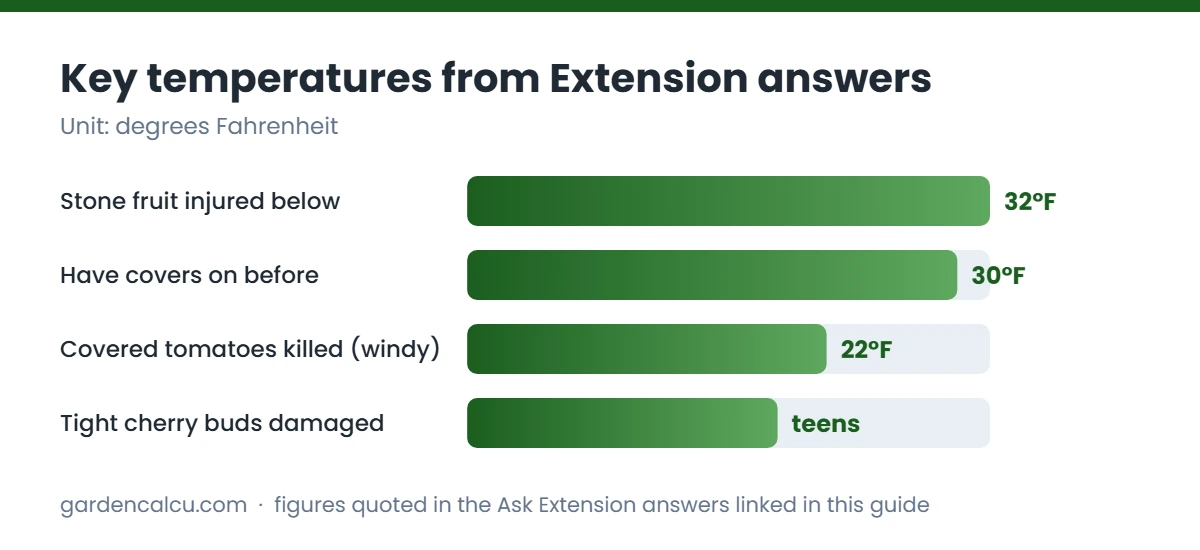
Chart for “protect plants from frost”: temperature thresholds mentioned by Extension experts.
These are the thresholds that came up in the Extension answers. They are not a complete scale, but they mark the points where the advice changes.
“Feels like” does not count
Weather apps show a wind chill or “feels like” figure. The Maryland expert cleared this up: it does not matter to plants if the actual air temperature is above 32°F. Wind chill describes how fast a warm body loses heat. A plant cannot be cooled below the real air temperature by wind.
Wind matters in a different way. It strips the warm air out from under a cover, which is part of what happened in Michigan. On a still, clear night, frost settles in low spots. Cloud cover and a light breeze actually reduce frost injury, as the Maryland expert noted.
Why covers sometimes fail
The Michigan gardener did almost everything right and still lost the tomatoes. The expert’s explanation is worth understanding.
Watch out: Treat any cover as a few degrees of help, not a guarantee. When a hard freeze in the low 20s is forecast, tender plants in the ground are unlikely to survive under fabric alone. Harvest what you can, or in spring, wait to plant.
The closed cold frame failed as well. In a very cold night, a small enclosed space loses its stored heat, and moisture inside can freeze on the plants.
Fall frost and spring frost
The method is the same in both seasons, but the goal differs.
Hardy greens are a separate case. In Maryland, kale, spinach and arugula overwinter under a row cover that stays on for months. See what to plant in October for that method.
Know when frost is likely
Open the planting calendar to see average frost dates for your area, so you can plant after the last spring frost and prepare for the first one in fall.
Protecting fruit trees and shrubs
Large trees cannot be covered, and usually do not need it. The Ohio answer shows why. A dormant or barely budding tree tolerates much colder temperatures than one in bloom. Tightly wrapped cherry buds can take temperatures down to the teens. Open blossoms and small fruit are injured just below freezing.
For a small tree in flower, a sheet or row cover thrown over the canopy and reaching the ground can save part of the crop. For a large one, there is little a home gardener can do, and as the Maryland expert put it, if you are lucky the cold will just thin the excess fruit for you.
Common mistakes
Frequently asked questions
Short answers to the questions that come up most often.
Quick recap
To protect plants from frost, cover tender crops before the temperature reaches 30°F, seal the cover to the ground, keep plastic off the leaves and uncover after sunrise. Water the day before and bring pots inside.
Covers add a few degrees. They beat a light frost and often lose to a hard, windy freeze, so harvest what you cannot afford to lose.
Plan around frost
Check the planting calendar for frost timing in your area and set your planting and harvest dates around it.
Related guides
Sources
The facts in this guide to “protect plants from frost” come from these university Extension pages and public questions: