How Many Tomatoes Per Plant? 8 to 20 Pounds and 7 Easy Tips
How many tomatoes per plant should you expect? University yield charts put a healthy garden tomato at about 8 to 20 pounds over the season. The University of Maine uses 8 pounds per plant as its average. Cornell gives 10 to 20 pounds per plant for staked tomatoes. For a medium slicing tomato that works out to roughly 20 to 80 fruits.
Your own number can land well outside that range. A cherry tomato may give hundreds of small fruits. A giant beefsteak may give a dozen. And a plant with too little sun, uneven water or a heat wave at flowering time may give almost nothing while still looking lush and green, which is the complaint Extension experts hear most.
This guide combines the published yield figures with real questions from gardeners in Minnesota, Ohio, New Hampshire, Texas and Colorado. You will see what a normal harvest looks like, how many plants you need for fresh eating or canning, and seven things the experts say make the difference.
Key takeaways
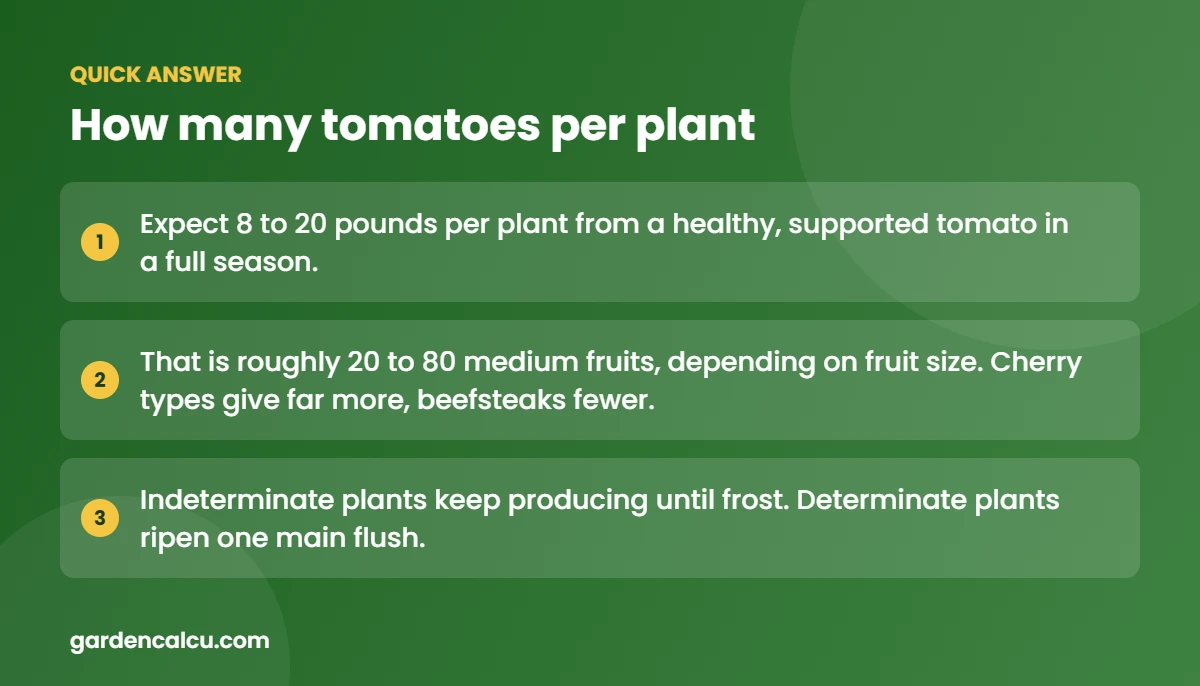
Quick answer to “how many tomatoes per plant” in three points.
Real questions gardeners asked
These are real questions sent to Ask Extension, the free service run by US land-grant universities. Each card shows where and when the gardener asked, and links to the full answer.
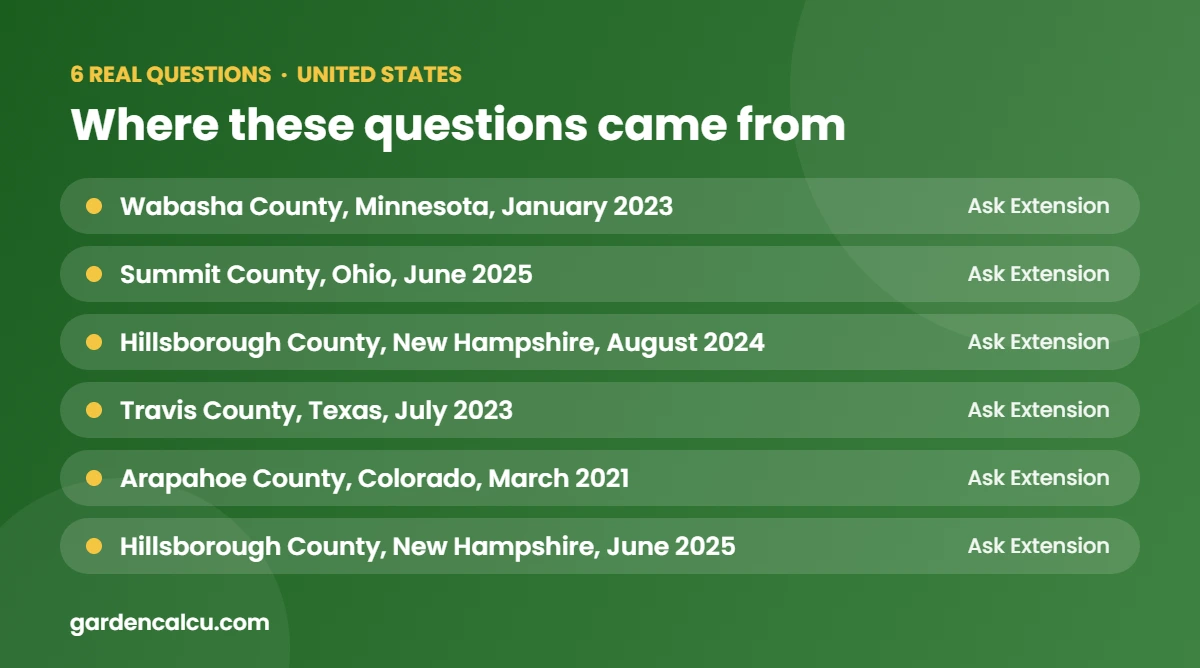
“Lots of vegetation, low fruit production”
The question: I have two sources of frustration with tomatoes in my home garden: late harvest, and profuse vegetation with seemingly low fruit production.
What the expert said: The expert recommended a soil test, staking the plants in place of the netting the gardener was using, and choosing shorter-season varieties that mature in 65 to 70 days in place of heirlooms needing 80 or more days to maturity.
“How do I get bigger tomatoes?”
The question: Is there something I can do to get larger tomatoes from my tomato plants?
What the expert said: The expert asked which varieties were being grown, then listed the basics: a minimum of 6 hours of direct sunlight per day, 1 to 1.5 inches of water per week, mulch and a soil test. Tomatoes are heavy feeders and respond well to fertilizer. For the gardener’s Early Girl, an indeterminate hybrid, normal fruit size is 4 to 6 ounces, and pruning side suckers was advised.
“Planted July 2: when will I harvest?”
The question: I planted some tomato plants on July 2nd. When should I expect to harvest them?
What the expert said: A University of New Hampshire Extension specialist explained that the harvest date depends on the variety. Each variety has a different expected number of days to harvest, ranging from 60 to 100 days. The seed packet or catalog listing gives the number.
“Flowering in the heat but setting no fruit”
The question: I currently have one cherry and 2 Sun Gold tomato plants that are healthy and growing in the Texas heat (zone 8b). They are growing tall and healthy and due to the heat they are flowering but not setting fruit. I’ve heard people say that you can baby a tomato plant and get another crop in the fall.
What the expert said: The expert said the first step is to know whether the plants are determinate or indeterminate. Determinate plants need to be replaced to get a fall crop. Indeterminate types should continue producing until frost if they are kept fertilized, watched for pests and watered, possibly daily, through the hot period.
“Five years of poor results in pots”
The question: I have been here 5 years and have yet to have good results with tomatoes. I grow them in pots. This year I will use 10 gallon pots. Is there a particular variety I should use here?
What the expert said: The expert said it is quite possible to grow tomatoes in containers, with fresh potting soil each year and 6 to 8 hours of sun. If daytime temperatures are above 90 degrees by 10 am, plants may drop their blossoms. Fertilizing every 2 to 4 weeks until fruit sets was advised, along with varieties such as Celebrity, Sweet 100 and Sun Gold.
“Six plants and conflicting advice”
The question: I am growing 6 tomato plants for the first time, in a community garden. There is so much conflicting information about growing tomatoes. Especially about pruning suckers or not and the best support for them. What is your advice?
What the expert said: The expert’s key recommendation was to give the tomato foliage plenty of space for air flow, as that prevents disease from spreading. The reply also suggested recording the yield of each variety to guide next year’s choices, and to relax and have fun with it.
How Many Tomatoes Per Plant: The Published Numbers
Two university charts give yield per plant directly. They were written for northern gardens, so they are a fair baseline for most of the country.
Source | Yield per plant | Notes |
|---|---|---|
University of Maine Cooperative Extension | 8 lb | Average yield in its home garden planting chart |
Cornell Cooperative Extension | 10 to 20 lb | Staked tomatoes, 18 inches apart |
Cornell, per 10 ft of row | 70 to 140 lb | About 6 to 7 staked plants |
The gap between 8 and 20 pounds is not a contradiction. It reflects how the plant is grown. A sprawling plant in an average year sits near the low end. A staked, well-fed indeterminate plant picked from July to frost reaches the high end.
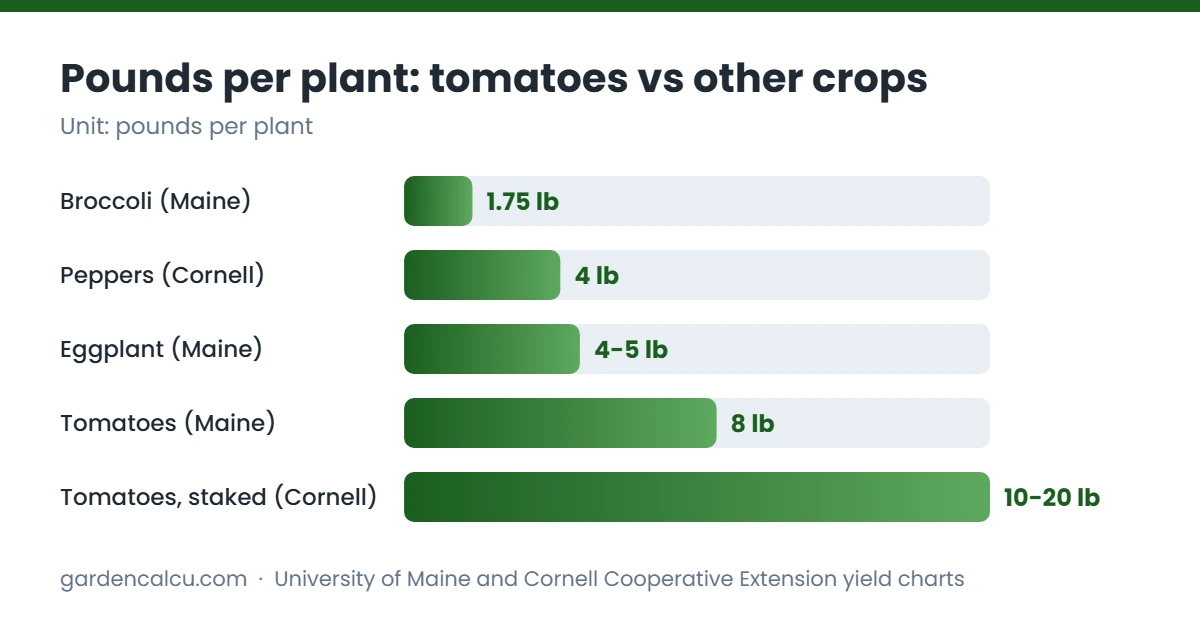
Average yield per plant from the University of Maine planting chart and Cornell Cooperative Extension’s expected yield table. The mid-point is plotted for ranges.
The chart also shows why tomatoes earn their space. Per plant, they outproduce peppers, eggplant and broccoli several times over.
From Pounds to Tomatoes
To turn pounds into a fruit count, divide by the weight of one tomato. The Ohio expert noted that Early Girl, a very common variety, produces fruit of 4 to 6 ounces.
Yield per plant | At 6 oz per fruit | At 4 oz per fruit |
|---|---|---|
8 lb | About 21 tomatoes | About 32 tomatoes |
10 lb | About 27 tomatoes | About 40 tomatoes |
15 lb | About 40 tomatoes | About 60 tomatoes |
20 lb | About 53 tomatoes | About 80 tomatoes |
The same weight splits very differently by type. Fifteen pounds of one-pound beefsteaks is 15 fruits. Fifteen pounds of half-ounce cherry tomatoes is close to 500. When someone asks how many tomatoes per plant, the honest reply is another question: which kind?
Determinate or Indeterminate Changes Everything
The Texas expert started with this question for a reason. The two growth habits produce on completely different schedules. University of Illinois Extension describes them this way: determinate tomatoes set fruit at the ends of their branches and stop growing in height once buds are set, while indeterminate tomatoes keep growing, set fruit along the stem, and keep producing throughout the growing season.
Trait | Determinate (bush) | Indeterminate (vining) |
|---|---|---|
Harvest pattern | One main flush over a few weeks | Steady picking until frost |
Total yield | Lower per plant | Higher per plant over a long season |
Support | Short cage or stake | Tall stake, cage or trellis |
Best for | Canning a batch, small spaces, pots | Fresh eating all summer |
After the flush | Replace for a fall crop | Keep feeding and watering |
That last row comes straight from the Texas answer. Determinate plants need to be replaced to get a fall crop, while indeterminate plants should continue producing until the frost. If your plant gave one good picking and stopped, it may simply be a determinate variety doing its job.
How Long Until the First Tomato?
Yield depends on how many weeks the plant has to ripen fruit, so days to maturity matters as much as care. The New Hampshire specialist gave the range: 60 to 100 days from transplanting, depending on the variety.
In a short season, a 60-day tomato may ripen fruit for two months, while a 100-day tomato ripens for two weeks. That was the Minnesota expert’s point in recommending 65 to 70 day varieties over heirlooms that need 80 or more days. The gardener’s plants were healthy. They were just running out of summer. Our comparison of heirloom vs hybrid seeds explains how to read those packet numbers.
The New Hampshire gardener who planted on July 2 shows the cost of a late start. A 70-day variety would begin ripening around mid-September, only weeks before frost in that state. Start on time with the dates in when to start seeds indoors.
7 Easy Ways to Get More Tomatoes Per Plant
Tip: Follow the New Hampshire expert’s suggestion and keep a tally. Weigh or count what you pick from each variety. After one season you will know your own number, and which varieties earn a place next year.
Estimate Your Tomato Harvest
Enter your number of plants or row length. The free Harvest Yield Calculator estimates how many pounds to expect, so you can plan for canning and fresh eating.
Why a Big, Green Plant Makes Few Tomatoes
The Minnesota gardener’s description, profuse vegetation with low fruit production, is the classic sign of a plant that is growing but not fruiting. The experts in these answers pointed to several causes.
A soil test settles the fertilizer question quickly. The Minnesota expert put the cost at about $17. See how to read a soil test.
Watch out: Do not respond to poor fruit set with more fertilizer. In a heat wave the plant cannot use it, and extra nitrogen makes the leaf problem worse.
Tomatoes in Pots Yield Less, but Still Plenty
Container plants have less root room, so expect the lower end of the range. The Colorado expert was encouraging all the same: it is quite possible to grow tomatoes in containers. The basics were fresh potting soil each year, a large pot (the gardener was moving up to 10 gallons), 6 to 8 hours of sun, and feeding every 2 to 4 weeks until fruit sets.
A Minnesota Extension volunteer advising on Sungold cherry tomatoes in a planter gave a minimum of a five-gallon pot, 12 to 15 inches tall and at least a foot across, and warned that irregular watering makes the fruit crack. In midsummer, pots may need water every day.
How Many Plants Do You Need?
Work backward from what you want to do with the harvest.
Goal | Pounds needed | Plants at 8 lb each | Plants at 15 lb each |
|---|---|---|---|
Fresh eating for two, about 2 lb a week for 8 weeks | 16 lb | 2 | 1 to 2 |
Fresh eating for a family of four | About 32 lb | 4 | 2 to 3 |
One bushel for canning | 53 lb | 7 | 4 |
Two bushels for sauce | 106 lb | 13 to 14 | 7 to 8 |
The bushel figure comes from an Ask Extension canning answer: a bushel of tomatoes weighs 53 pounds. The same answer notes that one pound of tomatoes yields about 1 cup of pulp after peeling and seeding, so a bushel gives roughly 53 cups, a little over 13 quarts.
For fresh eating, plant a mix: one early variety, one or two main-season slicers and a cherry. For canning, determinate paste tomatoes ripen together, which is what you want on processing day. Our tomato planting guide covers planting depth and spacing.
Frequently asked questions
Short answers to the questions that come up most often.
Quick recap
So, how many tomatoes per plant? Plan on 8 pounds as a safe average and up to 20 pounds from a staked, well-tended indeterminate plant, or roughly 20 to 80 medium tomatoes. Fruit size and growth habit swing the count more than anything else.
To push your plants toward the top of that range, give them full sun, an inch or more of water every week, a sturdy stake, room to breathe and a variety that fits your season. Then keep a tally, so next year you know your own number.
Get your exact number
Estimate your harvest in pounds with the free Harvest Yield Calculator.
Related guides
Sources
The facts in this guide to “how many tomatoes per plant” come from these university Extension pages and public questions: