How Big Should a Vegetable Garden Be? 5 Easy Size Rules
How big should a vegetable garden be? For a first garden, University of Maryland Extension gives a clear number: a good starter garden size is 25 to 50 square feet. That is one or two small beds. A household that wants a steady supply of fresh vegetables all summer usually ends up with 100 to 400 square feet of actual planting space, and only people who can and store a lot need more.
Most new gardeners guess too big. A 30 by 50 foot plot looks modest on paper and feels enormous in July, when every square foot needs weeding and watering. Others go too small, plant six tomatoes in a 4 by 4 bed, and wonder why nothing thrives. The right size depends on what you want to harvest and how much time you have, not on how much lawn is available.
The questions below came from gardeners in Michigan, Vermont, Minnesota, Colorado and Ohio who were laying out new gardens. Their plans ranged from two beds to 5,000 square feet. The Extension answers, along with Cornell’s yield figures, show how to size a garden that feeds you without wearing you out.
Key takeaways
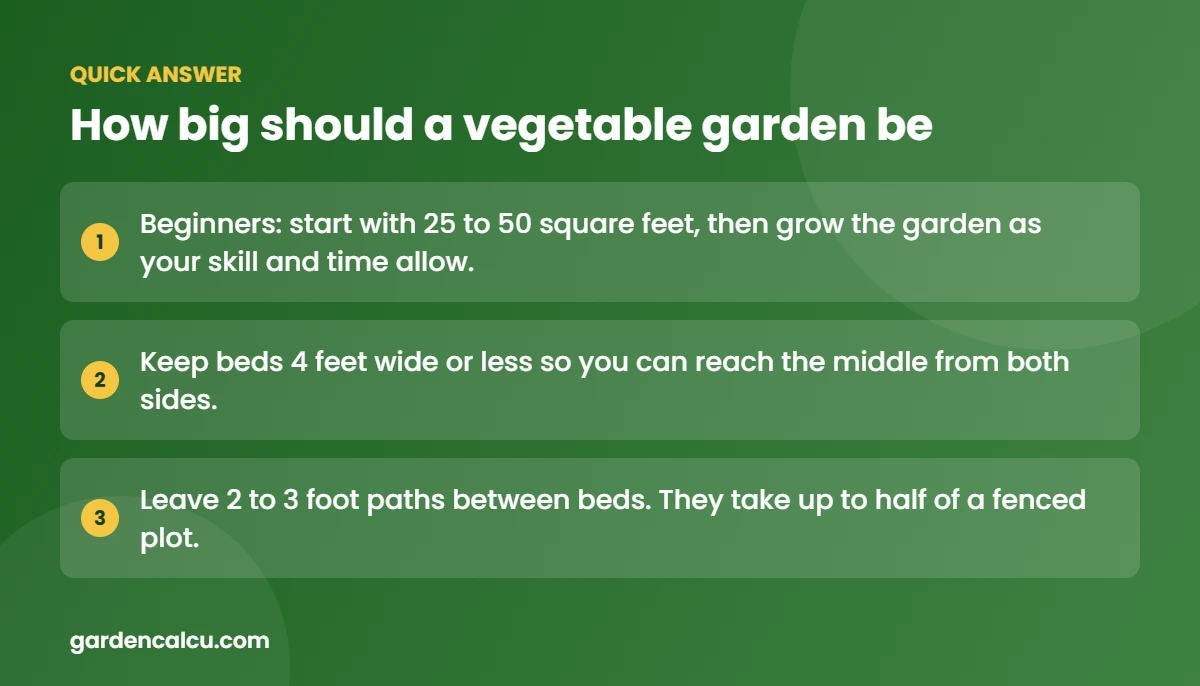
Quick answer to “how big should a vegetable garden be” in three points.
Real questions gardeners asked
These are real questions sent to Ask Extension, the free service run by US land-grant universities. Each card shows where and when the gardener asked, and links to the full answer.
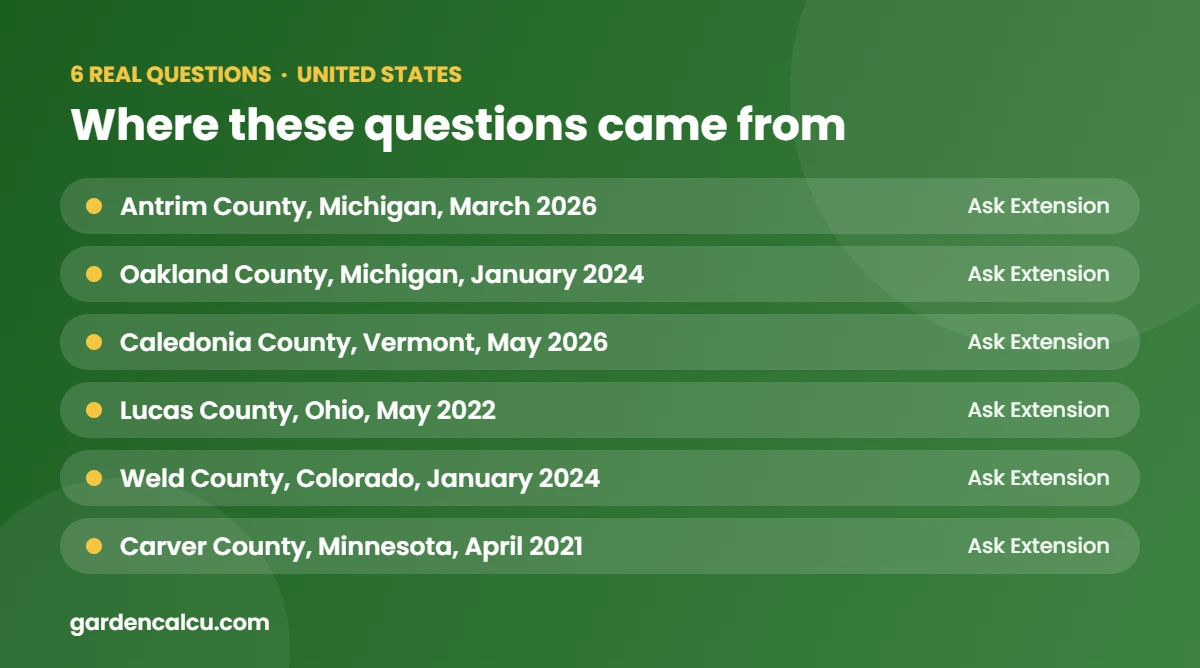
“Laying out a 30 x 50 foot fenced garden”
The question: I have a 30×50 area that I am fencing off for a raised bed garden. Wondering if you could help with bed size, bed layout and crop placements design.
What the expert said: The expert suggested beds 4 feet wide and 4 to 12 feet long, 12 to 18 inches high, running north to south. In a 30 by 50 foot space you can fit six to eight beds with 2 to 3 foot wide paths between them. Taller plants go on the north side of beds so they do not shade smaller ones.
“Planning twelve 4 x 8 beds”
The question: I am planning for a vegetable garden (twelve 4 x 8 beds) and am having trouble finding clear advice on how to start seeds. Finding enough room inside near a window or growing with lights indoors isn’t ideal for us.
What the expert said: An expert who had raised vegetable transplants in the same county for more than 20 years was frank that it is not a simple or inexpensive task to get strong transplants for a garden that size. A big garden multiplies every job, including the seed starting that happens before a single bed is planted.
“Twelve raised beds in a 40 x 40 foot space”
The question: A gardener in eastern Vermont had about 40 by 40 feet for twelve raised beds, each 4 by 8 feet and 16 inches deep, six for perennial crops and six for annuals. He asked how to orient them, with hills blocking morning sun and trees limiting evening light.
What the expert said: A University of Vermont Extension Master Gardener said north to south was the way to go for that site, and that 16 inches should be plenty of depth for most plants. The reply added that orienting beds for yield is not as important as many online resources suggest. Working comfort matters more.
“Best way to build a raised vegetable garden”
The question: Suggestions requested on the best way to construct a raised vegetable garden. Remove the grass first? How high? We have clay soil in Sylvania, OH.
What the expert said: The expert said a depth of 8 to 12 inches is typical, and that four feet is the maximum width you would want, as that allows you to reach the middle of the bed from both sides. You do not need to kill the grass first. Cardboard or a few sheets of newspaper under the bed is enough.
“Two 6 x 8 beds and thirteen crops”
The question: A gardener had installed two raised beds, each 6 by 8 feet, with drip irrigation. She wanted to grow lettuce, radish, spinach, cucumber, carrots, bell peppers, green onions, peas, tomatoes, broccoli, beans, garlic and parsley, and asked for a planting layout.
What the expert said: Weld County Master Gardeners replied that raised beds are an excellent way to manage soil and that a drip system can reduce water needs by up to 50 percent. They recommended a soil test before amending and pointed to a sample planting guide for raised beds with timing and spacing.
“A 50 x 100 foot vegetable and herb garden”
The question: A gardener planning a 50 by 100 foot vegetable and herb garden asked an expert to review the layout, with questions about crop rotation, irrigation and where to place herbs.
What the expert said: An Extension Master Gardener recommended organizing the crops into three rotation groups: tomatoes, potatoes, peppers and eggplant; melons, squash and cucumbers; and a third group of peas, beans, greens, beets and onions. Watering was advised in the morning and at the base of the plants.
How Big Should a Vegetable Garden Be? Start With the Real Numbers
It helps to see what real people build. These are garden sizes mentioned in Ask Extension questions, next to the University of Maryland starter figure.
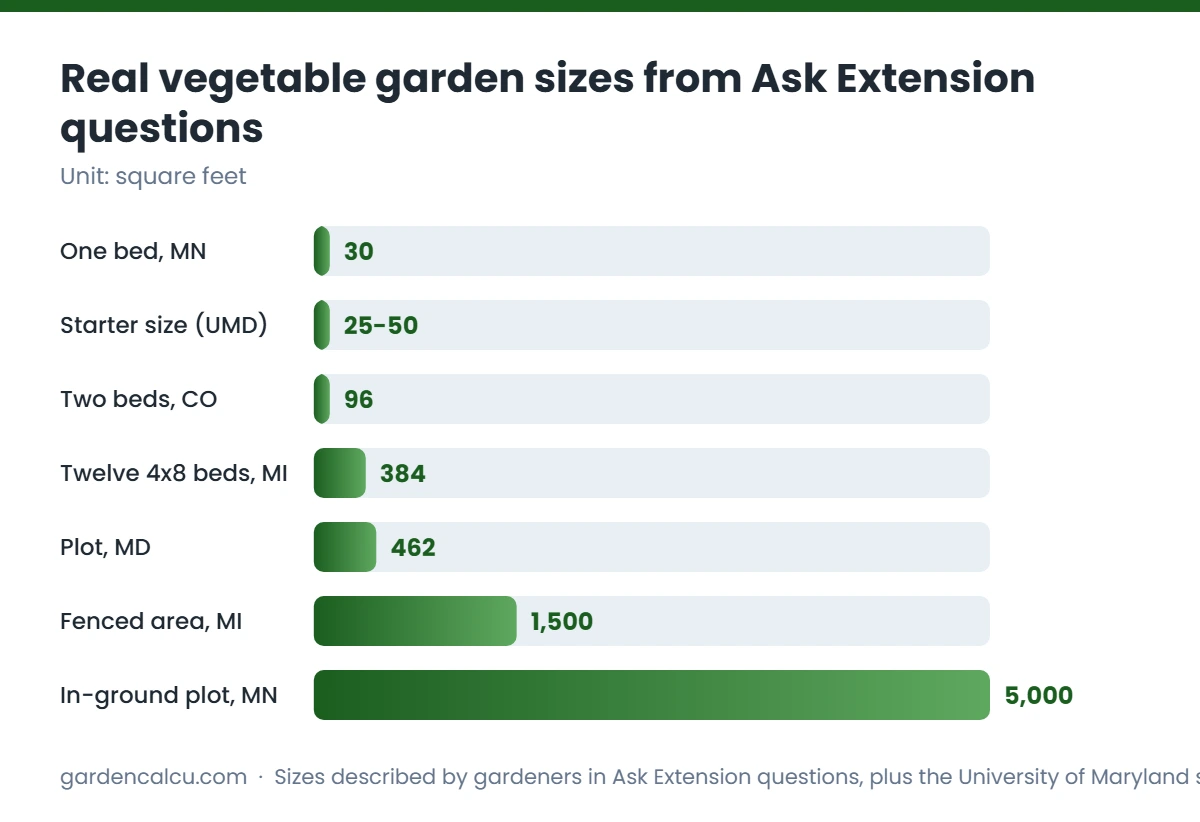
Garden sizes described in Ask Extension questions from Minnesota, Colorado, Michigan and Maryland, compared with the 25 to 50 square foot starter garden recommended by University of Maryland Extension.
Garden | Dimensions | Total area |
|---|---|---|
One raised bed (Hennepin County, MN) | 7.5 x 4 ft | 30 sq ft |
Starter garden (University of Maryland) | For example 4 x 8 ft | 25 to 50 sq ft |
Two raised beds (Weld County, CO) | Two 6 x 8 ft | 96 sq ft |
Twelve raised beds (Oakland County, MI) | Twelve 4 x 8 ft | 384 sq ft of beds |
Garden plot (Howard County, MD) | 22 x 21 ft | 462 sq ft |
Fenced raised bed area (Antrim County, MI) | 30 x 50 ft | 1,500 sq ft |
In-ground plot (Carver County, MN) | 50 x 100 ft | 5,000 sq ft |
The spread is huge, from a single bed to a plot the size of a small house lot. None of these is wrong. But notice that the two largest gardens came with questions about managing the work: rotation, irrigation and layout. And the gardener with twelve beds had already hit a practical limit before planting anything, with nowhere to start that many seedlings.
Rule 1: Start Small
University of Maryland Extension’s advice is plain: a good starter garden size is 25 to 50 square feet. One 4 by 8 foot bed is 32 square feet. Two of them is 64.
The reason is time. The same guide notes that vegetable gardens require at least a small amount of daily attention. Weeding, watering, tying up, checking for pests and picking all scale with area. A small garden kept well will out-yield a large one that gets away from you by midsummer.
A first-year bed of that size can hold a surprising amount. Maryland lists the easiest crops to manage as bush beans, tomatoes, cucumbers, peppers, lettuce, summer squash and leafy greens. Two tomato plants, two peppers, a short row of beans and a block of lettuce fit comfortably in 32 square feet.
Tip: Plan the garden you want in three years, but build one third of it this year. Leave room to add beds. Expanding a garden you love is easier than rescuing one that overwhelmed you.
Rule 2: Size the Beds to Your Arms
However much area you choose, the shape matters more than the total. Three separate experts gave the same limit.
Source | Bed width | Other dimensions |
|---|---|---|
Ask Extension, Lucas County, Ohio | 4 feet maximum | 8 to 12 inches deep is typical |
Ask Extension, Coshocton County, Ohio | 4 feet or less | Most beds are between 4 x 4 and 4 x 8 feet |
Ask Extension, Antrim County, Michigan | 4 feet | 4 to 12 feet long, 12 to 18 inches high |
Four feet is the widest bed an adult can tend from both sides without stepping in. If a bed sits against a fence or wall and can be reached from one side only, make it 2 to 3 feet wide. Length is flexible. Longer beds mean fewer corners to build, but more walking to get around them.
For depth, see how deep should a raised bed be. To fill the beds, the Raised Bed Soil Calculator gives the cubic feet and bags you need.
Rule 3: Count the Paths
Paths are the part of garden size that people forget. The Michigan expert laid it out for the 30 by 50 foot space: six to eight beds with 2 to 3 foot wide paths between them.
Work that through. Eight beds of 4 by 12 feet is 384 square feet of planting area inside a 1,500 square foot fence. Even with more or longer beds, a raised bed layout rarely plants much more than half of the fenced area. The Vermont gardener’s plan was similar: twelve 4 by 8 beds, 384 square feet of soil, in a 1,600 square foot space.
So when you ask how big should a vegetable garden be, decide whether you mean planting area or total footprint. A family that needs 200 square feet of beds should set aside roughly 400 square feet of yard.
Rule 4: Size by What You Want to Harvest
This is where a yield chart earns its keep. Cornell Cooperative Extension publishes expected yields for garden vegetables per 10 feet of row.
Crop | Expected yield per 10 ft of row | Space between rows |
|---|---|---|
Tomatoes, staked | 70 to 140 lb | 48 in |
Peppers | 30 lb | 36 in |
Potatoes | 20 to 30 lb | 36 in |
Cabbage | 15 lb | 24 in |
Beets | 12 lb | 12 in |
Broccoli | 12 lb | 24 in |
Peas | 10 lb | 12 in |
Bush beans | 8 lb | 24 in |
Carrots | 8 lb | 12 in |
Spinach | 5 lb | 12 in |
The differences are striking. Ten feet of staked tomatoes can give more than ten times the weight of ten feet of beans. If your goal is fresh tomatoes, peppers and salad for two people, a couple of 4 by 8 beds will do it. If you want a winter’s worth of potatoes, beans for the freezer and tomatoes for sauce, you need rows, and plenty of them.
A quick way to plan:
For example, 50 pounds of potatoes needs about 20 to 25 feet of row. A bushel of canning tomatoes, 53 pounds, needs well under 10 feet of staked plants. Our guides on how many potatoes per plant and how many tomatoes per plant go through the math crop by crop.
See How Much Your Garden Will Produce
Enter your beds or row lengths. The free Harvest Yield Calculator estimates the pounds of vegetables to expect, so you can size the garden to your household.
Rule 5: Let Sun and Water Decide the Location and the Limit
A big garden in the wrong place is worse than a small one in the right place. Maryland’s requirement is that the garden be on level ground in an area that gets at least 6 hours, ideally more, of full sun a day. An Oregon Extension answer about bed layout said to look for as much full sunlight as possible, ideally eight hours or longer during the growing season.
If only a 10 by 12 foot patch of your yard gets that much sun, then that is how big your vegetable garden should be, at least for fruiting crops. Leafy greens and herbs tolerate a little less light and can go in the dimmer spots.
Water matters too. A garden needs about an inch of water a week, and a hose that will not reach is a garden that will not get watered. The Colorado Master Gardeners noted that a drip system can reduce water needs by up to 50 percent, which is worth knowing before you size up.
Watch out: Check the sun in the season you will be growing, not in March. Trees that are bare in spring can put half a garden in shade by June.
Sample Garden Sizes
Who it suits | Planting area | Example layout | Total footprint with paths |
|---|---|---|---|
First-time gardener | 25 to 50 sq ft | One 4 x 8 bed, or a few large containers | About 6 x 10 ft |
Fresh vegetables for two | About 64 sq ft | Two 4 x 8 beds | About 10 x 12 ft |
Fresh vegetables for a family of four | 130 to 200 sq ft | Four to six 4 x 8 beds | About 16 x 20 ft to 20 x 24 ft |
Fresh eating plus some canning and freezing | About 400 sq ft | Twelve 4 x 8 beds | About 30 x 30 ft |
Serious food production | 1,000 sq ft and up | In-ground rows | A 30 x 50 ft plot or larger |
These are planning examples, not rules. They follow from the bed and path dimensions the experts gave and from the real gardens above. The right row for you depends on how much you eat fresh, how much you preserve, and how many hours a week you want to spend out there.
Raised Beds or In-Ground Rows?
Size and style go together. Under about 400 square feet of planting area, raised beds are tidy, productive and easy on the back. As the Colorado answer put it, raised beds are an excellent way to manage soil content. Above that, the cost of lumber and soil climbs fast, and most large gardens switch to in-ground rows, as the 50 by 100 foot Minnesota garden did.
In-ground gardens need wider spacing between rows for walking and for a tiller or wheel hoe, which is why Cornell’s row spacings above run from 12 to 48 inches. Whichever you choose, rotate crop families from bed to bed each year. The Minnesota expert’s three groups are an easy system for any size garden.
If you are converting lawn, you do not need to dig it out. Two of the Ohio and Maryland answers said cardboard or newspaper under a new bed is enough to kill the grass. See cardboard to kill grass.
When to Make It Bigger
Add space when the garden you have is under control and still not giving you enough of something. Good signs:
If any of those is missing, improve the beds you have first. Better soil, mulch and succession planting often raise the harvest more than extra square feet. A soil test is the cheapest place to start. See how to read a soil test.
Frequently asked questions
Short answers to the questions that come up most often.
Quick recap
How big should a vegetable garden be? Big enough to grow what you will eat and small enough to look after. For a first garden that means 25 to 50 square feet. For a household that wants fresh vegetables all season, a few hundred square feet of beds, kept 4 feet wide with 2 to 3 foot paths, in a spot with at least 6 hours of sun.
Use the yield per 10 feet of row to size the garden to your own table, and remember that paths roughly double the footprint. Then start a little smaller than you think you need. You can always add a bed next spring.
Get your exact number
Estimate your harvest by bed or row with the free Harvest Yield Calculator.
Related guides
Sources
The facts in this guide to “how big should a vegetable garden be” come from these university Extension pages and public questions: