How Long Do Seeds Last? 9 Crop Lifespans and an Easy Test
How long do seeds last? Most vegetable and flower seeds stay good for one to five years, and the number depends far more on the crop and on where the packet spent the winter than on the date stamped on the envelope. Onion and parsley seed fade after about a year. Tomato, squash, lettuce and broccoli seed often sprout well four or five years later.
That gap is why this question fills Extension inboxes every spring. Somebody finds a shoebox of half-used seed packets, or a bag left in a freezing garage, or a packet that arrived in the mail already stamped with last year’s date. They want to know one thing before they waste a planting window: will these old seeds come up?
Below are real questions from gardeners in Minnesota, Oregon, Maryland, Pennsylvania and Georgia, with the answers that Extension experts gave them. You will also find a shelf life chart by crop, the easy 10-seed germination test, and the simple math for sowing heavier when your seeds are getting old.
Key takeaways
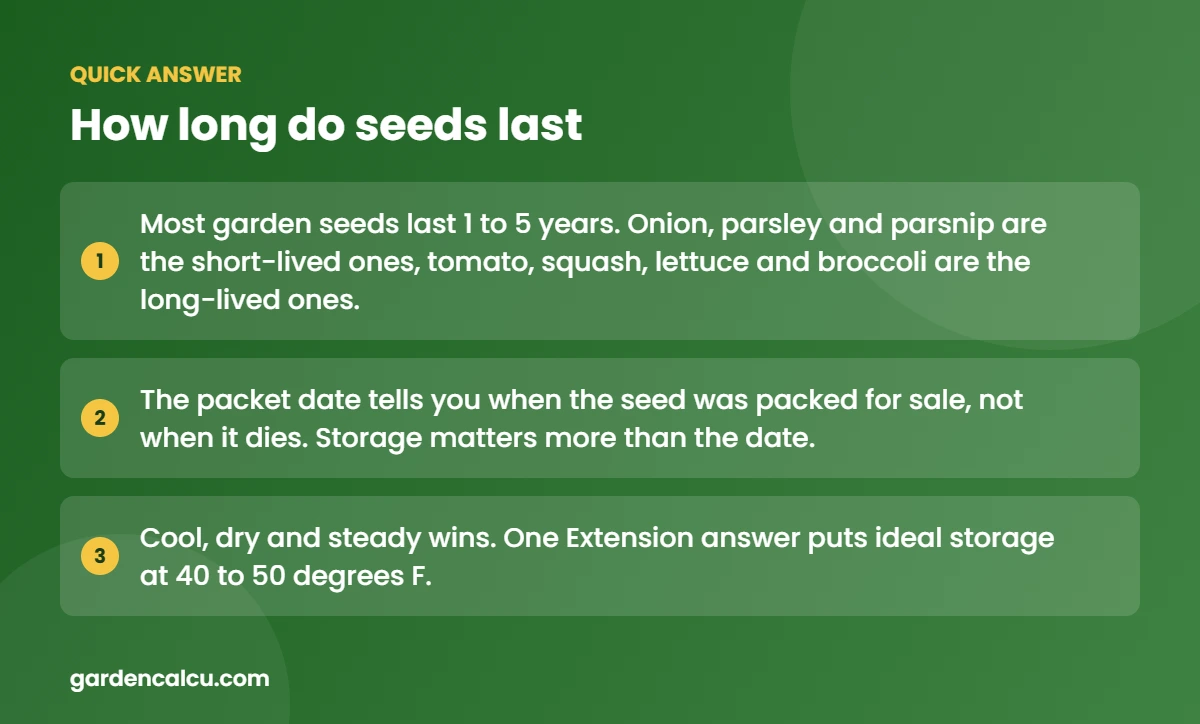
Quick answer to “how long do seeds last” in three points.
Real questions gardeners asked
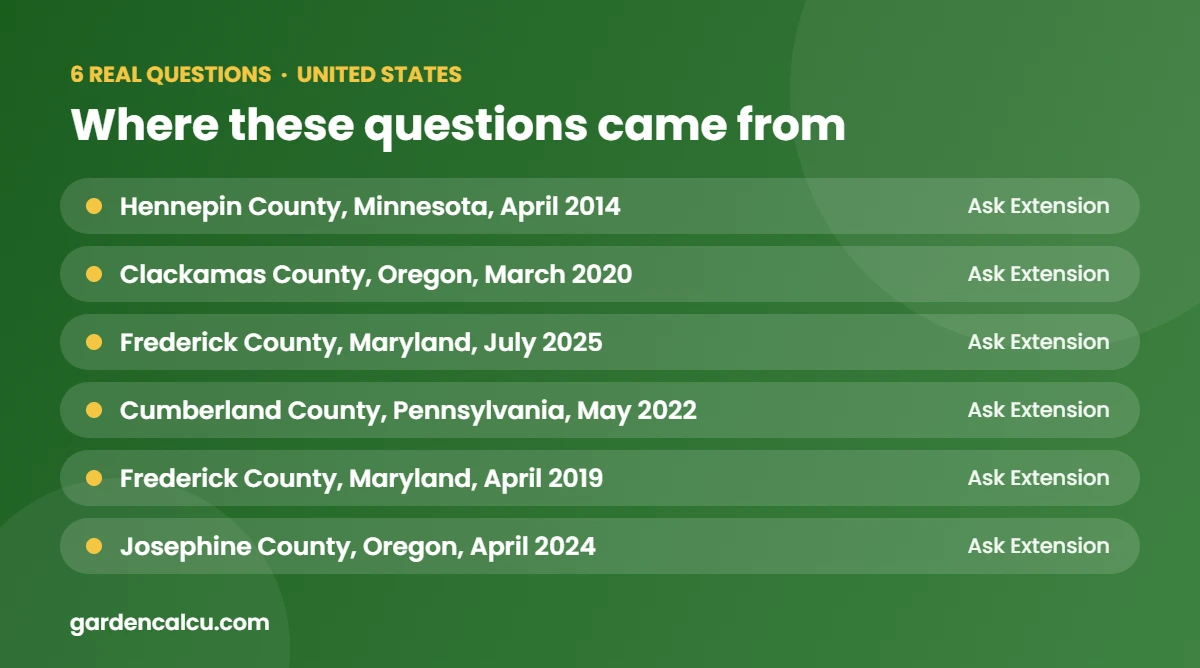
These are real questions sent to Ask Extension, the free service run by US land-grant universities. Each card shows where and when the gardener asked, and links to the full answer.
“Seed packets left in the garage over winter”
The question: How hardy are seeds? I left some packets of seeds in the garage over the winter. Obviously, temperatures were very, very low (many nights below 0). The seeds are mostly from vining plants: squash, tomatoes, tomatillos. Are they still viable? Or have I killed them?
What the expert said: The expert replied that freezing temperatures can kill some types of vegetable seeds, and that ideal seed storage temperatures are between 40 and 50 degrees F. The answer then listed life expectancy by crop group under good storage, from 1 year for onion and parsley to 4 to 5 years for squash, lettuce and broccoli, and said it is best to test the seed.
“Is last year’s seed still good?”
The question: Can I test my seeds to find out if they are still viable?
What the expert said: The expert said most seeds last for several years, though others have a relatively short life, and that a cool, dry place extends shelf life. Two tests were offered: a quick water test (seeds that sink after about 15 minutes are likely still good) and, for surer results, a germination test with about 10 seeds on a damp paper towel in a sealed bag.
“Seeds arrived already past their packed-for year”
The question: I just purchased several packets of seeds online and they came in the mail today. I noticed that two of the packets were labeled as packed for 2024. My mom thinks that they shouldn’t have sold those to me without a label saying they were old.
What the expert said: The expert agreed that seeds are not supposed to be sold past their packing date unless they have been re-tested for the current year. But the reply added that many seeds stay viable for more than a year if stored well, and suggested testing 20 seeds on a moistened paper towel to find the germination rate.
“Using year-old grass seed”
The question: Last spring, I purchased a large bag of grass seed but did not use it. It’s still sealed in the bag. Is there a reason that I shouldn’t use these seeds this year? Should I just discard it?
What the expert said: The expert said seed past its sell-by date will have reduced germination, and to look for mold as a sign of moisture damage. Then test it: 10 seeds on a damp paper towel in a sealed bag, in a warm place, for 10 days. If fewer than 5 sprout, viability is under 50 percent, and at 50 percent you need to plant double the recommended amount.
“Saved zinnia seeds, freezer versus left on the stem”
The question: I collected zinnia seeds at the end of the fall, 2017, and put these in the freezer. This fall, 2018, I didn’t collect the seeds. They wintered over on the stems and I am just now collecting the remaining seeds. Are both of these seeds equally viable?
What the expert said: The reply said fresher seeds are generally more likely to be viable, but that temperature and moisture also affect viability, and that the drier the seeds are, the longer they store. It added that zinnia seeds can remain viable for about 5 or 6 years and suggested testing both batches side by side.
“Can seed packets stay in the freezer?”
The question: I recently received a packet of Maximilian sunflower seeds as a gift. It’s been stored in my freezer (unopened) and I had hoped to plant them this spring. If I continue to store them in the freezer, will they be viable next spring?
What the expert said: The expert advised an airtight container in a cool, dry place, labeled with the variety and date, and said seed lasts for years stored that way. For freezer storage the moisture content of the seed needs to be very low, around 5 percent or less, so a cool, dark spot is far easier.
How Long Do Seeds Last, Crop by Crop?
There is no single answer, because every crop ages at its own speed. The clearest list we found came from the Minnesota answer above. The expert gave the relative life expectancy of seed kept under favorable storage conditions, in years, for the main vegetable groups.
Crop group | Typical seed life (good storage) | What that means for you |
|---|---|---|
Onion, parsley, parsnip, salsify | 1 year | Buy fresh every year |
Peppers | 2 years | Use up within two seasons |
Corn | 2 to 3 years | Test before a big planting |
Spinach, beets, carrots, chard | 2 to 3 years | Test in year three |
Beans and other legumes | 3 to 4 years | Usually fine, sow a little thick |
Tomatoes | 4 years | Safe to keep a few seasons |
Lettuce, endive, chicory | 4 to 5 years | Long keepers |
Broccoli, cauliflower (crucifers) | 4 to 5 years | Long keepers |
Melons, squash (cucurbits) | 4 to 5 years | Long keepers |
Flowers vary just as much. In the zinnia question from Frederick County, Maryland, the reply said zinnia seeds can remain viable for about 5 or 6 years.
Read these numbers as averages for seed that was kept well, not as promises. The same Minnesota expert added an honest warning: even under ideal conditions, germination of any seed lot declines with time. A four-year tomato packet from a cool closet may sprout almost as well as new seed. The same packet from a hot shed may give you nothing.
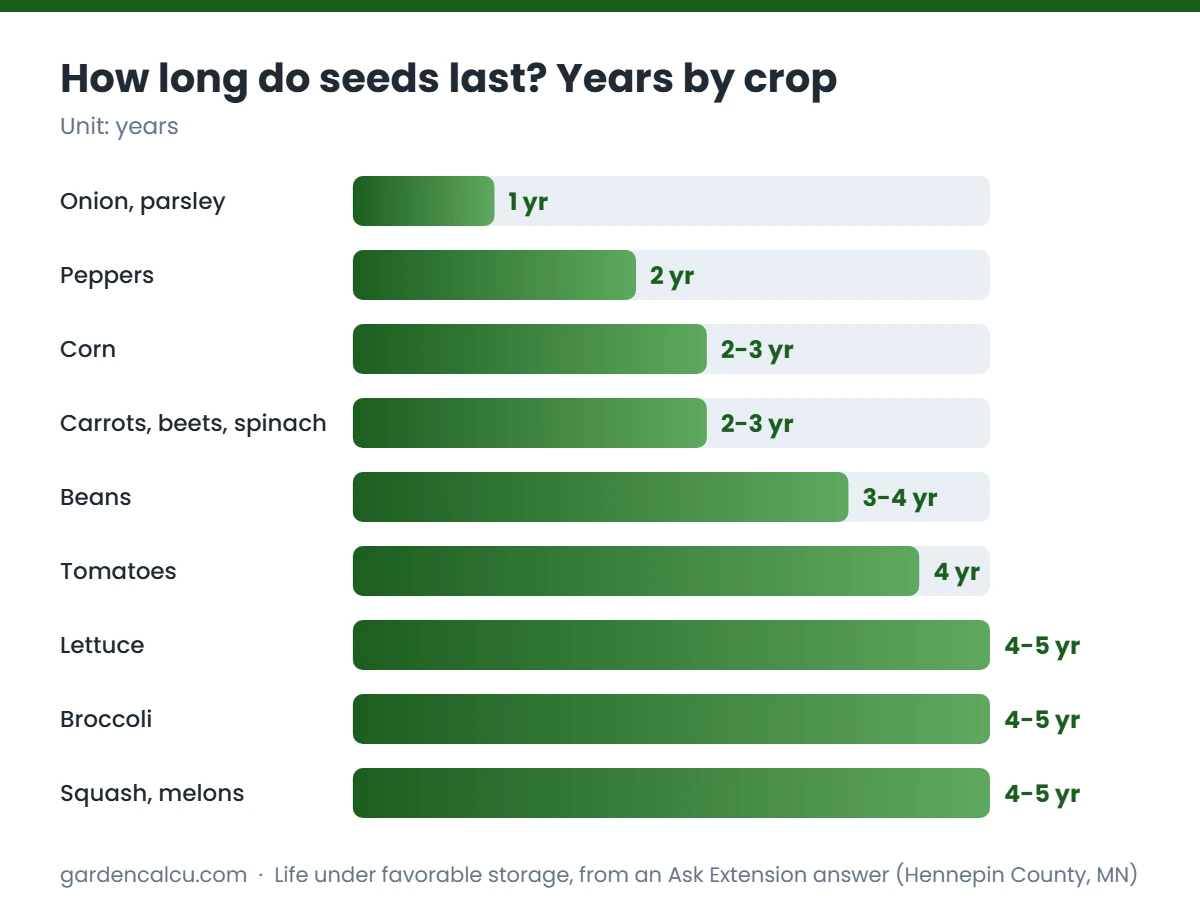
Seed life expectancy by crop group under favorable storage, as listed in an Ask Extension answer to a Minnesota gardener. Mid-points are plotted for ranges.
Tip: Write the year you bought it on every packet with a marker. Two springs from now you will not remember, and the tiny packed-for stamp is easy to miss.
What the Date on the Seed Packets Really Means
Most seed packets carry a line such as “packed for 2026” along with a sell-by date. That tells you which season the seed was tested and packed for. It is not an expiry date in the way a milk carton has one.
The Maryland gardener who received packets marked for 2024 in the summer of 2025 had a fair complaint. The Extension reply was direct: seeds are not supposed to be sold past their packing date unless they have been re-tested for the current year. If your new order arrives already a season old, it is reasonable to ask the seller about it.
But the same reply made the more useful point for the rest of us. Depending on the plant type, many seeds will still be viable for more than a year as long as they were stored well. A date that has passed is a reason to test the seeds. It is not a reason to throw them out.
Colorado State University Extension, in the fact sheet two of these answers pointed to, says vegetable and flower seeds may be kept for one year without appreciable decrease in germination, and that storage may be extended to 10 or more years under proper conditions. So how long do seeds last in practice? As long as their storage allows.
Why Old Seeds Fail: Heat, Moisture and Time
A seed is alive. Inside the coat is a tiny plant and a packed lunch, both ticking over very slowly. Warmth and moisture speed that ticking up, and the seed burns through its reserves before it ever touches soil.
The Colorado State fact sheet names the two things that matter most: seed moisture and storage temperature. The Maryland zinnia answer said the same in plainer words. The drier the seeds are, the longer they will store successfully.
That explains the usual ways old seeds get ruined at home:
Watch out: Mold on seed means it has been wet. The Pennsylvania expert told the grass seed owner to do a visual check first, because mold or fungus can indicate the seed has been damaged by moisture.
The Easy 10-Seed Germination Test
Every one of the experts above ended in the same place: stop guessing and run a germination test. It costs a paper towel and a sandwich bag, and it works for vegetables, flowers and lawn seed alike.
With 10 seeds the math is instant: 8 sprouted is 80 percent. With 20 seeds, multiply the count by five.
The Oregon expert also described a faster water test. Drop the seeds in a container of water and wait about 15 minutes. Seeds that sink are likely still viable, and floaters most likely will not sprout. It is quick, but the same expert said that for surer results you should do the towel test. Very small or flat seeds can float for reasons that have nothing to do with age.
How to Read Your Germination Test
Seeds sprouted (out of 10) | Germination rate | What to do |
|---|---|---|
8 to 10 | 80 to 100 percent | Sow as normal |
6 to 7 | 60 to 70 percent | Sow about one and a half times as thick |
5 | 50 percent | Sow double the usual amount |
Under 5 | Below 50 percent | Replace the seed for important crops |
The double-up rule comes straight from the Pennsylvania answer about grass seed: at 50 percent viability, you will need to plant double the recommended amount. The Maryland reply drew the line in the same place and suggested discarding seed that tests under 50 percent.
Know How Many Seeds to Sow
Once you know your germination rate, use the free Seed Calculator to work out how many seeds or packets you need for your rows and beds, then add extra for old seed.
How to Store Seeds So They Last
Good storage is boring, and that is the point. The Oregon expert summed it up in one sentence: store seed in an airtight container in a cool, dry place until you are ready to plant, and label the container with the variety and the date.
Should You Freeze Seeds?
You can, but it is the advanced option. In the Josephine County, Oregon answer, the expert explained that seed going into a freezer needs a very low moisture content, in the range of 5 percent or even less. Seed that still holds moisture can be damaged when it freezes. The expert’s practical view was that it is far easier to store seeds in a cool, dark spot, and that if you plan to use them next season you would be fine with almost any method.
That lines up with the Minnesota garage story. Those packets were not dried for freezing. They simply sat through nights below zero, and the expert could not promise they survived. The honest advice was to test them.
Tip: If you do take seed out of a fridge or freezer, let the closed jar warm to room temperature before you open it. That keeps moist room air from condensing on cold seed.
Sowing Old Seeds: The Simple Math
A lower germination rate does not make seed useless. It just changes how much you sow. Divide the amount you would normally plant by the germination rate, written as a decimal.
You want | Test result | Seeds to sow |
|---|---|---|
20 plants | 90 percent | About 22 |
20 plants | 70 percent | About 29 |
20 plants | 50 percent | 40 |
5 lb of grass seed | 50 percent | 10 lb |
For crops you sow in a row and thin, such as carrots, lettuce and beets, just scatter old seeds thicker and thin as usual. For crops where every plant matters, such as tomatoes and peppers started indoors, drop two or three older seeds in each cell and snip the extras.
Lawn seed follows the same rule, and the cost of guessing wrong is higher because you are covering a whole yard. If you have a leftover bag, test it before you spread it, then adjust the pounds you need. Our guide on how long grass seed takes to grow explains what normal sprouting looks like for each grass type, and the Grass Seed Calculator gives you the starting rate to adjust.
When to Give Up and Buy Fresh Seed
Old seeds are worth saving when the packet is nearly full, the variety is hard to find, or the crop is a long keeper. They are not worth the risk in a few cases:
If you are planning a fall or winter sowing with leftover lawn seed, read dormant seeding first. Timing is tight, and weak seed makes it tighter.
Frequently asked questions
Short answers to the questions that come up most often.
Quick recap
So, how long do seeds last? Long enough that you should never bin a packet just because of the date. Count on about a year for onion and parsley, two to three for peppers, corn and carrots, and four or five for tomatoes, lettuce, squash and broccoli, provided the seed was kept cool and dry.
When you are unsure, do what every Extension expert in this article told a real gardener to do. Put 10 seeds on a damp paper towel, wait a week, and count. Then sow with confidence, or sow a little thicker, or buy a fresh packet knowing you made the right call.
Get your exact number
Plan your rows and packets in seconds with the free Seed Calculator.
Related guides
Sources
The facts in this guide to “how long do seeds last” come from these university Extension pages and public questions: