Hardening Off Seedlings: 7 Easy Steps and a 14-Day Plan
Hardening off seedlings means getting indoor-grown plants used to sun, wind and cool nights before you plant them in the garden. It takes one to two weeks. You start with an hour or so outside in the shade and add more time and more sun each day, until the plants can stay out all day and all night.
Skip this step and even the healthiest seedlings can scorch, wilt or stall within days. Leaves grown under lights or behind glass have never met direct sun or a steady breeze. The change is a shock, and gardeners write to Extension offices about it every spring, usually after a week of rain has wrecked their careful schedule.
Below are real questions from gardeners in Maryland, Washington DC, Colorado and Michigan, with the advice Extension experts gave them. You will find a simple 14-day plan, the temperatures that matter, what to do when the weather will not cooperate, and how to help a plant through transplant shock.
Key takeaways
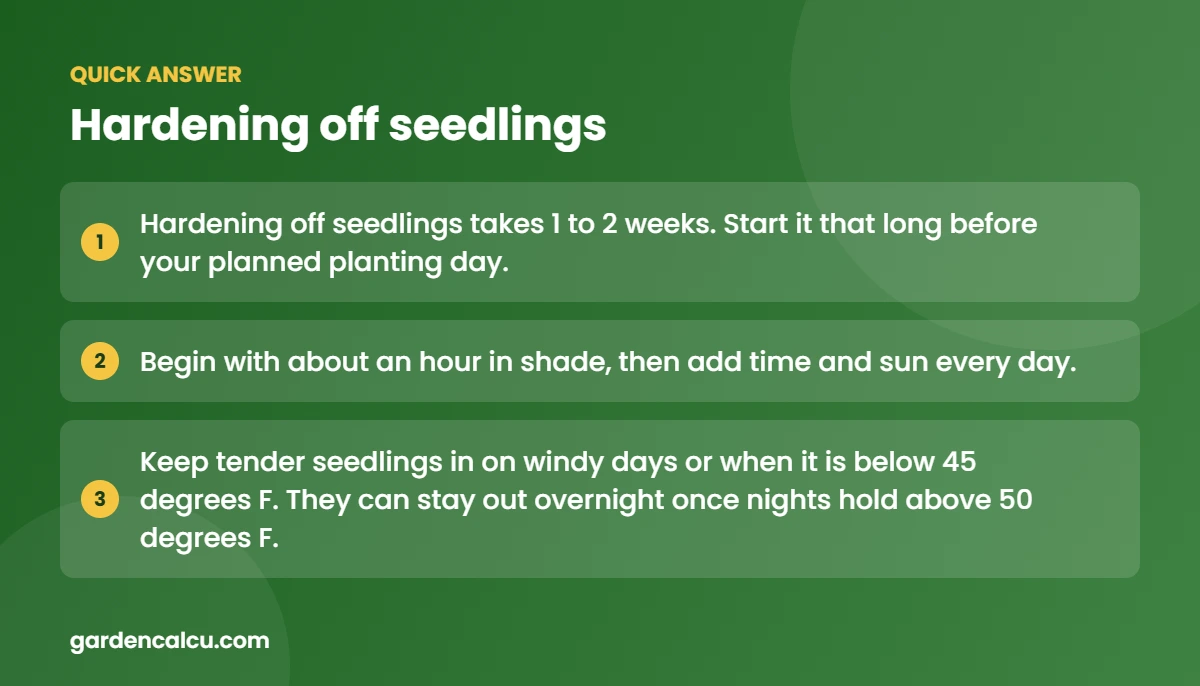
Quick answer to “hardening off seedlings” in three points.
Real questions gardeners asked
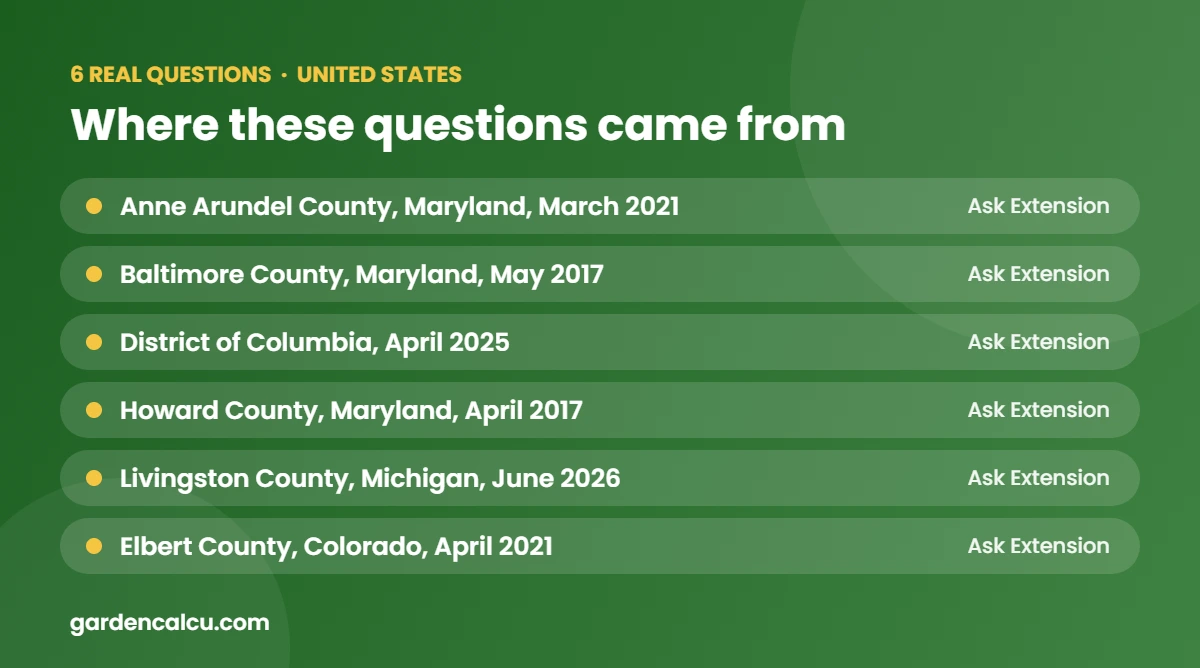
These are real questions sent to Ask Extension, the free service run by US land-grant universities. Each card shows where and when the gardener asked, and links to the full answer.
“Hardening seedlings in fickle weather”
The question: How many consecutive days of outdoor hardening do my seedlings need to be prepared for outdoor life? If I have them outside on my deck for an afternoon to work on hardening, but then the next day is driving rain and wind and I have to leave them protected indoors, does the hardening process restart?
What the expert said: The expert said hardening off should begin 1 to 2 weeks before setting plants out. Do not put tender seedlings outdoors on windy days or when temperatures are below 45 degrees F, because even cold-hardy plants will be hurt by freezing temperatures before they are hardened. A cold frame is an excellent place to do it, and plants may stay out overnight if it will not fall below 50 degrees F.
“A rainy week and a planting day coming up”
The question: I am a newbie gardener and started a couple of plants from seed this year (2 tomatoes, 1 cucumber and 2 peppers). I barely had the chance to give them a couple of hours in the evening for 2-3 days. I was planning to plant them outside this weekend but am not sure how to proceed since they have not spent any time outside due to the rainy weather.
What the expert said: The advice was to delay planting, because the plants had not been hardened off to sunlight yet. Set them outside where they can get a little more full sun each day for at least a week, weather permitting, and then plant them out in the garden. The tall tomato could be set deep so only two or three sets of true leaves are above ground.
“Is it warm enough to plant out tomato seedlings?”
The question: I’m wondering if it’s warm enough to plant my tomato seedlings outside. I’ve seen sources say both mid April (now) and Mother’s Day. Temperatures look pretty warm for the next 10 days, but I’m unsure.
What the expert said: The expert said seedlings started indoors need hardening off first, a gradual process of about two weeks that begins with one hour in the shade and builds to full days outside, with nights out once lows reach the low to mid 50s. Water before putting them out to prevent wilting, check the soil daily, and transplant on an overcast day.
“Hardening tomatoes through hot and cold swings”
The question: I brought them outside for a couple of hours on warm days and built the number of hours up. It’s been rainy and cold for the last several days and so I kept them inside. And then when I brought them outside again (it was about 58/60 degrees), a couple of the tomato plants wilted. Are nights in the 52/53 degree range too cold to leave them outside at night?
What the expert said: The expert said to harden plants off 1 to 2 weeks before setting them out, and that it is fine to keep transplants in the shade on hot or windy days. Transplants may be left outside overnight if the temperature will not fall below 50 degrees F. Planted too early, tomatoes just sit until the soil warms to about 60 degrees.
“Cucumbers struggling after transplanting”
The question: A gardener started Diva cucumbers indoors and transplanted them once the first mature leaves had developed. All three plants then showed damaged, flattened stems about an inch and a half above the ground, in sandy soil with careful watering.
What the expert said: The expert identified transplant shock, which in cucumbers shows up as sudden wilting, slowed growth and leaf stress soon after moving. Recovery steps were evenly moist soil, temporary shade for 3 to 5 days, a 2 to 3 inch mulch layer and no fertilizer for 7 to 10 days. For next time: harden off for 7 to 10 days, transplant on a cloudy day and disturb the roots as little as possible.
“What is hardening, and how do we do it?”
The question: We have started flower and vegetable seeds inside in grow pots under grow lights 3 weeks ago. They are doing real well. When should we transplant them outside? What is hardening? How should we do it?
What the expert said: The expert explained that transplants should generally be six to eight weeks old with at least four true leaves before planting outside. Once seedlings are strong enough to go out, the hardening off process begins, and it can be done in an outdoor cold frame.
What Hardening Off Seedlings Really Does
A seedling raised indoors has had an easy life. The light is gentle, the air is still, and the temperature barely moves. Outdoors it meets direct sun many times stronger than a shop light, wind that pulls water out of the leaves, and nights 20 or 30 degrees cooler than the days.
Hardening off gives the plant time to adjust. Over a week or two the leaves thicken, the stems stiffen, and growth slows down. That last part is on purpose. As the Maryland expert put it, the hardening process is intended to slow plant growth. A slightly tougher, slower plant handles the move far better than a soft, fast one.
The Baltimore County answer explains why time on a shady deck is not enough by itself. Those tomatoes and peppers had spent a few evenings outside, but they had not been hardened off to sunlight yet. Sun is the hardest part of the adjustment, so it has to be built up in steps.
When to Start Hardening Off
Count back from the day you plan to plant. Three separate Extension answers gave the same window: begin 1 to 2 weeks before setting plants out in the garden. The Washington DC answer described a full two-week routine, and the Michigan answer suggested 7 to 10 days for cucumbers.
So the planting date comes first. For tomatoes, peppers and other warm-season crops that is after your last frost, once the soil has warmed. Cool-season crops such as broccoli, chard and spinach can go out earlier, which means their hardening starts earlier too. If you have not worked out your dates yet, when to start seeds indoors walks through the count-back method.
Seedlings should also be big enough. The Colorado expert’s rule of thumb is transplants that are six to eight weeks old with at least four true leaves.
Tip: Mark two dates on the calendar: planting day, and the day hardening off begins. If you only mark planting day, the week before it tends to disappear.
A 14-Day Plan for Hardening Off Seedlings
There is no single official timetable. The plan below is an example built from the advice in the answers above: start with an hour in shade, add time and sun daily, and leave plants out at night only when it is warm enough.
Days | Time outside | Where |
|---|---|---|
1 to 2 | 1 to 2 hours | Full shade, out of the wind |
3 to 4 | 3 hours | Shade with an hour of morning sun |
5 to 6 | 4 to 5 hours | Morning sun, afternoon shade |
7 to 8 | 6 hours | Sun for half the day |
9 to 10 | 8 hours | Mostly sun |
11 to 12 | All day | Full sun, in at night |
13 to 14 | Day and night | Full sun, out overnight if lows stay above 50 degrees F |
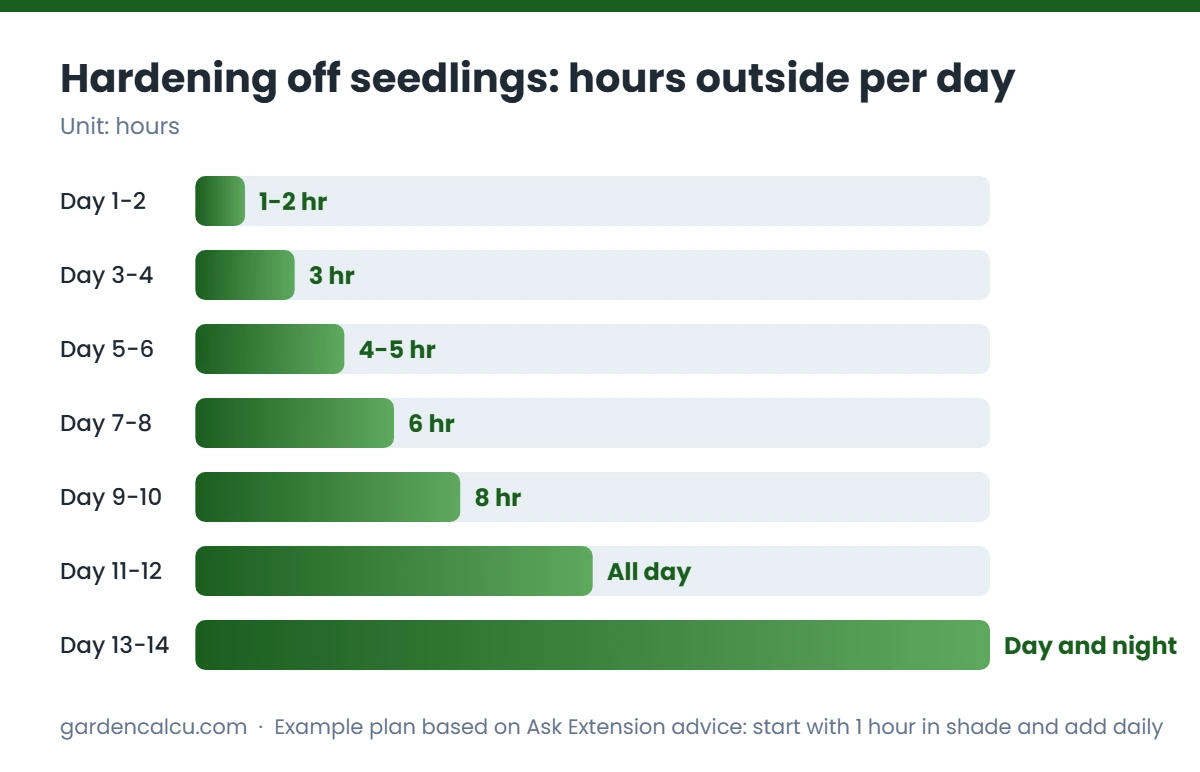
An example 14-day plan for hardening off seedlings, built from the advice in the Ask Extension answers quoted in this article.
If you only have a week, compress it. The Baltimore County expert asked for at least a week of a little more full sun each day, which is the minimum that still works. Move through the same stages in half the time, and watch the leaves closely.
7 Easy Steps
Temperatures to Remember
Situation | Number from the experts | What to do |
|---|---|---|
Too cold or windy for a day outside | Below 45 degrees F | Keep tender seedlings in |
Safe to leave out overnight | Will not fall below 50 degrees F | Leave trays out |
Tomatoes start growing in the ground | Soil about 60 degrees F | Wait to plant until soil warms |
Hot day during hardening | 80s to 90s | Keep transplants in shade |
All four figures come from the Maryland answers. The warning that goes with the first one is worth repeating: even cold-hardy plants will be hurt if exposed to freezing temperatures before they are hardened. Broccoli that could shrug off a frost in the garden next month can still be damaged by one today.
Watch out: Do not judge by air temperature alone. A sunny, windy 60 degree day can wilt soft seedlings faster than a calm 50 degree one. Wind is the reason the experts mention shelter so often.
What If the Weather Ruins Your Schedule?
This is the most common worry, and the Anne Arundel County gardener asked it best. If seedlings spend an afternoon outside and then two days indoors because of driving rain, does the process restart?
It does not. Hardening is cumulative. What the plant gained on Monday is not lost by Wednesday. The expert did not ask for consecutive days at all, only for the 1 to 2 week window and for seedlings to stay in on windy days and below 45 degrees F.
The Howard County story shows what a break does cost. After several rainy days inside, the tomatoes went straight back out at 58 to 60 degrees and a couple wilted. They recovered with water. The lesson is simple: after a gap, step back one stage instead of resuming at full exposure.
Use a Cold Frame if You Have One
Two of the experts mentioned cold frames. The Maryland answer called a cold frame an excellent environment for hardening off transplants, and the Colorado answer said the process may be done in outdoor cold frames. A cold frame is a bottomless box with a clear lid. Prop the lid open a little wider each day and close it at night, and the plants adjust without being carried in and out.
Seedlings raised by winter sowing in milk jugs work the same way. They grow up in outdoor light and temperature swings, so they need very little hardening.
Find Your Planting Dates
Hardening off starts 1 to 2 weeks before planting day. Use the free Planting Calendar to find the right transplanting window for each crop, then count back.
Planting Day: How to Avoid Transplant Shock
Hardening off prepares the leaves. Planting day is about protecting the roots. The Michigan cucumber case shows what happens when a plant is stressed at the move: sudden wilting, slowed growth and leaf stress shortly after the seedlings go into the garden.
How to Fix Transplant Shock
If seedlings wilt or stall after planting, do not panic and do not reach for more fertilizer. The two transplant shock answers gave nearly the same recovery plan.
Step | Michigan cucumber answer | Maryland lettuce answer |
|---|---|---|
Shade | Temporary shade for 3 to 5 days | Light shade for 3 to 7 days |
Water | Evenly moist, not waterlogged | Keep soil moist |
Mulch | 2 to 3 inch layer | Not mentioned |
Fertilizer | Delay 7 to 10 days | Not mentioned |
The Maryland case involved lettuce seedlings that had been pulled apart and repotted one by one. The expert explained that fine roots are damaged when seedlings are separated, and that less light helps recovery. For crowded seedlings, the suggestion was to transplant in chunks instead of teasing out single plants.
A laundry basket turned upside down, a piece of shade cloth, or a row cover held up on hoops all make good temporary shade. In the Howard County answer, a floating row cover was also recommended to protect young eggplant from flea beetles, so it does two jobs.
Most plants bounce back within a week. Once new leaves appear, remove the shade and return to normal care. If frost threatens after planting, protect plants from frost covers what to throw over them.
Frequently asked questions
Short answers to the questions that come up most often.
Quick recap
Hardening off seedlings is the short bridge between the light shelf and the garden, and it is worth every trip in and out of the house. Begin 1 to 2 weeks before planting day with an hour in the shade, add time and sun daily, keep plants in when it is windy or below 45 degrees F, and finish with nights outdoors once lows stay above 50.
Bad weather will interrupt you, and that is fine. Step back a stage, carry on, and delay planting by a few days if you must. Then plant on a cloudy day, water well, and give any plant that sulks a few days of shade.
Get your exact number
Check transplanting windows for your crops with the free Planting Calendar.
Related guides
Sources
The facts in this guide to “hardening off seedlings” come from these university Extension pages and public questions: