How Deep to Plant Seeds: Easy 2x Rule and 14 Crop Depths
Wondering how deep to plant seeds? The rule that Extension services repeat is simple: sow a seed at a depth of about two times its width. A bean goes about an inch down. A carrot seed gets a quarter to half an inch. Dust-fine seeds such as petunia and lettuce are pressed onto the surface and barely covered, or not covered at all.
It is a small detail with big results. A seed carries a fixed store of energy. Buried too deep, the shoot runs out of fuel before it reaches daylight. Sown too shallow, the seed dries out, washes away or gets eaten. Either way the row comes up thin or empty, and the gardener is left guessing what went wrong.
This guide answers the question with real cases from gardeners in Pennsylvania, Michigan, Vermont and Colorado, plus depth rules from the University of Maryland, the University of New Hampshire and the University of Maine. You will get a depth table for common crops, the list of seeds that need light, and what to do if you have already planted too deep.
Key takeaways
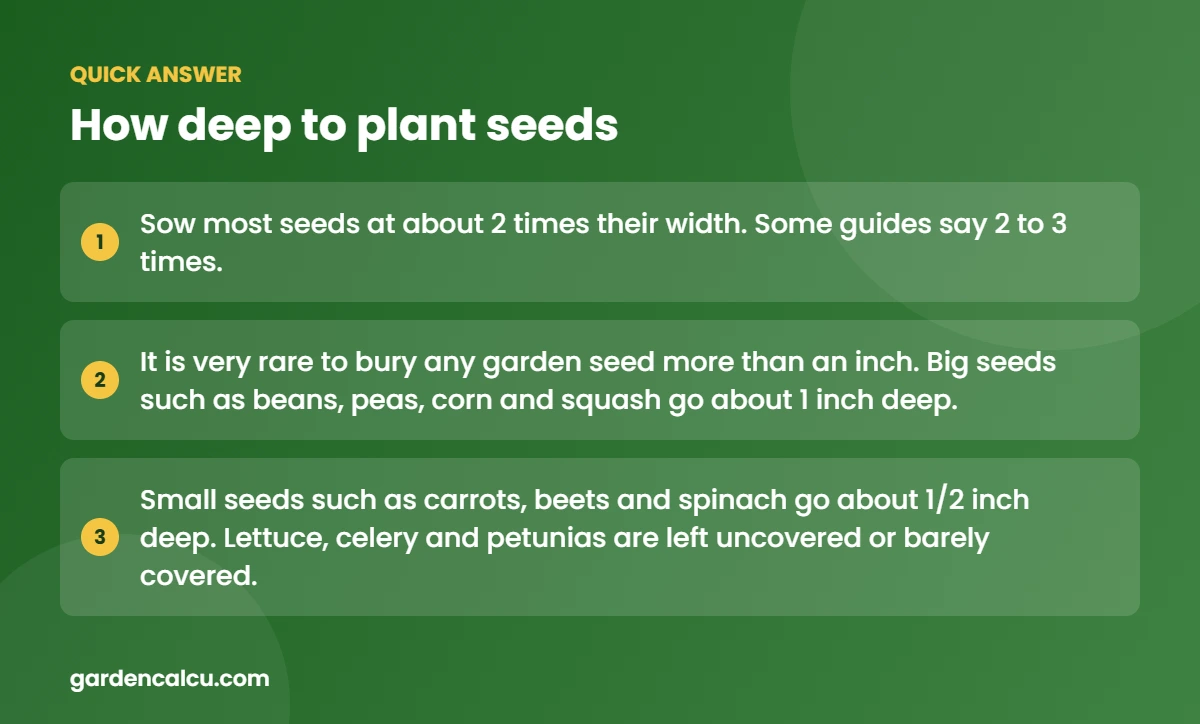
Quick answer to “how deep to plant seeds” in three points.
Real questions gardeners asked
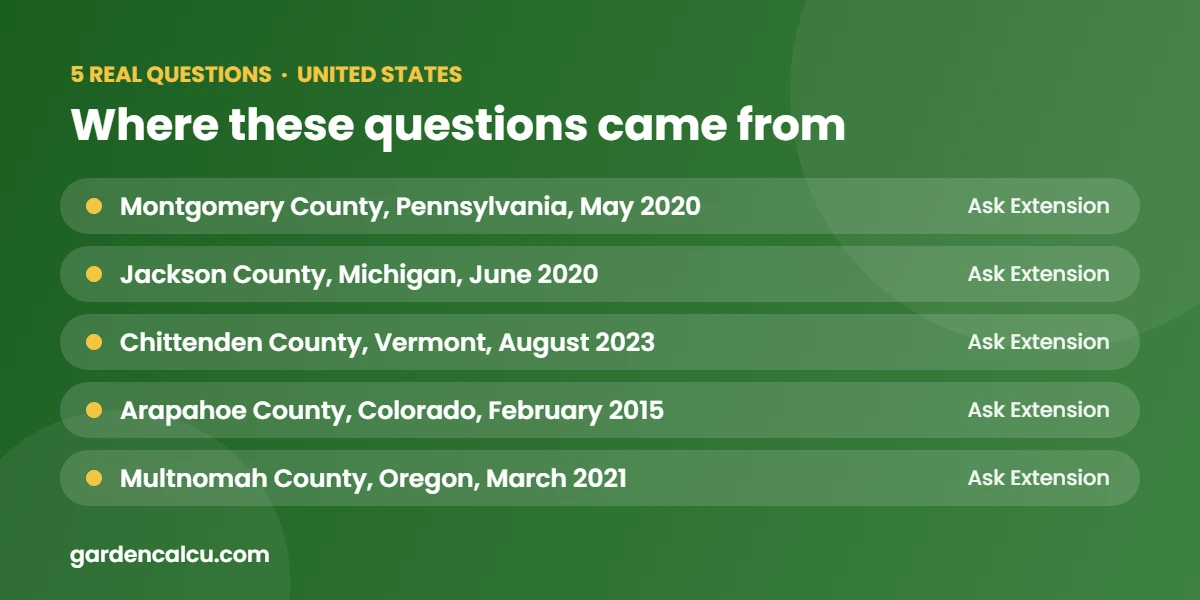
These are real questions sent to Ask Extension, the free service run by US land-grant universities. Each card shows where and when the gardener asked, and links to the full answer.
“Perennial seeds planted 6 to 10 inches deep”
The question: I planted a bunch of perennial seeds this weekend in the warm 65 degree weather. However, after doing so I realized I planted them too deep (about 6-10 inches in the ground). Is there any way my seeds will germinate and survive or is it a lost cause? Is it possible that I could use a till of some sort to mix up the soil and bring the seeds closer to the top?
What the expert said: The expert replied that it is very rare to bury any seed more than an inch, and to check the seed packet for the right depth. Trying to bring the seeds back up would be hit or miss, so buying new seed was the better plan. The reply ended kindly: we all had to learn how to garden, with lots of trial and error.
“Beans and sweet corn that will not come up”
The question: For the last 5 years or so I have been totally unsuccessful with green bean and sweetcorn planting or any kind of garden seeding. In years prior I had no problems.
What the expert said: The gardener had sown at a depth of half an inch. The expert answered that corn needs to be planted at a depth of 1.5 to 2 inches and will have trouble developing if this is not done, and that the recommendation for beans is a 1 inch depth.
“Why can’t I germinate any carrot seeds?”
The question: A gardener reported failing with carrots for the second time in four years. Four varieties were sown on July 9 in a raised bed with good soil, covered with straw and a row cover, and watered in dry spells. Nothing sprouted.
What the expert said: A University of Vermont Extension Master Gardener said the key is keeping seeds moist until they have germinated, which can take up to 3 weeks. Heavy rains could have affected the seeds, or they may have dried out between waterings. Carrots need deep, loose, well-drained soil, and soils that crust easily after rain are unsuitable.
“Green beans and peas that never emerge”
The question: I have tried green beans and peas in my raised garden with no success. I have tried both seed and seedlings. The seeds never emerge and the seedlings brown and die. The bed produces squash, peppers and tomatoes.
What the expert said: The expert recommended a laboratory soil test and explained the temperature side of germination: beans need soil temperatures above 50 degrees F, while peas can be planted when soil temperatures reach 40 degrees F and should go in as early as possible.
“Poor eggplant germination on a heat mat”
The question: I’m having problems sprouting seeds to grow plant starts in our new greenhouse. So far I’ve gotten great germination of peppers, tomatoes, bok choy and leeks. Also, I only have about 10% germination rate on my eggplant seeds.
What the expert said: Among other fixes, the expert pointed to temperature. For eggplant, the growing medium should be kept at about 85 degrees F during germination, with an optimum range of 75 to 90 degrees F, and bottom heat should come off right after the seeds sprout.
How Deep to Plant Seeds: The 2x Rule
Three university sources give almost the same instruction, in almost the same words.
Source | The rule |
|---|---|
University of Maryland Extension, sowing seeds outdoors | Sow seeds at a depth that is two times their width |
University of Maryland Extension, poor germination | Plant seeds at a depth that is 2 to 3 times their diameter |
University of New Hampshire Extension, starting plants from seed | Plant most seeds at a depth of about twice their diameter |
In practice, lay the seed on your palm and look at how thick it is. A bean is about half an inch thick, so it goes roughly an inch down. A beet seed cluster is under a quarter inch, so half an inch of cover is plenty. A lettuce seed is paper thin, so it needs almost no cover at all.
The Pennsylvania expert added the sentence that keeps beginners out of trouble: it is very rare to bury any seed more than an inch. If you find yourself digging a hole for seeds, stop and read the packet. Bulbs, garlic cloves and seed potatoes go deep. Seeds do not.
Tip: The seed packet always wins. If the packet gives a depth, use it. The 2x rule is for saved seed, loose seed from a swap, or a packet you have lost.
Planting Depth for Common Vegetables
The University of Maine Cooperative Extension publishes a planting chart for home vegetable gardens that lists a depth for each direct-sown crop. These are its figures.
Crop | Planting depth | Spacing in the row |
|---|---|---|
Turnips | 1/4 to 1/2 inch | 1 inch |
Carrots | 1/2 inch | 2 to 3 inches |
Beets | 1/2 inch | 2 to 3 inches |
Spinach | 1/2 inch | 3 to 4 inches |
Onions | 1/2 inch | 1 to 3 inches |
Parsnips | 1/2 inch | 2 to 4 inches |
Cucumbers | 3/4 inch | Hills 48 inches apart |
Snap beans | 1 inch | 2 to 4 inches |
Pole beans | 1 inch | Hills 24 inches apart |
Peas | 1 inch | 1 to 2 inches |
Sweet corn | 1 inch | 6 to 8 inches |
Summer and winter squash | 1 inch | Hills 48 to 72 inches apart |
Pumpkins | 1 inch | Hills 48 inches apart |
Potatoes (seed pieces, not true seed) | 4 to 6 inches | 8 to 12 inches |
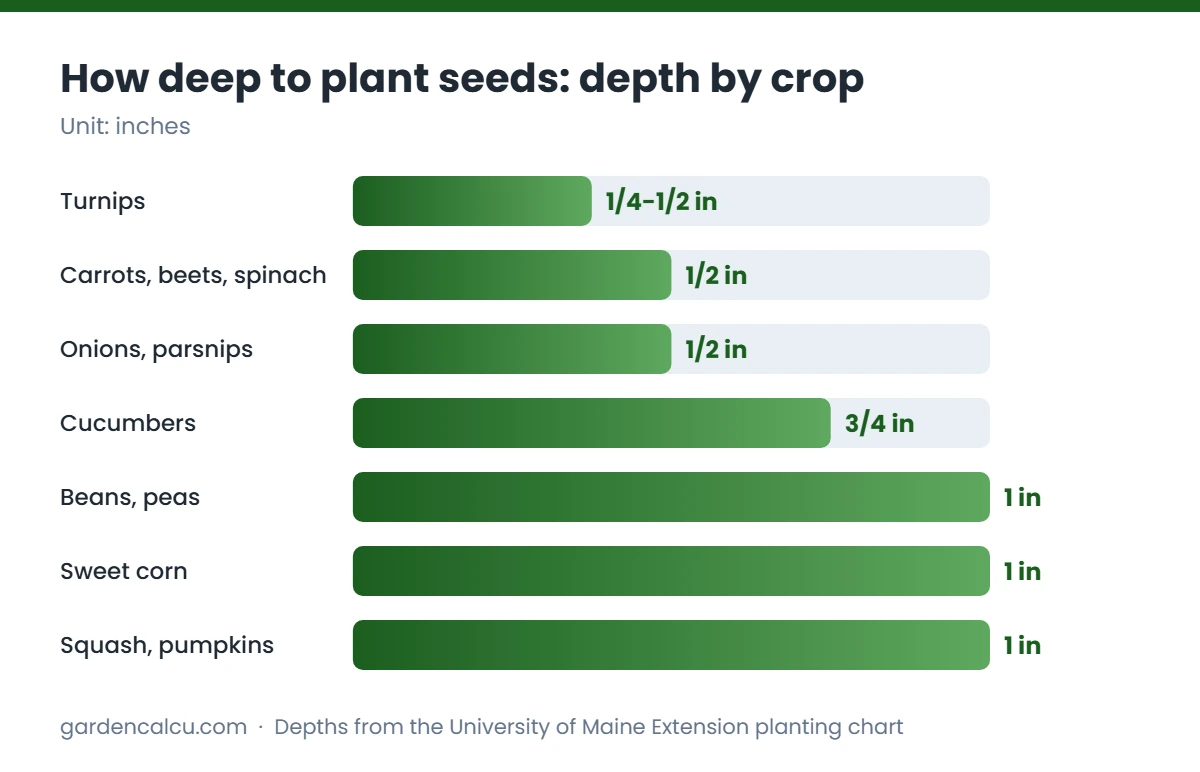
Planting depth for direct-sown vegetables, from the University of Maine Cooperative Extension planting chart for the home vegetable garden.
Notice how narrow the range is. Apart from potatoes, which are planted as tuber pieces, every crop on the list sits between a quarter inch and one inch. That matches the Maryland guidance for large seeds: cover them with half an inch to 1 inch of soil, or as the packet recommends.
Corn is the one crop where advice differs. The Maine chart gives 1 inch. The Michigan expert who answered the failed bean and corn question said corn needs 1.5 to 2 inches and will have trouble developing if planted shallower. Warm, dry or sandy soil favors the deeper figure. Cold, wet spring soil favors the shallower one. Either way, the gardener’s half inch was too shallow for corn, and on the light side for beans.
Seeds That Should Not Be Covered
Some seeds need light to trigger germination. Bury them and they simply sit. The University of New Hampshire fact sheet lists ageratum, begonia, browallia, impatiens, lettuce and petunia as crops that require light to germinate, and says not to bury them. If they are covered at all, cover them lightly with fine peat moss or fine vermiculite so some light still reaches the seed.
The University of Maryland adds celery to that group and says celery and lettuce should be left uncovered.
Group | Examples | How to sow |
|---|---|---|
Need light | Lettuce, celery, petunia, begonia, impatiens, ageratum | Press onto the surface; leave uncovered or dust with fine vermiculite |
Extremely tiny seed | Petunia, begonia, snapdragon | Do not cover; press in or water in with a fine mist |
Germinate best in the dark | Calendula, annual phlox, verbena, vinca, centaurea | Cover fully to the recommended depth |
Most vegetables | Beans, peas, corn, squash, beets, carrots | Cover to about twice the seed width |
For the surface-sown group, contact with moisture matters more than depth. Press the seeds gently into a damp surface so they do not dry out, and mist them instead of pouring water, which washes them into the corners of the tray.
Adjust for Your Soil
The same Maryland guide gives one adjustment worth remembering: sow seeds deeper in light, sandy soils and shallower in heavier clay soils.
After covering, firm the soil. Maryland Extension says to firm soil over the seeds to hasten germination. A pat with the flat of your hand or the back of a rake closes the air gaps so the seed can pull moisture from the soil around it.
Why Seeds Fail Even at the Right Depth
The University of Maryland lists incorrect planting depth as just one of eight causes of poor germination. If your depth was right and nothing came up, work through the rest.
Watch out: Do not keep re-sowing into cold ground. If the soil is under 50 degrees F, beans, corn, squash and cucumbers will rot before they sprout, no matter how deep you plant them.
Work Out How Many Seeds You Need
Once you know the depth and spacing, use the free Seed Calculator to see how many seeds or packets your rows and beds will take.
I Planted My Seeds Too Deep. Now What?
It depends on how deep and how long ago.
Situation | What to do |
|---|---|
An extra half inch or so, large seeds | Leave them. Beans, peas, corn and squash usually make it, just a few days late. |
Small seeds buried an inch or more | Re-sow at the right depth. They are unlikely to surface. |
Several inches deep | Buy fresh seed and start again. |
Seeds sown too shallow and now exposed | Sift a little fine soil or compost over the row and water gently. |
The Pennsylvania gardener who buried perennial seed 6 to 10 inches down asked whether tilling could bring it back up. The expert’s view was that it would be hit or miss, and that new seed was the practical answer. Tilling scatters seed through the whole depth of the soil, so only a small share ends up near the top.
If you re-sow, use the chance to improve the bed. That expert suggested working in compost first, because it helps hold moisture in the soil and supplies nutrients. Our guide on how much compost to add to a garden gives the amounts.
A Simple Way to Sow at the Right Depth
Indoors, the method is the same in miniature. Make a dimple with a pencil tip, drop in one or two seeds, and pinch the mix closed. For timing, see when to start seeds indoors.
Frequently asked questions
Short answers to the questions that come up most often.
Quick recap
The answer to how deep to plant seeds fits on a plant label: about twice the width of the seed, rarely more than an inch, and not covered at all for the few that need light. Read the packet first, adjust a little deeper for sand and a little shallower for clay, and firm the soil when you are done.
Then give the seed what depth alone cannot: soil that is warm enough for the crop, and a surface that stays moist until the seedlings are up. Get those three things right and empty rows become rare.
Get your exact number
See how many seeds and packets you need with the free Seed Calculator.
Related guides
Sources
The facts in this guide to “how deep to plant seeds” come from these university Extension pages and public questions: