Winter Sowing in Milk Jugs: 7 Easy Steps and Best Seeds
Winter sowing is a way of starting seeds outdoors in the middle of winter, inside vented plastic containers such as milk jugs. The jugs act as tiny unheated greenhouses. Cold, snow and rain do the work that a refrigerator and grow lights would do indoors, and the seeds sprout on their own when spring warmth arrives.
It appeals to gardeners who are short on shelf space, tired of leggy windowsill seedlings, or keen to grow native perennials that refuse to sprout without a cold spell. But the first try raises fair questions. When do the jugs go out? How cold is too cold? Which seeds suit the method, and which are better sown straight in the ground?
Gardeners in Minnesota, Maryland and North Carolina have put those questions to Extension experts. Their answers are below, along with timing from three university guides, a seven-step method for milk jugs, and a plain explanation of cold stratification.
Key takeaways
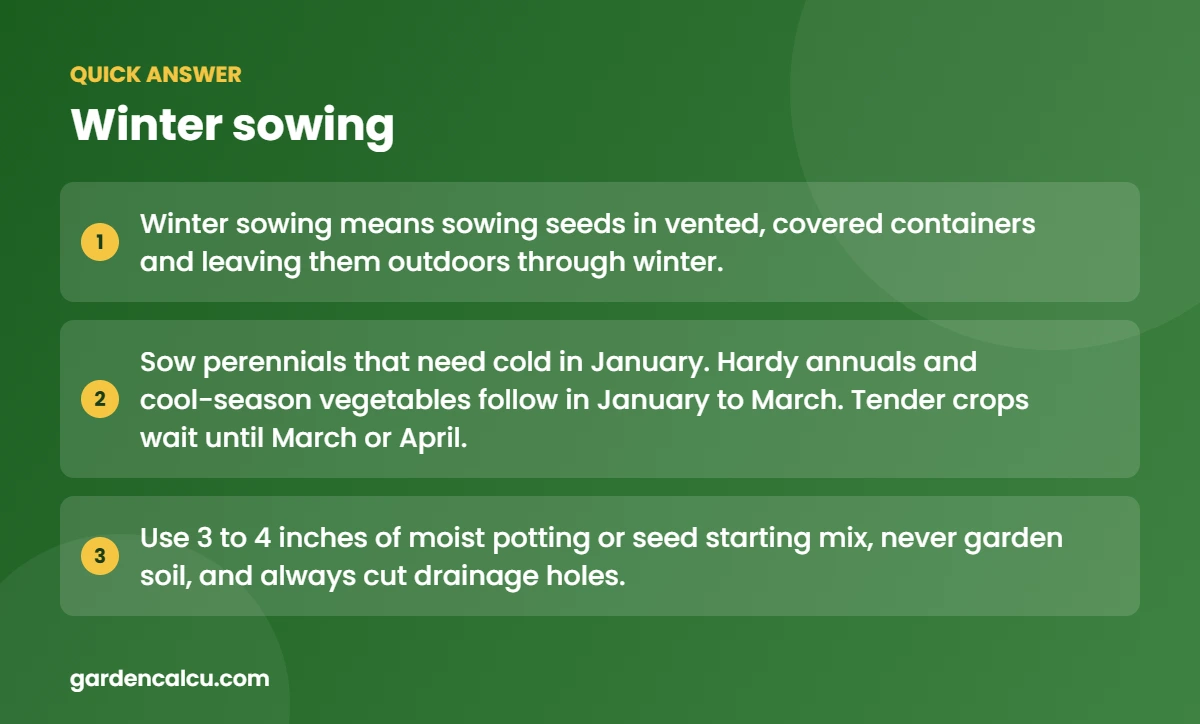
Quick answer to “winter sowing” in three points.
Real questions gardeners asked
These are real questions sent to Ask Extension, the free service run by US land-grant universities. Each card shows where and when the gardener asked, and links to the full answer.
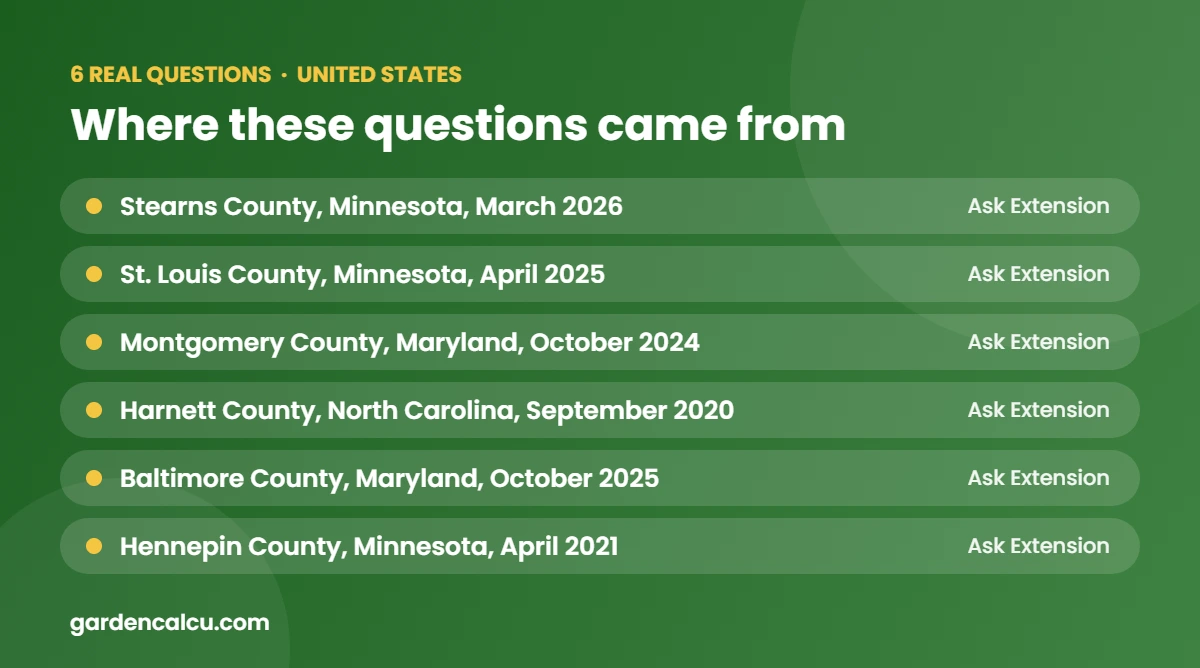
“Milk jug greenhouses: start date and how cold is too cold?”
The question: I live in zone 4b and want to try starting some seeds such as stock, snapdragons, bachelor buttons, lupine, and delphinium using the milk jug greenhouse method. I’ve never used this method before so not sure when to start the seeds or if I would need to bring the jugs in if temperatures drop. How cold is too cold?
What the expert said: A Minnesota Master Gardener replied that winter sowing can be successful as long as nighttime temperatures drop below freezing for some seeds, while others only need to be cold. Seeds that self-sow had worked best for her. She linked winter sowing guides from the University of Minnesota, Penn State and the University of Maryland.
“Is April too late to winter sow?”
The question: I am winter sowing for the first time using water jugs. I’m getting a late start. Can I winter sow sunflowers, cosmos, snow peas, and pole beans now even though they were supposed to be sown in March? Are some of these better when sown directly into the soil?
What the expert said: The expert said the general practice in Minnesota is to winter sow before the end of February. Seeds sown in jugs in April would need transplanting within about three weeks, and the loss of some seedlings in transplanting may not be worth it compared with direct seeding three to four weeks later. The suggestion was to direct seed.
“Milkweed seed: garden bed now, or fridge until spring?”
The question: What is the most successful way to grow milkweed in the garden from collected seeds? Overwintering in the garden bed by planting now? Or bringing the seeds inside and cold treating them in the refrigerator and planting in the spring?
What the expert said: The expert said that in general you could either use the fridge to give the seeds a stratification period (winter chilling) or sow them outdoors for the same effect, either in sheltered containers like a cut-open plastic milk jug or directly into the ground. The challenge of outdoor sowing is protecting the seed from wildlife such as birds and mice.
“How long does swamp milkweed need to cold stratify?”
The question: I collected the seeds from my swamp milkweed to give away to local gardeners. How long do the seeds need to cold stratify? Ninety days? I read that you’re supposed to plant them in the late fall, but I can’t find an exact period of time. Is our area cold enough for that?
What the expert said: The expert confirmed that milkweed needs cold stratification and that the area usually gets cold enough. You need 30 days minimum, and could go up to 6 weeks in a cool refrigerator. Leaving the seeds outside for the winter will do the trick too.
“Cold stratifying dogwood, redbud and black cherry seed”
The question: I’d like to cold-stratify some dry black cherry, dogwood, and redbud seeds so that I can plant them in April. Is this as simple as wrapping them in a damp paper towel in a ziploc, putting in the fridge for 100 days?
What the expert said: The expert cautioned that some species need to stay moist the entire time after harvest and may not remain viable if they dry out first. Citing William Cullina’s propagation guide, the reply gave the general period for cold, moist stratification at roughly 40 degrees as 90 to 140 days, in the fridge or in any outdoor spot where seed is protected from rodents and birds.
“When to sow saved perennial seeds?”
The question: I saved seeds from many of my perennials and a few annuals last fall. Should I sow them in my garden now, or wait until the soil is warmer? Do different seeds need to be planted at different times?
What the expert said: The reply said annual seeds usually require warmer soil and nighttime temperatures in the 50s. Perennial seeds should be planted after the weather is warm and settled, unless you want to try a technique called winter sowing. Each kind of seed has different optimal conditions for germination.
What Is Winter Sowing and Why Does It Work?
Many seeds are built to wait. A coneflower or milkweed seed that drops in October would die if it sprouted during a warm week in November, so it carries a built-in delay. It will not germinate until it has sat cold and moist for weeks. Gardeners call that requirement cold stratification.
Indoors, you copy winter with a bag of damp seed in the refrigerator. Winter sowing skips the fridge. You sow in a covered container, set it outside, and let real winter supply the chill. When days lengthen and the jug warms, seeds sprout at the time that suits them.
The Maryland milkweed answer described both routes as equal: use the fridge for a stratification period, or sow outdoors for the same effect, in sheltered containers like a cut-open milk jug or directly in the ground. The jug has one clear advantage over open ground. As that expert noted, the challenge of outdoor sowing is protecting seed from birds and mice, and a taped jug does that.
There is a second benefit. Seedlings raised in milk jugs grow in real sunlight and real temperature swings from day one. A University of Illinois Extension guide points out that they naturally harden off, so you skip the week of carrying trays in and out.
When to Start Winter Sowing
Timing depends on what is in the jug. Three university guides agree on the broad pattern.
Seed type | When to winter sow | Examples |
|---|---|---|
Perennials that need cold stratification | January is ideal; December to March works | Purple coneflower, swamp milkweed, wild bergamot, black-eyed Susan |
Hardy annuals and frost-tolerant vegetables | January and February, through March | Petunias, cosmos, kale, broccoli, spinach, Brussels sprouts |
Frost-sensitive plants | March or April | Zinnias, tomatoes, squash |
University of Minnesota Extension calls January perfect for perennials that need cold stratification, and says you can continue through March with hardy annuals while nights remain chilly. University of Illinois Extension says to wait until January or February to begin, so that a mild spell in early winter does not trick seeds into sprouting too soon, and lists zinnias, tomatoes and squash for March or April. Penn State Extension gives a general window of December to March for perennials and hardy annuals, and March or April for tender plants that do not need a cold period.
Can You Start Too Late?
Yes. The St. Louis County, Minnesota gardener asked in early April about jugs of sunflowers, cosmos, snow peas and pole beans. The expert, who gardens in the same county, said the general practice in Minnesota is to winter sow before the end of February.
The expert’s soil thermometer told the story. On April 5, at a depth of three inches, the garden soil was 34 degrees, still too cold for most seeds, but expected to reach the mid 40s within three weeks. Seeds started in jugs that late would be ready to transplant just as it became possible to sow them directly. With some seedlings always lost in transplanting, the advice was simply to direct seed.
Tip: Beans, peas and sunflowers are easy to sow straight into the ground and gain little from a jug. Save your milk jugs for seeds that need cold, or that are slow and tiny.
How Cold Is Too Cold?
For the right seeds, it is not. The Stearns County gardener in zone 4b wondered whether to carry jugs indoors on bitter nights. The Master Gardener’s answer turned the worry around: winter sowing works because nights drop below freezing. Some seeds need that freeze. Others only need to be cold.
So leave the jugs out. The only time to act is in spring, after seedlings are up, if a hard freeze threatens tender types such as tomatoes or zinnias. Then close the lids and throw a blanket over the jugs for the night.
Winter Sowing in Milk Jugs: 7 Easy Steps
That is all there is to building one. Most people can prepare a dozen milk jugs in under an hour.
Watch out: Do not put the jugs on a covered porch. Penn State Extension warns against it, because the containers should experience all the weather conditions they would in nature. Under a roof they get no rain or snow and dry out.
How Deep Should the Soil Be?
Source | Depth of mix in the jug | Type of mix |
|---|---|---|
University of Minnesota Extension | 3 inches | Potting soil, not garden soil |
University of Illinois Extension | About 3 to 4 inches | Light, fluffy, well-drained |
Penn State Extension | 2 to 4 inches | Soilless seed starting medium |
Aim for at least 3 inches. A shallow layer dries out fast in March sun, and roots need room for the weeks between sprouting and transplanting. For help choosing a bag, see seed starting mix vs potting soil.
Find Your Planting Dates
Use the free Planting Calendar to see when each crop can be sown and transplanted, so your winter sown seedlings go into the garden at the right time.
Best Seeds for Winter Sowing
The Minnesota Master Gardener gave the most practical rule in one line: seeds that self-sow have worked best. If a plant drops seed in your garden and comes up by itself the next spring, its seed can handle a winter in a jug.
Check the packet for clues. Phrases such as “needs cold stratification”, “sow in fall” or “self-sows” mark good candidates. If the seed is a few years old, test it first with the method in how long do seeds last.
Cold Stratification: How Long Do Seeds Need?
The length of the cold period varies a lot by species, which is the main reason January sowing is safer than March sowing for perennials.
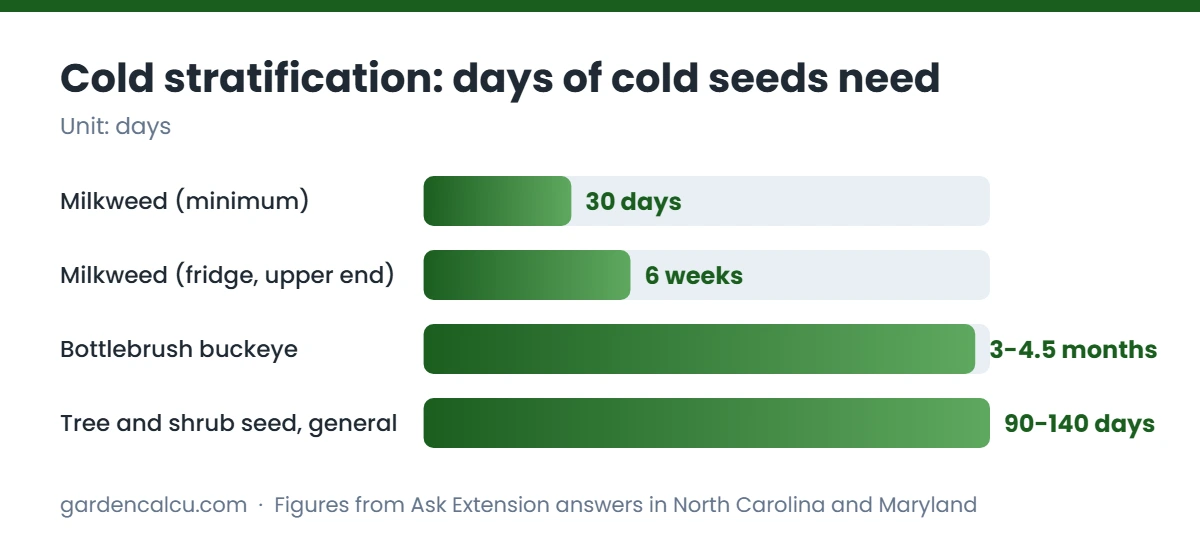
Cold, moist periods given in Ask Extension answers for milkweed and for native tree and shrub seeds. Mid-points are plotted for ranges.
Seed | Cold period given | Where the figure comes from |
|---|---|---|
Milkweed | 30 days minimum, up to 6 weeks in a refrigerator | Ask Extension, Harnett County, North Carolina |
Native trees and shrubs in general (such as dogwood) | 90 to 140 days at roughly 40 degrees F | Ask Extension, Baltimore County, Maryland, citing William Cullina |
Bottlebrush buckeye | 3 to 4.5 months at about 40 degrees F, kept slightly damp | Ask Extension, Baltimore County, Maryland, citing William Cullina |
A jug set out in early January in a cold-winter state will easily give milkweed its month or more. Tree and shrub seeds need most of the winter, so they should go out in fall or early winter.
Moisture matters as much as cold. In the Baltimore County answer about dogwood, redbud and black cherry, the expert warned that some species need to stay moist the whole time after harvest, and if they dry out before stratification they might not remain viable. Stratification is cold plus damp, not cold alone. That is why a dry packet in the freezer does not count, and why jugs need to sit where rain and snow can reach them.
Caring for the Jugs Until Spring
For most of the winter there is nothing to do. University of Minnesota Extension notes that snow and rain will keep seeds moist. A few checks are worth making once the weather turns:
When to Transplant
Move seedlings to the garden when they have a few true leaves and the soil is warm enough for that crop. Hardy perennials and cool-season vegetables can go out early. Tender plants wait until after your last frost. If you are unsure of that date, the count-back method in when to start seeds indoors shows how to find it.
Jug seedlings often come up thick. You can tease them apart, or cut the root mass into chunks and plant each chunk as a clump, thinning later.
Winter Sowing vs Starting Seeds Indoors
Question | Winter sowing in milk jugs | Starting indoors under lights |
|---|---|---|
Equipment | Recycled jugs, mix, tape | Lights, trays, shelf, timer |
Daily care in winter | Almost none | Watering and light adjustment |
Hardening off | Happens naturally | Takes a week or more |
Best for | Perennials, hardy annuals, cool-season crops | Tomatoes, peppers and other long, warm-season crops |
Earliness | Seedlings appear when weather allows | You control the date |
The two methods work well together. A Michigan gardener who asked about winter sowing vegetables was advised by a Michigan State University Extension educator to start them in March or April with a heat mat and bright lights. For warm-season vegetables in a short northern season, that indoor head start still pays. Use jugs for the hardy flowers and natives, and keep the light shelf for tomatoes and peppers. If indoor seedlings stretch, leggy seedlings has the fixes.
Frequently asked questions
Short answers to the questions that come up most often.
Quick recap
Winter sowing turns empty milk jugs into small greenhouses that need no electricity and almost no care. Cut drainage holes, add 3 to 4 inches of moist mix, sow, tape, and set the jugs in a sunny spot open to the weather. Start perennials in January, hardy annuals and cool-season crops through February and March, and tender plants in March or April.
Match the method to the seed. Plants that self-sow or need cold stratification thrive this way, while beans, peas and sunflowers are easier direct seeded and tomatoes still benefit from an indoor start. Used for the right seeds, winter sowing gives you sturdy, already hardened seedlings for the price of a bag of mix.
Get your exact number
See sowing and transplanting windows for your crops with the free Planting Calendar.
Related guides
Sources
The facts in this guide to “winter sowing” come from these university Extension pages and public questions: