Most Productive Vegetables: 12 Best Crops per Square Foot
The most productive vegetables for a home garden are staked tomatoes, Swiss chard, beets, rutabagas and turnips, peppers, peas, potatoes and carrots. Worked out from Cornell Cooperative Extension’s yield table, staked tomatoes return about 2 to 3.5 pounds per square foot, chard about 2 pounds, and most root crops around 1 pound. Bush beans, winter squash and sweet corn sit near the bottom.
That ranking matters most when space is tight. With one raised bed and a few pots, every square foot has to earn its place, and a crop that sprawls for four months to deliver a handful of fruit is a poor trade. Gardeners with shady yards, small lots or a single 4 by 12 bed ask Extension experts the same thing in different words: what should I grow to get the most out of this?
Below are their questions from Maryland, Colorado, Minnesota and Alabama, the experts’ answers, and a pounds-per-square-foot table calculated from Cornell’s numbers. Weight is not the only measure of a good crop, so the guide also covers what the figures leave out and five ways to raise the yield of any bed.
Key takeaways
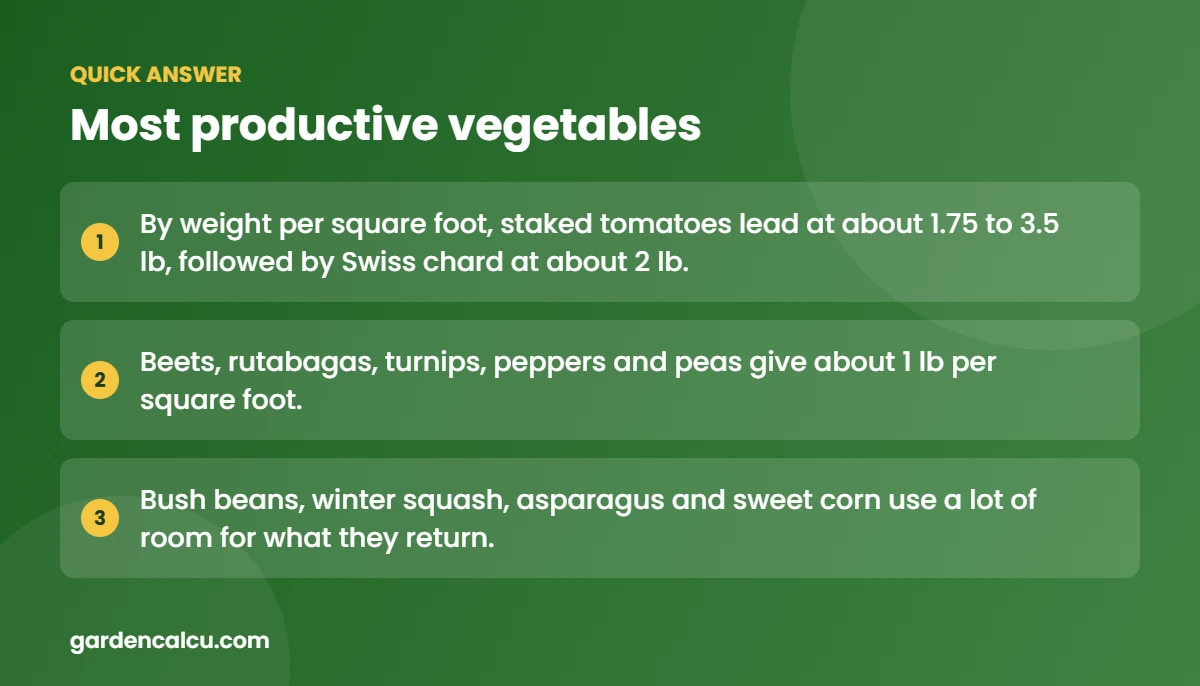
Quick answer to “most productive vegetables” in three points.
Real questions gardeners asked
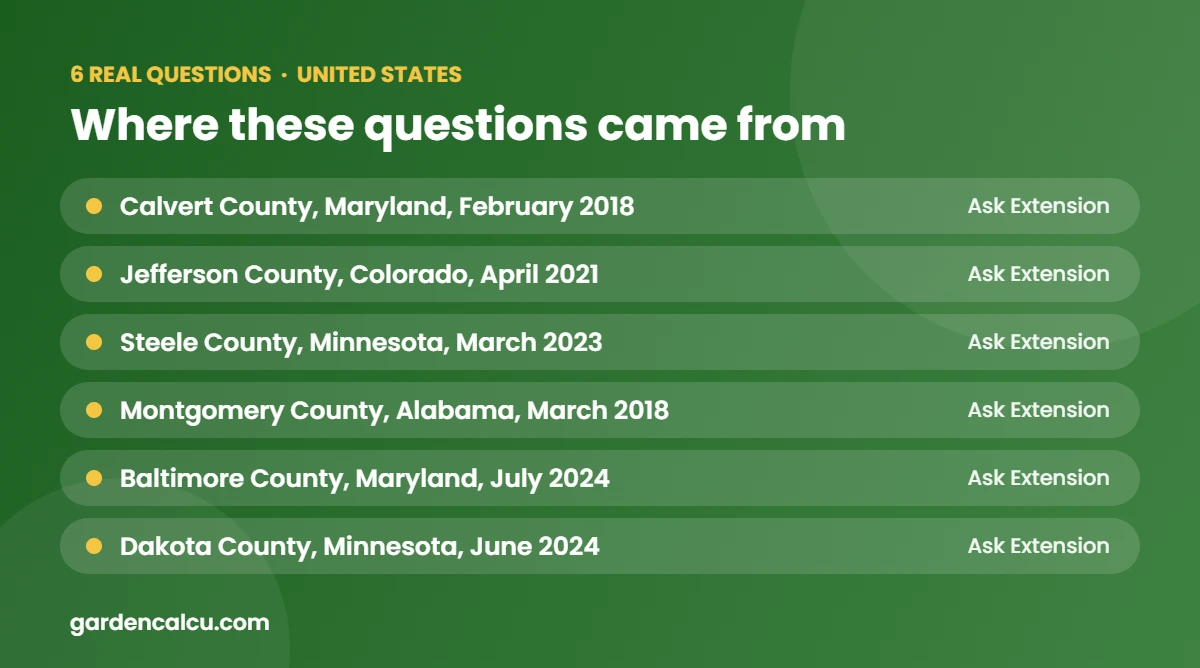
These are real questions sent to Ask Extension, the free service run by US land-grant universities. Each card shows where and when the gardener asked, and links to the full answer.
“Substantial output for two people from one bed and containers”
The question: In general, how many containers and how much container space do I need to grow vegetables such as spinach, peas, green beans, squash, and beets for a 2 person household? I have an 8×5 raised bed as well. I have a shady yard so the one raised bed and containers are my best option. I would like to have substantial output this year, so I need to use my space as wisely as I can.
What the expert said: The expert said it is difficult to state an area per person because there are so many variables. The practical advice was to plant second crops where early cool season vegetables grew: spinach or peas first, then beans or squash. Look for compact varieties for containers. Spinach and beets tolerate more shade than the other crops, and squash grows best in full sun.
“What will succeed in a 4 x 12 foot bed?”
The question: I have a 4 ft x 12 ft raised garden, some in full sun, some in partial shade. I’m interested in adding zucchini, but wondering what vegetables would you recommend that would have a good success rate for this summer?
What the expert said: The expert suggested planting cool season vegetables in the shadier part of the bed, as both a spring and a fall crop, and warm season vegetables in the sunny part. For a shorter growing season, choose varieties with a lower days to maturity so they have time to produce.
“Keeping the harvest coming”
The question: I would like to keep the vegetables and possibly berries and fruits coming over time, not just all coming at the same time. What crops can I plant at succeeding times so that they mature at different times and how do I do that?
What the expert said: A Minnesota Master Gardener answered that succession planting is the best way to have a continuous harvest. Vegetables that sprout and mature quickly are the easiest to make work. Melons are challenging because their time to harvest is so long.
“Should I make a second planting two weeks later?”
The question: Should I plant cucumbers, squash, zucchini, beans at the same time? Should I make 2nd planting two weeks apart? Would you prune suckers and lower leaves from the tomato plants?
What the expert said: The expert said these can all be planted at the same time, and that 2 to 3 weeks is good for succession planting to space out the harvest. On tomatoes, remove the lower limbs, clearing at least 8 to 12 inches above the ground as plants grow, and mulch to keep soil off the leaves.
“Winter squash taking over the garden”
The question: This is my first year growing winter squash and I clearly did not understand how much room it needed. These baby butternut plants are engulfing all the nearby eggplant and cucumber plants and just keep going. What can I do at this point to help keep them in check?
What the expert said: The expert suggested pruning the vines back, leaving around 3 to 5 developing fruits per vine, and repeating every few weeks. Stems can also be gently lifted and redirected. Some squash varieties take well to training up an A-frame trellis or inside a tomato cage, which frees up space on the ground.
“How much space for the two of us, plus some to share?”
The question: I am looking at planting a garden at our new home and wanting to make sure we utilize the most space and have enough sunlight for all the plants we want to grow. This garden is just for my wife and I but would like to be able to produce enough to be able to provide some to our friends.
What the expert said: The expert replied that the guidelines requested involve so many variables that they are difficult to address in a short answer, and pointed the couple to University of Minnesota Extension’s guide to planting a vegetable garden to refine and prioritize their goals first.
The Most Productive Vegetables, Ranked by Pounds per Square Foot
Two experts above said the same thing: yield per person involves too many variables to state simply. That is true. But there is a published starting point. Cornell Cooperative Extension lists the expected yield for 10 feet of row and the recommended distance between rows for each garden vegetable.
We used those two figures to work out pounds per square foot. Ten feet of row multiplied by the row spacing gives the ground that row occupies. Divide the yield by that area. The yields are Cornell’s. The division is ours.
Crop | Yield per 10 ft row | Row spacing | Pounds per square foot |
|---|---|---|---|
Tomatoes, staked | 70 to 140 lb | 48 in | 1.75 to 3.5 |
Swiss chard | 30 lb | 18 in | 2.0 |
Rutabagas | 20 lb | 18 in | 1.3 |
Beets | 12 lb | 12 in | 1.2 |
Turnips | 15 to 20 lb | 18 in | 1.0 to 1.3 |
Peppers | 30 lb | 36 in | 1.0 |
Peas | 10 lb | 12 in | 1.0 |
Potatoes | 20 to 30 lb | 36 in | 0.7 to 1.0 |
Parsnips | 10 to 15 lb | 18 in | 0.7 to 1.0 |
Carrots | 8 lb | 12 in | 0.8 |
Cabbage | 15 lb | 24 in | 0.75 |
Broccoli | 12 lb | 24 in | 0.6 |
Cauliflower | 12 lb | 24 in | 0.6 |
Pole beans | 16 lb | 36 in | 0.5 |
Spinach | 5 lb | 12 in | 0.5 |
Brussels sprouts | 10 lb | 24 in | 0.5 |
Sweet potatoes | 15 to 20 lb | 36 in | 0.5 to 0.7 |
Bush beans | 8 lb | 24 in | 0.4 |
Winter squash | 20 lb | 60 in | 0.4 |
Asparagus | 5 to 8 lb | 48 in | 0.1 to 0.2 |
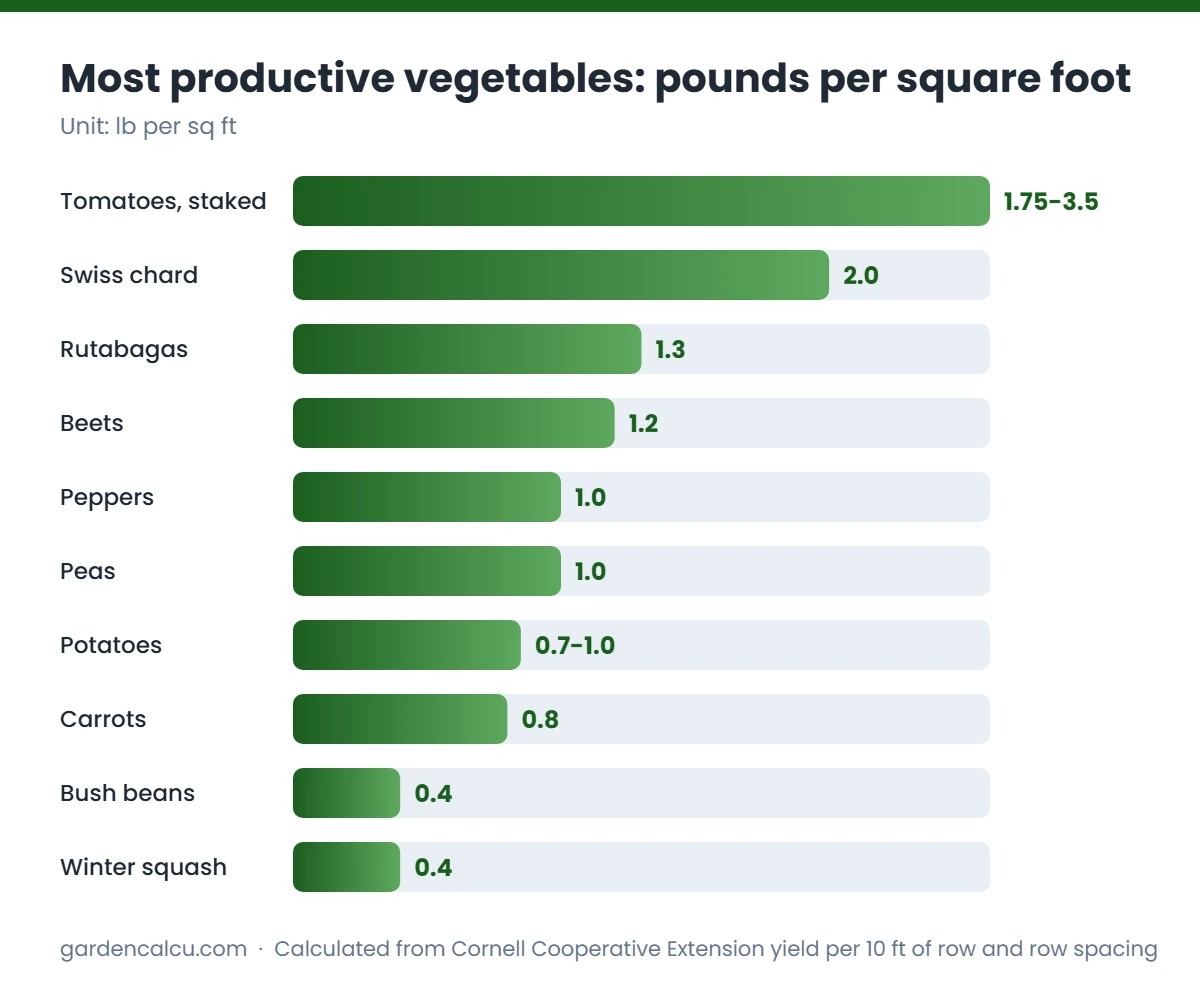
Pounds per square foot, calculated by dividing Cornell Cooperative Extension’s expected yield per 10 feet of row by the area that row occupies at the recommended row spacing. Mid-points are plotted for ranges.
Tomatoes win clearly, which will surprise no one who has grown them. The less expected results are how well plain root crops and chard score, and how low beans and squash fall. A 10 foot row of winter squash claims 50 square feet of ground for about 20 pounds of fruit. The Baltimore County gardener whose butternuts were engulfing the eggplants found that out the hard way.
Crops Counted by the Piece
Some vegetables are listed by the fruit or ear, so they cannot be ranked by weight. Cornell’s figures for those:
Crop | Yield per 10 ft row | Yield per plant |
|---|---|---|
Cucumbers on a trellis | 80 fruit | 4 fruit |
Summer squash | 20 to 25 fruit | 4 to 5 fruit |
Sweet corn | 15 ears | 1 ear |
Muskmelon | 10 melons | 3 melons |
Garlic | 20 bulbs | 1 bulb |
Bulb onions | 30 to 40 bulbs | 1 bulb |
Trellised cucumbers are the standout here: 80 fruit from 10 feet of row, in rows only 24 inches apart. Sweet corn is the weakest: one ear per plant, and corn needs to be planted in blocks to pollinate, so it suits large gardens.
What the Numbers Leave Out
Pounds per square foot is a useful measure, not the only one. Before you fill the garden with tomatoes and chard, weigh three other things.
The yields also assume full sun, decent soil and a full season in New York conditions. A crop in part shade or poor soil will not reach them. That is the main reason the experts above avoided giving a single figure.
12 Best Crops for a Small Garden
Putting weight, speed and usefulness together, these are the most productive vegetables for limited space.
Tip: In a shady yard, lean on the leafy and root crops. The Maryland expert noted that spinach and beets will tolerate more shade than the rest, while squash grows best in full sun.
Estimate Your Harvest
Enter your crops and row lengths. The free Harvest Yield Calculator estimates the pounds each one should produce, so you can give your best space to your best crops.
5 Easy Ways to Get More From Every Square Foot
1. Follow One Crop With Another
The Maryland expert’s advice to the gardener who wanted substantial output from one bed was succession by season: plant cool season crops like spinach or peas, then follow with warm season crops such as beans or squash. The Colorado expert added the other end of the year, a spring and a fall crop of cool season vegetables in the same spot. A square foot that grows peas, then beans, then fall spinach has produced three harvests.
2. Sow Little and Often
The Minnesota Master Gardener called succession planting the best way to have a continuous harvest, and the Alabama expert gave the interval: 2 to 3 weeks between plantings spaces out the harvest well. Sow a short row of beans, lettuce or beets every few weeks, and you avoid both the glut and the gap. Quick crops are the easiest to manage this way.
3. Grow Up
Vertical crops use air instead of soil. Cornell’s numbers show it: trellised cucumbers at 80 fruit per 10 feet, pole beans at twice the yield of bush beans. Even winter squash can be trained. The Maryland expert said some squash varieties take well to an A-frame trellis or a tomato cage, which frees up space on the ground. Put tall crops on the north side so they do not shade the rest.
4. Pick Compact and Fast Varieties
For containers, the Maryland advice was to look for compact varieties. For short seasons, the Colorado advice was to choose a lower days to maturity. A bush zucchini, a patio tomato or a 55-day bean fits a small garden better than a full-size, full-season type.
5. Keep Plants Healthy to the End
A crop that dies of disease in August stops producing in August. The Alabama expert’s routine for tomatoes is a good habit for the whole garden: remove lower leaves, keep foliage off the soil, and mulch to create a barrier between soil and leaves. Steady watering and decent soil do the rest. See how to read a soil test.
Watch out: Do not squeeze plants closer than the packet says to raise yield. Crowded plants compete for light and stay wet, and total harvest usually falls. Use the Plant Spacing Calculator to fit the right number in.
Space Hogs: Grow Only if You Have Room
Crop | Why it scores low | How to make it work |
|---|---|---|
Winter squash and pumpkins | Vines need rows 5 feet apart | Train up a trellis or let vines run onto lawn |
Sweet corn | One ear per plant; needs a block | Buy it at a farm stand |
Melons | Long season, few fruit per plant | Small-fruited types on a trellis |
Asparagus | Low yield and a permanent bed | Worth it only for the long term |
Bush beans | 0.4 lb per square foot | Switch to pole beans, or use as a quick follow-on crop |
None of these are bad crops. They simply cost more space than they return, and in a small bed that space is better used by something from the top of the table.
A Sample High-Yield 4 x 8 Bed
Here is one way to plant 32 square feet using the ideas above. Treat it as an example to adapt.
Where | Spring | Summer | Fall |
|---|---|---|---|
North edge, on a trellis (8 ft) | Peas | Cucumbers or pole beans | Finish and clear |
Middle strip | Lettuce and spinach | 2 staked tomatoes, 2 peppers | Tomatoes and peppers until frost |
South edge | Beets and carrots | Bush beans after the beets | Turnips, spinach or garlic |
Even at the low end of Cornell’s figures, two staked tomato plants alone would give about 20 pounds. Add the peas, greens, roots and beans, and one small bed carries a good share of a household’s summer vegetables. For sizing a larger garden, see how big should a vegetable garden be.
Frequently asked questions
Short answers to the questions that come up most often.
Quick recap
The most productive vegetables are the ones that give the most food for the space and time they take: staked tomatoes, Swiss chard, trellised cucumbers, beets, peppers, peas, carrots and potatoes. Winter squash, corn and asparagus are best left to gardens with room to spare.
The ranking is only half the story. Following one crop with another, sowing every few weeks and growing upward can double what a bed produces, whatever you plant in it. Start with the crops your household eats most, and give them your sunniest square feet.
Get your exact number
See how many pounds your beds should produce with the free Harvest Yield Calculator.
Related guides
Sources
The facts in this guide to “most productive vegetables” come from these university Extension pages and public questions: