Leggy Seedlings: 6 Easy Fixes for Tall, Thin Plant Starts
Leggy seedlings are seedlings with long, thin, pale stems that lean or flop over. In almost every case the cause is the same: not enough light reaching the leaves, so the plant stretches upward to look for more. The fix is usually to bring the light much closer, run it longer, and give the plants a little breeze.
If your tomato starts look like green threads with two leaves on top, you are in good company. This is one of the most common seed starting problems sent to Extension offices every March and April. First-time growers ask whether to throw the tray away and start over. Experienced growers with heated greenhouses ask why it keeps happening.
Below are real questions from gardeners in Ohio, Oregon, Oklahoma, Maryland and Minnesota, along with what the experts told them. You will see how close grow lights should really be, how many hours they should run, six easy fixes, and which leggy seedlings can be saved.
Key takeaways
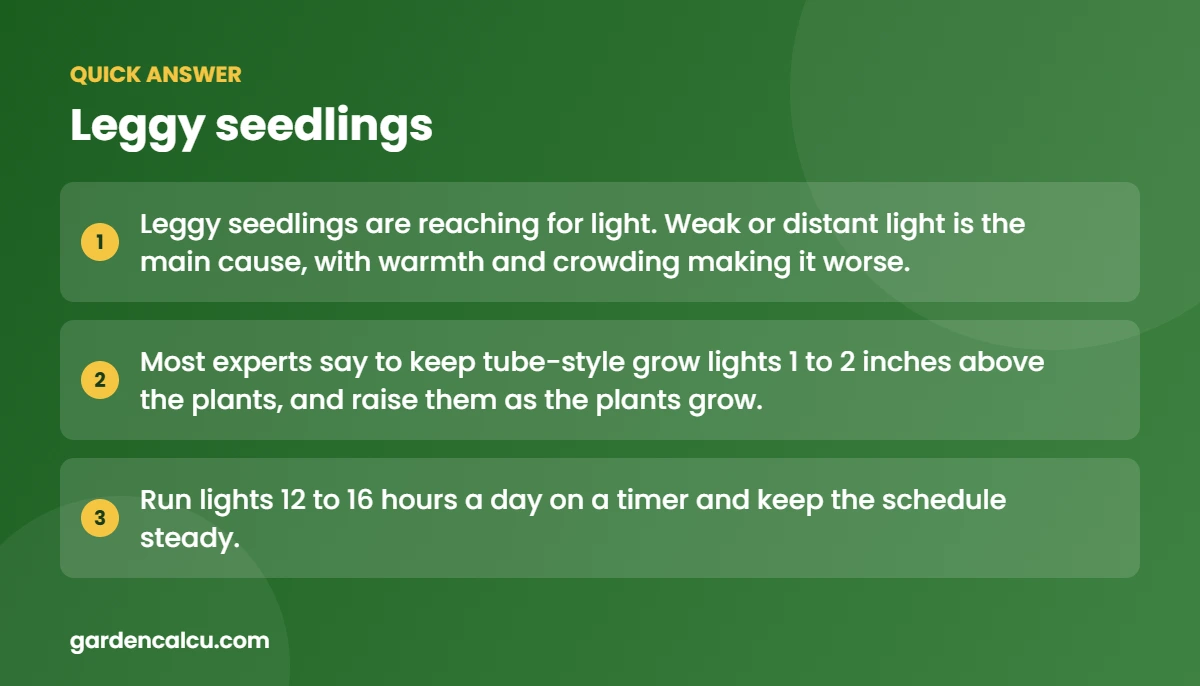
Quick answer to “leggy seedlings” in three points.
Real questions gardeners asked
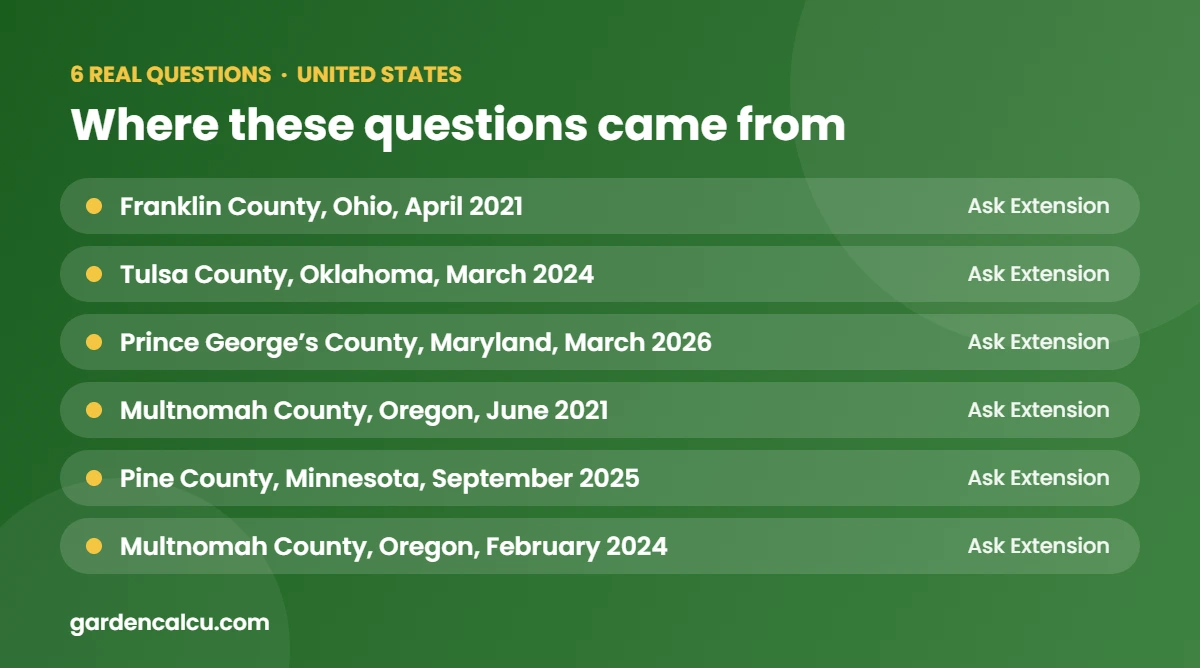
These are real questions sent to Ask Extension, the free service run by US land-grant universities. Each card shows where and when the gardener asked, and links to the full answer.
“Leggy seedlings under 15 hours of light”
The question: Should I be concerned that the seedlings are leggy? I have them under 15 hours of light. First photo are sunflowers, second are Romas and the third Big Boy.
What the expert said: The expert said they are leggy but can still grow strong, and asked how far the lights were above the plants. Ideally, lights should be 1 or 2 inches, up to 4 inches, above growing plants, hung on chains so the height can be adjusted. With leggy plants, close lighting is essential. Tomatoes can be planted deeper at transplant time.
“First time: tall and skinny after two days”
The question: This is my first time to plant seeds indoors. I’m using a heat mat and domes. Some started popping up yesterday but seem too tall and skinny. Is there something different I should do or should I just start over?
What the expert said: The expert said these should be fine as long as you continue to provide adequate lighting. The lights should be bright and placed within 6 to 8 inches above the plants if they are fluorescent, adjusted upward as the plants grow but still close. Plants should receive 12 to 14 hours of light per day, and brushing over them with your hand a couple of times a day helps strengthen the stems.
“A light that is not adjustable”
The question: The seedlings that have sprouted so far seem leggy to me and the light seems farther away than I think it should be. It’s not adjustable. Also the length of time maxes out at 12 hours. Are these too leggy and is 12 hours enough time?
What the expert said: The expert agreed the plants were not getting enough light and gave a list: put some support under the trays so the grow lights sit 1 to 2 inches above the tops of the seedlings, increase the exposure time to 14 to 16 hours per day and keep it consistent, and add airflow with a small fan on low. Even 1 to 2 hours a day helps thicken stems.
“Leggy tomatoes in a heated greenhouse”
The question: I have a small heated greenhouse with five 4-foot grow lights. How do I keep seedlings, especially tomato seedlings, from becoming extremely leggy? I have been keeping lights on just above all my seedlings 16 hours per day, and temperature at 70 degrees.
What the expert said: The expert said the constant temperature may play a part, but that light height and plant spacing matter more. The ideal is to keep uniform batches of plants under each light and keep raising the lights to stay about two inches above the plant canopy. Transplant several times as they grow, burying the excess stem so it roots, and space tomato transplants further apart so they do not compete for light.
“How many hours of LED light?”
The question: I was wondering how many hours of artificial light my garden starters need and does it vary over the course of 3-4 months prior to planting outdoors?
What the expert said: The expert said that for most vegetables and annual flowers, 12 to 16 hours of LED light per day is ideal, with enough intensity to grow sturdy and not leggy. It is best to keep the photoperiod consistent. A steady 14 to 16 hours a day ensures uniform growth and avoids stressing the plants.
“Are grow lights a smart investment?”
The question: I’ve grown starts indoors before, and the biggest problem I have is starts that are a bit on the leggy side. I have never used grow lights, but am guessing this would help? Would like some input on whether or not grow lights are a smart investment.
What the expert said: The expert explained that once seeds have sprouted they need consistent heat and light, and that the advantage of grow lights is full spectrum light, much like the sun. The reply also said tomatoes should be seeded about 8 weeks before planting and not set in the garden until the soil is warm.
What Causes Leggy Seedlings?
A seedling that cannot find enough light does the only thing it can. It pours its energy into the stem and stretches. The result is a tall, thin, pale plant with a long gap between the soil and the first leaves.
Light is the root of the problem in every answer above, but a few other things push seedlings in the same direction:
The Tulsa gardener’s story shows how fast it happens. The seeds were sown on a Sunday. By Wednesday some had sprouted under a dome on a heat mat, with the grow light switched off. In two days in the dark and warmth, they were already tall and skinny.
Tip: Turn the light on the day you sow, not the day you see green. Seedlings start stretching within hours of breaking the surface.
How Close Should Grow Lights Be?
Much closer than most people expect. Here is what six different Extension answers recommended. The numbers differ because the lights differ, but the pattern is clear.
Where the question came from | Recommended distance above the plants | Type of light discussed |
|---|---|---|
Montgomery County, Maryland | About 1 inch | Fluorescent tubes |
Prince George’s County, Maryland | 1 to 2 inches | Grow light kit |
Franklin County, Ohio | 1 to 2 inches, up to 4 | Fluorescent shop lights |
Multnomah County, Oregon | About 2 inches above the canopy | 4-foot grow lights |
Tulsa County, Oklahoma | Within 6 to 8 inches | Fluorescent; farther if the bulb gives off heat |
Ramsey County, Minnesota | Start at 12 to 18 inches, then adjust | Red and blue LED panel |
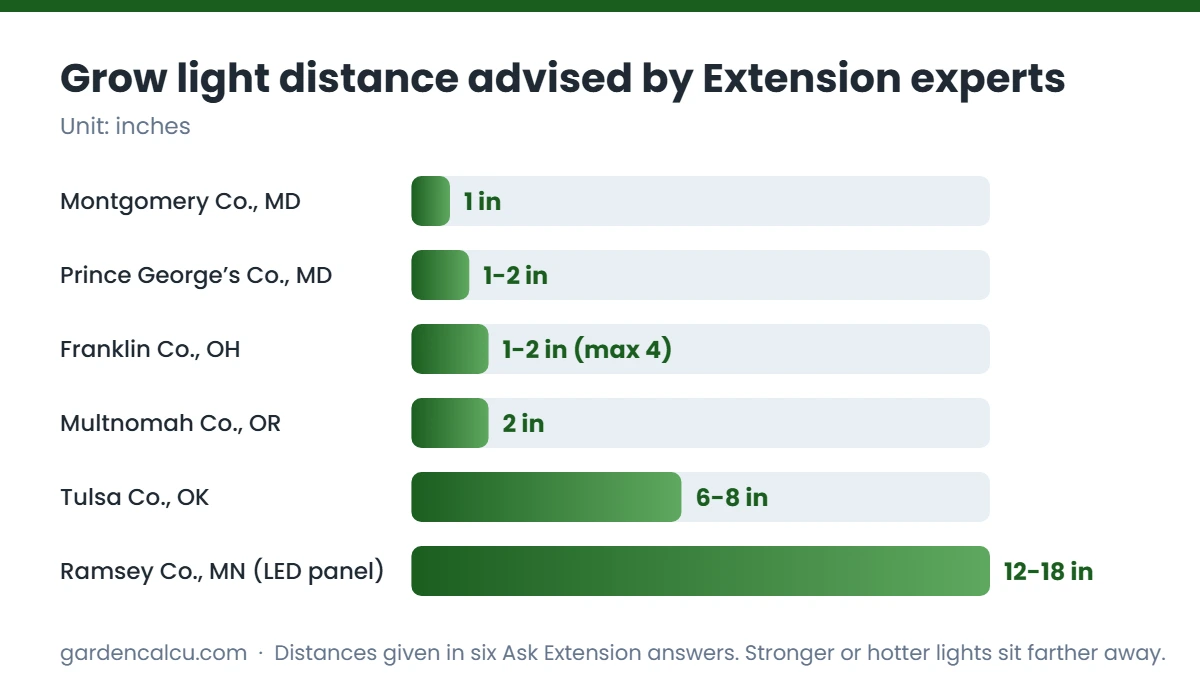
Recommended distance between grow lights and seedlings in six Ask Extension answers. Mid-points are plotted for ranges.
For ordinary fluorescent tubes and basic LED shop lights, which run cool, the answers cluster at 1 to 2 inches. That feels alarmingly close the first time you set it up. It is correct.
Stronger lights are the exception. A Minnesota expert advising on a red and blue LED grow light suggested starting about 12 to 18 inches away and then watching what the seedlings do and moving the lights as needed. A Maryland expert gave the same 12 to 18 inch figure for pepper seedlings whose leaves were curling under a light that sat too close. And the Oklahoma expert noted that bulbs which produce heat need to be farther away.
So use this rule: cool tube lights go as close as you can get them without touching, and high-output LED panels start farther back. Then let the plants tell you. Stretching means move closer. Curled, bleached or crisp leaf edges mean back off.
Watch out: Check for heat with the back of your hand at leaf level. If it feels warm after a minute, the light is too close for that fixture, whatever the inch rule says.
Keep Raising the Lights
Distance is not a one-time setting. The Ohio expert suggested hanging the fixture on chains so you can adjust the height as plants grow. The Oregon expert said to keep raising the lights to stay about two inches above the canopy.
If your light cannot move, do what the Maryland expert told the gardener with the fixed kit: put some support under the trays. A stack of books or an upturned box lifts short seedlings toward the light, and you remove layers as they grow.
How Many Hours of Light Do Seedlings Need?
Expert location | Hours of light per day |
|---|---|
Tulsa County, Oklahoma | 12 to 14 hours |
Pine County, Minnesota | 12 to 16 hours; a steady 14 to 16 is best |
Prince George’s County, Maryland | 14 to 16 hours, kept consistent |
Baltimore County, Maryland | 12 to 16 hours, then off for the rest of the day |
Every answer lands between 12 and 16 hours. A cheap plug-in timer makes it automatic. The Minnesota expert added a useful detail: do not bother stepping the hours up through the season. Indoors, plants respond more to total light than to gradual seasonal shifts, so keep the schedule the same from sowing to planting.
Do not run lights around the clock either. The Maryland advice was 12 to 16 hours and then off for the rest of the day.
6 Easy Fixes for Leggy Seedlings
Do the first two today. Most trays of leggy seedlings stop stretching within a few days once the light is right, and new growth comes in darker and tighter.
Plan Your Seed Starting Dates
Seedlings started too early get leggy before they can go outside. Use the free Planting Calendar to find the right sowing and transplanting windows for your crops.
Can Leggy Seedlings Be Saved?
Usually, yes. The Ohio expert’s verdict on a tray of leggy Romas and sunflowers was that they can still grow strong. The Oklahoma expert told a nervous first-timer the same: these should be fine with adequate lighting. Nobody was told to start over.
How you rescue them depends on the crop.
Crop | Can you bury the stem? | Best rescue |
|---|---|---|
Tomatoes | Yes | Pot up deep, then plant deep. Roots form along the buried stem. |
Peppers, eggplant | A little | Fix the light, add a fan, pot up slightly deeper |
Broccoli, cabbage, kale | Up to the first leaves | Fix the light, keep cool, set a bit deeper at transplant |
Squash, cucumbers, sunflowers | No | Fix the light and support gently, or resow since they grow fast |
Lettuce, onions | No | Fix the light; these recover well |
Tomatoes are the forgiving ones, and two experts said so directly. The Ohio answer noted you can plant them deeper in the garden when you transplant. The Oregon greenhouse answer went further: transplant several times as they grow to keep any excess stem in the soil to root. Our tomato planting guide covers deep planting in the garden.
Cool-season seedlings have another trick. The Maryland expert told the gardener with leggy broccoli and cauliflower that those plants like lower temperatures and can be taken outside on mild days. Real sunlight, even for a few hours, is far stronger than any shelf light.
When to Start Over
Resow if the stems have pinched in at the soil line and fallen over, which is damping off and not legginess, or if a fast crop such as squash or cucumber has stretched badly. Those take only about 3 weeks to reach planting size, so a fresh sowing costs little. Check your timing first in when to start seeds indoors, and test leftover packets with the steps in how long do seeds last.
Do You Need Grow Lights at All?
The Portland gardener who had always used a window asked whether grow lights were a smart investment. The expert’s answer was that sprouted seeds need consistent heat and light, and that grow lights offer full spectrum light, much like the sun, which window glass and ordinary bulbs do not fully supply.
In practice you do not need an expensive unit. The Ohio expert described a basic setup: two shop lights, or fluorescent bulbs with one cool and one warm tube, hung on chains. That has raised good transplants for decades.
If you have a red and blue LED, a Minnesota expert found that blue light helps increase chlorophyll while red promotes growth and flowering, and concluded that a mix is the best option. Use the combined setting.
Tip: Not sure a window is enough? Watch the seedlings for three days. If they lean hard toward the glass and the stems lengthen daily, they need more light.
Leggy Seedlings or Something Else?
A few other seedling troubles get mistaken for legginess:
Frequently asked questions
Short answers to the questions that come up most often.
Quick recap
Leggy seedlings are not a disaster and rarely a reason to start over. They are a clear message that the plants want more light. Bring cool tube lights down to 1 or 2 inches, run them 14 to 16 hours on a timer, add a little air movement, and take away the dome and heat mat once the seeds are up.
Then use the plant’s own habits to finish the rescue. Bury tomato stems, give cool-season crops some time outdoors on mild days, and space everything so the leaves are not fighting. In a week or two you will have stocky, dark green transplants.
Get your exact number
Find the right sowing window for every crop with the free Planting Calendar.
Related guides
Sources
The facts in this guide to “leggy seedlings” come from these university Extension pages and public questions: