What Hardiness Zone Am I In? 5 Easy Facts About the New Map
What hardiness zone am I in? Enter your zip code on the USDA Plant Hardiness Zone Map and it will tell you in seconds. The zone is based on one thing only: the average coldest winter temperature where you live. It tells you which perennial plants, trees and shrubs are likely to survive your winters.
The map was updated in late 2023, and many gardeners found they had moved half a zone warmer overnight. That raised fair questions. Do the old books still apply? Can I plant earlier? Can I grow things I could not before?
This guide is built from five real questions sent to university Extension services in Minnesota, Maryland, Delaware and Oregon. The experts explain how to look up a zone, what the 2023 change means in practice and why the zone number is only part of the story.
Key takeaways
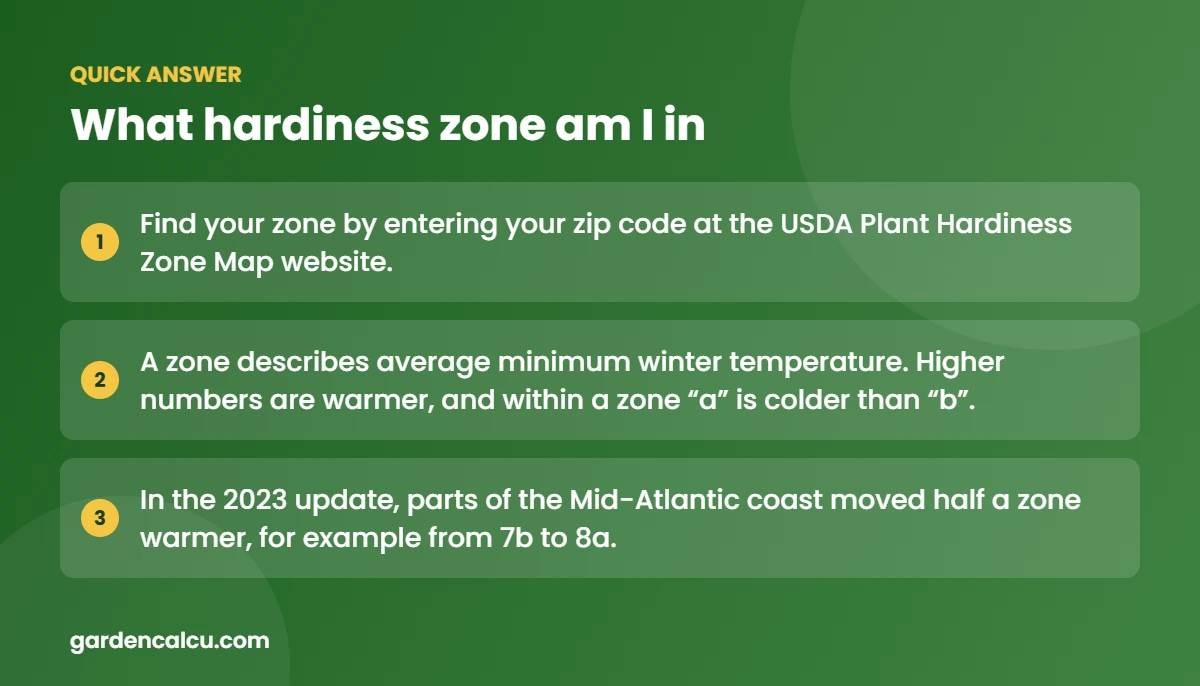
Quick answer to “what hardiness zone am I in” in three points.
Real questions gardeners asked
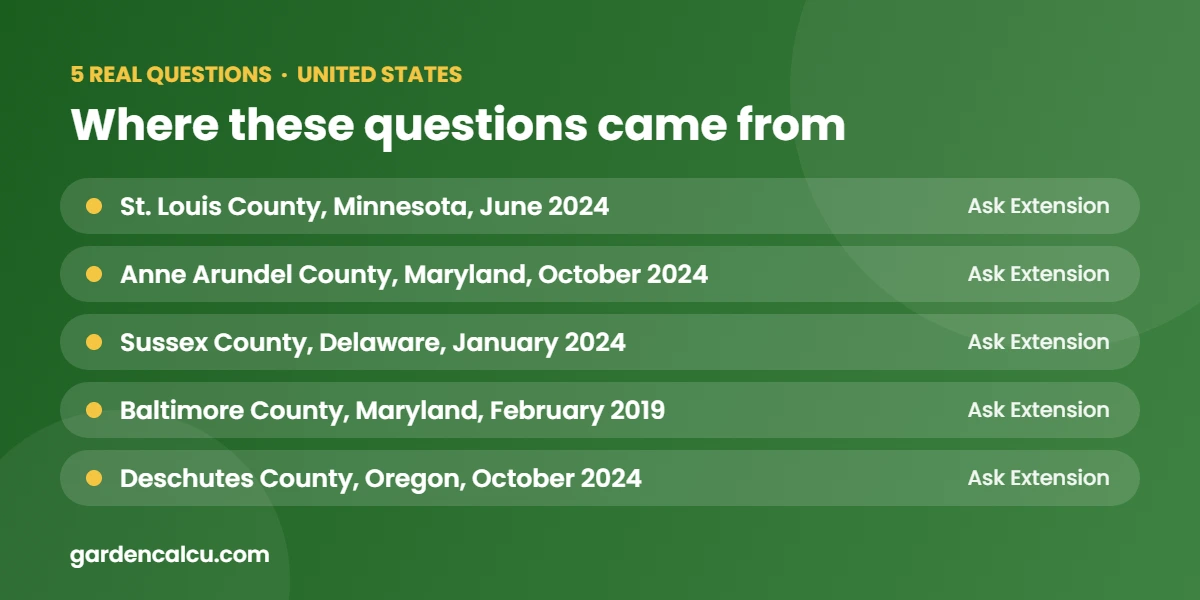
The question what hardiness zone am I in has been asked much more often since the map changed. We read five real questions sent to Extension experts and summarized each in our own words, with a link to the original.
“what zone am I in?”
The question: A Duluth resident asked simply what gardening zone they were in.
What the expert said: Enter your zip code on the USDA plant hardiness website and it will tell you, the volunteer replied, with a link to the official map.
“Zone 8a”
The question: A gardener a few blocks from the Chesapeake Bay had just learned of the reclassification from zone 7 to 8a. All their books and planting decisions had assumed zone 7, and the zone 8a places they knew in the South seemed very different.
What the expert said: When the USDA updated the map, horticulturists were not surprised that Bay-side areas and southern Maryland came out as zone 8a, the expert said. The area had functionally been 8a for some time, and the map relies on prior decades of climate data. Not all of zone 7 moved. Since zone 8 has a slightly longer growing season than zone 7, sowing and harvest seasons can be extended a little.
“USDA hardiness zones”
The question: A community garden asked how the new USDA zones affect gardening in lower Sussex County.
What the expert said: Each zone in southern Delaware went up half a zone, the expert said. Coastal areas that were 7b are now 8a, and western areas that were 7a are now 7b. An “a” zone is cooler than a “b” zone, and the higher the number the warmer. The change reflects warmer winters and growing seasons, but it does not mean there will be no well-below-freezing weather. More insect pests that used to occur only further south are also appearing.
“What Zone Am I”
The question: A gardener had been told to choose container plants two zones hardier and asked what zone Catonsville is in and what two zones hardier would be.
What the expert said: Catonsville was in zone 7a, the expert said. For perennial container plants meant to overwinter outdoors, look for ones cold hardy to at least zone 5a. Hardiness zone information is on the plant tag or pot at the garden center.
“Planting Zone”
The question: A gardener in Sisters asked what planting zone they were in and, knowing there are microclimates, asked for a range.
What the expert said: The expert quoted Oregon State University’s guide for Central Oregon. Many factors besides minimum temperature decide whether a plant survives, including soil type, rainfall, heat tolerance and exposure to wind and sun. The USDA map places Central Oregon in zone 6, which is minus 10 to 0°F, but that is oversimplified given the area’s many microclimates.
Fact 1: how to find your zone
That is the whole lookup, and it is what the Minnesota volunteer told the Duluth gardener to do. The same number appears on plant tags, in catalogs and in seed listings, where it tells you the coldest zone in which the plant is expected to survive winter.
Fact 2: what the number means
The map divides North America into zones by the average of each year’s single coldest night, measured over 30 years. Each numbered zone covers a 10 degree range, and each is split into a colder “a” half and a warmer “b” half of 5 degrees each.
Zone | Average coldest winter temperature |
|---|---|
3 | -40 to -30°F |
4 | -30 to -20°F |
5 | -20 to -10°F |
6 | -10 to 0°F |
7 | 0 to 10°F |
8 | 10 to 20°F |
9 | 20 to 30°F |
10 | 30 to 40°F |
The Oregon answer confirms the zone 6 line: minus 10 to 0°F. The Delaware expert gave the two reading rules. The higher the number, the warmer the winter. And “a” is cooler than “b”.
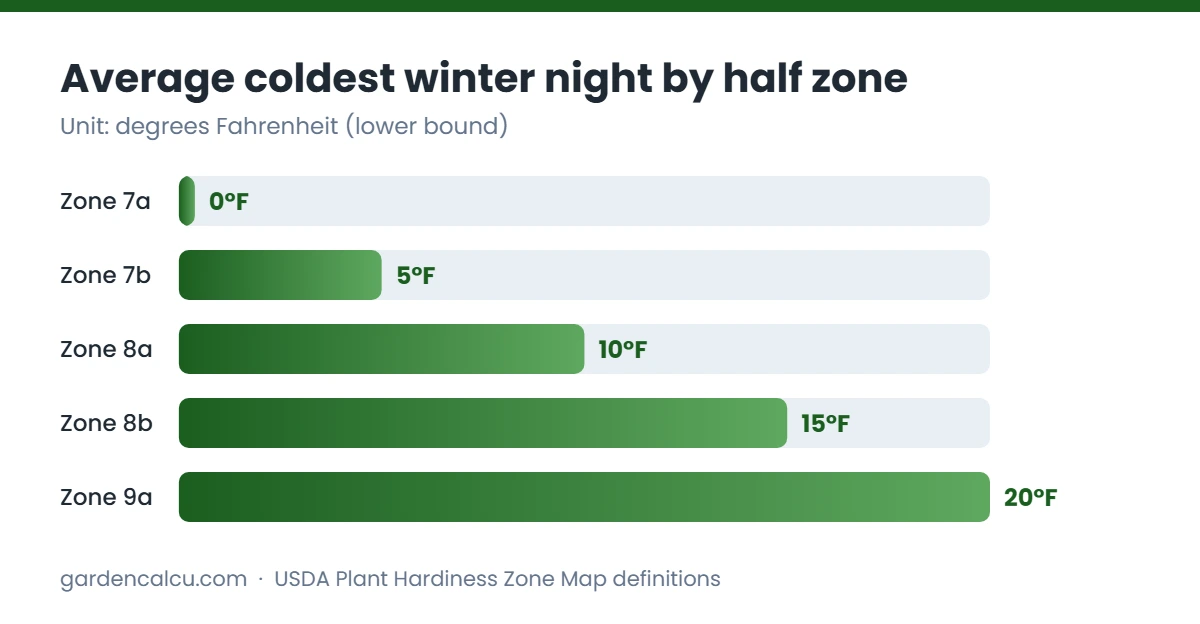
Chart for “what hardiness zone am I in”: the lower end of the average coldest winter temperature for half zones 7a to 9a.
Worked example: a shrub labeled “hardy to zone 5” can survive average winter lows down to minus 20°F. If you live in zone 6b, where the average low is minus 5 to 0°F, it has a comfortable margin. A plant labeled zone 8 in the same garden would be killed in a normal winter.
Fact 3: what changed in the 2023 map
The USDA released an updated map in November 2023, based on weather data from 1991 to 2020. Much of the country shifted about half a zone warmer than on the previous 2012 map.
The two Mid-Atlantic answers show what that looks like on the ground.
Area | Old zone | New zone | Source |
|---|---|---|---|
Coastal Sussex County, Delaware | 7b | 8a | Delaware answer, 2024 |
Western Sussex County, Delaware | 7a | 7b | Delaware answer, 2024 |
Chesapeake Bay shore, Anne Arundel County, Maryland | 7 | 8a | Maryland answer, 2024 |
Other parts of Maryland’s zone 7 | 7 | Unchanged in many places | Maryland answer, 2024 |
The Maryland expert made a point worth repeating. The map looks backward. It summarizes decades of past weather, so by the time a place is redrawn as 8a it has functionally been 8a for a while. Your garden did not change the day the map did.
Do I need to change what I do?
Mostly no. The Bay-side gardener worried that years of zone 7 planning were now wrong. The expert’s answer was reassuring. Zone 8 has a slightly longer growing season than zone 7, so you can stretch sowing and harvest a little at each end. Nothing you were already growing stops working.
What a half-zone shift does allow is a bit more ambition with borderline perennials and shrubs, in a sheltered spot, knowing a severe winter may still take them.
Watch out: A warmer zone is not a promise. The Delaware expert was clear that the change does not mean there will be no well-below-freezing weather. Zones are averages. A once-in-ten-years cold snap still arrives about once in ten years.
Fact 4: what the zone does not tell you
This is where gardeners go wrong, and the Oregon answer says it best. Many factors decide whether a plant survives besides minimum temperature.
So the zone answers one question: will this perennial, tree or shrub survive my average winter? For when to plant vegetables, use frost dates and the Planting Calendar, not the zone.
Microclimates in your own yard
Your property is not one zone. A bed against a south-facing brick wall can behave half a zone warmer. A low corner where cold air pools can be half a zone colder. An exposed hilltop is harder on plants than the map suggests. Put borderline plants in the warm spots and tough ones in the cold spots.
Fact 5: the two-zone rule for containers
The Catonsville question contains a rule every container gardener should know. A plant in a pot is not protected by the mass of the earth. Its roots are exposed to air temperature on all sides, and roots are less hardy than tops.
The Maryland expert’s advice was to choose plants rated two zones hardier than your own for containers that stay outdoors all winter.
Your zone | Choose container perennials hardy to |
|---|---|
5 | Zone 3 |
6 | Zone 4 |
7 | Zone 5 |
8 | Zone 6 |
In zone 7a, that means plants hardy to at least zone 5a, exactly as the expert said. Large pots, grouping pots together and placing them against a wall all help.
Find your planting dates
Your zone tells you what survives winter. For when to plant, open the planting calendar and check frost dates and planting windows.
Zones for vegetables and annuals
Annual vegetables and flowers complete their life in one season and never face winter, so the hardiness zone matters little for them. What matters is the length of your frost-free season and how warm it gets.
The zone becomes relevant again for anything that stays in the ground over winter: garlic, overwintered spinach and kale, asparagus, rhubarb, strawberries and fruit trees. See when to plant garlic and mulch strawberries for winter for two of those.
For trees and shrubs, always check the zone on the tag before buying, then check the mature size as well. Our guide on how far to plant a tree from a house covers that side.
Other things that came with warmer zones
The Delaware expert mentioned a less welcome change. Insect pests that used to be found only in more southern states are now appearing in southern Delaware. Milder winters let them survive further north. It is one more reason to check with your state Extension service, which tracks new pests as they arrive.
Common mistakes
Frequently asked questions
Short answers to the questions that come up most often.
Quick recap
What hardiness zone am I in? Look it up by zip code on the USDA map. The number tells you how cold an average winter gets, and whether a perennial, shrub or tree is likely to survive it.
It does not tell you frost dates, summer heat or anything about your own microclimates. Use it for choosing plants and use frost dates for timing.
Plan by frost dates
Open the planting calendar to see frost timing and planting windows for the crops you grow.
Related guides
Sources
The facts in this guide to “what hardiness zone am I in” come from these university Extension pages and public questions: