What Do Fertilizer Numbers Mean? N-P-K in 5 Easy Steps
What do fertilizer numbers mean? The three numbers on every bag are the percentage by weight of nitrogen (N), phosphate (P) and potash (K), always in that order. A 10-pound bag of 27-0-3 contains 2.7 pounds of nitrogen, no phosphate and 0.3 pound of potash. The rest is carrier.
That is simple enough. The confusion starts when a soil test comes back saying you need “3 to 4 pounds of nitrogen, 5.1 pounds of phosphate and 4.8 pounds of potassium per 1,000 square feet” and the store sells nothing with those numbers on it.
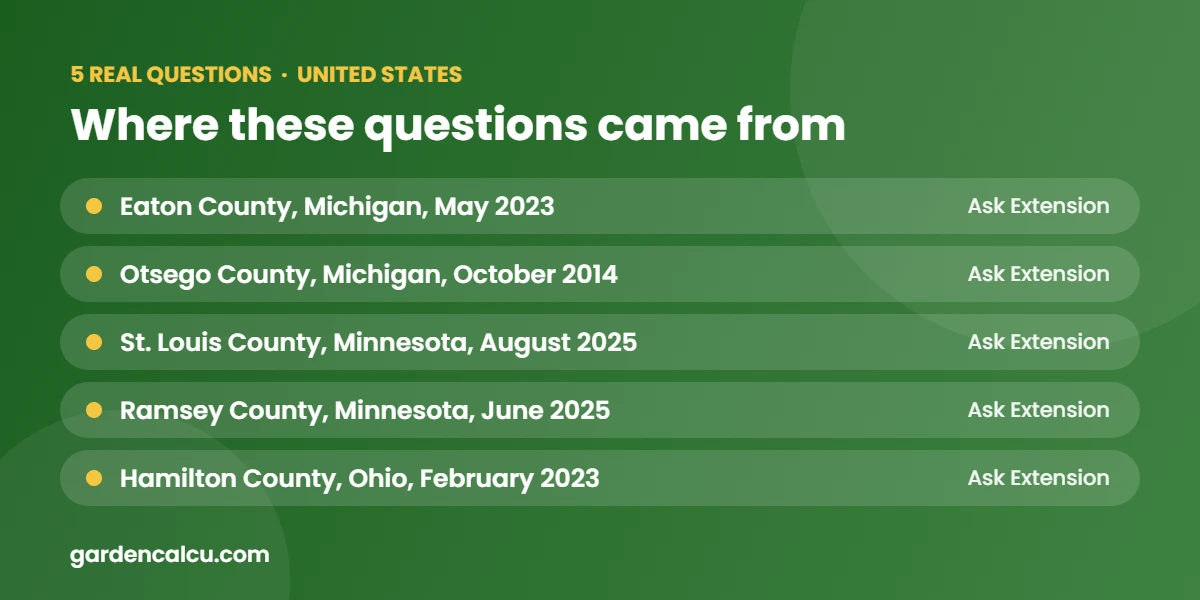
This guide is built from five real questions sent to university Extension services in Michigan, Ohio and Minnesota by people holding exactly that kind of report. The experts explain the numbers, the ratios and how to get from pounds of nutrient to pounds of product.
Key takeaways
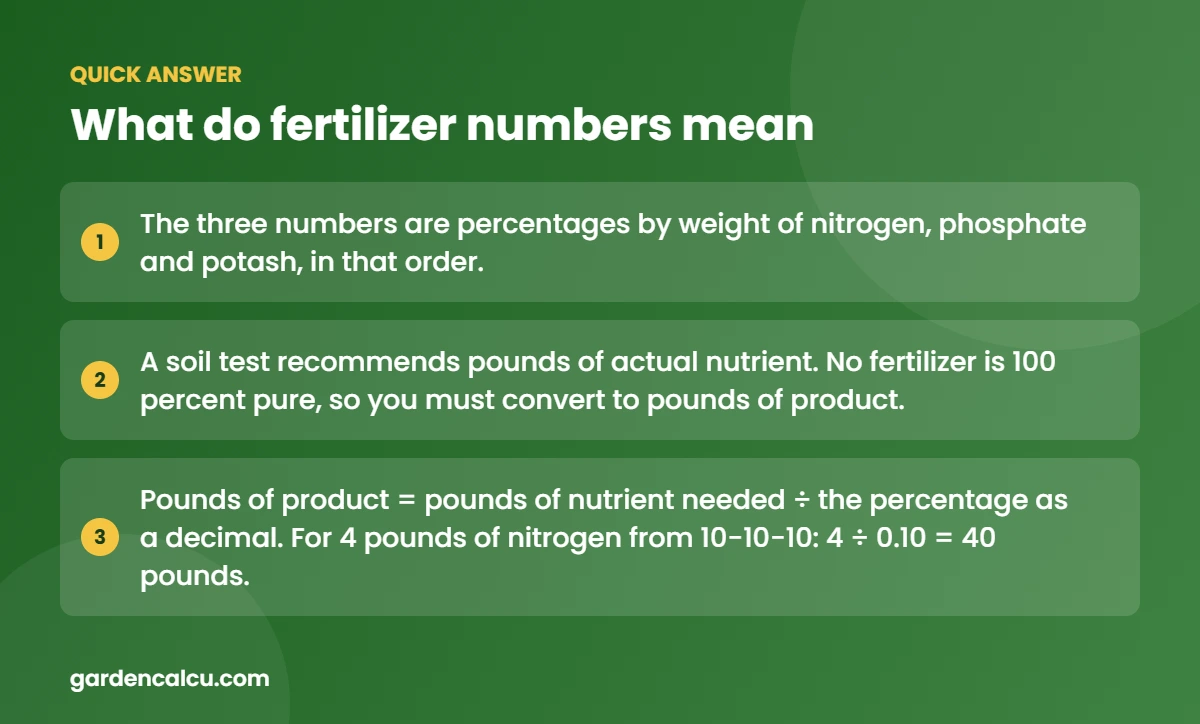
Quick answer to “what do fertilizer numbers mean” in three points.
Real questions gardeners asked
People ask what do fertilizer numbers mean when a soil test and a store shelf do not match. We read five real questions from gardeners in that position, and summarized each in our own words with a link to the original.
“Explanation of fertilizer ratio to use, please”
The question: A soil test said the garden needed 3 to 4 pounds of nitrogen, 5.1 pounds of phosphate and 4.8 pounds of potassium per 1,000 square feet, with a desired fertilizer ratio of 1:1:1. Did that mean buying something like 12-12-12?
What the expert said: Yes, the expert said. The three amounts can all be rounded to about 5 pounds, so equal parts of each nutrient are needed. That is why the report gives a 1-1-1 ratio. A 12-12-12, a 5-5-5 or a 2-2-2 all have the same ratio. What changes is how much of each product you apply.
“What kind of fertilizer do I use?”
The question: A gardener’s soil test called for 3 to 4 pounds of nitrogen, 2.8 pounds of phosphate and 5.8 pounds of potassium per 1,000 square feet, and also mentioned 0-0-60. What was the most cost-efficient way to do it?
What the expert said: The expert explained that the first listing is for pure nutrients, and no such products exist. Fertilizers are always percentages, such as 46-0-0, which is 46 percent nitrogen, or 0-0-60, which is potash. The potash figures were the same recommendation stated two ways, as nutrient and as product.
“Fall lawn fertilizer”
The question: A homeowner asked which granular fertilizer is best for a fall lawn feeding.
What the expert said: A mostly nitrogen product such as 27-0-3, the Master Gardener said. In that example 27 percent of the bag weight is nitrogen, 3 percent is potassium and the remainder is an inert carrier such as clay. A 10-pound bag holds 2.7 pounds of nitrogen. Look for a lawn fertilizer with a large first number and a small last number. In Minnesota, lawn fertilizers have zero phosphorus by law.
“Do I even fertilize?”
The question: A soil test recommended a 1-0-1 fertilizer. The homeowner could find almost nothing with that ratio and asked whether to fertilize at all.
What the expert said: The volunteer was not surprised by the high phosphorus, since most Minnesota lawns test that way. She advised against fertilizing in summer heat and pointed to the early September timing on the report.
“Fertilzer for Vegetable garden and yard”
The question: A soil report listed N, P2O5, K2O and other nutrients for a 900 square foot lawn and a vegetable garden. The homeowner asked where to buy each one and whether they come in one bag.
What the expert said: The volunteer suggested buying a complete fertilizer with an N-P-K of 10-10-10 and setting the broadcast spreader to deliver 1 pound per 1,000 square feet, using the spreader’s manual.
What do fertilizer numbers mean, exactly?
Every fertilizer label carries three numbers separated by dashes. This is the grade, or guaranteed analysis.
Position | Nutrient | Written on soil tests as | What plants use it for |
|---|---|---|---|
First | Nitrogen | N | Leaf and stem growth, green color |
Second | Phosphate | P2O5 | Roots, flowers, fruit and seed |
Third | Potash | K2O | Overall vigor, stress tolerance, fruit quality |
Each number is a percentage of the bag’s weight. In a 50-pound bag of 10-10-10 there are 5 pounds of nitrogen, 5 pounds of phosphate and 5 pounds of potash. The other 35 pounds are carrier and filler that make the product spreadable, as the Minnesota Master Gardener described.
A fertilizer with all three, such as 10-10-10, is called complete. One with a single nutrient, such as 46-0-0 or 0-0-60, is a straight fertilizer.
Step 1: read the soil test as pounds of nutrient
A soil test tells you how many pounds of each actual nutrient to apply, usually per 1,000 square feet. The Otsego County expert put it plainly. Those figures are for products that do not exist, because nothing is 100 percent pure.
So the report is a target, and the bag is a way of hitting it.
Step 2: find the ratio
Divide each recommended amount by the smallest one to see the proportions. The Eaton County report asked for roughly 4, 5.1 and 4.8 pounds. Those are nearly equal, so the ratio is 1-1-1.
Soil test asks for (N, P, K) | Ratio | Grades that match |
|---|---|---|
4, 5, 5 lb | 1-1-1 | 10-10-10, 12-12-12, 5-5-5 |
4, 2, 2 lb | 2-1-1 | 20-10-10, 10-5-5 |
4, 0, 4 lb | 1-0-1 | 15-0-15, or separate products |
4, 0, 0.5 lb | Mostly nitrogen | 27-0-3, 32-0-4 |
0, 0, 6 lb | Potash only | 0-0-60 |
Any grade with the same ratio does the same job. As the Michigan expert said, 12-12-12, 5-5-5 and 2-2-2 are all 1-1-1. The difference is concentration.
Step 3: convert nutrient to pounds of product
This is the one formula to remember.
Worked example: the test calls for 4 pounds of nitrogen per 1,000 square feet and the ratio is 1-1-1. With 12-12-12: 4 ÷ 0.12 = 33.3 pounds of product. That also delivers 4 pounds each of phosphate and potash, close to the 5.1 and 4.8 the report wanted.

Chart for “what do fertilizer numbers mean”: pounds of each grade needed to deliver 4 pounds of nitrogen per 1,000 square feet.
Grade | Nitrogen | Product for 4 lb N per 1,000 sq ft | Product for 1 lb N |
|---|---|---|---|
46-0-0 (urea) | 46% | 8.7 lb | 2.2 lb |
27-0-3 | 27% | 14.8 lb | 3.7 lb |
12-12-12 | 12% | 33.3 lb | 8.3 lb |
10-10-10 | 10% | 40 lb | 10 lb |
5-5-5 organic | 5% | 80 lb | 20 lb |
2-2-2 | 2% | 200 lb | 50 lb |
A low-analysis fertilizer is not weaker in any harmful sense. You simply need more of it. Organic fertilizers tend to have low numbers and release their nutrients slowly.
Tip: The Fertilizer Calculator does this conversion. Enter your area, the three numbers on the bag and the pounds of nutrient you need.
Step 4: scale to your area
Rates are per 1,000 square feet. Multiply by your area divided by 1,000.
Worked example: the Hamilton County lawn was 30 by 30 feet, which is 900 square feet. To apply 1 pound of nitrogen per 1,000 square feet with 10-10-10, you need 10 pounds of product per 1,000 square feet, so 10 x 0.9 = 9 pounds for that lawn.
Vegetable gardens are often given a total for the season, split between a pre-plant application and one or two side dressings. Lawns are given a rate per application, commonly 0.5 to 1 pound of nitrogen per 1,000 square feet. See when to fertilize lawn in fall.
Watch out: Do not apply a season’s worth of nitrogen at once. Four pounds of nitrogen per 1,000 square feet is a yearly total for a vegetable garden or lawn, not a single dose. Too much at one time burns plants and washes away.
Step 5: handle a ratio the store does not sell
The Ramsey County homeowner needed 1-0-1 and found almost nothing. This is common. There are three ways through.
What you should not do is use a balanced 10-10-10 when the report says phosphorus is already high. That adds a nutrient the soil does not need.
Why the middle number is often zero
The Minnesota answers explain the zeros. Most Minnesota lawns test high in phosphorus, and state law keeps phosphorus out of lawn fertilizer for established turf. Several other states have similar rules, because phosphorus that washes off lawns feeds algae in lakes and streams.
Phosphorus also moves very little in soil, so it builds up where it has been applied for years. Gardens that have had regular compost or manure often test high as well. That is another reason to test before choosing a grade.
Starter fertilizers for new seed are the exception. They include phosphorus because seedlings with tiny roots benefit from it.
Convert your soil test to pounds of product
Enter the area, the three numbers on the bag and the pounds of nutrient your soil test recommends. The calculator gives the pounds of fertilizer to apply.
Other things on the label
Choosing a fertilizer for vegetables
Without a soil test, a balanced grade used at a modest rate is the usual starting point for a vegetable garden, and compost supplies much of what plants need. Our guide on how much compost to add to garden covers that side.
With a soil test, follow the ratio. Leafy crops respond to nitrogen. Too much nitrogen on tomatoes and peppers gives leaves at the expense of fruit.
Common mistakes
Frequently asked questions
Short answers to the questions that come up most often.
Quick recap
What do fertilizer numbers mean? Percent by weight of nitrogen, phosphate and potash. A soil test gives pounds of nutrient, and you divide by the percentage on the bag to get pounds of product.
Match the ratio, scale to your area, split the yearly total into several applications and skip any nutrient your soil already has in excess.
Get your exact number
Enter your area and the bag analysis, and the calculator shows how many pounds of fertilizer deliver the nutrients you need.
Related guides
Sources
The facts in this guide to “what do fertilizer numbers mean” come from these university Extension pages and public questions: