Coffee Grounds in the Garden: 5 Facts and Easy Safe Uses
Coffee grounds in the garden are useful but modest. They are a low-level nitrogen source, roughly 2.0-0.3-0.2 as a fertilizer, and a good ingredient for the compost pile. They do not change soil pH much, and spread thickly on the surface they can stop seeds from sprouting.
Few garden materials come with as many claims attached. Grounds are said to acidify soil, turn hydrangeas blue, repel slugs, feed tomatoes and replace fertilizer. One Minnesota gardener summed up the problem when she wrote that the advice online is all over the range from good to bad.
This guide is built from five real questions sent to university Extension services in Minnesota, Ohio, Colorado and Maryland. The experts’ answers sort the claims into what is supported, what is not and how to use grounds without causing problems.
Key takeaways
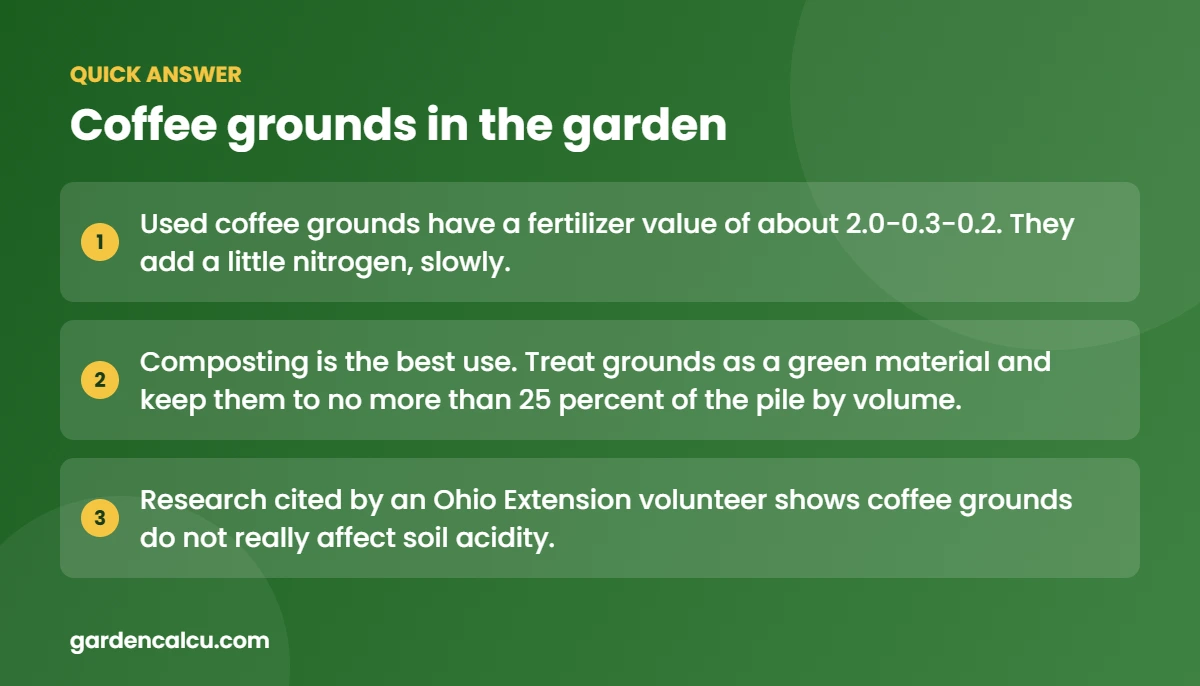
Quick answer to “coffee grounds in the garden” in three points.
Real questions gardeners asked
Questions about coffee grounds in the garden usually begin with something read online. We looked at five real ones sent to Extension experts and the replies. Here is each in our own words, with a link to the original.

“Are used coffee grounds good for a vegetable garden”
The question: A gardener asked whether used coffee grounds are good for a vegetable garden, how to add them and which vegetables benefit most.
What the expert said: Grounds are a low-level source of nitrogen, with a fertilizer value of around 2.0-0.3-0.2, and a minor source of calcium and magnesium, the expert said. Used grounds are reported as slightly to highly acidic depending on the source, but no more so than peat moss. It is better to err on the light side. A rate of 10 pounds dry weight per 1,000 square feet would be conservative. Composting is an excellent way to recycle them. Their carbon to nitrogen ratio is about 20 to 1, so use them like green, leafy material, at no more than 25 percent of the pile by volume.
“Coffee in the garden?”
The question: A gardener asked if outdated coffee could be used in the garden, whether it would help hydrangeas turn blue and whether acid-loving plants would like it.
What the expert said: Coffee grounds can be great in the garden or added to compost bins, the volunteer said. Research shows coffee really does not affect the acidity of soil. She linked to University of Arizona and Washington State University publications on the subject.
“Used coffee grounds in the garden”
The question: Finding the advice online contradictory, a gardener asked whether adding used grounds to soil is a good idea and when it helps.
What the expert said: Coffee grounds are a great source of organic material for the compost pile, the Master Gardener said. Caffeine in the grounds may deter slugs from hostas, and grounds can be spread about an inch deep around individual plants. Research has shown that coffee grounds inhibit seed germination when used as a topdressing.
“Are coffee grounds worthwhile in a Colorado garden?”
The question: A Front Range gardener had heard grounds enrich some soils and asked whether using them in Colorado is worthwhile or a gardening myth.
What the expert said: Grounds are a low-level nitrogen source at about 2.0-0.3-0.2, the Master Gardener said, so they will not act as the strongest option for a garden fertilizer. Plants that prefer more acidic soil like them more than others, and they offer general mulching benefits such as moderating temperature and moisture.
“Spread Coffee Ground on Tall Fescue Lawn”
The question: A homeowner with a demanding lawn on clay had seen people online swear by spreading coffee grounds on grass, and asked if a light coat from a spreader would make the soil too acidic or attract pests and deer.
What the expert said: Start with a laboratory soil test, the expert said. Coffee grounds contain nitrogen, but in low amounts, and may not release it well until they are composted first. Any nutrients applied to a lawn also have to comply with Maryland’s fertilizer law.
Fact 1: coffee grounds are a weak fertilizer
Two experts in two states gave the same analysis: about 2.0 percent nitrogen, 0.3 percent phosphorus and 0.2 percent potassium. That is real but small.
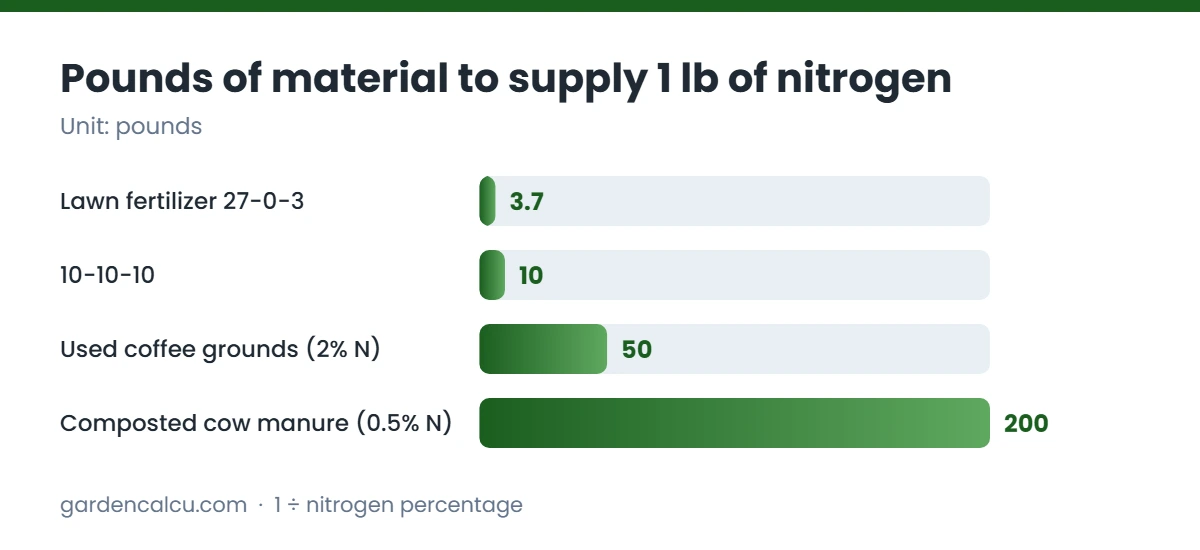
Chart for “coffee grounds in the garden”: how much of each material it takes to supply one pound of nitrogen.
Material | Nitrogen | Pounds needed to supply 1 lb of nitrogen |
|---|---|---|
Lawn fertilizer 27-0-3 | 27% | 3.7 lb |
10-10-10 | 10% | 10 lb |
Used coffee grounds, dry | About 2% | 50 lb |
Composted cow manure | About 0.5% | 200 lb |
Worked example: the conservative rate from the Minnesota answer is 10 pounds of dry grounds per 1,000 square feet. At 2 percent nitrogen that delivers 10 x 0.02 = 0.2 pound of nitrogen. A typical single lawn feeding is 0.5 to 1 pound per 1,000 square feet. So grounds at a safe rate supply a fifth of a light feeding, and the Maryland expert pointed out that the nitrogen is not released well until the grounds have been composted.
Grounds are best thought of as organic matter with a small bonus, not as a fertilizer. For feeding plants properly, see what do fertilizer numbers mean.
Fact 2: they do not acidify soil much
This is the most repeated claim and the weakest. The Ohio volunteer put it plainly. Research shows coffee really does not affect acidity of soil.
Most of the acid in coffee ends up in the cup. Used grounds vary, and the Minnesota expert described them as slightly to highly acidic depending on the source, but no more so than peat moss. Whatever acidity they have is quickly neutralized in soil as they decompose.
To change pH in a way you can measure, see how to lower soil pH, which covers elemental sulfur.
Fact 3: compost is the best place for them
Three of the five answers point to the compost pile. Grounds are fine-textured, moist and fairly rich in nitrogen, with a carbon to nitrogen ratio around 20 to 1. In composting terms they are a green, even though they are brown in color.
Composting first also solves the release problem the Maryland expert raised. Finished compost made with grounds can be used at normal compost rates. See how much compost to add to garden.
Worm bins take coffee grounds as well. Mix them with dry bedding before adding, as the Minnesota expert advised.
Fact 4: on the soil surface, less is more
Applied directly, grounds have two drawbacks named in the answers.
So how much is safe? The answers give two workable rules.
Use | Amount | Source |
|---|---|---|
Spread over a garden or lawn | 10 lb dry weight per 1,000 sq ft | Minnesota answer, 2015 |
Around individual established plants | Up to about an inch deep | Minnesota answer, 2022 |
In the compost pile | Up to 25% by volume | Minnesota answer, 2015 |
Over seeds or seedlings | None | Germination is inhibited |
Worked example: a 4 x 8 ft bed is 32 square feet. At 10 pounds per 1,000 square feet, that is 0.32 pound of dry grounds, roughly a few days of household coffee. Scratch it into the surface or cover it with other mulch so it does not crust.
Watch out: Do not dump a week of coffee shop grounds on one bed. A thick layer stays soggy, grows mold and can stunt plants. Spread large quantities thinly over a wide area or compost them.
Fact 5: slugs, pests and other claims
Claim | What the Extension answers say |
|---|---|
Repels slugs | Caffeine may deter slugs from hostas, a Minnesota Master Gardener said. Results vary. |
Acidifies soil | Not meaningfully. |
Replaces fertilizer | No. Too weak and too slow. |
Good mulch | Only thinly, or mixed with coarser material. |
Great for the lawn | Low nitrogen that is not released well until composted. Test the soil instead. |
Improves soil | Yes, as organic matter, especially through compost. |
Work out real fertilizer needs
Enter your garden or lawn area and the fertilizer analysis. The calculator shows how many pounds of product supply the nitrogen your plants need.
Coffee grounds on the lawn
The Maryland homeowner hoped a light coat of grounds would cut down on fertilizer. The expert steered him to a soil test first, since a lawn that needs constant feeding and gets disease often has an underlying pH or nutrient problem.
A thin scattering of grounds does a lawn no harm, but it does not replace a fall feeding. See when to fertilize lawn in fall for rates that actually move the needle, and keep grounds off any area you are seeding. In some states, lawn nutrient applications of any kind are regulated, as the Maryland answer noted.
How to use them: a short plan
Fall is a good time to stockpile. Layer grounds with shredded leaves through the season and you will have compost by spring. See leaves as mulch for what else to do with the leaves.
Common mistakes
Frequently asked questions
Short answers to the questions that come up most often.
Quick recap
Coffee grounds in the garden are a mild, slow nitrogen source and a good compost ingredient. They do not acidify soil in any useful way and should not be used thickly or over seeds.
Compost most of them, scatter the rest thinly, and keep feeding plants according to a soil test.
Get your exact number
Enter your area and the bag analysis, and the calculator gives the pounds of fertilizer to apply.
Related guides
Sources
The facts in this guide to “coffee grounds in the garden” come from these university Extension pages and public questions: