When to Fertilize Lawn in Fall: 5 Best Dates and Easy Rates
The short answer to when to fertilize lawn in fall is September in northern states and September to October further south, always while the grass is still green and growing. Stop before the lawn goes dormant or the ground starts to freeze.
Fall is the feeding that matters most for cool-season lawns, and it is also the one people time badly. Some go too early, in the heat of August. Others wait for a “winterizer” date in November, after the grass has stopped taking anything up.
This guide is built from six real questions sent to university Extension services in Minnesota, Ohio, Texas and Oregon. Each answer comes with a date, so you can see where the fall window opens and closes, and one of them contains the clearest rate math we have seen.
Key takeaways
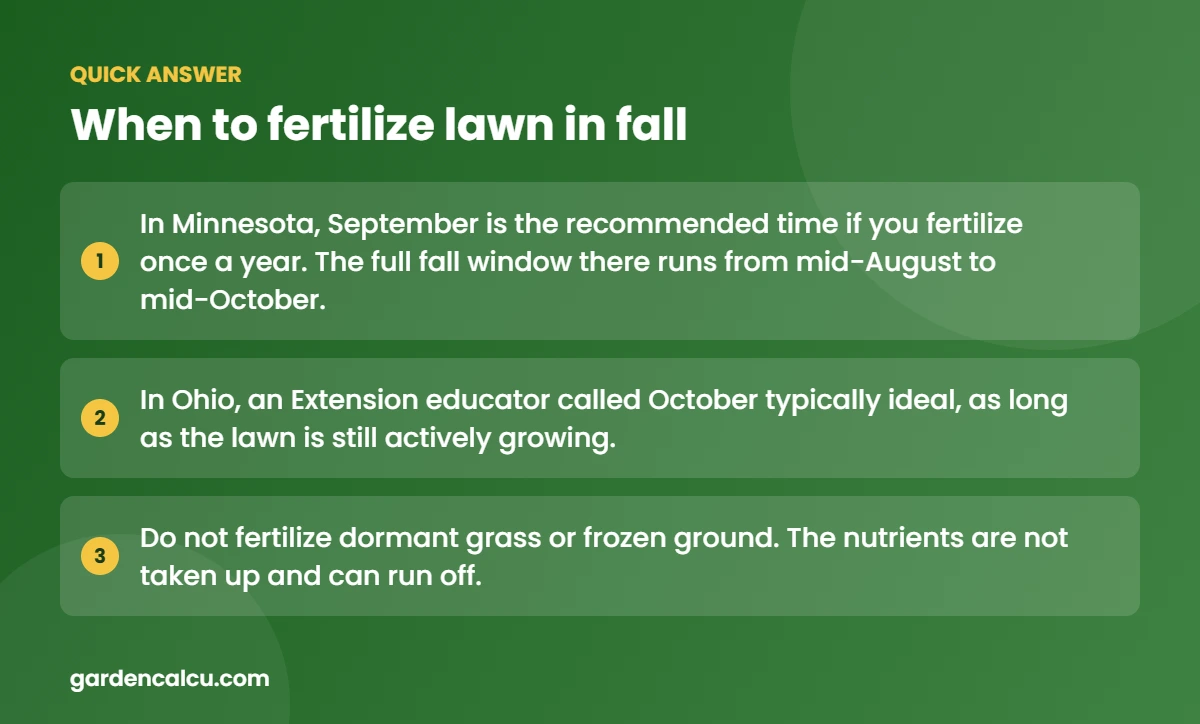
Quick answer to “when to fertilize lawn in fall” in three points.
Real questions gardeners asked
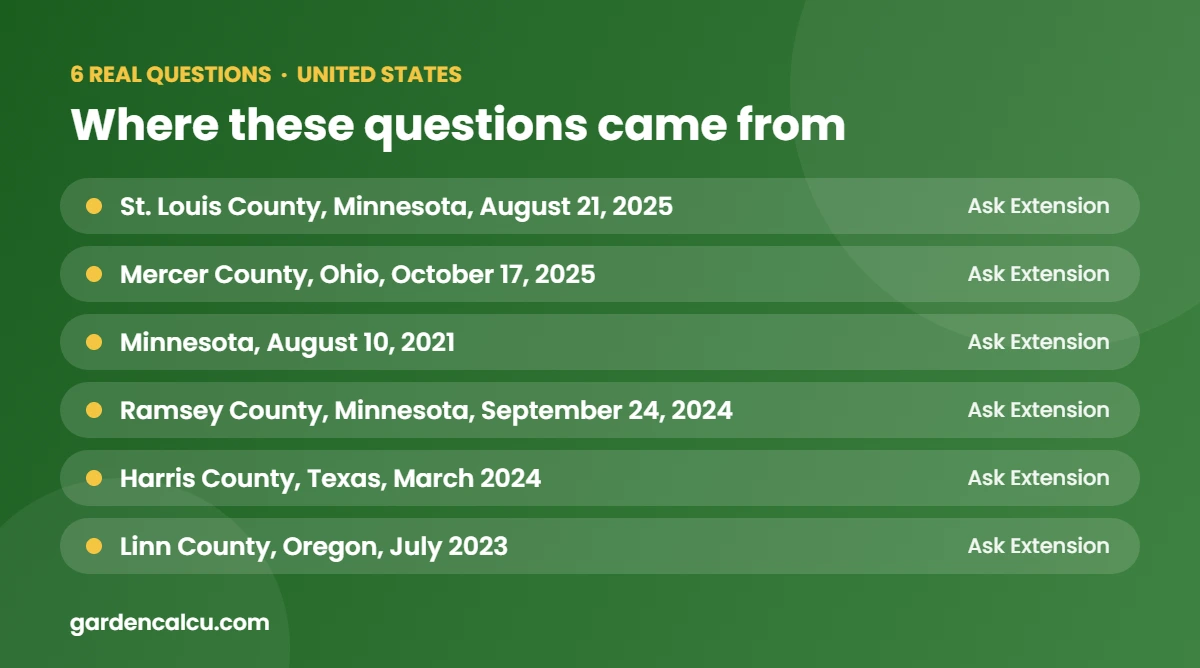
Search for when to fertilize lawn in fall and you get a dozen different dates. So we went to the questions homeowners actually sent to Extension experts, each tied to a real place and day. Here they are in our own words, with a link to each original.
“Fall lawn fertilizer”
The question: A homeowner near Duluth who skips spring and summer feeding asked if August 21 was too early for fall fertilizer, whether to apply again in late October, and which granular product is best.
What the expert said: Too early, the Master Gardener said. September is the recommended time for a single application per year. It should be mostly nitrogen, such as a 27-0-3, at 0.5 to 1.0 pound of nitrogen per 1,000 square feet. A 10-pound bag of 27-0-3 holds 2.7 pounds of nitrogen, enough for 2,700 square feet at the full rate. Leaving clippings on the lawn is recommended.
“Lawn fertilizer”
The question: A homeowner asked two things in mid-October: when should fall fertilizer go on, and what should I use?
What the expert said: The educator said timing depends on grass type, condition and weather, but October is typically ideal for a lawn that is actively growing. Fertilizer put on dormant grass or frozen soil may not break down and can run off. The best way to choose a product is a soil test that shows which nutrients are lacking.
“Fertilizer for Lawn”
The question: After a hot, dry summer with no lawn food, a homeowner on sandy loam asked what ratio to use for a late summer feeding and for a pre-winter feeding.
What the expert said: The Master Gardener recommended a soil test every four or five years as the only accurate guide. In Minnesota the best time for fall fertilizing is mid-August to mid-October. By October the ground generally begins to freeze, and fertilizer applied after that has little chance of being taken up by the grass.
“lawn aerating and winterizer fertilizer”
The question: A homeowner had aeration booked for October 5 and asked whether to fertilize before or after.
What the expert said: After. The volunteer explained that fertilizing after aeration lets nutrients move deeper into the soil through the holes, which improves uptake by the roots.
“lawn fertilization”
The question: A Houston-area homeowner who uses an organic 5-1-3 fertilizer twice a year asked for the best timing of the spring and winterizer applications.
What the expert said: In spring, wait until the lawn has needed mowing two or three times, which is late March to April there. Fertilizer can be applied again in fall, in September or October. Never fertilize a stressed lawn, such as after a freeze or during drought.
“When to fall fertilize in 8D region”
The question: A homeowner at 1,200 feet in the Oregon foothills asked when to fertilize in spring and fall.
What the expert said: The expert pointed to an Oregon State University guide and explained that timing follows growth. Grass grows fastest in mild weather around 70 to 75°F, slows in summer heat, picks up again as late summer cools, and slows sharply with cold, frost and short days.
When to fertilize lawn in fall: dates by region
Line the answers up and the rule is consistent. Feed in early fall while the grass is growing strongly, and finish before growth stops.
Place | Fall fertilizer window | From |
|---|---|---|
Northern Minnesota | September, one application | Ask Extension, 2025 |
Minnesota, general | Mid-August to mid-October | Ask Extension, 2021 |
Ohio | October, while lawn is growing | Ask Extension, 2025 |
Houston area, Texas | September or October | Ask Extension, 2024 |
Western Oregon | As late summer cools and growth resumes | Ask Extension, 2023 |
These are mostly cool-season lawns: Kentucky bluegrass, fescues and ryegrass. They do most of their root growth in fall. Nitrogen applied then is stored and used for early green-up in spring, which is why University of Minnesota Extension says the best time to feed lawns there is fall.
What about a November “winterizer”?
Bags labeled winterizer suggest a very late feeding. The Extension answers are cautious about that. Once grass goes dormant or the soil freezes, fertilizer is not taken up. The Ohio educator warned about runoff, and the Minnesota Master Gardener about burn. A winterizer product is fine. Just apply it inside the window above.
Watch out: Never spread fertilizer on frozen ground, on dormant brown grass or on a lawn stressed by drought. It will not help the grass, and the nutrients can wash into storm drains and streams.
Why August is too early and November is too late
The Oregon answer explains the logic. Grass growth follows temperature. It surges in mild weather, stalls in summer heat, recovers as nights cool, then shuts down with frost and short days.
Fertilizer works when the plant is growing. In hot August weather, cool-season grass is stressed and may be half dormant. Feeding it pushes soft growth at the wrong time. That is why a northern Minnesota homeowner was told on August 21 to wait for September.
At the other end, the grass has to be awake to absorb what you spread. A simple test: if you are still mowing, the lawn is still growing.
Tip: Use mowing as your signal. When growth picks up after summer and you are mowing weekly again, the window is open. When you put the mower away for winter, it has closed.
How much fall fertilizer to apply
Rates for lawn fertilizer are given in pounds of actual nitrogen per 1,000 square feet. The Minnesota answer gave 0.5 to 1.0 pound. The trick is turning that into pounds of product from the bag.
Worked example: a 5,000 square foot lawn at 1.0 pound of nitrogen per 1,000 square feet, using 27-0-3. 3.7 x 5 = 18.5 pounds of product. At the lower rate of 0.5 pound, it is 9.25 pounds.
The Master Gardener ran the same sum from the other direction. A 10-pound bag of 27-0-3 holds 2.7 pounds of nitrogen, so it covers 2,700 square feet at 1.0 pound per 1,000 square feet, or 5,400 square feet at 0.5 pound.
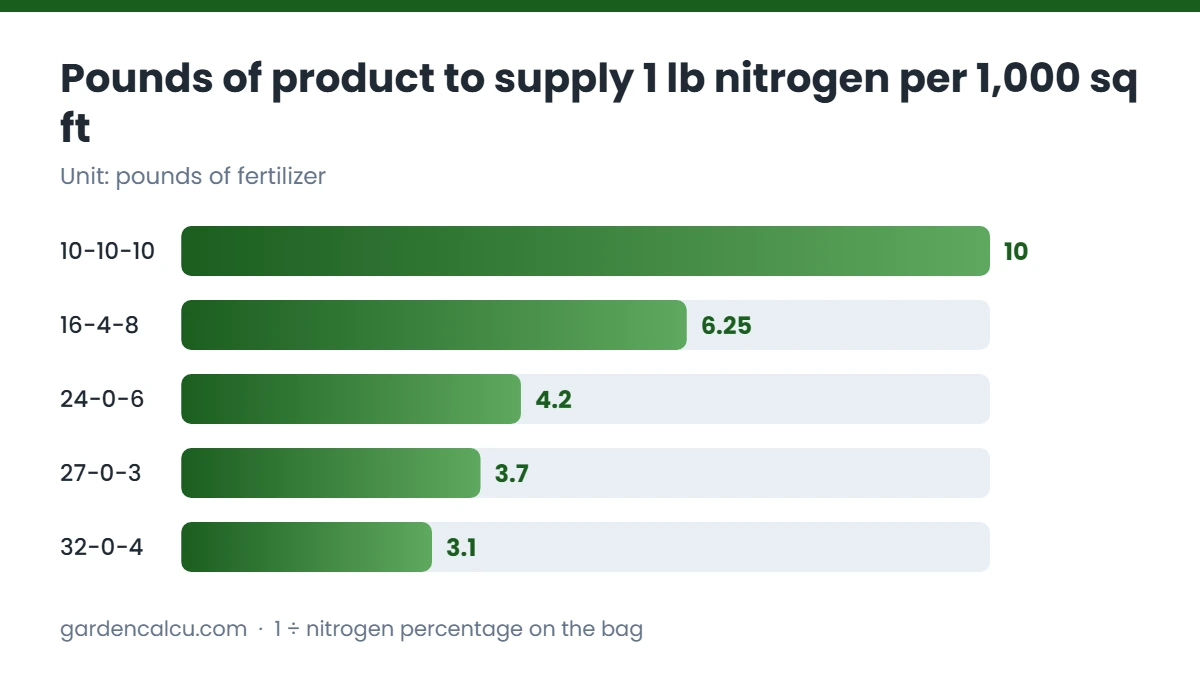
Chart for “when to fertilize lawn in fall”: pounds of each fertilizer grade needed to apply 1 pound of nitrogen per 1,000 square feet.
Fertilizer grade | Nitrogen | Product for 1 lb N per 1,000 sq ft | Product for 0.5 lb N |
|---|---|---|---|
10-10-10 | 10% | 10 lb | 5 lb |
16-4-8 | 16% | 6.25 lb | 3.1 lb |
24-0-6 | 24% | 4.2 lb | 2.1 lb |
27-0-3 | 27% | 3.7 lb | 1.9 lb |
32-0-4 | 32% | 3.1 lb | 1.6 lb |
5-1-3 organic | 5% | 20 lb | 10 lb |
The last row is the organic product the Texas homeowner uses. Low-analysis organic fertilizers are perfectly good. You simply need more pounds of product for the same nitrogen.
Tip: The Fertilizer Calculator does this conversion for any bag. Enter your lawn size, the numbers on the bag and the rate you want.
What kind of fertilizer to use in fall
The Minnesota advice was simple: look for a lawn fertilizer with a large first number and a small last number, such as 27-0-3. The fall application should be primarily nitrogen.
The middle number, phosphorus, is zero on most lawn fertilizers sold in Minnesota because state law restricts phosphorus on established lawns. Several other states have similar rules. If a soil test shows your lawn is short of phosphorus or potassium, that changes the choice, which is why both the Ohio and Minnesota experts pushed soil testing so firmly.
Work out your fertilizer rate
Enter your lawn size and the three numbers on the bag. The calculator tells you how many pounds of product to spread for the nitrogen rate you want.
Aerating, overseeding and fertilizing in the right order
Fall is also the season for aeration and seeding, and the order matters.
If you seeded, go easy. A Minnesota Master Gardener told another homeowner to wait until new grass is at least a month old before fertilizing it. Our guide on when to plant grass seed in fall covers the seeding dates.
Warm-season lawns are different
St. Augustine, bermudagrass and zoysia grow in summer and go dormant in winter, so they are fed mainly from late spring through summer. The Texas answer allowed a fall application in September or October, but the bigger rule there was about stress. Do not feed a lawn after a freeze or during a drought, hoping to fix it. That only adds stress.
Common fall fertilizing mistakes
Most of these come down to one habit: measure the lawn, read the bag, and check the grass is growing before you load the spreader.
Frequently asked questions
Short answers to the questions that come up most often.
Quick recap
When to fertilize lawn in fall comes down to one condition: the grass must be growing. That means September in the North, September to October further south, and never on dormant or frozen turf.
Aim for 0.5 to 1.0 pound of nitrogen per 1,000 square feet, convert it to pounds of product using the first number on the bag, and fertilize after aerating. A soil test every few years keeps the guesswork out.
Get your exact number
Enter your lawn area and the bag analysis, and the calculator shows exactly how many pounds of fertilizer to apply.
Related guides
Sources
The facts in this guide to “when to fertilize lawn in fall” come from these university Extension pages and public questions: