Best Time to Plant Trees: Fall vs Spring and 6 Real Answers
The best time to plant trees is early fall, with early spring a close second. Fall wins in most of the country because the soil is still warm, the air is cool and roots keep growing after the leaves drop. But it has a deadline, and in cold states that deadline arrives sooner than people think.
That deadline is what homeowners actually ask about. A landscaper wants to plant in late October. A wedding tree has to go in on October 8. Fruit trees will not arrive until late November. Is that still fine, or should it wait?
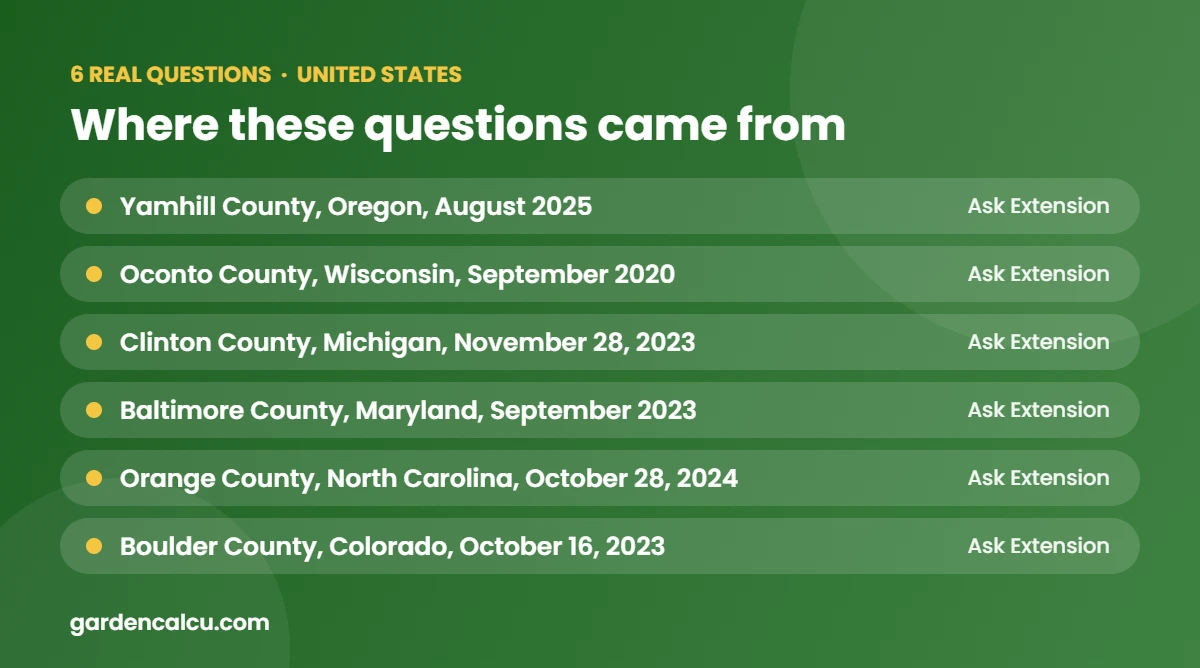
This guide is built from six real questions sent to university Extension services in Oregon, Michigan, Wisconsin, Maryland, North Carolina and Colorado. Their answers show where fall planting works, where it stops working and which trees are better held until spring.
Key takeaways
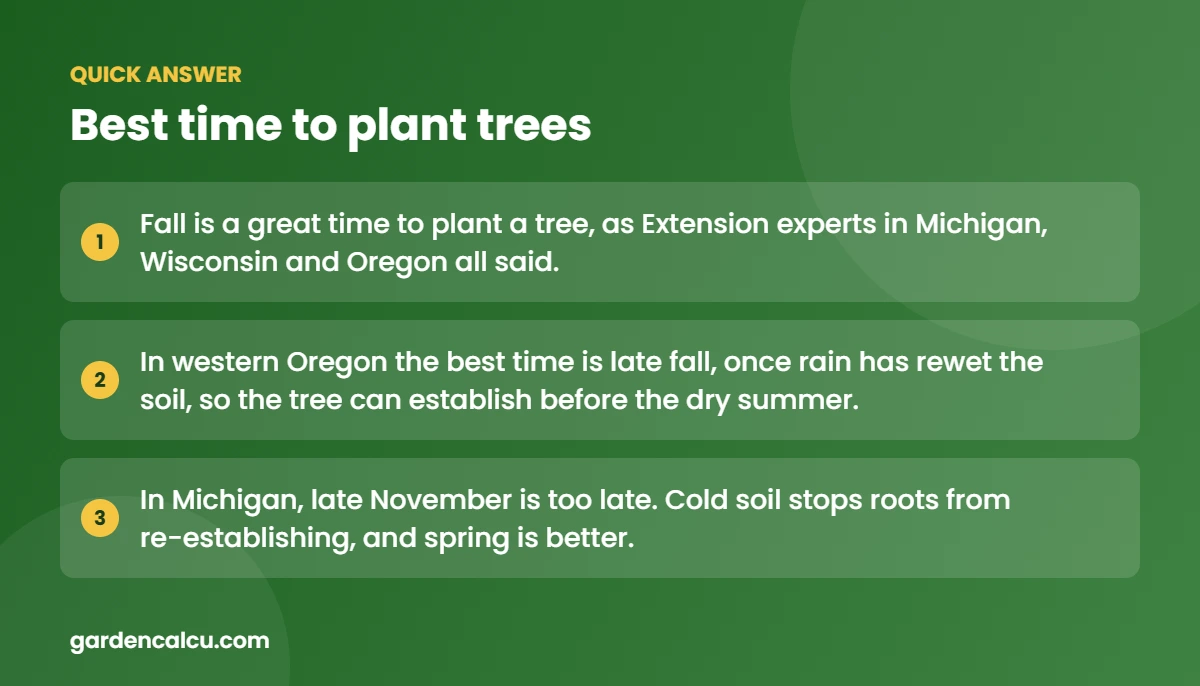
Quick answer to “best time to plant trees” in three points.
Real questions gardeners asked
The best time to plant trees is easy to state and hard to apply to a real date in a real yard. These six questions each came with a date and a place. Here they are in our own words, with what the expert said and a link to each original.
“Best time to plant trees?”
The question: A homeowner wanted to plant oaks or other shade trees and asked which month or season is best to start them.
What the expert said: The best time is during the rainy season, the expert said, especially late fall once the rains have rewet the soil. That lets the tree establish before the dry summer. It will still need some extra watering while it establishes.
“Planting trees”
The question: A homeowner north of Green Bay asked when it becomes too late in fall for trees to root before winter.
What the expert said: Fall planting is fine, the expert said, but do not plant on a day close to freezing, which can freeze the roots. Frost can heave the soil and expose roots, so check that they stay covered, and stake the tree if needed. Roots keep developing through winter. Late fall planting is a bad idea if the tree is still actively growing and the temperature suddenly drops into the teens.
“Planting (trees, perennials)”
The question: A Lansing-area gardener asked if it was too late to plant trees and perennials.
What the expert said: Yes. Soil temperature is what matters for both, the expert said. Late in the season, cold soil reduces the chance that roots re-establish and the plant survives, so spring would be better. For perennials, six weeks before the first frost is the guideline, and the average first frost in that county is early October.
“Planting fruit trees in November?”
The question: A homeowner asked whether cherry and apple trees could be planted in late November, or should wait until spring.
What the expert said: Stone fruits such as cherry, plum and peach are best planted earlier in autumn, in September or October, or in spring, because their thin bark is vulnerable to winter damage before roots establish. Apples and pears are more reliable. If late November is the earliest possible, waiting for spring is more practical for both. In general, it is fine to plant trees after leaf fall as long as the ground is workable.
“fall outdoor planting”
The question: A homeowner asked at the end of October whether shrubs could still go in the ground.
What the expert said: The expert said any shrubs could be planted right then, along with perennials.
“How late in fall can we plant?”
The question: A landscaper planned to install many perennials, shrubs and a couple of trees that fall. The homeowner’s husband worried it was already too late.
What the expert said: It depends on how hardy the plants are and how well established they were at the nursery, the expert said. There had been no hard freeze yet, but they were getting close to the point where the ground is too cold for new plants to establish.
Why fall is the best time to plant trees
A newly planted tree has one job in its first year: grow roots into the surrounding soil. Fall gives it the best conditions to do that.
A tree planted in April has only a few weeks before leaves open and demand water. A tree planted in September or October has months.
How late is too late? Six dates, six answers
Put the answers in date order and the limit of fall planting becomes visible.
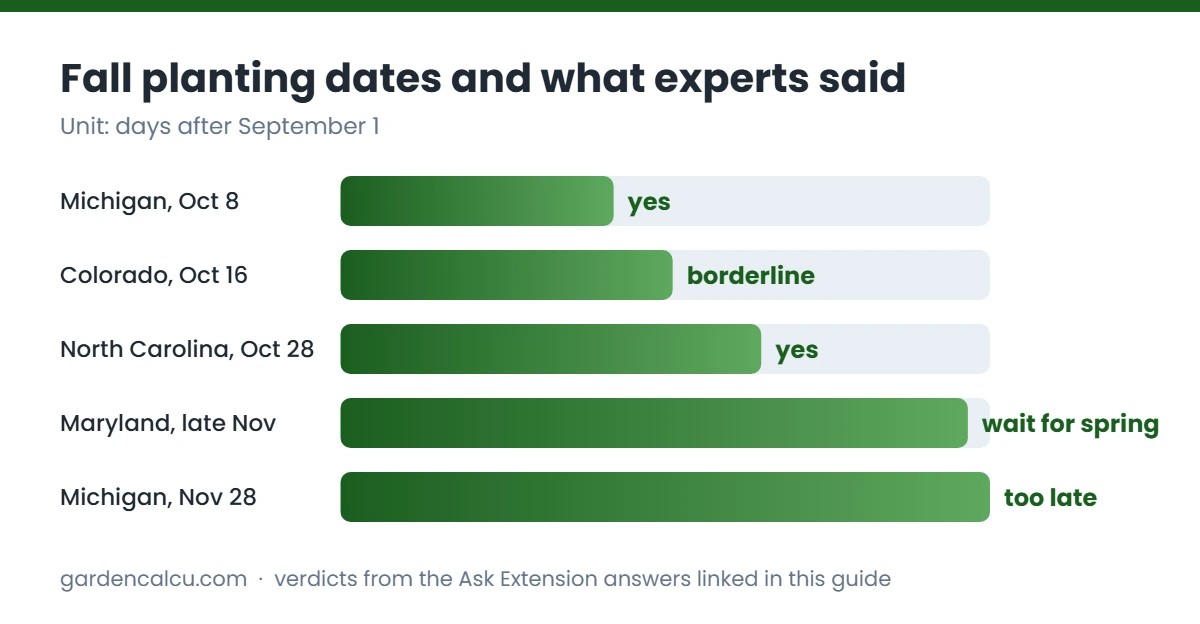
Chart for “best time to plant trees”: fall dates that homeowners asked about and the verdict each expert gave.
Date and place | What was asked | Verdict |
|---|---|---|
October 8, Michigan | Wedding tree planting | Fall is a great time. Go ahead. |
October 16, Colorado | Shrubs and a couple of trees | Getting close to too cold. Depends on the plant. |
October 28, North Carolina | Shrubs | Plant any shrubs now. |
Late fall, western Oregon | Oaks and shade trees | Best time, once rain has wet the soil. |
Late November, Maryland | Cherry and apple | Wait for spring. |
November 28, Michigan | Trees and perennials | Too late. Soil is too cold. |
Two things move the deadline. One is climate. Late October is comfortable in North Carolina and marginal on Colorado’s Front Range. The other is the tree itself, which the next section covers.
The real test: soil, not the calendar
The Michigan expert named soil temperature as the deciding factor. Roots stop growing when the soil gets cold. A common rule of thumb is that root growth slows sharply once soil falls below about 40°F.
The Maryland expert gave the practical version. You can plant as long as the ground is workable, which means not frozen and not too soggy. Workable soil lets you plant. Warm soil lets the tree root. For the best result, aim to plant at least four to six weeks before the ground usually freezes.
Tip: Look up your average first frost date. First frost is not the deadline for trees, since the ground stays unfrozen for weeks afterwards, but it tells you the planting window is entering its final stretch.
Which trees should wait for spring?
Not every tree likes fall planting. The Maryland answer drew the clearest line.
Tree type | Best planting time | Why |
|---|---|---|
Most shade trees in containers or with a root ball | Early fall or early spring | Root ball makes fall planting less traumatic |
Cherry, peach, plum, apricot | September to October, or spring | Thin bark is vulnerable to winter damage |
Apple, pear | Fall or spring | More reliable than stone fruits |
Bare-root trees | Early spring, while dormant | Roots have no soil to protect them |
Evergreens | Early fall or spring | Leaves lose water all winter |
Trees still actively growing | Not late fall | A sudden drop to the teens can kill soft growth |
The evergreen line is general horticultural practice. Because evergreens keep their needles, they lose water through winter and need roots in place before the ground freezes. Plant them early in fall or wait for spring.
Spring planting: the second best time
Spring is the right choice when fall has run out, and it is the first choice for the trees in the table above. Nurseries also have their widest selection at the start of the growing season, as the Maryland expert pointed out.
Plant as early as the soil can be worked. The goal is to get roots growing before leaves open and heat arrives. A spring-planted tree needs more careful watering through its first summer than a fall-planted one.
Summer is the season to avoid. Heat and a full canopy of leaves put heavy demands on roots that have not yet grown out.
Check frost dates for your area
Open the planting calendar to see when frost usually arrives, then plan to plant at least four to six weeks before the ground freezes.
How to plant a tree so it survives
Timing matters less than planting it correctly. More trees are lost to deep planting than to the wrong month.
For the mulch ring, follow the rules in mulch around trees. To work out how much you need, use the Mulch Calculator.
Extra care for fall-planted trees
The Wisconsin answer included three points that apply to any tree planted in fall.
Keep the soil moist but not soggy until the ground freezes. A dry fall is hard on a new tree, and the Oregon expert stressed that even rain-season plantings need extra water during establishment.
Watch out: Do not fertilize a newly planted tree to help it along. Fertilizer pushes top growth the roots cannot yet support. Water and mulch are what it needs.
Common mistakes
Frequently asked questions
Short answers to the questions that come up most often.
Quick recap
The best time to plant trees is early fall, while the soil is warm and at least four to six weeks before the ground freezes. Early spring is next best and is the safer choice for cherry, peach and plum trees, bare-root stock and late arrivals.
Whatever the season, plant with the root flare at ground level, water well and mulch in a wide ring kept off the trunk.
Plan your planting window
Use the planting calendar to find frost timing for your area and count back to a safe planting date.
Related guides
Sources
The facts in this guide to “best time to plant trees” come from these university Extension pages and public questions: