
How Long Does Grass Seed Take to Grow? 7 to 21 Days Guide
How long does grass seed take to grow? Most lawn seed sprouts in 7 to 21 days when the soil is warm and kept moist, then needs a couple more weeks to root. Allow about two months from sowing before you treat it as an established lawn.
The wide range is what confuses people. One homeowner in Ohio was told by the lawn company that grass would be up in a week, and by the mowing company that tall fescue takes a full 28 days. Both could not be right, so he asked an Extension expert.
This guide is built from six real questions like that one, sent to university Extension services in Ohio, Minnesota, Colorado and Michigan. Each answer includes a number of days, and together they give a realistic timeline from seed to first mowing.
Key takeaways
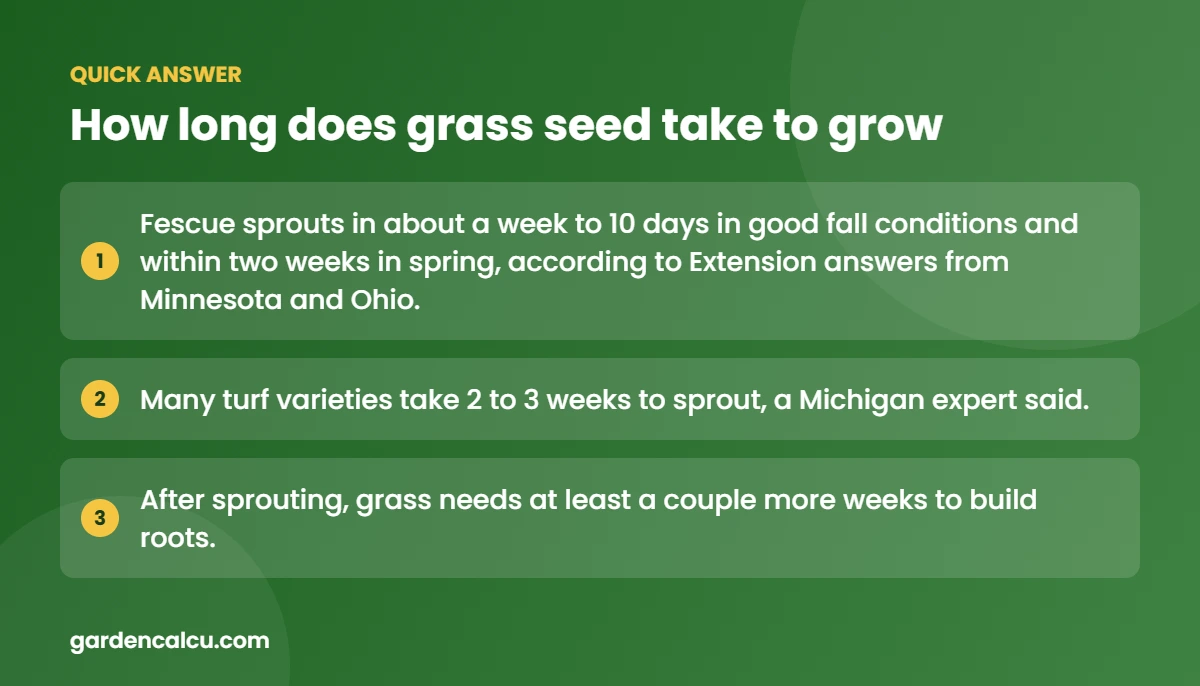
Quick answer to “how long does grass seed take to grow” in three points.
Real questions gardeners asked
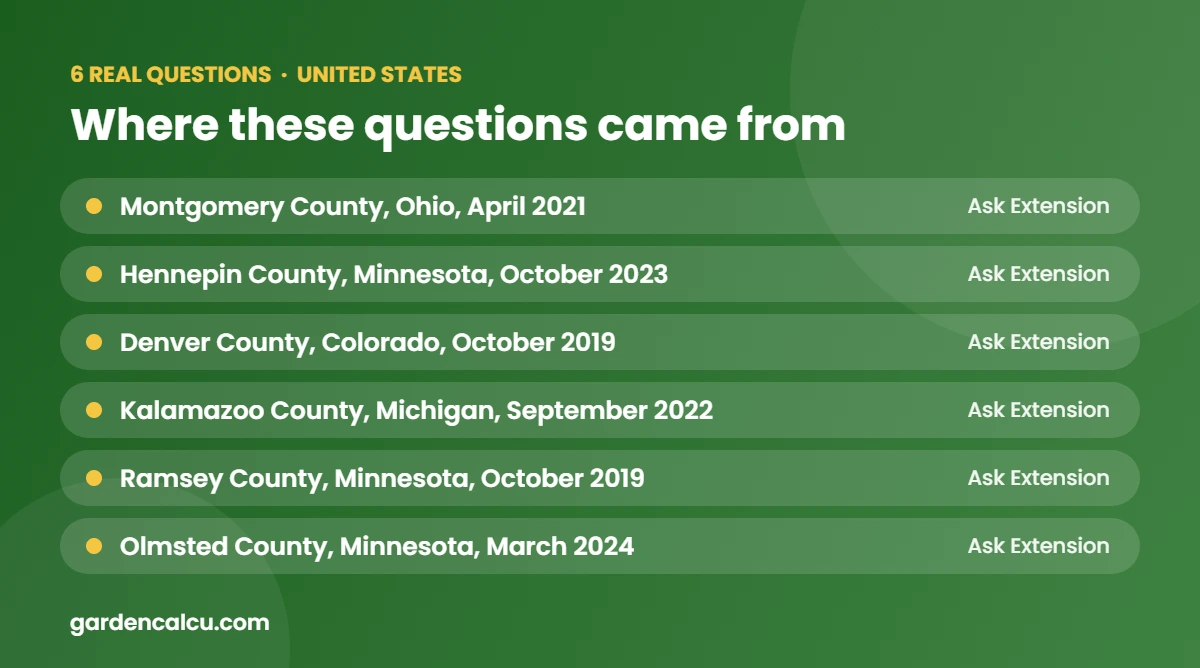
People who ask how long does grass seed take to grow are usually staring at bare soil and wondering if something has gone wrong. We read six real questions and the experts’ replies. Here is each one in our own words, with a link to the original.
“Grass seed germination – tall fescue”
The question: A lawn company slice-seeded tall fescue on April 5 and promised grass in about a week. The mowing company said it takes a full 28 days. The homeowner asked who was right.
What the expert said: Neither, quite. The expert said fescue prefers soil at 50 to 65°F, which matches air temperatures of about 60 to 75°F. With frequent light watering to keep the seedbed moist but not soggy, the fescue should germinate within two weeks.
“Too late to plant turf grass?”
The question: A homeowner asked on October 3 whether fescue sown that week would have time to grow before frost.
What the expert said: The expert said fescue would take a week to 10 days to germinate, then at least another couple of weeks for a good root system to form. With frost usually arriving before mid-October, that was not enough time.
“fall reseeding of lawn in Denver”
The question: A homeowner who planned to reseed in mid-September was delayed until October 8 and asked if the new grass could still establish.
What the expert said: Grass seed usually takes up to 2 weeks to germinate, the expert said, then another couple of weeks to grow roots strong enough to carry it through winter. In warm weather it might just work, but that was a big “if”.
“Too late to seed lawn?”
The question: With highs in the 60s forecast, a homeowner asked if bare spots could still be seeded at the end of September.
What the expert said: The expert explained that seed has to germinate, grow stems and leaves, and develop roots to store sugars for winter. Since many useful turf cultivars take 2 to 3 weeks to germinate, new grass needs upwards of 2 months of favorable weather.
“Can I still plant grass seed”
The question: A homeowner asked on October 7 whether seed sown now would sprout and survive the winter.
What the expert said: No, the Master Gardener said. Seed sown then would germinate within the next two weeks, just as night temperatures dropped to the mid or high 20s. Freezing nights while seed is germinating will kill most of it.
“Spring lawn seeding”
The question: During an unusually warm March, a homeowner asked if it was too soon to seed, and whether a later freeze could kill sprouted grass.
What the expert said: Wait, the Master Gardener advised. Grass seed will not germinate until the soil warms up and it gets water. In that part of Minnesota it is better to seed from May through early June, when germination is better.
How long does grass seed take to grow? The numbers
Here are the sprouting times given in the Extension answers, side by side.
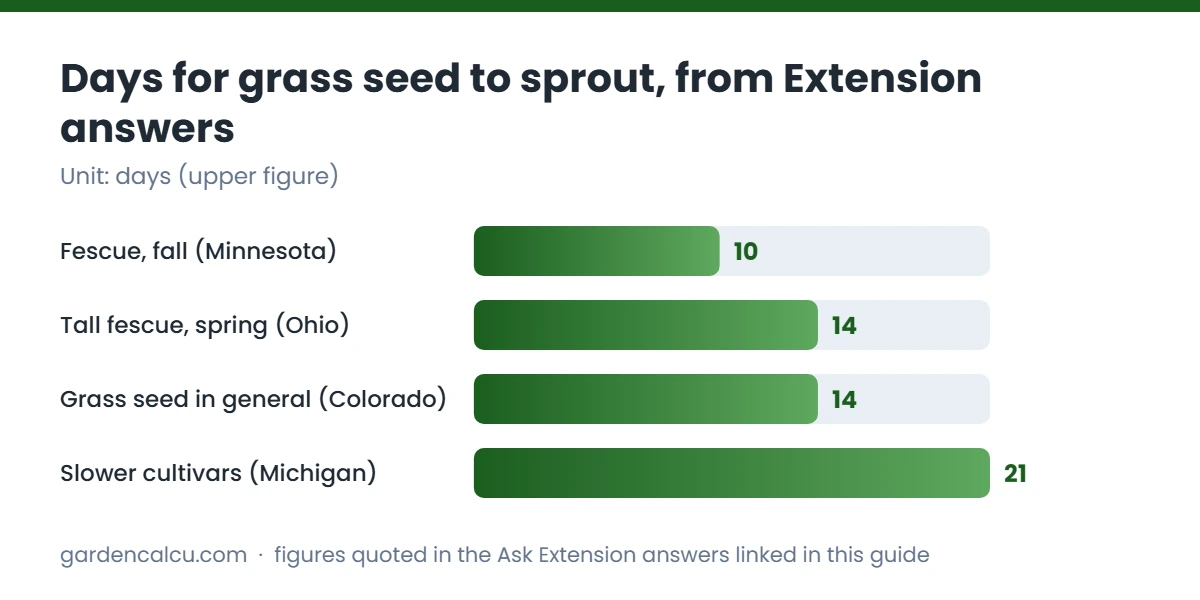
Chart for “how long does grass seed take to grow”: days to sprout quoted by Extension experts in four states.
Grass and conditions | Time to sprout | Source |
|---|---|---|
Fescue, good fall conditions | 7 to 10 days | Minnesota answer, 2023 |
Tall fescue, mild spring, kept moist | Within 2 weeks | Ohio answer, 2021 |
Grass seed in general | Up to 2 weeks | Colorado answer, 2019 |
Many turf cultivars | 2 to 3 weeks | Michigan answer, 2022 |
So the lawn company’s “about a week” was optimistic and the mowing company’s “full 28 days” was pessimistic. For most seed, in decent conditions, expect to see green somewhere between one and three weeks.
Lawn seed is usually a blend. Perennial ryegrass tends to appear first, fescues next, and Kentucky bluegrass last. That is why a newly seeded lawn often looks thin and patchy for a couple of weeks before it fills in. It is not failing. The slower grasses are still on their way.
The full timeline, from seed to lawn
Sprouting is only the first step. The Michigan answer describes the whole sequence: germinate, grow stems and leaves, then develop roots.
Stage | Typical timing | What is happening |
|---|---|---|
Sprouting | Days 7 to 21 | First green shoots appear |
Rooting | The next 2 weeks or more | Roots grow down, seedlings still fragile |
First mowing | Around weeks 4 to 6 | Grass reaches mowing height |
Established | About 2 months | Able to cope with winter cold or summer heat |
The two-month figure is the one to plan around. It explains why Extension experts give seeding deadlines that seem early. If you plant grass seed in fall, count two months back from hard frost. In spring, count two months back from summer heat.
What controls the speed: soil temperature and moisture
Two things decide whether seed sprouts in one week or three, or not at all.
Soil temperature
Seed responds to the temperature of the soil, not the air. The Ohio expert gave fescue’s preferred range as 50 to 65°F in the soil. A Minnesota expert told another homeowner that 60 to 85°F works for cool-season grasses, and called soil temperature the number one issue for germination.
Below that range, seed just sits. That is what the Olmsted County answer means. A warm week in March does not warm the soil enough, so seed sown then waits for weeks and is exposed to birds, rot and washing away.
Moisture
Seed must stay damp from the day it is sown until it sprouts. If it dries out after it has started to swell, it dies. Light, frequent watering is the method. Our guide on how often to water new grass seed gives a schedule.
Tip: A cheap soil thermometer removes the guesswork. Push it 2 inches into the soil in mid-morning. If it reads in the 50s or 60s, cool-season seed will sprout.
Why your grass seed is not growing
If three weeks have passed with warm soil and nothing has come up, one of these is usually the cause.
Problem | Sign | Fix |
|---|---|---|
Soil too cold | Seeded in early spring or late fall | Wait. It may sprout when soil warms. |
Dried out | Surface crusted, a day or more without water | Reseed and water lightly 2 to 3 times a day |
Washed away | Seed collected in low spots after rain | Rake level, reseed, water gently |
No contact with soil | Seed sitting on thatch or dead grass | Rake so seed touches bare soil |
Buried too deep | Seed raked in more than half an inch | Reseed and barely cover |
Weed preventer used | Pre-emergent applied the same season | Wait out the product’s interval |
Old seed | Bag stored several years | Buy fresh seed |
The weed preventer line catches many people. A Maryland Extension expert pointed out that pre-emergent products meant to stop weed seeds also stop grass seed.
Watch out: Do not give up at day 10 and reseed heavily. Doubling the seed crowds the seedlings and wastes money. Check soil temperature and moisture first, and give slower grasses their full three weeks.
Can you make grass seed grow faster?
You cannot rush biology, but you can remove the delays.
A blend that includes some perennial ryegrass gives quick cover while slower grasses fill in. Seed that sprouts fast is not always the grass you want long term, so read the label.
How much grass seed do you need?
Enter your lawn size and whether you are starting a new lawn or overseeding. The calculator gives the pounds of seed to buy.
Too late or too early: what the dates mean
Four of the six questions were really about whether there was enough time. The experts worked it out the same way each time.
Worked example: the Minnesota homeowner wanted to sow on October 7. Add up to 14 days to sprout and it is October 21. By then nights were expected to be in the 20s. The seed would sprout straight into freezing weather, which kills most seedlings. The advice was not to sow.
The Colorado homeowner on October 8 got a softer answer because the weather was still very warm: possible, but a gamble. The Michigan homeowner on September 29 was told it could work, with October being hit-or-miss.
In spring the risk runs the other way. Seed sown in a warm spell in March may sit in cold soil for a month. The Olmsted County answer recommended waiting until May.
To find your own cut-off, look up your first frost date and count back eight weeks.
When to mow new grass
Wait until the new grass is taller than your normal mowing height, usually around 3 to 4 inches, and the soil is firm enough to walk on without leaving footprints. Use a sharp blade and take off no more than a third of the height. Seedlings pulled by a dull blade come out by the roots.
Hold off on fertilizer too. A Minnesota Master Gardener advised waiting until new grass is at least a month old. See when to fertilize lawn in fall for rates.
Common mistakes
Frequently asked questions
Short answers to the questions that come up most often.
Quick recap
How long does grass seed take to grow? One to three weeks to sprout, a couple more weeks to root, and about two months to become a lawn that can handle a season. Warm soil and steady moisture are what decide which end of that range you get.
If nothing has appeared after three weeks of warm, moist conditions, check the list of causes above before reseeding.
Get your exact number
Measure your lawn and the calculator shows how many pounds of seed to buy, so you sow at the right rate.
Related guides
Sources
The facts in this guide to “how long does grass seed take to grow” come from these university Extension pages and public questions: