
How Often to Water New Grass Seed: 3 Easy Stages by Week
How often to water new grass seed comes down to one rule: keep the top of the soil moist, never soggy, until the grass is up. For most lawns that means light watering two to three times a day for the first couple of weeks, then gradually less often and more deeply.
New seed fails far more often from drying out than from anything else. A seed that has started to swell and sprout dies if it dries for even a day. But puddles are just as bad, because they wash seed into clumps and rot it.
This guide is built from five real questions that homeowners sent to university Extension services in Ohio, Minnesota, Oregon and Colorado. The experts’ answers give actual numbers: how many times a day, for how many minutes, and when to cut back.
Key takeaways
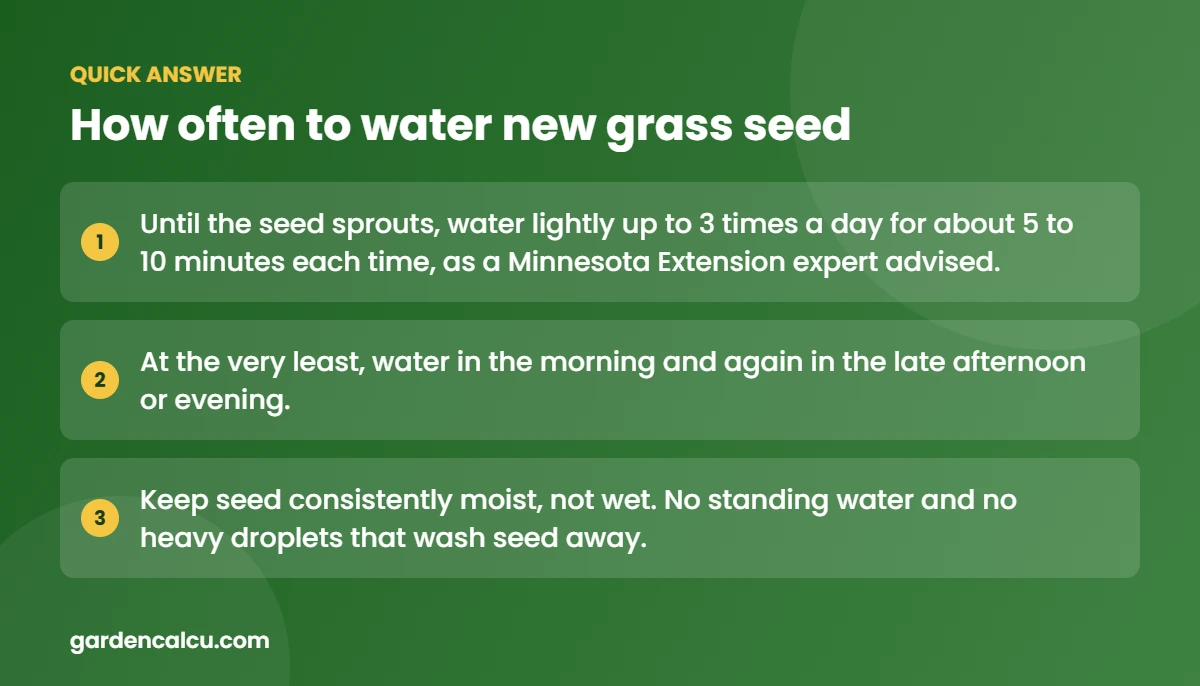
Quick answer to “how often to water new grass seed” in three points.
Real questions gardeners asked
How often to water new grass seed is asked every spring and fall, often by people who have just paid for seeding and received conflicting advice. We read five of those questions and the replies. Here is each one in our own words, with a link to the original.

“When to plant grass seed *this year specifically*”
The question: With highs in the mid-80s forecast, a homeowner asked whether to seed right away or wait for the heat to pass.
What the expert said: Go ahead, the expert said. Soil temperature is the key, and 60 to 85°F works for cool-season grasses. The warm air will not bother the seed as long as it is kept consistently moist, not wet, with no standing water. That may mean watering up to 3 times a day for about 5 to 10 minutes at a time for several weeks. As the grass sprouts, cut back so the soil stays slightly moist, and keep a regular schedule into fall.
“Watering grass seed”
The question: A homeowner had a large area hydroseeded during a dry spell. Two people said watering was not needed and the seed could wait, dormant, for rain. Was that right?
What the expert said: No. The expert replied quickly because it was crucial to water. Hydroseed is still grass seed and needs water to germinate. The whole area should be lightly watered several times a day, and at a minimum in the morning and in the late afternoon or evening.
“Grass seed germination – tall fescue”
The question: A lawn company promised grass in a week. The mowing company said tall fescue takes a full 28 days. The homeowner asked who was right and how often to water to speed things up.
What the expert said: Water frequently but lightly, the expert said. Mist the seeded area to keep it moist but not soggy, since heavy droplets from a sprinkler or hose can wash seeds away. Fescue prefers soil at 50 to 65°F. With light watering once a day in that mild, rainy week, it should germinate within two weeks.
“overseeding a lawn”
The question: A gardener had read that lawn advice had shifted from long, deep, infrequent watering to shorter, more frequent watering, and asked if overseeding needed a different approach.
What the expert said: The expert said that as long as you water at the right time, meaning early morning, more frequent watering is generally better for grass because the soil stays evenly moist and the grass is not stressed. This is especially true on sandy soil, which cannot hold much water.
“fall reseeding of lawn in Denver”
The question: A homeowner who had aerated in mid-September could not seed until October 8 and asked if that was too late.
What the expert said: The expert said grass seed usually takes up to two weeks to germinate, then another couple of weeks to build roots strong enough for winter. Seeding that late would be an experiment that risks the cost of the seed and the water.
How often to water new grass seed: the 3 stages
Watering a new lawn is not one schedule. It changes as the grass grows. Think of it in three stages.
Stage | When | How often | How much |
|---|---|---|---|
1. Seed down, nothing showing | Day 1 to about day 14 to 21 | 2 to 3 times a day | Light, about 5 to 10 minutes |
2. Sprouted and growing | From first green to first mowing | Once a day, then every other day | Longer, to wet the top few inches |
3. Established | After two or three mowings | Once or twice a week | Deep soak |
The numbers in stage 1 come straight from the Minnesota and Ohio answers. The step down in stages 2 and 3 follows the Minnesota expert’s instruction to start cutting back once the grass is sprouting, while never letting the soil dry out.
Stage 1: keep the surface moist
Seed sits in the top quarter inch of soil, which is the first part to dry. That is why the schedule is little and often. You are not trying to soak the ground. You are trying to stop the surface from drying between waterings.
A good routine is early morning, around midday, and late afternoon. If you can only manage two, the Ohio expert’s minimum was morning and late afternoon or evening. On a cool, cloudy or rainy day you can skip a turn. In the Ohio spring example, with mild temperatures and frequent rain, once a day was enough.
Watch out: Watch for runoff. If water is pooling or running down the slope, you are applying it faster than the soil can take it. Stop, let it soak in and shorten the next cycle. Standing water moves seed and leaves bare patches.
Stage 2: fewer, longer waterings
When a green haze appears, roots are heading down. Now you want to follow them. Drop to once a day and water a little longer. A week or two later, move to every other day. The goal is damp soil a few inches down with a surface that is allowed to dry slightly between waterings.
Not all the seed sprouts at once. Ryegrass in a mix may be up in a week while bluegrass is still waking. Keep the surface from drying completely until the slower seed has had its three weeks.
Stage 3: water like a lawn
After the new grass has been mowed two or three times, treat it as part of the lawn. The Oregon answer is a useful reminder that there is no single correct pattern for established turf. On sandy soil, more frequent watering keeps moisture even. On clay or loam, which hold water well, you can go longer between soakings.
How long does it take, and how long must you keep watering?
People often stop watering too soon because nothing seems to be happening. The Extension answers give realistic timing.
So plan on three weeks of frequent, light watering before you judge the result, and about two months of attention in all. If you plant grass seed in fall, that is the same two months the grass needs before winter.
Tip: Bare soil and seed dry out much faster than the old lawn around them. Check the seeded patch itself by pressing a finger into it. If the top half inch is dry, water.
How much water is that?
A light watering puts down very little water. One inch of water over 1,000 square feet is about 623 gallons. A stage 1 watering is closer to a tenth of an inch.
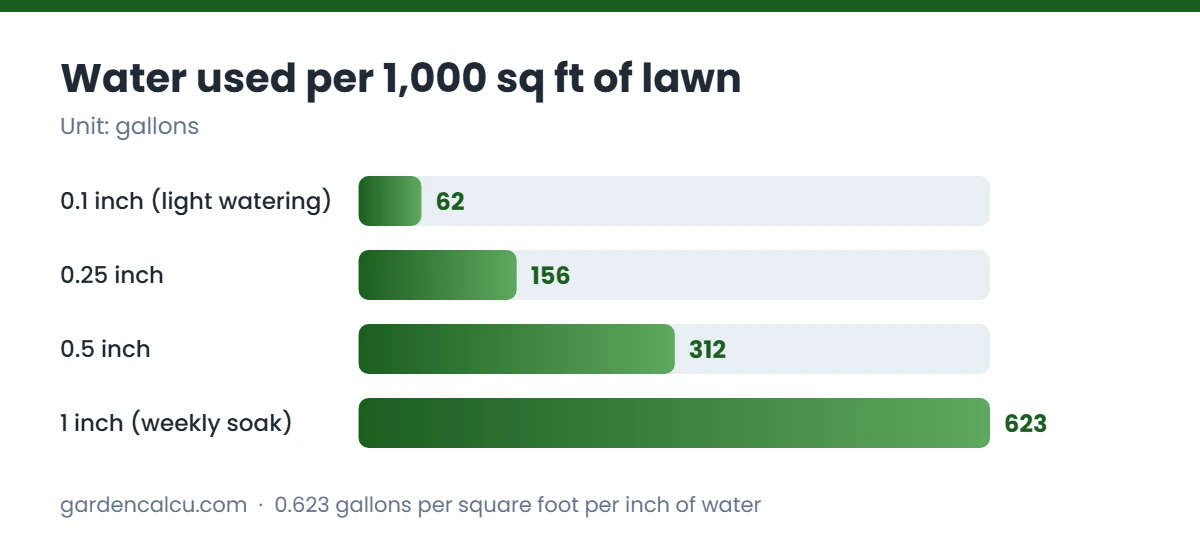
Chart for “how often to water new grass seed”: gallons needed to put each depth of water on 1,000 square feet.
Water applied | Gallons per 1,000 sq ft | Typical use |
|---|---|---|
0.1 inch | 62 | One light stage 1 watering |
0.25 inch | 156 | A stage 2 watering |
0.5 inch | 312 | Half of a weekly soak |
1 inch | 623 | A full weekly soak for established lawn |
Worked example: a 2,000 square foot seeded area watered lightly three times a day at about 0.1 inch each time uses 62 x 2 x 3 = 372 gallons a day. Over two weeks that is roughly 5,200 gallons.
To find out how long your sprinkler takes to deliver a tenth of an inch, set out a few straight-sided cans, run the sprinkler for 10 minutes and measure the depth. Then adjust the minutes. Sprinklers vary a lot, so the Minnesota figure of 5 to 10 minutes is a starting point.
Tip: The Water Calculator converts inches of water into gallons for any area, which helps if you are on a meter or filling from a tank.
How many gallons does your lawn need?
Enter the size of the area and the inches of water you want to apply. The calculator converts it into gallons.
Best time of day to water new seed
Early morning is the most efficient time. The air is cool, the wind is light and less water evaporates. The Oregon expert named early morning as the correct time for lawns in general.
New seed is the exception to the “water once in the morning” habit. It needs the midday and afternoon turns as well, because the surface dries fastest then. Try to finish the last watering early enough that the grass blades dry before dark.
Does hydroseed need watering?
Yes. The Ohio homeowner had been told by two people that hydroseed could sit dry and dormant until rain came. The expert’s answer was blunt: it is still grass seed and it needs water to germinate. The mulch in the hydroseed mix slows drying a little, but it does not replace watering.
Signs you are watering too much or too little
What you see | Likely cause | Fix |
|---|---|---|
Soil surface pale and crusted by afternoon | Too little, too seldom | Add a midday watering |
Seed sprouted, then seedlings shrivel | Dried out after germination | Do not skip days in stage 1 |
Puddles, seed collected in low spots | Too much at once | Shorter cycles, more often |
Green slime or mushy seedlings | Constantly soggy | Cut back and let the surface dry slightly |
Patchy strips of green | Uneven sprinkler coverage | Move the sprinkler and overlap |
Common mistakes
If the amount of seed is the open question, the Grass Seed Calculator works it out from your lawn size.
Frequently asked questions
Short answers to the questions that come up most often.
Quick recap
The answer to how often to water new grass seed changes with the stage. Before it sprouts, water lightly two to three times a day so the surface never dries. Once it is up, water less often and more deeply. After a few mowings, treat it like the rest of the lawn.
Keep it up for at least three weeks before deciding the seed has failed, and avoid both extremes: a dry crust and standing water.
Get your exact number
Enter your lawn area and how much water you plan to apply, and the calculator shows the gallons you will use.
Related guides
Sources
The facts in this guide to “how often to water new grass seed” come from these university Extension pages and public questions: