Leaves as Mulch: 7 Easy Rules for Beds, Trees and Lawns
Yes, you can use leaves as mulch, and most university Extension experts encourage it. Spread shredded leaves about 3 inches deep around vegetables, a few inches deep in flower beds, and keep them a couple of inches back from stems and tree trunks.
That covers most yards. The details people actually ask about are a little messier: whole leaves or shredded, oak leaves and soil acidity, how thick is too thick on a lawn, and whether last year’s bagged leaves are still good.
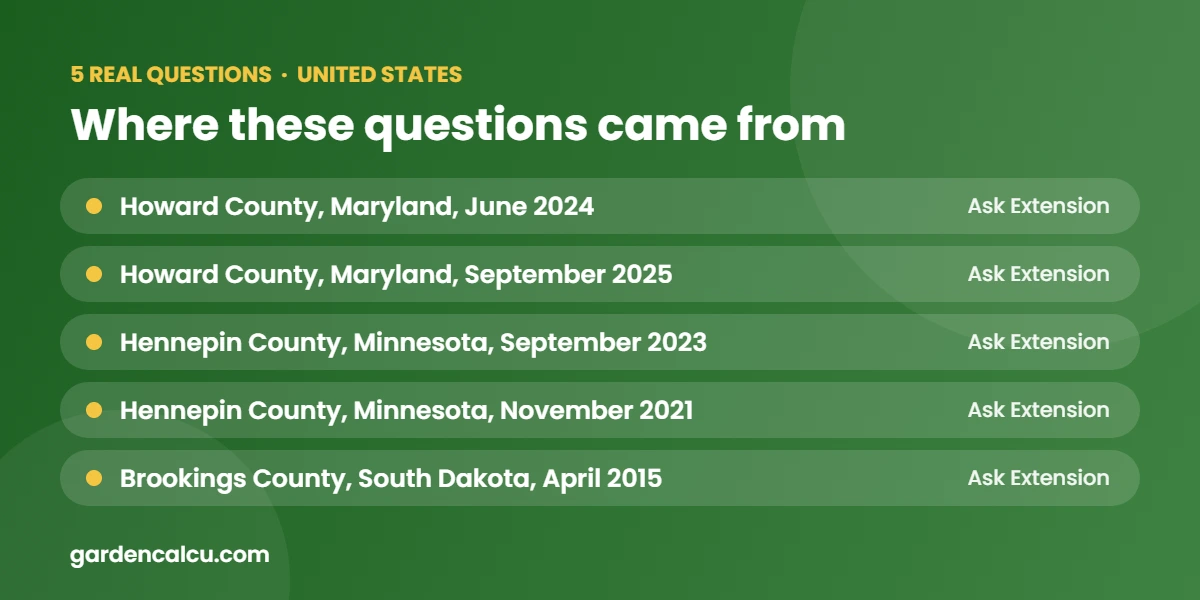
This guide is built from five real questions that US gardeners sent to Extension services in Maryland, Minnesota and South Dakota. The depths and rules below come from those answers, and the bed-size numbers show the arithmetic so you can check them.
Key takeaways
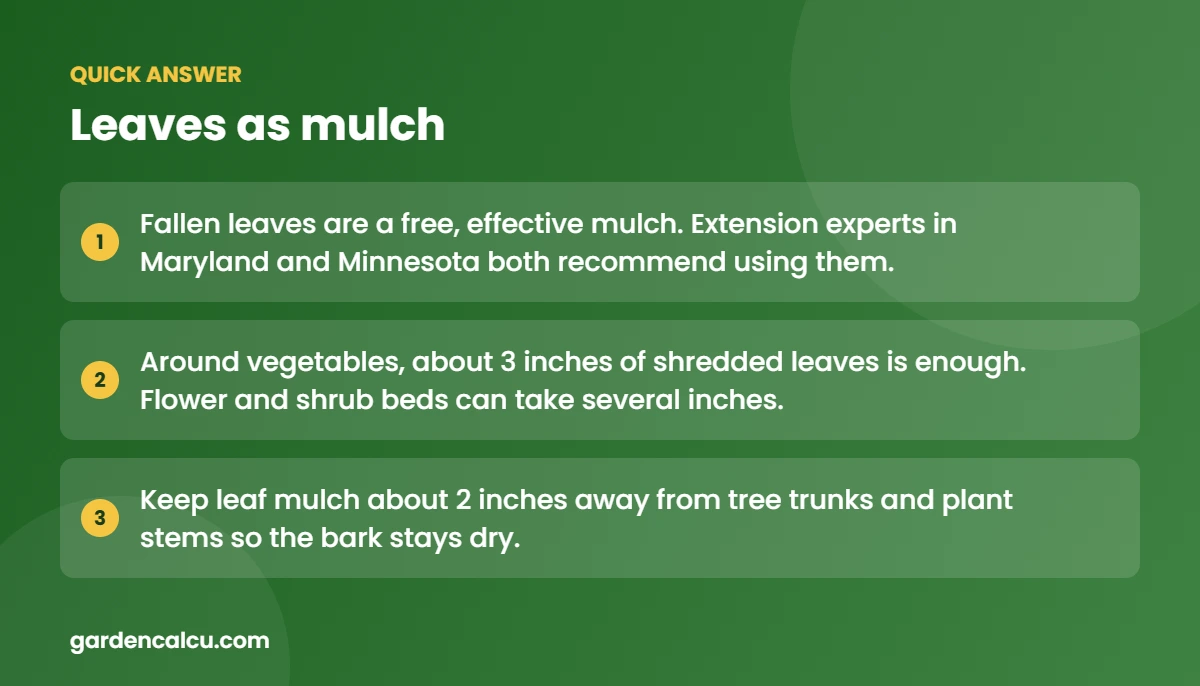
Quick answer to “leaves as mulch” in three points.
Real questions gardeners asked
Every fall the same question lands in Extension inboxes: are leaves as mulch a good idea, or should they go to the curb? We read five of those questions and the replies. Here is what people asked, in our own words, with a link to each original.
“shredded leaves as ground cover”
The question: A gardener had shredded the leaves from their backyard trees the fall before. They wanted to know if the leaves were good between vegetable plants, whether any plants could be harmed, and how thick was too thick.
What the expert said: The Maryland Extension expert called leaf litter a great natural mulch. Around vegetables, about 3 inches of shredded leaves is fine. In ornamental beds several inches works, and if a pile is over a foot deep the extra can be moved or composted. Whole leaves protect more insects than shredded ones.
“Best practices for mulching in the fall/spring”
The question: A community group asked whether leaving leaves in garden beds is the best practice, what to use if residents do not want leaves, and whether to mulch in both spring and fall.
What the expert said: The expert said they encourage using fallen leaves when available. Any mulch that breaks down, such as pine needles, shredded bark or wood chips, is also a good option, but leaf litter has the added benefit of feeding and sheltering wildlife. Timing depends on what the garden needs.
“Best practices for using leaves as mulch”
The question: A homeowner asked if oak leaves can simply be raked up and put under the trees, and what the best practices are.
What the expert said: The University of Minnesota Extension volunteer said yes. She suggested shredding the leaves with a mower first so they do not blow away, and keeping the mulch about 2 inches away from tree trunks and plant stems. Mulch protects roots, holds moisture and keeps soil cool in summer.
“How much leaf mulch is too much?”
The question: A homeowner with more leaves than bed space asked for a rule of thumb on how much leaf matter a yard can take.
What the expert said: The Master Gardener gave a simple test for lawns: after mowing over the leaves you must still be able to see the ground through them. You can mulch-mow the same area a couple of times, but too much will smother the grass, so the excess has to be picked up.
“Is it ok to use chopped tree leaves from the yard as mulch for the garden?”
The question: A gardener was cleaning beds with a blower vacuum that chops leaves into a bag, and asked if that material could go straight onto garden plants.
What the expert said: The expert said it is a good idea as long as no diseased material is mixed in. Leaves from a tomato bed that had a fungal or bacterial disease, for example, could reinfect next year’s plants. Finer pieces break down faster.
Can you use leaves as mulch? What the experts agree on
All five answers point the same way. Leaves are not yard waste. They are a mulch that falls on your property for free every October and November.
A layer of leaves does the same jobs as bagged bark. It shades the soil so fewer weed seeds sprout, slows evaporation, and softens the swing between hot days and cold nights. As the leaves rot they turn into organic matter that feeds soil life. Bagged mulch does that too, but you pay for it and haul it.
The Maryland expert added one benefit bark does not have. Leaf litter is food and shelter for wildlife, including the caterpillars and cocoons of moths and butterflies that spend the winter in it.
Tip: Not sure how much material your beds need? Measure the bed and enter the numbers in the Mulch Calculator. It gives cubic feet and cubic yards for any depth.
How deep to spread leaves as mulch
Depth is the number people get wrong most often. Too thin and weeds push through. Too thick and the layer mats down, sheds rain and can rot the crowns of small plants.
Where | Depth | Notes from the Extension answers |
|---|---|---|
Vegetable beds | About 3 inches, shredded | Maryland Extension, 2024 |
Flower and shrub beds | Several inches | Woodland plants tolerate thicker layers than meadow plants |
Under trees | 2 to 3 inches | Keep 2 inches clear of the trunk |
Any bed, piled over 12 inches | Too deep | Move the extra or compost it |
Lawn | Thin enough to see grass | Mow again or collect the excess |
Leaves settle a lot. A fluffy 6-inch layer of dry whole leaves in November can be 2 inches by April. That is why the Maryland expert was relaxed about several inches in ornamental beds but drew the line at a foot.
Around trees and shrubs
Spread leaves out to the edge of the branches if you can, and pull them back from the trunk. Piling any mulch against bark keeps it wet, and wet bark invites decay and gnawing rodents. The Minnesota answer put the gap at about 2 inches.
In the vegetable garden
Once the summer crops are out, cover bare soil with about 3 inches of shredded leaves. They protect the bed from winter rain and wind. In spring, rake them aside to let the soil warm, plant, then pull them back around the seedlings. Fall-planted garlic does especially well under a leaf blanket.
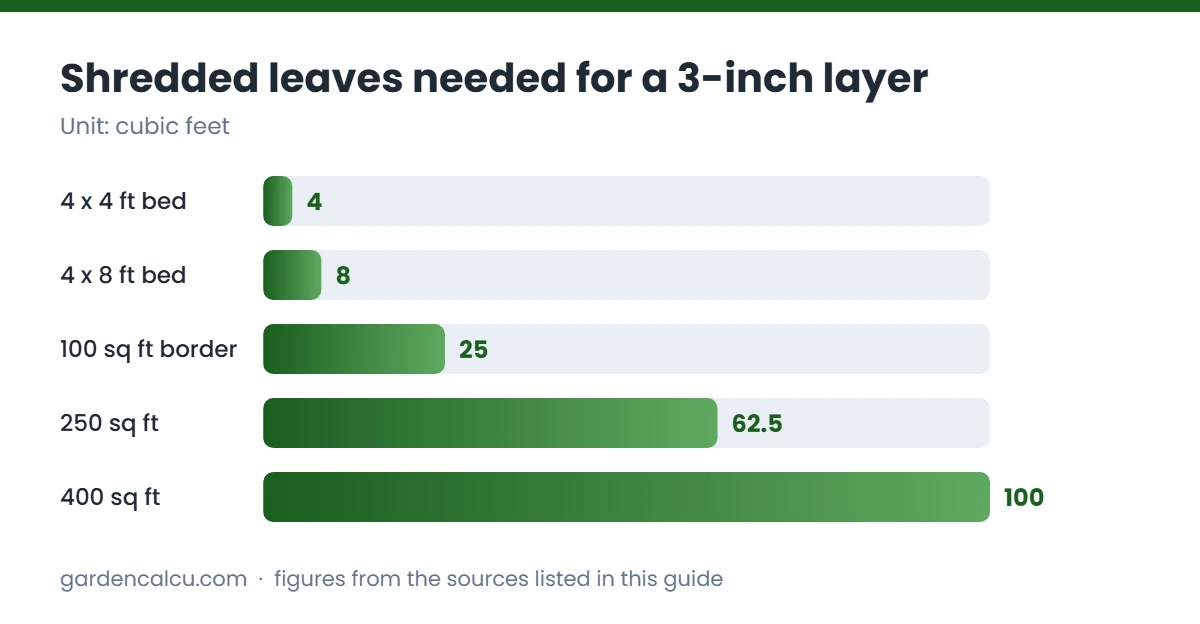
Chart for “leaves as mulch”: Shredded leaves needed for a 3-inch layer, in cubic feet.
How much leaf mulch do you need?
The arithmetic is the same as for any mulch. Multiply the bed area in square feet by the depth in feet. Three inches is 0.25 feet.
Worked example: a 4 x 8 ft bed is 32 square feet. 32 x 0.25 = 8 cubic feet of shredded leaves. A 400 square foot border needs 100 cubic feet, which is 3.7 cubic yards.
Bed size | Area (sq ft) | Leaves for 3 in (cu ft) | Cubic yards |
|---|---|---|---|
4 x 4 ft | 16 | 4 | 0.15 |
4 x 8 ft | 32 | 8 | 0.30 |
100 sq ft border | 100 | 25 | 0.93 |
250 sq ft | 250 | 62.5 | 2.31 |
400 sq ft | 400 | 100 | 3.70 |
If your trees do not drop enough, top up with bought mulch. The same numbers tell you how many bags to buy, and our guide to how much soil for a raised bed explains the cubic feet to cubic yards step in more detail.
How much mulch does your bed need?
Enter the length, width and depth of your bed and the calculator works out the cubic feet, cubic yards and bags of mulch to cover it.
Shredded leaves or whole leaves: which is better?
Both work. They just behave differently, and the Extension answers describe a real trade-off.
Shredded leaves | Whole leaves | |
|---|---|---|
Stay in place | Yes, they knit together | Can blow around until wet |
Break down | Faster | Slower |
Risk of matting | Lower | Higher with large flat leaves |
Wildlife value | Lower, shredding can kill insects | Higher, shelters caterpillars and cocoons |
Best use | Vegetable beds, tidy borders | Under trees, shrubs and wilder corners |
The Minnesota volunteer suggested running a mower over the leaves first so they do not fly away in the wind. The Maryland expert pointed out the cost: the shredding process can injure or kill insects sheltering in the leaves. A sensible split is to shred what goes on the vegetable garden and leave whole leaves under shrubs and trees.
Using leaves as mulch on the lawn
You do not have to rake every leaf off the grass. Mowing over a light layer chops it into pieces that sift down between the blades and feed the soil.
The limit is the one the Minnesota Master Gardener gave: you must still see the ground through the chopped leaves. If the grass disappears under a brown layer, mow again. If it is still covered after a couple of passes, collect the excess and move it to a bed.
Watch out: A thick, wet mat of whole leaves left on turf all winter blocks light and air and can kill the grass under it. Chop it or move it before snow arrives.
Which leaves to be careful with
The Maryland expert said they were not aware of any tree or shrub leaves that are a problem as leaf litter mulch. Still, a few situations call for care.
How to shred and store leaves
You do not need a chipper. A lawn mower with a bag does the job, and so does a blower that has a vacuum and shredder setting.
The South Dakota expert described that bag method for making leaf mulch. The holes matter. Without air the leaves turn slimy and give off a sulfur smell.
Leaves left to rot for a year or two turn into leaf mold, a dark, crumbly material that holds water well. It is a soil conditioner more than a fertilizer, and it is excellent mixed into vegetable garden soil.
When to put leaf mulch down
Fall is the natural time because that is when the leaves arrive. The 2025 Maryland answer explained why it also suits the garden: a fall layer insulates the soil and discourages the weeds that sprout in winter. A spring layer targets the weeds that sprout as the soil warms.
For a vegetable garden resting over winter, the expert said mulch can go on as soon as the harvest is finished and the crop debris is cleared. Around trees and shrubs, any time of year is fine.
Tip: If you plan to sow seeds in spring, rake the leaves off that row two weeks ahead. Bare soil warms faster, and small seeds struggle to push through mulch.
Common mistakes with leaves as mulch
Frequently asked questions
Short answers to the questions that come up most often.
Quick recap
Using leaves as mulch is one of the few garden jobs that saves money and effort at the same time. Spread about 3 inches of shredded leaves on vegetable beds, a few inches of whole or shredded leaves under shrubs and trees, and keep every layer 2 inches back from trunks and stems.
On the lawn, chop leaves with the mower until you can see grass again and move the rest to a bed. Skip diseased leaves, give stored bags some air, and you will have free leaf mulch every year.
Get your exact number
Measure your beds, pick a depth and the calculator shows the cubic feet and cubic yards of mulch to spread.
Related guides
Sources
The facts in this guide to “leaves as mulch” come from these university Extension pages and public questions: