How Deep Should Mulch Be? Depths, Bags and Tree Rules
If you are asking how deep should mulch be, the short answer is 2 to 4 inches for most beds, trees and shrubs. Use the lower end for fine mulch like grass clippings and the higher end for coarse wood chips, and never go over 4 inches around a tree.
Depth is only half of it. Mulch should never touch a tree trunk, old mulch counts toward the total, and vegetable beds follow slightly different rules.
This guide is built from six real questions that US homeowners asked university Extension experts and a garden forum, each one a version of how deep should mulch be for my yard. Each number below comes from those answers or from Extension fact sheets, with the arithmetic shown.
Key takeaways
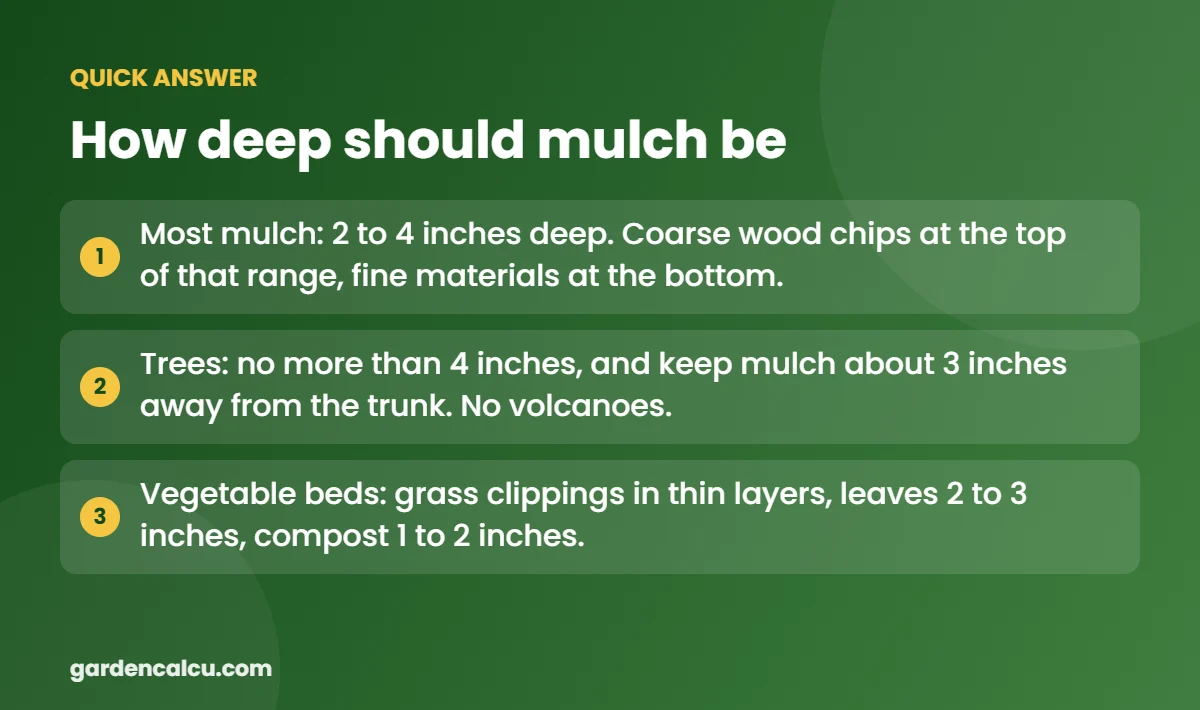
Quick answer to “how deep should mulch be” in three numbers.
Real questions gardeners asked
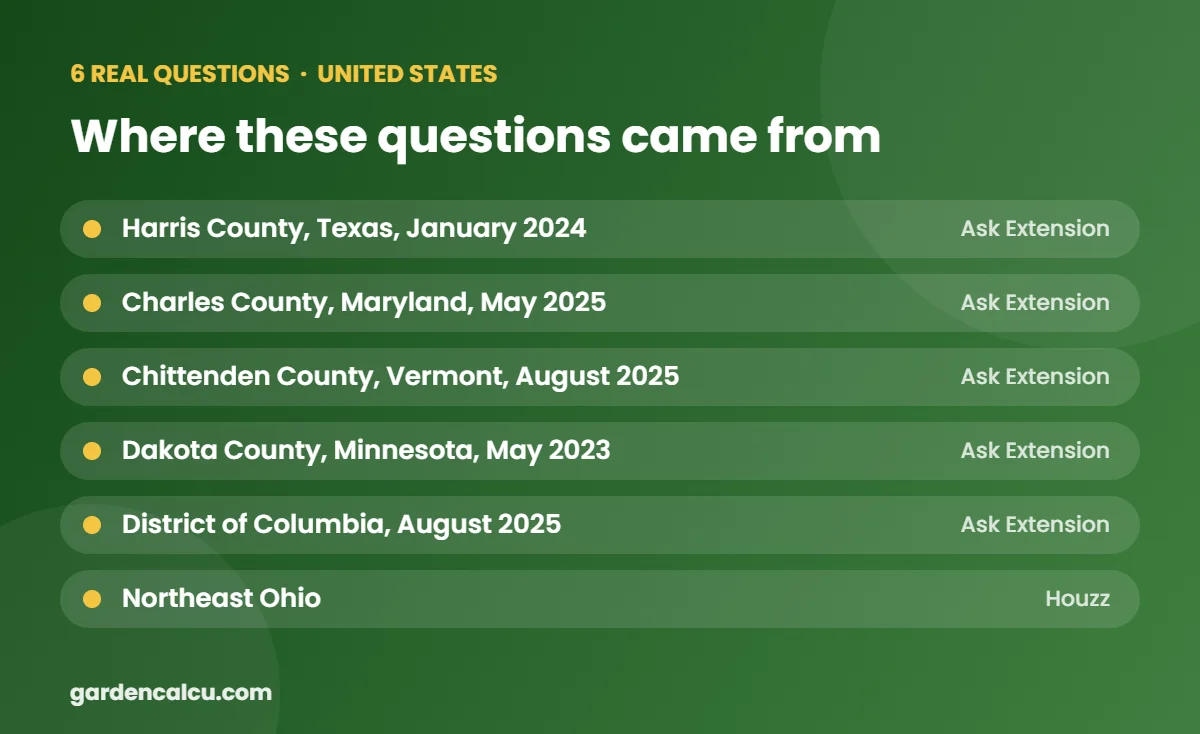
Every season people type “how deep should mulch be” into a search box, and many of them also ask it on public gardening Q&A boards. This guide is built from real questions posted by people in the United States. We read each one, along with the replies. Here is what they asked, in our own words, with a link to every original question.
“Mulch for trees”
The question: A homeowner in a subdivision said everyone agreed volcano mulch is bad, but wanted to know whether a 2-inch-deep mulch ring actually helps trees, and whether the answer changes with tree age or species such as pines, crepe myrtles and oaks.
What the expert said: The Extension expert recommended mulch rings for trees of all ages for weed control, moisture and cooler soil. The mulch should be 3 to 4 inches deep but tapered toward the trunk so none touches it, and small trees need a bed at least 6 feet across.
“Removing Mulch Volcanoes”
The question: A buyer of a home built in 1966 found mature pines and oaks with mulch mounds up to 24 inches high at the trunk, mostly old pine needles and oak leaves. He asked whether removing the mounds would hurt such old trees.
What the expert said: University of Maryland Extension said removal would help, not harm. An arborist can use an air spade to blow the excess off the root area, or it can be dug away gently by hand. Water the root zone deeply afterward and have any girdling roots checked.
“Mulch”
The question: A gardener asked whether last year’s mulch has to be removed before a fresh layer goes on top.
What the expert said: The UVM Extension Master Gardener Helpline said it depends on how much is already there, since mulch breaks down into the soil. The recommended depth is 2 to 4 inches in total, too much can cause harm, and mulch should be pulled back from the base of trees and shrubs.
“Grass clippings as mulch”
The question: A gardener asked whether grass clippings are a good mulch to keep weeds down around vegetable plants, and whether they could harm the soil.
What the expert said: A Master Gardener volunteer said clippings make a great mulch. Apply no more than 2 inches at a time, use dried clippings or thin layers of fresh ones so they do not mat, and never use clippings from a lawn treated with weed killer.
“Mulch”
The question: A gardener who had just finished weeding raised beds and in-ground plantings asked whether mulch would stop the weeds coming straight back, and which type to use.
What the expert said: The expert suggested arborist wood chips, pine fines, shredded leaves or softwood mulch at about 2 to 3 inches. Coarse mulch goes on at the full 3 inches and fine material like grass clippings thinner, because too much depth can waterlog the soil and cut off oxygen.
“Are these Mulch Installation costs realistic in Northeast Ohio”
The question: A homeowner needed 9 cubic yards of mulch spread on flat flower beds, 5 yards in one area and 4 in another. Mulch was $45 to $55 per yard plus delivery, and they asked whether $35 per yard for labor was fair.
What people replied: The poster cited a typical labor range of $25 to $45 per cubic yard. The one visible reply pointed out that wood chips dropped off by an arborist are free.
Those are the real cases. The rest of this guide answers “how deep should mulch be” step by step, with the numbers the experts gave.
How deep should mulch be? The short answer by area
Iowa State University Extension puts it simply: 2 to 4 inches is generally effective, with coarse mulch like wood chips at the higher end and fine mulch like grass clippings at the lower end.
University of Maryland Extension is a little more cautious for trees and shrubs. It says to keep mulch shallow, from 1 to 3 inches. Put together, 2 to 3 inches is the safe middle that every source here agrees with.
Where or what | Depth | Source |
|---|---|---|
Trees and shrubs, wood chips or bark | 2 to 3 in, never over 4 in | Iowa State, Maryland |
Leaves | 2 to 3 in | Maryland |
Pine needles | 2 to 3 in | Maryland |
Grass clippings | 1 to 2 in, in thin layers | Maryland |
Compost or leaf mold | 1 to 2 in | Colorado State |
Wood chip paths between raised beds | 3 to 4 in | Colorado State |
Gravel or stone | 1 in | Maryland |
Tip: Once you know your depth, the Mulch Calculator turns your bed size into cubic yards and bags so you do not have to guess at the store.
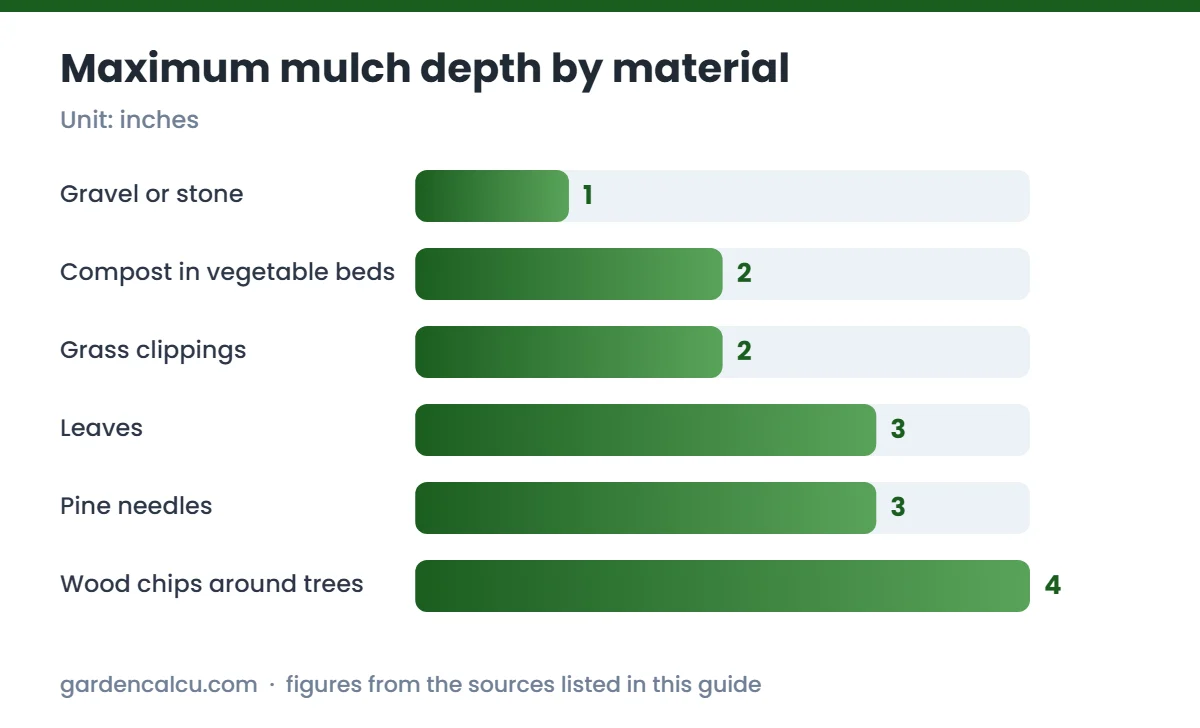
Chart for “how deep should mulch be”: Maximum mulch depth by material, in inches.
How deep should mulch be around trees?
A Texas homeowner asked whether a 2-inch mulch ring really helps a tree. The Extension answer was yes, for trees of any age: it controls weeds, holds moisture and keeps the soil cooler.
The expert’s numbers were 3 to 4 inches deep, tapered down toward the trunk so no mulch touches it, in a bed at least 6 feet across for a small tree. Iowa State sets the ceiling: no more than 4 inches, feathered away from the trunk.
The 3-3-3 rule
University of New Hampshire Extension gives an easy rule for established trees: 3 inches deep, in a ring with a 3-foot radius, with a 3-inch gap between the mulch and the trunk. Maryland gives the same 3-inch gap.
Worked example: a 3-foot-radius ring covers 3.14 x 3 x 3 = 28.3 square feet. At 3 inches (0.25 ft) deep that is 28.3 x 0.25 = 7.1 cubic feet, or four 2-cubic-foot bags per tree.
Shallow roots change the answer. A Minnesota gardener planting under a big silver maple worried that more than 2 inches would hurt the surface roots, and the Extension tree advisor agreed that 2 inches, kept off the trunk, was a great plan.
Skip the math
Enter your bed’s length, width and mulch depth and it works out the cubic yards and number of bags to buy.
Mulch volcanoes: why they hurt trees and how to fix one
A mulch volcano is a cone of mulch piled up against the trunk. University of New Hampshire Extension says it buries the root flare, keeps the bark wet so disease and decay set in, and encourages shallow roots that struggle in drought.
The worst case in our research came from Maryland. A home buyer found mature oaks and pines with mounds up to 24 inches high at the trunk and asked if taking them down would hurt trees that old.
University of Maryland Extension said removal would benefit the trees. That is the answer to remember: an old volcano is not a reason to leave it alone.
Watch out: Fresh mulch on top of an old volcano every spring is how 24-inch mounds happen. Check the depth before you add any. If a tree is already in serious decline, our tree removal cost calculator shows what replacing it could cost, which is a good reason to fix the mulch first.
What happens when mulch is too thick
More is not better, which is why how deep should mulch be is really a question about limits. Iowa State lists the problems with too-deep mulch: waterlogging, lower soil oxygen, shallow rooting and soil that stays too warm in winter.
Fine mulch is the bigger risk because it packs down. Iowa State notes that fine-textured mulch piled over 10 inches will likely block oxygen from reaching the soil at all. The Washington, DC expert gave the same warning for raised beds.
Maryland Extension is blunt about the result: plants that are mulched incorrectly can decline and even die from too much mulch piled on their roots.
Signs you have too much
Matted mulch does not always need replacing. In a Virginia question about three-year-old mulch, the expert said to rake and break it up so water and air get through, and to think about removal only if the layer is over 3 inches.
Which mulch for vegetable beds, and how deep
For vegetables, how deep should mulch be depends on the material. Beds are replanted every season, so soft mulches that break down fast work best. Iowa State calls straw an excellent vegetable garden mulch and says grass clippings and leaves are ideal there too.
Watch out: Do not mulch vegetables with clippings from a lawn treated with weed killer. Colorado State says to avoid clippings from lawns treated with herbicide within the past month.
Are wood chips OK in a vegetable bed?
Extension advice differs by region. Colorado State says to keep wood and bark chips to the paths between raised beds, 3 to 4 inches deep, and out of the growing beds in Colorado’s alkaline soils.
In New Hampshire, a UNH expert told a raised bed gardener that hardwood chips are fine as a surface mulch. He said nitrogen loss is mostly a problem when fresh chips are tilled into the soil.
The safe rule: chips stay on top, never mixed in. If you are still building beds, the raised bed soil calculator sizes the soil, and our vegetable garden starter guide covers the rest.
How much mulch to buy: bags vs. cubic yards
Once you have settled how deep should mulch be for your beds, the shopping list is simple arithmetic. Mississippi State University Extension gives the method. Multiply the bed’s length by its width for square feet, multiply by the depth in feet for cubic feet, then divide by 27 for cubic yards.
Their example: a 5 x 20 ft border is 100 square feet. At 4 inches deep that is about 33 cubic feet, or 1 cubic yard plus a little extra. In bags, that is 27 bags of 1.25 cubic feet or 17 bags of 2 cubic feet.
Our example: a 10 x 20 ft bed is 200 square feet. At 3 inches (0.25 ft) it needs 200 x 0.25 = 50 cubic feet. That is 50 ÷ 27 = 1.85 cubic yards, or 25 bags of 2 cubic feet.
Mulch depth | 1 cubic yard covers | One 2-cu-ft bag covers |
|---|---|---|
1 in | 324 sq ft | 24 sq ft |
2 in | 162 sq ft | 12 sq ft |
3 in | 108 sq ft | 8 sq ft |
4 in | 81 sq ft | 6 sq ft |
A real bulk order, priced
The Northeast Ohio homeowner needed 9 cubic yards. At 3 inches, that covers 9 x 108 = 972 square feet. Their quote was $45 to $55 per yard for mulch, so $405 to $495, plus $35 per yard for spreading, which adds $315.
Nine yards would be 122 bags of 2 cubic feet, so bulk delivery is the only sensible route at that size. The reply in that thread is worth repeating: wood chips dumped by an arborist are free.
For your own beds, enter the length, width and depth in the mulch calculator. It gives cubic yards for a bulk order and the bag count for a store run.
Topping up: do you remove old mulch first?
A Vermont gardener asked exactly this. The UVM Extension helpline said removal is usually not needed, because mulch breaks down into the soil. What matters is how much is still there.
So the question is not only how deep should mulch be, but how deep it already is. Push a ruler down to the soil in a few spots, then add only the difference.
Worked example: your 200-square-foot bed has 1 inch left and you want 3. You need 2 inches: 200 x 2 ÷ 12 = 33.3 cubic feet, or 1.23 cubic yards. That is 17 bags instead of the 25 a full 3-inch layer takes.
The helpline gave one exception. If the trees or shrubs had a disease or fungus that overwinters, clear away the old mulch and fallen leaves before adding fresh.
Tip: Mulch cuts how often you need to water but does not replace watering. After spreading, water it in, and use the water calculator to check how much your beds need each week.
Frequently asked questions
Short answers to the questions people ask most about “how deep should mulch be”.
Quick recap
The short version of “how deep should mulch be”: Most mulch: 2 to 4 inches deep. Coarse wood chips at the top of that range, fine materials at the bottom.
For your own garden, the Mulch Calculator does the math in a few seconds. Check its answer against the real examples above.
Get your exact number
Enter your bed’s length, width and mulch depth and it works out the cubic yards and number of bags to buy.
Sources
The numbers in this guide to “how deep should mulch be” come from these university Extension and official pages: