When to Start Seeds Indoors: Easy Dates for 12 Crops
Wondering when to start seeds indoors? The short answer is to find your average last frost date and count backward. Most vegetables and annual flowers need 6 to 8 weeks under lights before they go outside. Tomatoes need about 6. Onions and celery need a lot longer, and squash and cucumbers need only about 3.
It sounds simple, yet this is one of the questions Extension offices hear most from January through April. Some gardeners worry they are too late. Others see a warm February and want to start a month early. Both mistakes cost you: late seedlings miss the season, and early ones turn tall, pale and root-bound on the windowsill.
This guide uses real questions from gardeners in Maryland, Ohio, Michigan and Colorado, plus the answers Extension experts gave them. You will get the count-back method, a table of start dates for common frost dates, a crop calendar, and a list of crops you should not start indoors at all.
Key takeaways
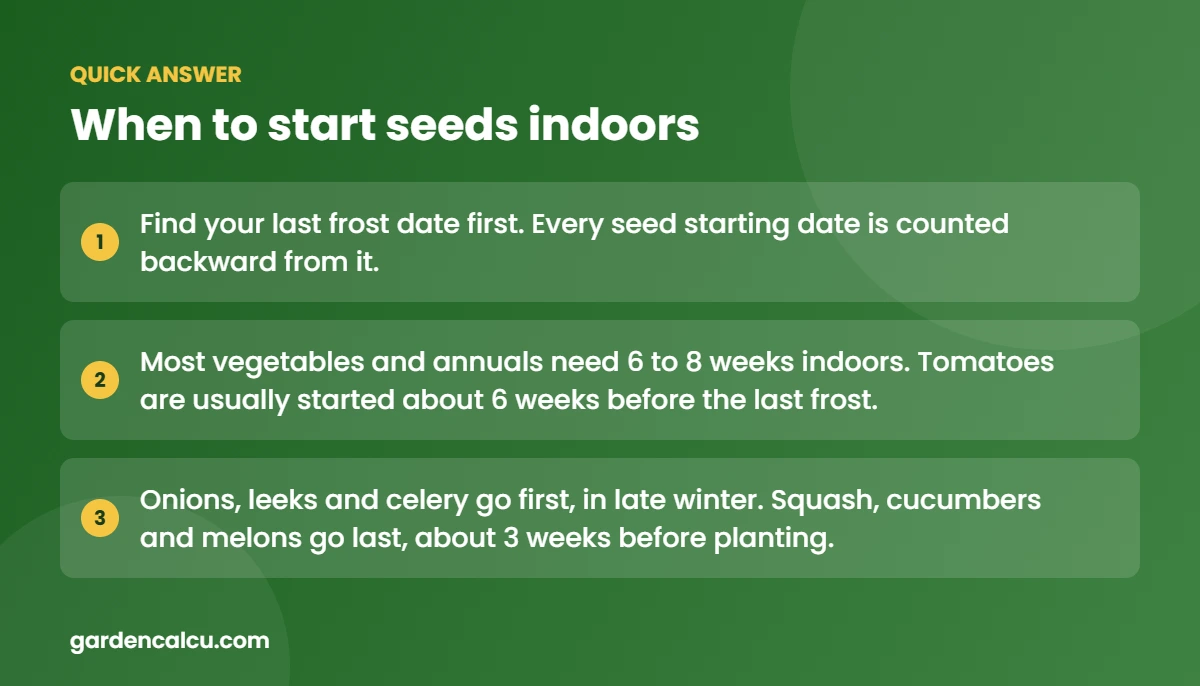
Quick answer to “when to start seeds indoors” in three points.
Real questions gardeners asked
These are real questions sent to Ask Extension, the free service run by US land-grant universities. Each card shows where and when the gardener asked, and links to the full answer.
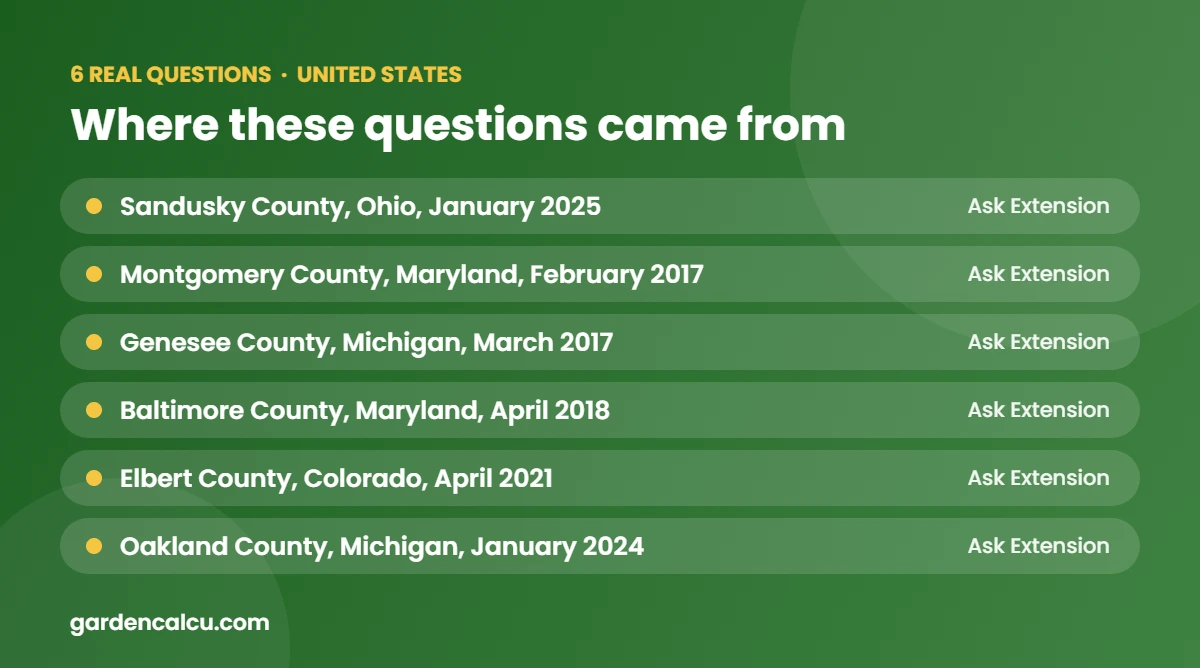
“Zone 6b beginner: when to start planting indoors?”
The question: Zone 6b when to start planting indoors?
What the expert said: The expert explained that different crops need different amounts of time, and that the seed packet tells you how many weeks before planting out to start. Most tomatoes should be started 6 to 8 weeks before the last frost date. Then count back: if your last frost date is April 15th, 6 weeks before that is March 4th, and you would start your tomatoes on that date.
“Early spring: should I start tomatoes sooner?”
The question: Since it seems we are on track for an early spring, should I start my tomato starts indoors earlier this year? The planting calendar says not to start them till April, but last year I started them too late and missed the boat!
What the expert said: The expert said tomato seeds are generally started about 6 weeks before the last frost date: around the end of March there, for transplanting about Mother’s Day or later. Seed now, the reply warned, and the plants will be big in April when the weather may not cooperate. Tomatoes are a warm season plant and will not take off until soils warm.
“A good date for seeds in a sunny window in Michigan”
The question: When should you start vegetable seeds indoors in Michigan? Can you give me a good date to put my seeds in 3.5-inch pots and put in a sunny window? I don’t want to be too late or too early. Mainly tomatoes, kohlrabi and candy onions.
What the expert said: The expert noted that not all vegetables benefit from being started indoors, and that the seed starting mix you pick is critical. Warm-season vegetables such as tomatoes, peppers and eggplant can typically be started indoors in April there, depending on the weather. A rule of thumb was given: start tomatoes, eggplant, peppers, cucumber, cantaloupe, squash and watermelon within 4 to 10 weeks of last frost.
“Am I too late to start seeds?”
The question: I think I am a little late to the game. Is there still time to start growing seeds indoors? I have seeds for broccoli, beans, squash, peppers, tomato, lettuce, spinach.
What the expert said: On April 4 the answer was: you can start peppers, tomato, lettuce and spinach indoors now. Broccoli was a little late for seed, so buy transplants. Beans and squash should be direct seeded after frost, or squash can be sown indoors in 3-inch containers 3 weeks before planting time.
“Seedlings under lights at 6,300 feet: when do they go out?”
The question: We have started flower and vegetable seeds inside in grow pots under grow lights 3 weeks ago. They are doing real well. When should we transplant them outside? What is hardening? How should we do it?
What the expert said: The expert said it depends on whether the crop is cool season or warm season, and that the average last frost there falls between mid May and early June. In general, transplants should be six to eight weeks old with at least four true leaves before planting outside, and then go through a hardening off period first.
“Seed starting for twelve 4 x 8 beds”
The question: I am planning for a vegetable garden (twelve 4 x 8 beds) and am having trouble finding clear advice on how to start seeds. Finding enough room inside near a window or growing with lights indoors isn’t ideal for us.
What the expert said: The expert, who had started vegetable seeds indoors in the same county for over 20 years, was honest: it is not a simple or inexpensive task to get high germination and strong transplants. The first factor listed was the growing medium, which should be a soilless, sterile seed starting mixture in sterilized containers.
When to Start Seeds Indoors: The Count-Back Rule
Every expert above used the same method. It has three steps, and none of them needs a zone map.
That is the whole system. Deciding when to start seeds indoors is a subtraction problem, not a guess based on how warm it feels in February.
Notice that hardiness zone was not part of the math. The Ohio gardener asked about zone 6b, and the expert steered straight to the last frost date instead. Zones describe winter cold. They do not tell you when spring frost ends. Our guide to what hardiness zone you are in explains what the zone number is actually for.
Tomato Start Dates for Common Last Frost Dates
Here is the count-back done for you, using the 6 to 8 week window that the Ohio and Maryland experts gave for tomatoes.
Average last frost date | Start 8 weeks before | Start 6 weeks before |
|---|---|---|
April 1 | February 4 | February 18 |
April 15 | February 18 | March 4 |
May 1 | March 6 | March 20 |
May 15 | March 20 | April 3 |
June 1 | April 6 | April 20 |
If you are new to this, use the later date. A stocky 6-week tomato seedling beats a lanky 9-week one every time.
Tip: Write your last frost date on the first page of your garden notebook. Then write the sowing date on each seed packet in pencil. You only have to do the math once a year.
How Many Weeks Does Each Crop Need?
Crops grow at very different speeds, which is why the seeds do not all get sown on the same weekend. Iowa State University Extension gives a simple baseline: most annuals and vegetables need 6 to 8 weeks from sowing to transplanting, and tomatoes can need as little as 4. Slow flowers are the outliers. Their list puts geraniums, wax begonias and pansies at 12 to 14 weeks, impatiens at 10 to 12, and petunias and snapdragons at 8 to 10.
For vegetables, University of Illinois Extension lays out a month-by-month calendar for central Illinois, where the average last frost falls around early May. It is a useful pattern for much of the Midwest and Mid-Atlantic. Shift it earlier or later to match your own frost date.
When to sow indoors (central Illinois) | Crops | Roughly how long before last frost |
|---|---|---|
February | Celery, leek, onion, parsley | 10 to 12 weeks |
Early to mid March | Broccoli, cabbage, cauliflower, eggplant, kale, lettuce | 7 to 9 weeks |
Mid to late March | Tomato, pepper, basil, Swiss chard | 6 to 7 weeks |
Early to mid April | Okra | 3 to 4 weeks |
Mid to late April | Cucumber, melons, pumpkin, squash | 2 to 3 weeks |
The right-hand column is our own count from an early May frost date, so treat it as approximate. Cool-season crops such as broccoli, cabbage and lettuce go outside before the last frost, which is why the same article says to start broccoli 4 to 6 weeks before the average last frost date when you plan to set it out early.
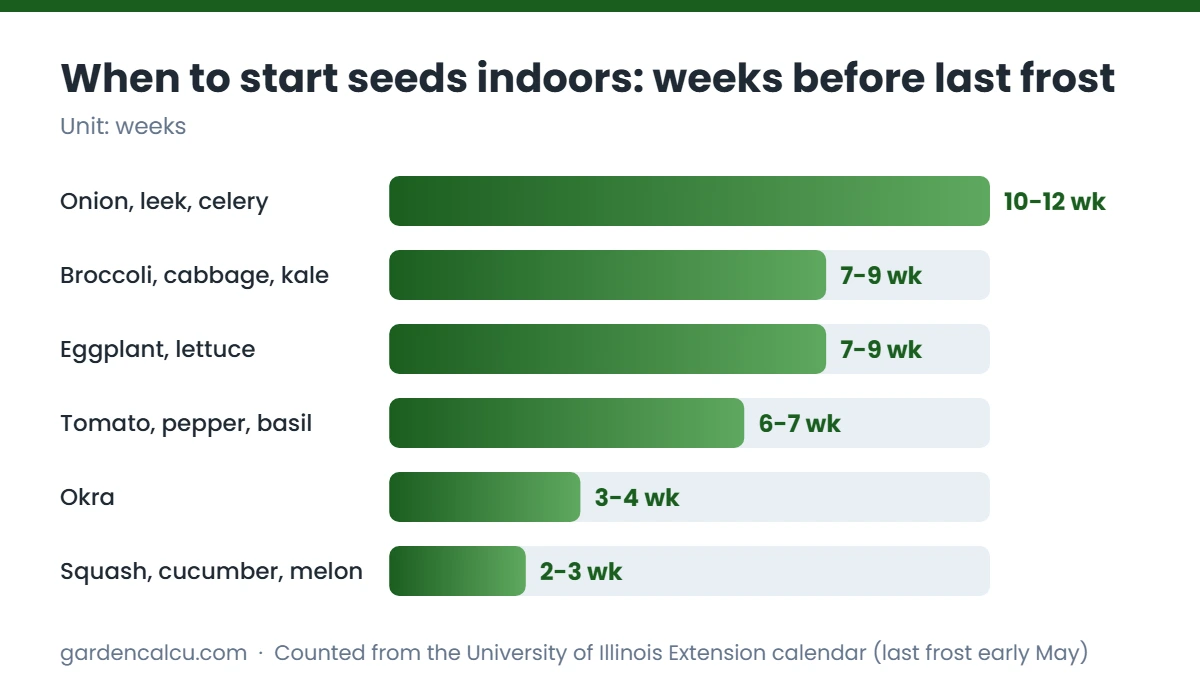
Approximate weeks before the last frost to sow each group indoors, counted from the University of Illinois Extension calendar for central Illinois. Mid-points are plotted.
The Maryland answer backs up the bottom of that table. Squash, the expert said, can be sown indoors in 3-inch containers 3 weeks before planting time. Give squash, cucumbers and melons longer than that and the roots circle the pot, and the plants sulk after transplanting.
Why Starting Too Early Backfires
The Maryland gardener who wanted to start tomatoes in February had a reasonable worry. The year before, the seeds went in late and the season slipped away. But the fix for late is not early. The fix is on time.
The expert’s reply spelled out the risk. Seed in late February and the plants will be big in April. If the weather does not cooperate, they have nowhere to go. And tomatoes will not take off until soils warm, so a large plant set into cold ground just sits there.
Iowa State University Extension makes the same point about the whole seed tray: start too soon and you end up with plants that are too large and leggy before transplanting time arrives. Here is what goes wrong with seedlings held indoors too long:
Watch out: A warm week in late winter does not move your last frost date. The Maryland expert still told the gardener to be prepared to protect plants if frost is predicted, even with a Mother’s Day planting.
Am I Too Late to Start Seeds Indoors?
Probably not. The Baltimore County gardener asked on April 4, convinced the window had closed. The expert’s answer was reassuring: start peppers, tomato, lettuce and spinach indoors now.
Only broccoli had slipped past, and the fix was simple: buy transplants and set them out under a row cover to protect them from frost. Beans and squash were never indoor crops to begin with.
So if you are running behind, use this order of thinking:
If you are well past the window, our list of 15 vegetables that grow fast shows what still has time to finish.
Get Your Planting Dates
Use the free Planting Calendar to see sowing and transplanting windows for your crops, then count back to find the day to start seeds indoors.
Seeds You Should Not Start Indoors
The Michigan expert opened with a point beginners often miss: not all vegetables benefit from being started indoors and then transplanted. Some resent root disturbance. Others grow so fast in the ground that a head start gains nothing.
Crop | Better method | Why |
|---|---|---|
Beans | Direct seed after frost | Fast, and dislike transplanting |
Peas | Direct seed in early spring | Cool-season crop, sprouts in cold soil |
Spinach | Direct seed early | Hardy; can be sown when soil is around 40 degrees F |
Carrots, beets, radishes | Direct seed | Root crops fork or stall when moved |
Corn | Direct seed after frost | Grows fast in warm soil |
Squash, cucumbers, melons | Direct seed, or 3 weeks indoors at most | Roots are easily set back |
The spinach figure comes from a Colorado answer. An expert in Arapahoe County told a gardener that spinach is a hardy, cool season plant that can be direct seeded once the garden has dried out and soil temperatures are around 40 degrees F, and that cilantro can be direct sown after the last spring frost. The Maryland expert said the same about beans and squash: direct seed after frost.
Leaving these out of your trays frees up shelf space and light for the crops that truly need the head start: tomatoes, peppers, eggplant, onions and the cabbage family.
What Seedlings Need Once They Are Up
Getting the date right is half the job. The Oakland County, Michigan expert, with two decades of seed starting behind him, warned that strong transplants take real effort. A few basics cover most of it.
Hardening Off Before Planting Out
The Colorado gardeners asked what hardening meant. It is the week or two in which indoor seedlings get used to sun, wind and cool nights before they are planted. Start with an hour or two outside in shade, add time and sun each day, and bring trays in if frost threatens. The Elbert County expert listed it as the step that comes right after seedlings are strong enough to go out, never one to skip.
Build that week into your count. If your seedlings need 6 weeks to grow and a week to harden off, the last days of the 6 weeks are spent going in and out of the house.
Tip: Planting day depends on the crop, not just the calendar. Cool-season seedlings such as broccoli and lettuce can go out weeks before the last frost. Tomatoes and peppers wait until after it, when the soil has warmed.
Frequently asked questions
Short answers to the questions that come up most often.
Quick recap
Knowing when to start seeds indoors comes down to one date and a little subtraction. Find your average last frost date, read the packet, and count back: about 6 weeks for tomatoes, 6 to 8 for most vegetables and flowers, longer for onions and celery, and only about 3 for squash and cucumbers.
Resist the pull of a warm February, and do not panic in April. The gardeners in this article were told the same thing from both directions: on time beats early, and late is usually fixable with a few transplants and some direct seeding.
Get your exact number
Check sowing and transplanting windows for your crops with the free Planting Calendar.
Related guides
Sources
The facts in this guide to “when to start seeds indoors” come from these university Extension pages and public questions: