When to Remove a Tree: 7 Warning Signs and Expert Advice
When to remove a tree: when it has a structural defect, such as a large hollow, a crack in the trunk or rot at the base, and something valuable stands within reach of its fall. A tree that is merely ugly, messy or dropping leaves early rarely needs to come down.
This is a decision homeowners dread, partly because of the cost and partly because the advice often comes from the company that would do the cutting. One Maryland couple was told a poplar had to go because of a crack. They were not sure the problem was real, so they asked a university Extension expert.
This guide is built from six real questions like that one, sent to Extension services in Maryland, Michigan and Vermont. The experts explain which signs matter, which do not, when to get a second opinion and what the alternatives to full removal are.
Key takeaways
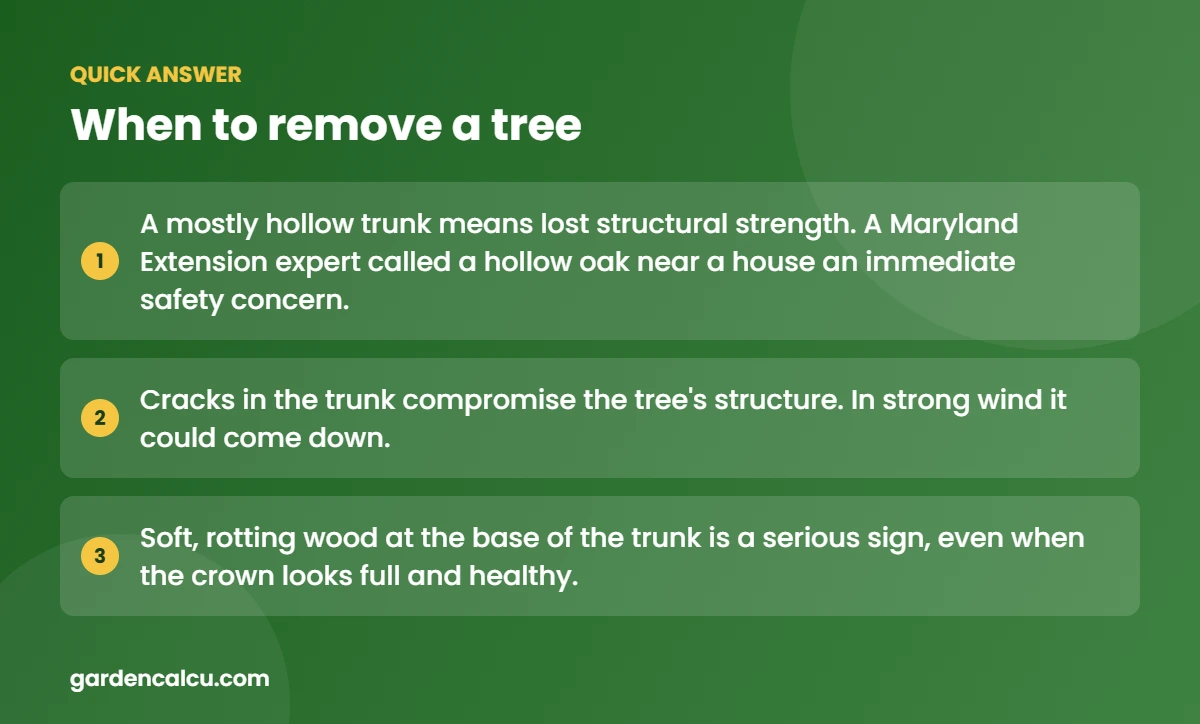
Quick answer to “when to remove a tree” in three points.
Real questions gardeners asked
People ask when to remove a tree after a storm, after a tree company visit or after noticing something that was not there last year. We read six real questions and the experts’ replies. Here is each one in our own words, with a link to the original.
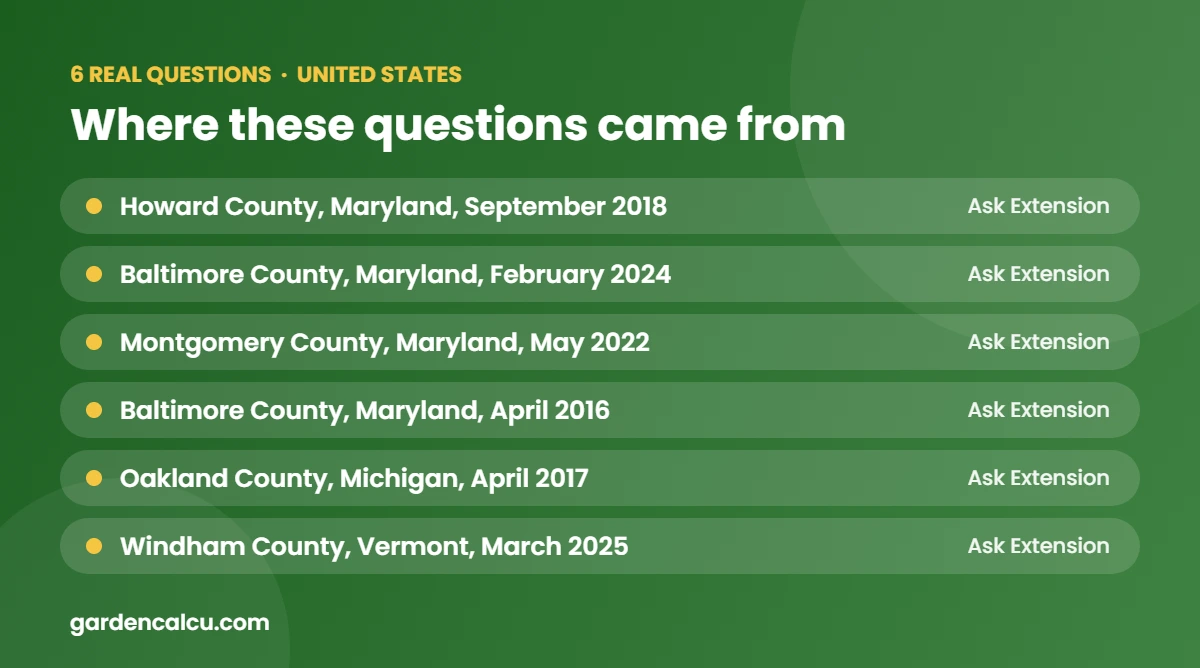
“hollow tree – when to cut”
The question: A 50 to 70 foot oak close to the house had a wide hollow starting at the ground and running up several feet, with only thin wood around the opening. It was not leaning and looked alive. How do you decide when to cut a hollow tree?
What the expert said: From that description there is immediate concern for the tree and for safety, the expert said. A mostly hollow tree may have lost a good deal of its structural integrity and could fall, especially in storms. Hire a Certified Arborist, credentialed by the International Society of Arboriculture, to evaluate its stability on site and make recommendations.
“Should This Poplar Tree be Cut Down?”
The question: A tree service pruning poplars pointed out a vertical crack in one trunk and recommended removal because of the tree’s height and nearness to the house. The owners were not sure it was really an issue.
What the expert said: Get another opinion from a certified arborist, the expert advised. Cracks in the trunk are definitely not a good sign. A crack compromises structural integrity, so in strong winds or a storm the tree could come down, and it invites pathogens and insects. Whether to remove it cannot be said from photos, but the cost of removal against the safety of the home may make it worthwhile. To keep some wildlife value, the trunk could be left standing at 10 to 12 feet.
“Tree rotting near base”
The question: An old, always-leaning dogwood had an opening near the base with soft, dark, rotting wood falling out. The owner loved the tree but did not want it to be a danger. Was it a goner?
What the expert said: The rot was crown canker, a disease that usually enters through trunk wounds from lawn equipment, the expert said. A crown that looks full, even with unusually heavy flowering, can be a sign of a late stage. Once the disease has invaded a large part of the base, as it had here, it is too late to control.
“Tree damage caused by wind”
The question: In high winds an ornamental pear lost a third of itself, and the falling section tore branches off a small Japanese maple beneath.
What the expert said: The pear looked like a Bradford pear, the expert said, an invasive tree with tight branch crotches that split in storms. Removal was recommended, since the tree would decline. The Japanese maple could be kept. Prune the dead limbs and ragged wounds, use no pruning paint and keep it watered in dry periods.
“Distance of white pine from home”
The question: A 30 to 35 foot white pine stood 4 feet from the corner of a house, with branches over the roof. Should it be cut down?
What the expert said: The tree is too close to the home, the expert agreed, but whether to take it down needs an on-site assessment by a certified arborist. A tree service wants your business and may not be unbiased. The roof condition and the wrong placement are two good reasons if the owner wants it gone.
“Possible dying tree”
The question: A crabapple that had always done well dropped its leaves very early last summer and had peeling bark. The owner hoped it could be saved.
What the expert said: The University of Vermont plant diagnostic clinic said early defoliation in crabapples has been common in recent years. It results from a few fungal leaf diseases that strip the leaves by mid-August, and it is not usually fatal.
The two questions that decide it
Arborists think about tree risk in two parts, and the Extension answers follow the same logic.
The hollow oak was 50 to 70 feet tall and close to the house. Both answers were bad, which is why the expert used the words immediate concern.
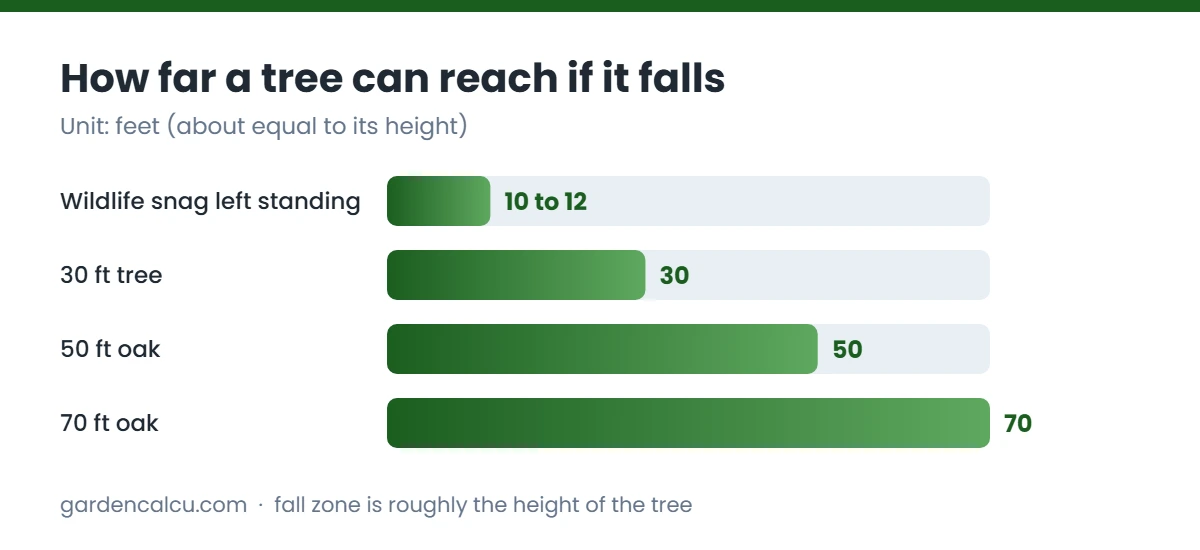
Chart for “when to remove a tree”: the distance a tree can reach is about equal to its height.
As a rough guide, a tree can reach anything within a distance equal to its height. Pace out the height of the tree toward the house, driveway, play area and power line. If any of them is inside that circle, a defect in that tree matters.
When to remove a tree: 7 warning signs
Sign | What it means | From |
|---|---|---|
Large hollow or cavity in the trunk | Lost structural strength | Maryland answer, 2018 |
Vertical crack in the trunk | Structure compromised, could fail in wind | Maryland answer, 2024 |
Soft, rotting wood at the base | Advanced decay or canker, often too late to treat | Maryland answer, 2022 |
Large sections splitting off | Weak branch unions, more will follow | Maryland answer, 2016 |
Mushrooms or conks on trunk or root flare | Internal decay | General arborist guidance |
New or increasing lean, heaving soil at the base | Roots are failing | General arborist guidance |
Large dead branches in the upper crown | Decline, and a falling hazard in themselves | General arborist guidance |
One sign on its own is a reason to call an arborist. Two or three together, on a tree within reach of the house, is a reason to call soon.
Hollow does not always mean doomed
Trees carry most of their strength in the outer wood, so a tree with a modest cavity can stand for decades. What worried the Maryland expert was the description: a very wide hollow from the ground up, with only thin wood left around it. How much sound wood remains is exactly what an on-site evaluation measures.
A full crown can be misleading
The dogwood answer contains a warning many people miss. The crown looked full and healthy, and the expert explained that this can be a sign of late-stage disease. A tree under severe stress sometimes flowers and fruits unusually heavily. Judge the trunk and base, not just the leaves.
Signs that usually do not mean removal
Get a certified arborist, and a second opinion
Three of the six answers give the same instruction. Have the tree evaluated on site by an ISA Certified Arborist. Photos and descriptions are not enough.
Two of them add a caution about who is giving the advice.
That is not a criticism of tree companies. It is ordinary good practice for an expensive decision. Ask for a consulting arborist who assesses risk for a fee, or get two or three companies to explain what they see and why.
To see whether a quote is in a sensible range, the Tree Removal Cost Calculator gives an estimate from the tree’s height and situation.
Estimate the cost before you call
Enter the tree’s height and situation. The calculator gives a cost range for removal so you can judge the quotes you receive.
Alternatives to taking the whole tree down
Option | When it fits |
|---|---|
Prune out dead and damaged wood | Sound trunk, defects limited to branches |
Crown reduction or cabling | Weak unions in an otherwise valuable tree, on an arborist’s advice |
Remove the target | Move the play set or parking spot instead of the tree |
Leave a wildlife snag | Cut to 10 to 12 feet and let birds, insects and fungi use it |
Monitor | Minor defect, no target. Recheck yearly and after storms. |
The snag idea came from the Maryland poplar answer. A short standing trunk cannot reach the house, and it is valuable habitat for woodpeckers and many other species.
Trees that are worth removing anyway
Sometimes removal is recommended even without an immediate hazard.
If you replace it, consider a native species and give it the right spacing. Our guide to the best time to plant trees covers when, and tree stump removal covers what to do with what is left.
Watch out: Do not cut down a large or defective tree yourself. Hollow and cracked trunks do not fall the way sound ones do, and trees near houses have to be taken down in pieces. This is work for an insured professional crew.
When to act fast
Most tree decisions can wait for a proper assessment. A few cannot.
Keep people and cars out of the fall zone until someone qualified has looked at it.
Common mistakes
Frequently asked questions
Short answers to the questions that come up most often.
Quick recap
When to remove a tree: when a real structural defect meets a real target. Hollow trunks, cracks, basal rot and splitting are the signs to take seriously. Early leaf drop, mess and a single broken branch are not.
Have a certified arborist look at it in person, get a second opinion on any costly removal and consider pruning, a wildlife snag or monitoring before the chainsaw.
Get your exact number
Use the calculator to get a cost range for the removal, then compare it with the quotes you receive.
Related guides
Sources
The facts in this guide to “when to remove a tree” come from these university Extension pages and public questions: