
How to Level a Bumpy Lawn: 3 Easy Methods and Topsoil Math
How to level a bumpy lawn without tearing it up: spread a thin layer of soil and compost mix, about a quarter to half an inch at a time, into the low areas and rake it down into the grass. Repeat over a season or two until the surface is smooth.
The key word is thin. The temptation is to order a truckload and bury the problem in one weekend. One Michigan homeowner planned to spread 3 inches of topsoil over the whole lawn, and an Extension expert explained why that would create a new problem under the surface.
This guide is built from four real questions sent to university Extension services in Michigan and Colorado. The experts describe three ways to smooth a lawn, what causes the bumps in the first place and why sand is the wrong material. The volume math shows how little soil a proper topdressing takes.
Key takeaways
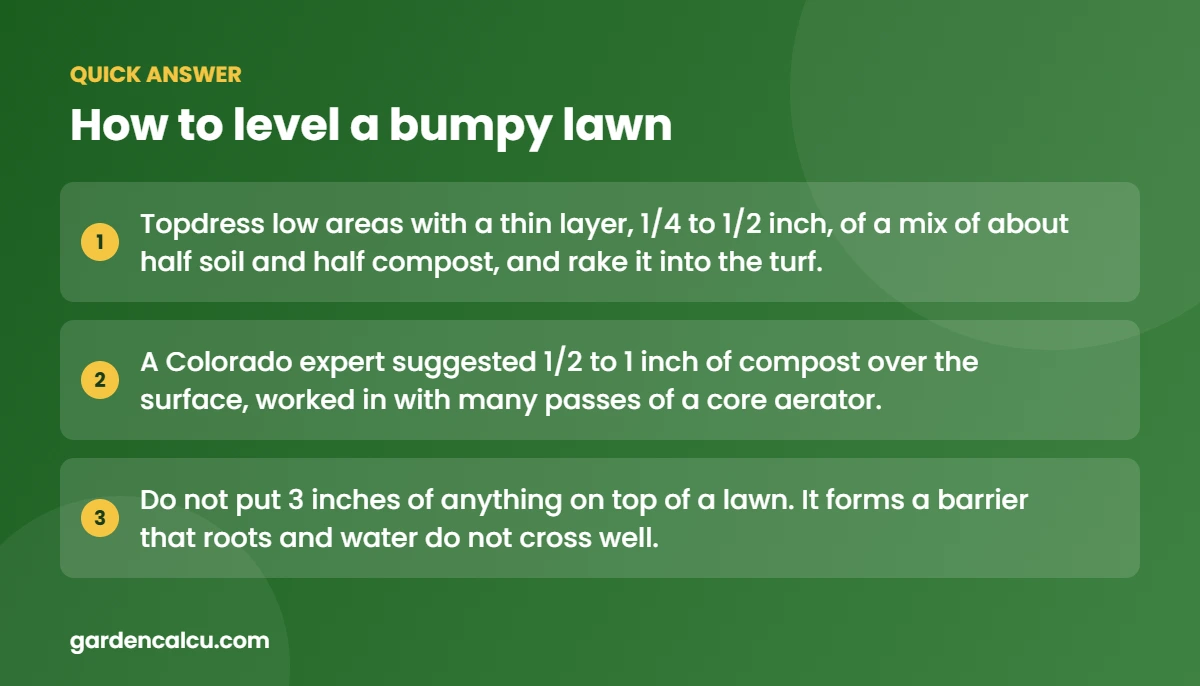
Quick answer to “how to level a bumpy lawn” in three points.
Real questions gardeners asked
People search how to level a bumpy lawn after a summer of mowing over what feels like a washboard. We read four real questions and the experts’ replies. Here is each in our own words, with a link to the original.

“Bumpy Yard”
The question: A homeowner with a healthy, good-looking lawn on a small suburban lot said mowing felt like riding over a washboard, and asked when and how to level an existing yard and with what material.
What the expert said: There are several ways, the expert said. One is rolling in fall or spring when the soil is moist, but rolling compacts soil, so core aerate afterwards and spread a thin layer of compost. Another is to improve smoothness gradually with a thin layer, 1/4 to 1/2 inch, of soil mix in the low areas, about 50 percent soil and 50 percent compost, raked into the turf. A third is power raking.
“Top Dressing in Fort Collins”
The question: The owner of a 25-year-old lawn wanted a smoother surface so children could play soccer without twisting ankles, and planned aeration, topdressing and overseeding.
What the expert said: In a lawn that old, a large nightcrawler population is probably causing the lumpiness, the expert said, and it will continue. To topdress, use compost of some sort. Do not use sand, which will make things worse. Apply 1/2 to 1 inch over the surface, then go over the lawn with an aerator, making lots and lots of passes to work the compost into the soil. Then overseed.
“tilling vs topdressing”
The question: A homeowner redoing an uneven back lawn could not get a tiller into the yard and was considering killing the grass and topdressing with 3 inches of good topsoil instead.
What the expert said: Three inches of anything sitting on top of soil and not worked in is too much, the expert said. The difference between the two layers is so great that a barrier develops. Roots tend not to cross it and grow deep enough, and water can stop at the barrier and not drain properly.
“Amount of top soil to purchase”
The question: A homeowner asked how much topsoil would cover 830 square feet one foot deep, in cubic feet, cubic yards and 40-pound bags.
What the expert said: The MSU Extension team worked it out: 830 cubic feet, or 30.88 cubic yards. They also warned that 1 foot of topsoil is very deep and may mat down unless amended with compost, and suggested buying in bulk from a landscape company.
Why lawns get bumpy
Knowing the cause tells you whether the fix will last.
Worm and frost bumps come back. Plan on a light touch-up every year or two instead of one big job.
How to level a bumpy lawn: 3 methods compared
Method | What it does | Drawback | Best for |
|---|---|---|---|
Topdressing | Fills low spots with a thin layer of soil and compost | Gradual, may take repeat applications | Most lawns |
Rolling | Presses bumps down when soil is moist | Compacts soil, needs core aeration afterwards | Light frost heaving in spring |
Power raking and core aeration | Breaks up mounds and thatch, lets soil resettle | Rough on the lawn for a few weeks | Worm-cast lumpiness |
All three come from the Wayne County answer. Topdressing is the one most homeowners should start with.
Method 1: topdressing, step by step
The Colorado variation covers the whole lawn. Spread 1/2 to 1 inch of compost, then run a core aerator over it many times. The cores and holes mix the compost into the top of the soil instead of leaving it as a layer.
How deep is too deep?
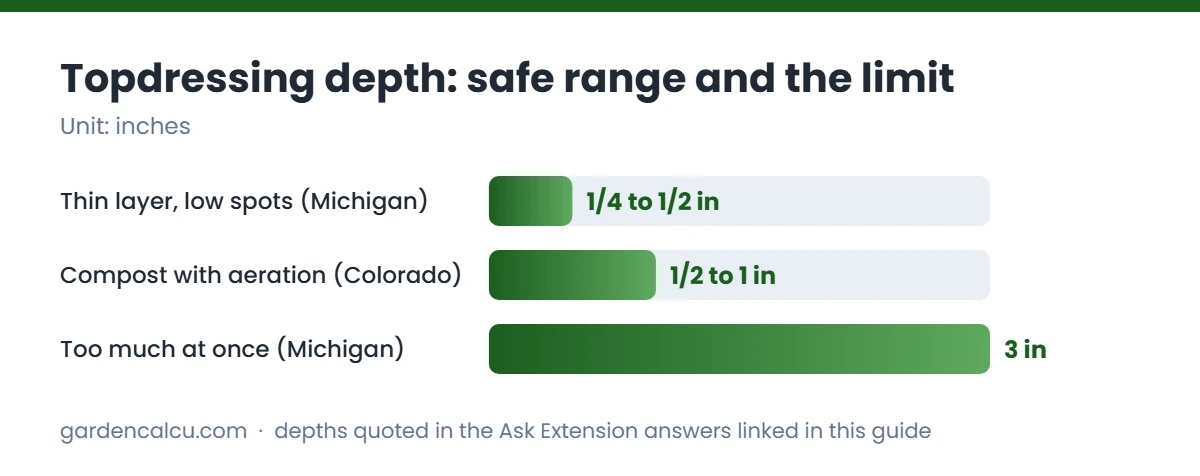
Chart for “how to level a bumpy lawn”: recommended topdressing depths and the depth an expert warned against.
The Ingham County answer sets the upper limit. Three inches of new soil sitting on old soil forms a barrier. The two layers differ so much in texture that roots stay in the top one and water stalls at the boundary. A lawn on a layer like that is shallow-rooted and often soggy.
For dips deeper than about an inch, there are two better options.
Watch out: Never bury a lawn under several inches of soil in one go, and do not raise the soil level over tree roots. Roots need air. The same warning appears in our guide to the best grass seed for shade, where two homeowners tried adding soil under trees.
What to use, and what not to
Material | Use it? | Why |
|---|---|---|
Half topsoil, half compost | Yes | Recommended in the Michigan answer |
Compost alone | Yes, thinly | Recommended in the Colorado answer, with aeration |
Topsoil similar to your own soil | Yes | Avoids a texture barrier |
Sand alone | No | The Colorado expert said it makes things worse |
Heavy clay fill | No | Seals the surface |
Fresh manure or wood chips | No | Burns or smothers grass |
Sand is the surprise for many people, since golf courses use it. Those greens are built on sand from the start. Spreading sand over ordinary loam or clay creates the same layering problem the Michigan expert described, and in clay it can set hard.
How much soil do you need?
Topdressing uses far less material than people expect, because the layer is so thin.
Worked example: half an inch over 1,000 square feet is 1,000 x 0.5 ÷ 12 = 41.7 cubic feet, or 1.54 cubic yards. A quarter inch is half that, 0.77 cubic yard.
Area | 1/4 inch | 1/2 inch | 1 inch |
|---|---|---|---|
250 sq ft of low spots | 5.2 cu ft | 10.4 cu ft | 20.8 cu ft |
1,000 sq ft | 20.8 cu ft (0.77 cu yd) | 41.7 cu ft (1.54 cu yd) | 83.3 cu ft (3.1 cu yd) |
5,000 sq ft | 104 cu ft (3.9 cu yd) | 208 cu ft (7.7 cu yd) | 417 cu ft (15.4 cu yd) |
Compare that with the 830 square foot question. At one foot deep the answer was almost 31 cubic yards, and the Extension team warned that a foot of topsoil is very deep and may mat down. At half an inch, the same area needs 34.6 cubic feet, about 1.3 cubic yards.
Tip: The Mulch Calculator works for any thin layer. Enter the area and the depth in inches to get cubic feet and cubic yards. For bags versus bulk, see how much mulch do I need.
How much topdressing do you need?
Enter the area you are leveling and the depth in inches. The calculator gives the cubic feet and cubic yards of soil mix to order.
Method 2: rolling
A lawn roller is a drum filled with water that you push or tow. It flattens small bumps, and it works only when the soil is moist enough to give.
The Michigan expert attached a condition. Rolling compacts the soil, so core aerate afterwards and spread a thin layer of compost to rebuild organic matter. Roll once, in spring or fall, with the drum only partly filled. Heavy or repeated rolling does more harm than the bumps.
Method 3: power raking and core aeration
For worm-cast lumpiness, the bumps are made of loose soil sitting on the surface. A power rake or dethatcher breaks them up, and core aeration opens the soil so it can resettle. Iowa State University and Purdue University both have pages on bumpy lawns, linked in the sources.
Expect the lawn to look rough for two or three weeks. Do it when the grass is growing strongly so it recovers, and follow with overseeding.
When to level a lawn
Work when the grass is growing and can push through the new soil. For cool-season lawns that is early fall or spring. For warm-season lawns it is late spring into summer.
Early fall has the advantage that you can aerate, topdress and overseed in one go. See when to plant grass seed in fall for the window and how often to water new grass seed for aftercare.
Avoid midsummer heat and avoid working on waterlogged soil, which ruts under your feet.
Common mistakes
Frequently asked questions
Short answers to the questions that come up most often.
Quick recap
How to level a bumpy lawn: topdress thinly, a quarter to half an inch at a time, with a soil and compost mix, and let the grass grow through. Use compost with core aeration over a whole lawn, and skip the sand.
Never bury turf under inches of new soil. Work out the volume first. A half-inch layer over 1,000 square feet is only about a yard and a half.
Get your exact number
Enter the area and layer depth, and the calculator converts it to cubic feet and cubic yards.
Related guides
Sources
The facts in this guide to “how to level a bumpy lawn” come from these university Extension pages and public questions: