Straw Over Grass Seed: 5 Easy Rules and How Many Bales
Putting straw over grass seed helps it stay moist and stay put. Use clean wheat, oat or barley straw, spread one layer thick so you can still see soil between the stems. That works out to about two 60-pound bales per 1,000 square feet.
The most common mistake is using too much. A thick blanket of straw shades out the seedlings it was meant to protect. The second most common is using the wrong material, either hay full of weed seeds or a sheet of plastic that cooks the seed.
This guide is built from five real questions that homeowners sent to university Extension services in Michigan, Ohio, Oregon, Minnesota and Maryland. They cover straw, seed blankets, peat moss, plastic sheeting and what to do on a slope.
Key takeaways
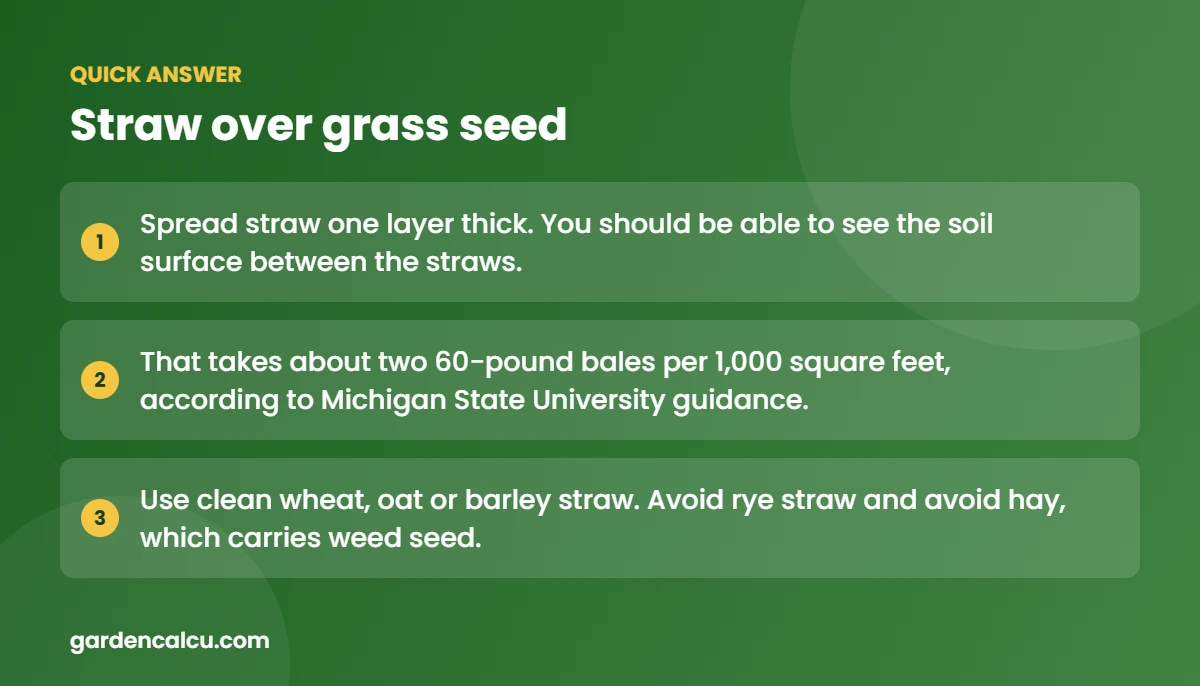
Quick answer to “straw over grass seed” in three points.
Real questions gardeners asked
Whether to put straw over grass seed is one of those jobs everyone has seen done and few have been taught. We read five real questions and the experts’ replies. Here is each one in our own words, with a link to the original.
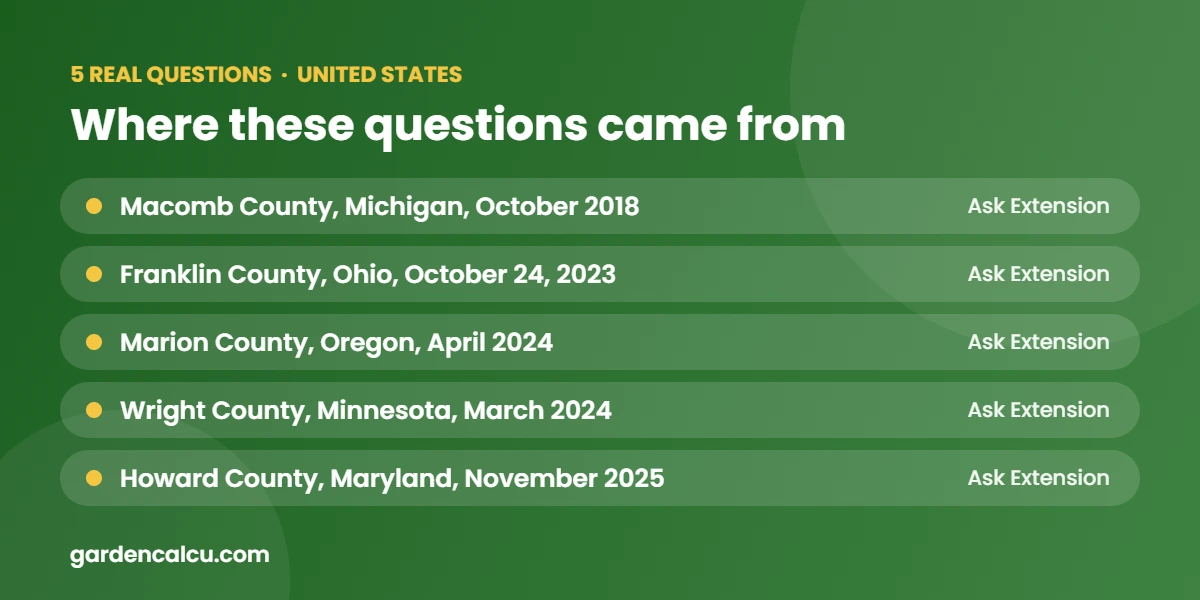
“Using a Seed Blanket on Existing New Grass”
The question: After a new driveway, a homeowner built up the edges with soil and seeded them. Rain and birds took much of the seed from the slight slope. They planned to reseed and asked about using a staked seed blanket.
What the expert said: The expert quoted Michigan State University’s lawn establishment guide. Straw is the traditional mulch, and processed wood fiber and other mulches are also available. Processed materials contain no weed or grain seed and are easier to spread, but cost more. Use clean wheat, oat or barley straw and avoid rye straw. Spread only one layer, about two 60-pound bales per 1,000 square feet, so the soil is visible between the straw.
“Start new grass seed under white plastic sheeting?”
The question: A homeowner with two worn patches of about 150 square feet each, thanks to two new dogs, asked whether to sow seed and cover it with white plastic sheeting to help it germinate.
What the expert said: Plastic sheeting is not recommended, the expert said, because it may cause the seed to overheat and die. Cool fall temperatures are ideal for germination, so use straw or even try without a cover. Loosen the soil first. Fine fescue suits the shady patch and turf-type tall fescue suits the high-traffic one.
“New lawn seed covering”
The question: A homeowner asked for the best product to cover a newly seeded lawn and preferred not to use peat moss.
What the expert said: The expert agreed that peat moss is not considered sustainable. Instead you can top-dress with any fine-textured mulch, including sawdust, fine fir bark mulch, compost or ground-up grass straw.
“Spring Seeding”
The question: A homeowner planned to overseed in mid-March and cover the seed with peat moss.
What the expert said: Hold off, the Master Gardener said. Germination needs soil near 50 degrees, and nights were still around freezing. Seed closer to mid-April. He also had mixed feelings about covering seed with peat moss.
“Planting grass seed at this point in year”
The question: Drilling had torn up 2,500 square feet of gently sloping lawn in November. It was too late to seed, and the owner worried about erosion over winter.
What the expert said: The expert suggested wood chips or mulch, or a combination of straw and burlap pinned down, to hold the soil and keep weed seeds out until spring. It all has to be removed before seeding or sodding.
Does grass seed need to be covered?
Not always. The Ohio expert told the homeowner with two small patches to use straw or even try without. In cool, damp fall weather on level ground, seed raked lightly into the soil often does fine uncovered.
A cover earns its keep in four situations.
If none of those apply, you can skip it. If any do, straw is the cheapest answer.
Rule 1: one layer, soil showing
The Michigan State guidance is precise. Spread the straw so there is only one layer on the ground, and you can see the soil surface between the straws. A common way to describe it is half soil, half straw when you look straight down.
Thin straw lets light reach the seedlings and lets them grow up through it. You do not have to rake it off afterwards. It breaks down, and the first mowings chop up what is left.
Watch out: If you cannot see soil, it is too thick. Heavy straw blocks light, stays wet underneath and smothers seedlings. Clumps left where a flake of the bale was dropped leave bare circles in the new lawn. Shake it apart as you spread.
Rule 2: how many bales
The rate is about two 60-pound bales per 1,000 square feet.
Worked example: the Ohio homeowner’s two patches were about 150 square feet each, 300 in total. 300 ÷ 1,000 x 2 = 0.6, so one bale covers both with plenty left over. A 5,000 square foot new lawn needs 10 bales.
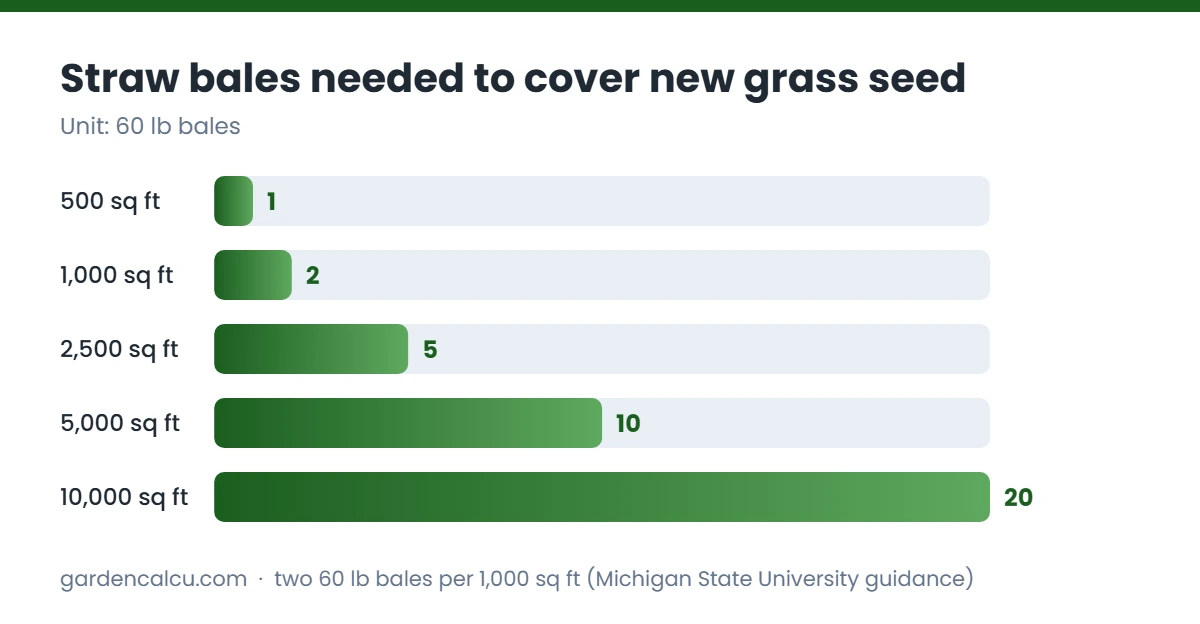
Chart for “straw over grass seed”: bales of straw needed at two 60-pound bales per 1,000 square feet.
Seeded area | Bales (60 lb) | Pounds of straw |
|---|---|---|
300 sq ft | 1 | 36 |
500 sq ft | 1 | 60 |
1,000 sq ft | 2 | 120 |
2,500 sq ft | 5 | 300 |
5,000 sq ft | 10 | 600 |
10,000 sq ft | 20 | 1,200 |
Bales vary in weight. Small square bales from a farm store can be 40 to 60 pounds, and compressed bagged straw covers more than its size suggests. Go by the look of the spread, not the count alone.
To work out the seed itself, use the Grass Seed Calculator.
Rule 3: use the right straw
Straw is the dry stalks left after grain is harvested. Hay is cut grass and legumes, seed heads included. They look alike in a bale and behave very differently on a lawn.
Material | Use it? | Why |
|---|---|---|
Wheat, oat or barley straw | Yes | Recommended in the Michigan State guidance |
Rye straw | No | The same guidance says to avoid it |
Hay | No | Full of grass and weed seed |
Pine straw (needles) | Not for seed | Mats and sheds water |
Bagged, processed straw mulch | Yes | Cleaner and easier to spread, costs more |
Even clean straw carries a few grain seeds. You may see some wheat or oat seedlings come up with the grass. They are annuals and disappear after a few mowings.
Tip: Ask for “clean” or “weed-free” straw at a farm or garden store. A Maryland Extension answer about vegetable mulch notes that straw is usually much cheaper bought locally than online.
Rule 4: never use plastic sheeting
The Ohio homeowner’s idea of covering seed with white plastic is a common one. The expert’s answer was no. Plastic traps heat, and seed under it may overheat and die. It also blocks rain and has to be lifted for every watering.
Clear plastic is worse than white, since it acts like a greenhouse. Neither belongs on a newly seeded lawn.
Rule 5: on slopes, pin it down
Loose straw blows and washes off a slope. That is where the Michigan homeowner’s seed blanket makes sense.
Biodegradable netting can stay in place. Plastic netting should come up once the grass is established, since it tangles mowers and wildlife.
How much grass seed do you need?
Enter the size of the area you are seeding. The calculator gives the pounds of seed, and you can use the same area to count straw bales.
Alternatives to straw
Straw is traditional, not compulsory. The Extension answers list several other covers.
Cover | Good points | Drawbacks |
|---|---|---|
Processed wood fiber or paper mulch | No weed seed, easy to spread | More expensive |
Compost, a quarter inch | Feeds soil, holds moisture | Must be fine and weed-free |
Fine fir bark or sawdust | Suggested by an Oregon expert | Use a very thin layer |
Peat moss | Holds water well | Not considered sustainable, hard to rewet once dry |
Seed blanket | Best on slopes | Cost, needs stapling |
Nothing | Free | Needs more frequent watering |
Peat moss came up twice. The Oregon expert said it is not considered sustainable or environmentally friendly, and the Minnesota Master Gardener had mixed feelings about it. Compost does the same job.
Whatever you use, keep it thin. Grass seed needs light soon after it sprouts. A quarter inch of fine material is plenty.
How to seed and straw, step by step
Timing still matters more than mulch. Straw will not make seed sprout in cold soil, as the Minnesota answer about a March seeding shows. See when to plant grass seed in fall and how long does grass seed take to grow.
Do you have to remove the straw?
No, if it was spread thinly. It decomposes and gets chopped by the mower. Rake off only thick clumps that are smothering the grass.
The exception is straw used as winter erosion cover on bare soil, as in the Maryland case. That layer is thicker and has to come off before you seed or sod in spring.
Common mistakes
Frequently asked questions
Short answers to the questions that come up most often.
Quick recap
Straw over grass seed works when it is clean, thin and the right kind: one layer of wheat, oat or barley straw, about two bales per 1,000 square feet, with soil still visible.
Skip hay and plastic, pin straw or a blanket on slopes, keep watering, and leave the thin layer to rot down under the new grass.
Get your exact number
Measure the area once and use it for both the seed and the straw.
Related guides
Sources
The facts in this guide to “straw over grass seed” come from these university Extension pages and public questions: