When to Plant Garlic: Best Dates and 5 Late-Planting Rules
When to plant garlic: in fall, from around the first frost until the ground freezes. For most of the country that means October into early November. The aim is roots before winter and little or no top growth.
Garlic forgives bad timing better than almost any crop, which is why Extension experts keep giving the same answer to people who think they have missed their chance. Planted in mid-September? It will be fine. Late November with the ground starting to freeze? Plant it anyway. February? Still plant it.
This guide is built from six real questions sent to university Extension services in Maryland, Michigan, Delaware, Minnesota and Oregon between September and February. Read in date order, they show the ideal window and how far it can be stretched.
Key takeaways
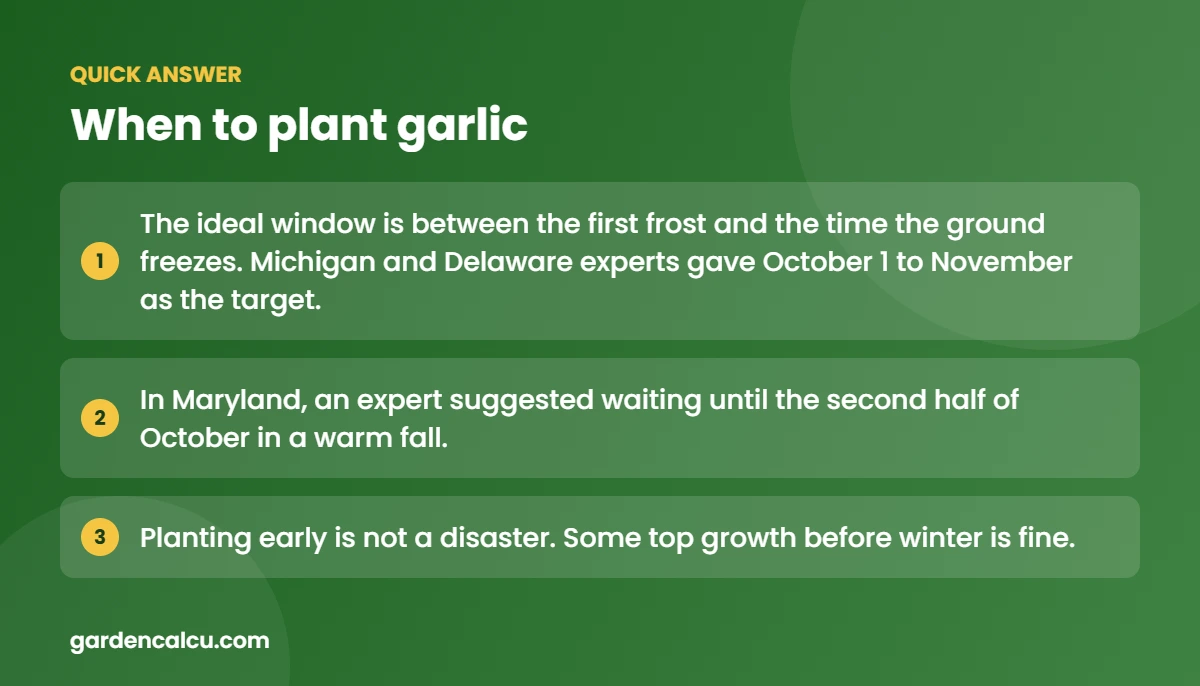
Quick answer to “when to plant garlic” in three points.
Real questions gardeners asked
People ask when to plant garlic in September because they are eager, and again in December because they are late. We read six real questions across that whole range. Here is each one in our own words, with what the expert said and a link to the original.
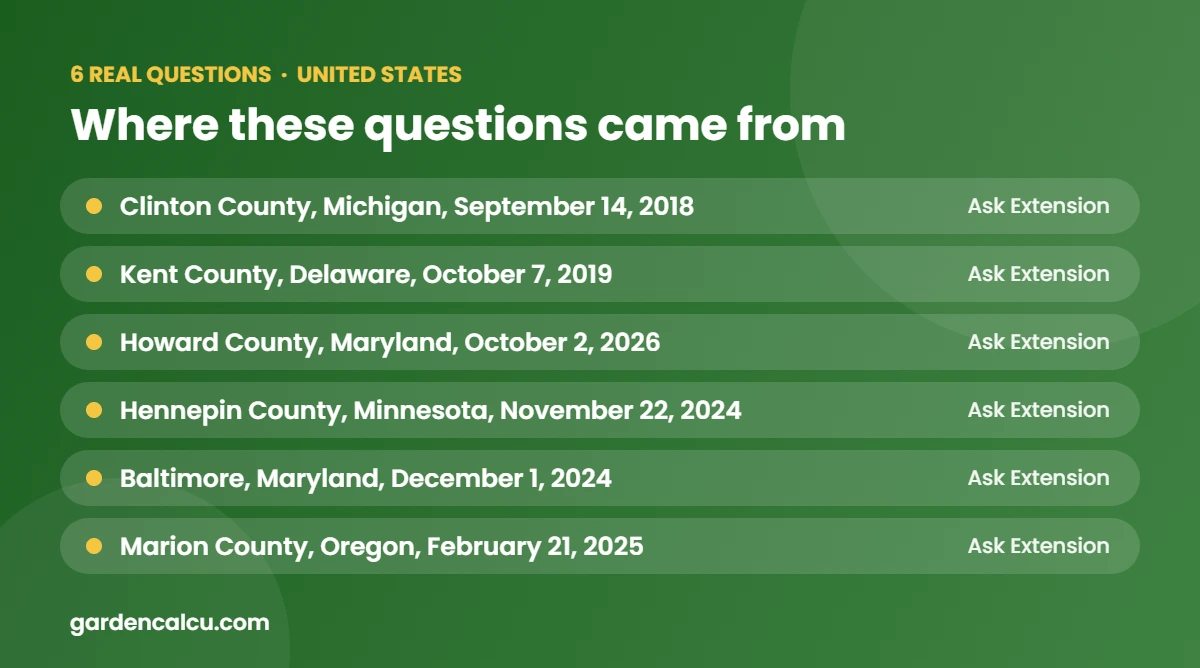
“Garlic, planting in the fall”
The question: A gardener asked if garlic could be planted now for next summer, and whether to plant whole bulbs or cloves.
What the expert said: Still a little early, the expert said. You want root growth this fall but no top growth. Garlic should be planted some time between the first frost and November, before the ground freezes. Plant individual cloves about 6 inches apart in rows 24 inches apart, 2 to 3 inches deep with the root end down, and cover them with 3 to 4 inches of mulch.
“Nervous first time garlic planter”
The question: A first-year gardener had planted garlic in mid-September out of eagerness, peeked three weeks later and found no root growth at all.
What the expert said: The expert reassured her. Garlic is best planted in fall between October 1 and November 1 and takes up to 9 months to mature. Buy planting garlic from a gardening source and not the grocery store, to avoid disease. Plant cloves 1 to 2 inches deep in a sunny spot with good drainage, and add organic matter and a thin layer of mulch.
“Plant garlic now or wait?”
The question: Worried that a mild winter would confuse the garlic, a gardener asked whether to plant now or wait a month, and what soil temperature to aim for.
What the expert said: Wait a couple of weeks, possibly until the end of the month, the University of Maryland Extension expert suggested. If sooner suits you better, top growth is not a problem. The plants just need a certain amount of cold for good bulbs. A mulch of straw or shredded leaves helps over winter.
“Can I Still Plant Garlic?”
The question: A gardener with a raised bed 20 inches high asked if it was too late to plant cloves for next summer’s harvest.
What the expert said: It is pretty late, the Master Gardener said, but garlic probably will not keep well enough to plant in spring. It is not a big investment, so plant it and there is a chance of a crop. Mulch thickly, leave the papery skin on the cloves and take the mulch off when shoots emerge in spring.
“GARLIC, Late Planting”
The question: A church garden had waited for a soil delivery. By December 1 it was 26°F and the ground was frozen. Could garlic still be planted for a crop?
What the expert said: Plant it as soon as possible, the expert said. Only the top 1 to 2 inches of ground is frozen, so a hoe or trowel can dig through.
“Missed fall Garlic planting”
The question: A gardener bought bulbs in fall and missed the window. She asked when to plant them now and whether to use a different spot from last year.
What the expert said: As soon as possible, since the bulbs will not store over summer. Avoid working wet soil. Rotate crops if you have space, using a different section of the beds each year to guard against fungal and nematode pests.
When to plant garlic: the calendar from real answers
Six dates, six verdicts. Together they draw the whole picture.
Date and place | Verdict |
|---|---|
September 14, Michigan | A little early. Wait for first frost. |
Mid-September, Delaware (already planted) | Do not worry. October 1 to November 1 is ideal. |
October 2, Maryland | Wait a couple of weeks, to late October. |
November 22, Minnesota | Pretty late, but plant it and mulch thickly. |
December 1, Maryland | Plant as soon as possible. Dig through the frozen crust. |
February 21, Oregon | Plant as soon as possible. |
The ideal window is short and the acceptable window is long. Nobody was told to throw the garlic away.
Why fall, and why not too early
Garlic needs a period of cold to split into a bulb of separate cloves. The Maryland expert put it simply: the plants need a certain amount of cold for good bulb growth. Fall planting provides it automatically.
The Michigan expert explained the other half. You want roots this fall but no top growth. Roots anchor the clove against frost heaving and let it start growing the moment the soil thaws. Tall green shoots before winter can be damaged by hard cold.
That is the reason to wait until around the first frost. If you do not know yours, see how to find your first frost date.
What if it is already up?
In a warm fall, early-planted garlic often sprouts. The Maryland answer was calm about it. Top growth is okay. The tips may brown over winter, and the plant grows new leaves in spring. Mulch helps protect them.
Rule 1: late is better than never
Three of the six answers are variations on the same instruction: plant it now. The reasoning came from the Minnesota Master Gardener and the Oregon expert. Garlic bulbs do not keep well enough to wait for the next planting season. By the following fall they will have sprouted or dried out.
Late garlic usually makes smaller bulbs, because it has less time to root and may get less cold. Smaller is still a harvest.
Tip: If the surface is frozen, test with a trowel. The Baltimore church garden was told only the top inch or two was frozen. Once you are through the crust, the soil below is workable.
Rule 2: plant at the right depth and spacing
The Michigan answer gives a complete recipe.
The Delaware answer gave a shallower depth, 1 to 2 inches. Shallower suits mild-winter areas. Deeper, with a thick mulch, suits cold ones, where it protects cloves from freezing and heaving.
How many cloves fit your bed?
At 6 inches apart each way, four cloves fit in one square foot.
Worked example: a 4 x 8 ft raised bed is 32 square feet. 32 x 4 = 128 cloves. A bulb of planting garlic has roughly 6 to 10 usable cloves depending on the type, so that is somewhere around 13 to 21 bulbs.
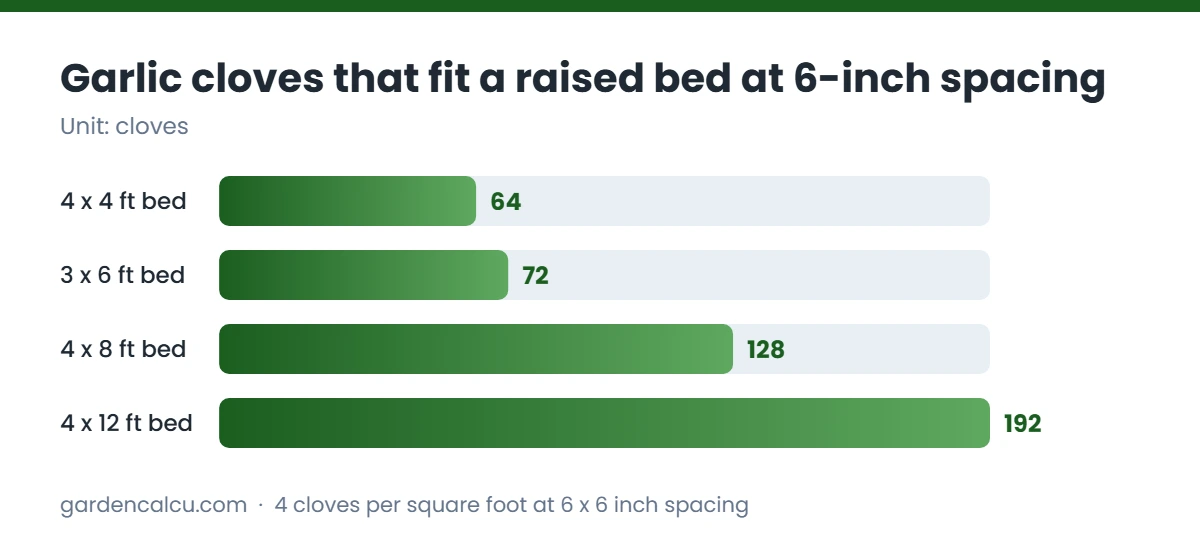
Chart for “when to plant garlic”: number of cloves that fit common raised bed sizes at 6-inch spacing.
Bed size | Area | Cloves at 6 in spacing | Cloves at 4 in x 8 in |
|---|---|---|---|
3 x 6 ft | 18 sq ft | 72 | 81 |
4 x 4 ft | 16 sq ft | 64 | 72 |
4 x 8 ft | 32 sq ft | 128 | 144 |
4 x 12 ft | 48 sq ft | 192 | 216 |
The Plant Spacing Calculator works this out for any bed and spacing. Each clove you plant becomes one bulb, so the number of cloves is also your harvest.
Rule 3: mulch it
Every one of the fall answers mentions mulch. Michigan said 3 to 4 inches. Minnesota said to mulch thickly. Maryland suggested straw or shredded leaves.
Mulch does three jobs for garlic. It keeps the soil from freezing and thawing repeatedly, which pushes cloves out of the ground. It protects early shoots. And it holds down winter and spring weeds, which garlic competes with poorly.
In cold regions, the Minnesota Master Gardener advised taking the mulch off when shoots emerge in spring. In milder regions a thinner layer can stay on all season. Free leaves as mulch are ideal and arrive at exactly the right time.
How many cloves fit your bed?
Enter your bed size and 6-inch spacing, and the calculator shows how many garlic cloves to plant.
Rule 4: use planting garlic, not grocery garlic
The Delaware expert recommended buying garlic for planting from a reputable gardening source and not the grocery store, to avoid bringing in disease. Supermarket garlic may also be a variety unsuited to your climate, and some is treated to stop it sprouting.
Seed garlic sells out early. Order in late summer for delivery in fall.
Rule 5: rotate the bed
The Oregon answer added a reminder that applies every year. Do not plant garlic in the same spot as last year if you can avoid it. Rotation guards against fungal diseases and nematodes that build up in soil, and against draining the same nutrients.
Garlic counts as part of the onion family, along with onions, leeks and shallots. Move the whole family to a new section each year.
What happens next
Garlic takes up to 9 months, as the Delaware expert said. Here is the rough sequence for a fall planting.
Time | What you see | What to do |
|---|---|---|
Fall | Nothing, or short green tips | Mulch and leave it alone |
Winter | Nothing | Check that cloves have not heaved out |
Early spring | Shoots push through | Pull mulch back in cold regions, feed and water |
Late spring | Hardneck types send up curly scapes | Cut the scapes and eat them |
Early to mid summer | Lower leaves turn brown | Dig, cure in shade for a few weeks, store |
Our garlic planting guide covers varieties, feeding and harvest in detail.
Watch out: Do not peek. The Delaware gardener dug up cloves after three weeks and panicked at the lack of roots. Garlic in cool soil roots slowly, and disturbing it sets it back. Plant, mulch and trust it.
Common mistakes
Frequently asked questions
Short answers to the questions that come up most often.
Quick recap
When to plant garlic: after the first frost and before the ground freezes, which is October to early November for most gardeners. Plant cloves 2 to 3 inches deep, 6 inches apart, root end down, and mulch well.
If you are early, do not worry about a little top growth. If you are late, plant anyway. Garlic in the ground has a chance, and garlic in the cupboard does not.
Get your exact number
Enter the bed size and spacing, and the calculator gives the number of cloves, which is also the number of bulbs you will harvest.
Related guides
Sources
The facts in this guide to “when to plant garlic” come from these university Extension pages and public questions: