How Much Lime for Lawn? 5 Easy Rules and Real Soil Test Rates
How much lime for lawn use depends on a soil test, but the real-world range is clear. Soil test reports commonly call for about 50 pounds of ground limestone per 1,000 square feet, a Maryland Extension expert says up to 70 pounds is safe in a single application, and larger amounts are split into two.
Lime is not fertilizer. It raises soil pH, and it only helps if the pH is too low to begin with. Spread on a lawn that does not need it, lime does nothing useful and can push the pH too high.
This guide is built from five real questions that homeowners sent to university Extension services in Maryland, Michigan, Oregon and Vermont, each with a soil test figure attached. The rates are theirs, and the bag counts are worked out for common lawn sizes.
Key takeaways
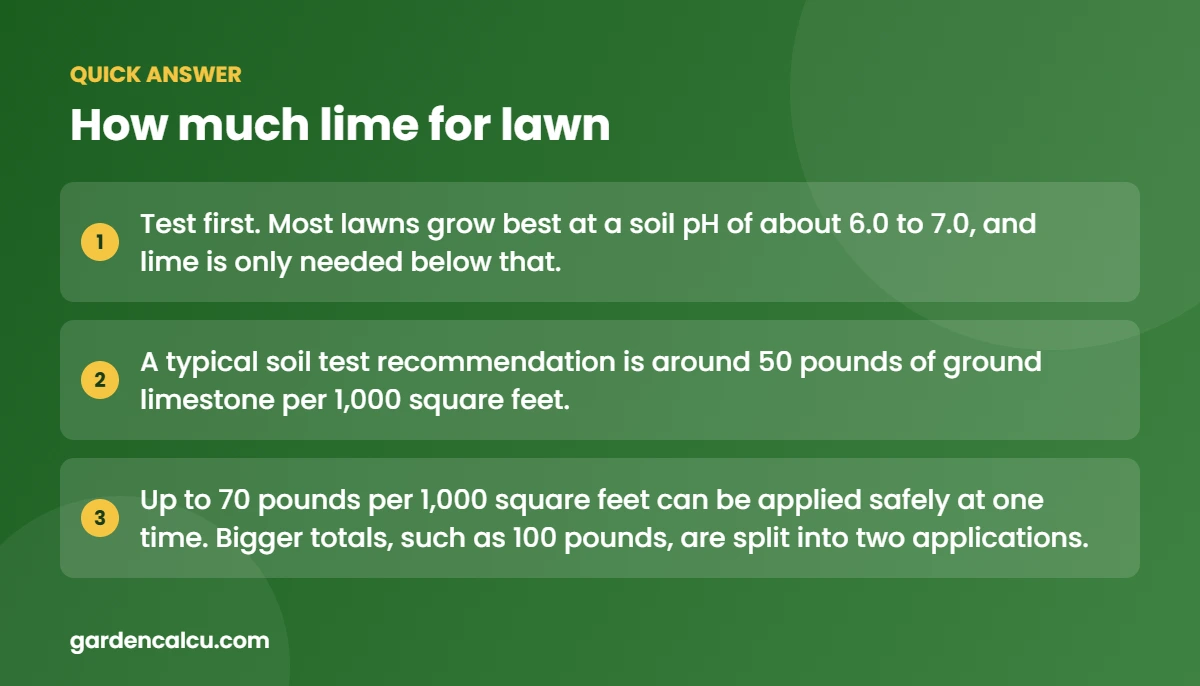
Quick answer to “how much lime for lawn” in three points.
Real questions gardeners asked
Almost everyone who asks how much lime for lawn care has a soil test report in hand and a number that looks too big. We read five of those questions and the replies. Here is each one in our own words, with a link to the original.
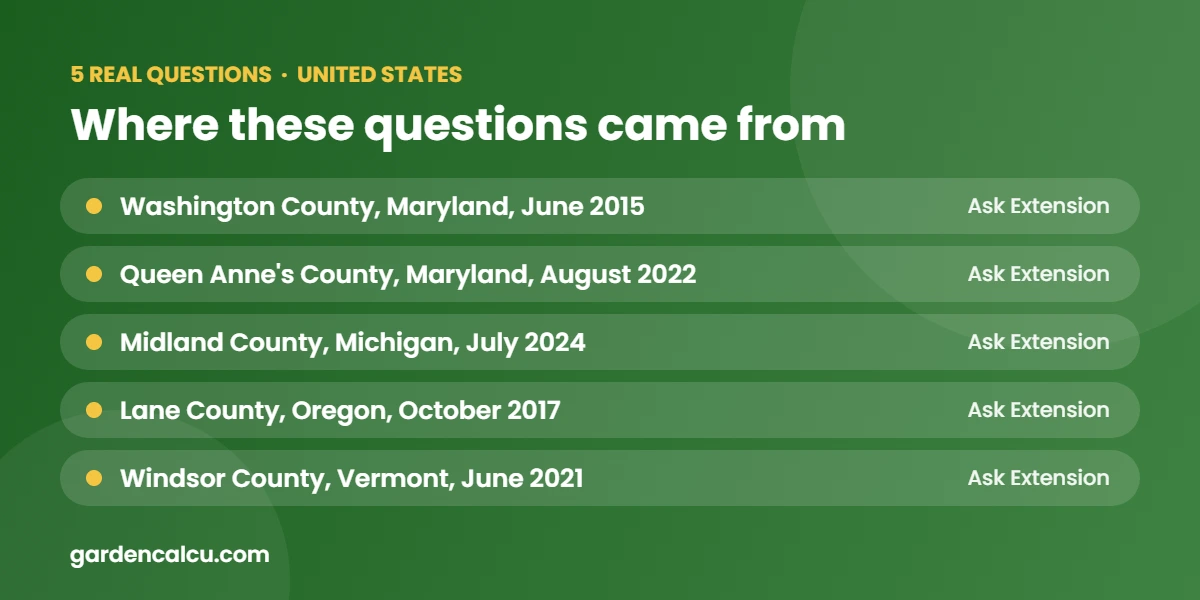
“Soil Test recommends limestone application – how much should I use?”
The question: A soil test recommended working in 50 pounds of ground limestone per 1,000 square feet. The homeowner asked if that amount was right for Maryland and what kind of limestone to buy.
What the expert said: The expert said 50 pounds per thousand square feet sounds like a lot but is not uncommon, and that up to 70 pounds can be applied safely in a single application. Look for ordinary agricultural lime, powdered or pelleted. Most people find pellets easier because they do not blow around.
“Choice of lime product for my lawn”
The question: A soil test called for about 100 pounds of lime per 1,000 square feet, in two 50-pound applications, on a 30,000 square foot lawn. The owner asked whether pulverized or pelletized lime matters.
What the expert said: Pelletized is recommended and is much less dusty, the University of Maryland Extension expert replied.
“Ongoing lime application”
The question: A soil test indicated 22 pounds of lime per 1,000 square feet annually. The homeowner had only heard of lime as a one-time fix and asked if it should really go on year after year, and whether it could be spread out through the season.
What the expert said: The expert noted the soil was fairly acidic at pH 5.8, while most lawns do best at 6.0 to 7.0, where nutrients are more available. Lime can be applied throughout the year instead of all at once, and it will take several years for the pH to change.
“Lime addition to soil”
The question: A new gardener with a mossy lawn assumed the pH was low and asked if lime could go on now, on soggy soil, without a soil test.
What the expert said: Moss is not necessarily a sign of low pH, the expert said. Most lawns like a pH of about 5.5 to 6.5, and most western Oregon soils are already there. Without a test, a general rule is no more than 50 pounds of lime per 1,000 square feet. That rate is not for every year. The alternative is 10 to 15 pounds per 1,000 square feet annually. Fall is a good time.
“Correct Lime Application Rate”
The question: A homeowner read a lawn soil test as recommending 200 pounds per 1,000 square feet, more than 4 tons per acre, to raise pH from 5.4 to 6.5, and asked if that could be right.
What the expert said: The Master Gardener agreed that it seemed incorrect and passed the question to a soil test specialist. The lesson is to check the units on a report and ask before spreading a very large amount.
How much lime for lawn: what the soil tests said
Here are the rates from the five questions, lowest to highest.
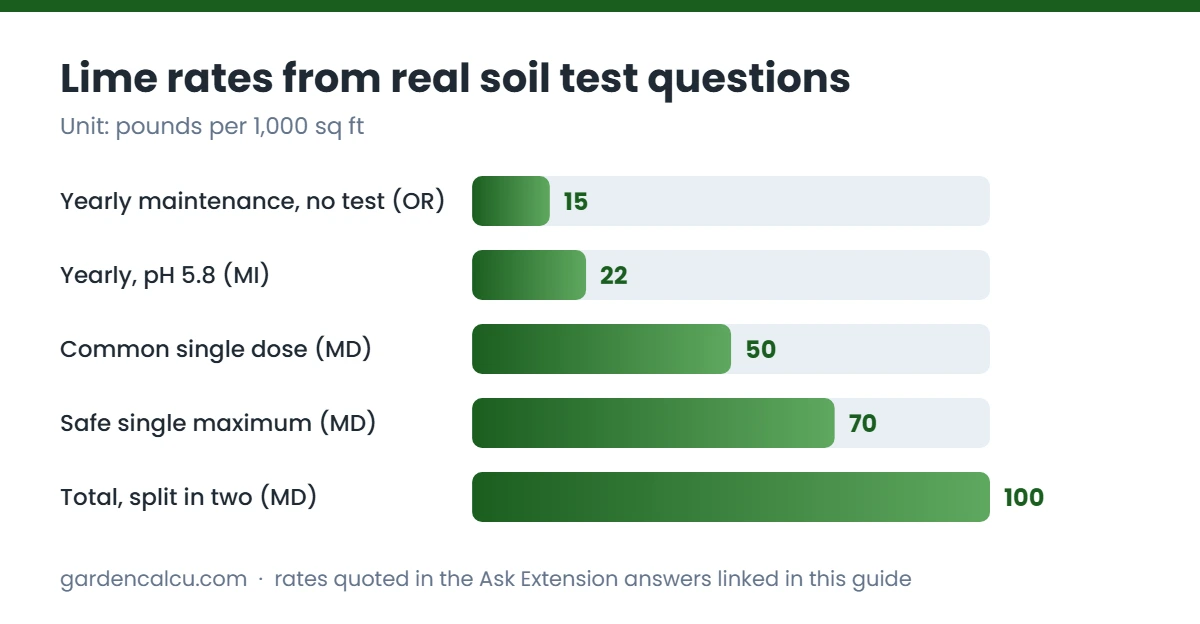
Chart for “how much lime for lawn”: lime rates per 1,000 square feet from five real Extension answers.
Rate per 1,000 sq ft | Situation | Source |
|---|---|---|
10 to 15 lb per year | Maintenance without a soil test | Oregon answer, 2017 |
22 lb per year | Soil test, pH 5.8 | Michigan answer, 2024 |
50 lb | Soil test recommendation, one application | Maryland answer, 2015 |
70 lb | Most to apply safely at one time | Maryland answer, 2015 |
100 lb | Soil test, split into two 50 lb applications | Maryland answer, 2022 |
The right number for your lawn sits somewhere in that table, and only a soil test tells you where. Two lawns with the same pH can need different amounts, because clay and soils rich in organic matter resist change more than sandy soils. Labs measure that resistance and build it into the recommendation.
Rule 1: test before you lime
Lime corrects one problem: soil that is too acidic. The Michigan expert gave the target range as pH 6.0 to 7.0, where nutrients are most available to grass. The Oregon expert gave 5.5 to 6.5 as acceptable. Below about 6.0, lime starts to make sense. Above 7.0, it makes things worse.
You cannot tell pH by looking. The Oregon homeowner assumed moss meant acid soil. The expert corrected that. Moss grows where grass is weak, usually because of shade, poor drainage or compaction.
A soil test from your state Extension lab costs little and reports both the pH and how much lime to apply. Without one, the Oregon rule of thumb is the cautious fallback.
Watch out: Do not lime “just in case” every year. Soil that has been pushed above pH 7 locks up iron and other nutrients, and the grass turns pale. Bringing pH back down is much harder than raising it.
Rule 2: respect the single-dose limit
Lime sits on the surface of an established lawn and works down slowly. Too much at once just cakes on top.
Split applications are usually made several months apart, for example one in fall and one in spring.
Rule 3: turn the rate into bags
Rates are given per 1,000 square feet. Multiply by your lawn area in thousands.
Worked example: a 5,000 square foot lawn at 50 pounds per 1,000 square feet needs 5 x 50 = 250 pounds. That is seven 40-pound bags.
The Queen Anne’s County lawn was much bigger. At 30,000 square feet and 100 pounds per 1,000 in total, it needs 30 x 100 = 3,000 pounds, a ton and a half. Each of the two applications is 1,500 pounds, or 38 bags of 40 pounds.
Lawn size | At 25 lb per 1,000 | At 50 lb per 1,000 | 40 lb bags at 50 lb rate |
|---|---|---|---|
2,500 sq ft | 63 lb | 125 lb | 4 |
5,000 sq ft | 125 lb | 250 lb | 7 |
10,000 sq ft | 250 lb | 500 lb | 13 |
20,000 sq ft | 500 lb | 1,000 lb | 25 |
1 acre (43,560 sq ft) | 1,089 lb | 2,178 lb | 55 |
Tip: The Fertilizer Calculator handles any rate per 1,000 square feet. Enter your lawn size and the rate from the soil test to get total pounds.
Check the units on your report
The Vermont homeowner’s question is a useful warning. A reading of 200 pounds per 1,000 square feet works out to 200 x 43.56 = 8,712 pounds per acre, more than 4 tons. The Master Gardener agreed it looked wrong and sent it to a soil specialist.
Reports sometimes give rates per acre, per 100 square feet or per 1,000 square feet. If your number is far outside the table above, ask the lab before you buy.
Rule 4: choose the right product
Ground agricultural limestone is what soil tests assume. The Maryland expert said there is nothing special to look for.
Rule 5: timing and patience
Lime can go on at any time the ground is not frozen. The Oregon expert called fall a good time, since rain and winter weather work it into the soil. The Michigan expert said applications can be spread through the year.
Do not expect a quick change. The Michigan answer was direct: it will take several years for the pH to change. Retest every two to three years and adjust.
If you are also feeding the lawn in fall, see when to fertilize lawn in fall. Lime and fertilizer do different jobs and can be applied in the same season.
Turn your soil test rate into pounds
Enter your lawn size and the rate per 1,000 square feet. The calculator gives the total pounds to spread.
How to apply lime to a lawn
The Oregon homeowner asked about soggy soil. Lime itself is not harmed by wet ground, but a loaded spreader will rut a waterlogged lawn. Wait until you can walk on it without leaving prints.
Does lime kill moss?
No. This is the most common reason people reach for lime, and the Oregon answer explains why it disappoints. Moss tolerates a wide range of pH. It wins where grass is thin.
To beat moss, fix what is weakening the grass: prune for more light, relieve compaction by aerating, improve drainage and overseed. The guide on when to plant grass seed in fall covers the seeding window. Lime helps only if a test shows the soil is too acidic for grass.
Common mistakes
Frequently asked questions
Short answers to the questions that come up most often.
Quick recap
How much lime for lawn use is a soil test question. Expect something like 50 pounds per 1,000 square feet for a one-time correction, never more than 70 pounds in one pass, and split anything larger.
Multiply the rate by your lawn area in thousands of square feet, buy pelletized lime, apply it in fall or whenever the ground is workable, and retest in two or three years.
Get your exact number
Enter your lawn area and the rate from your soil test, and the calculator shows total pounds and helps you count bags.
Related guides
Sources
The facts in this guide to “how much lime for lawn” come from these university Extension pages and public questions: