How Much Compost to Add to Garden: 1 to 3 Inches, Explained
How much compost to add to garden beds depends on the soil you start with, but the range is narrow: about 1 inch a year for a bed that is already in good shape, 1 to 2 inches worked into poor or new ground, and no more than 3 inches at one time.
One inch does not sound like much. Over a 4 x 8 ft bed it is 2.7 cubic feet, a bit more than one large bag. Over a 20 x 30 ft plot it is nearly two cubic yards. The amount to buy climbs quickly, which is why it pays to get the depth right.
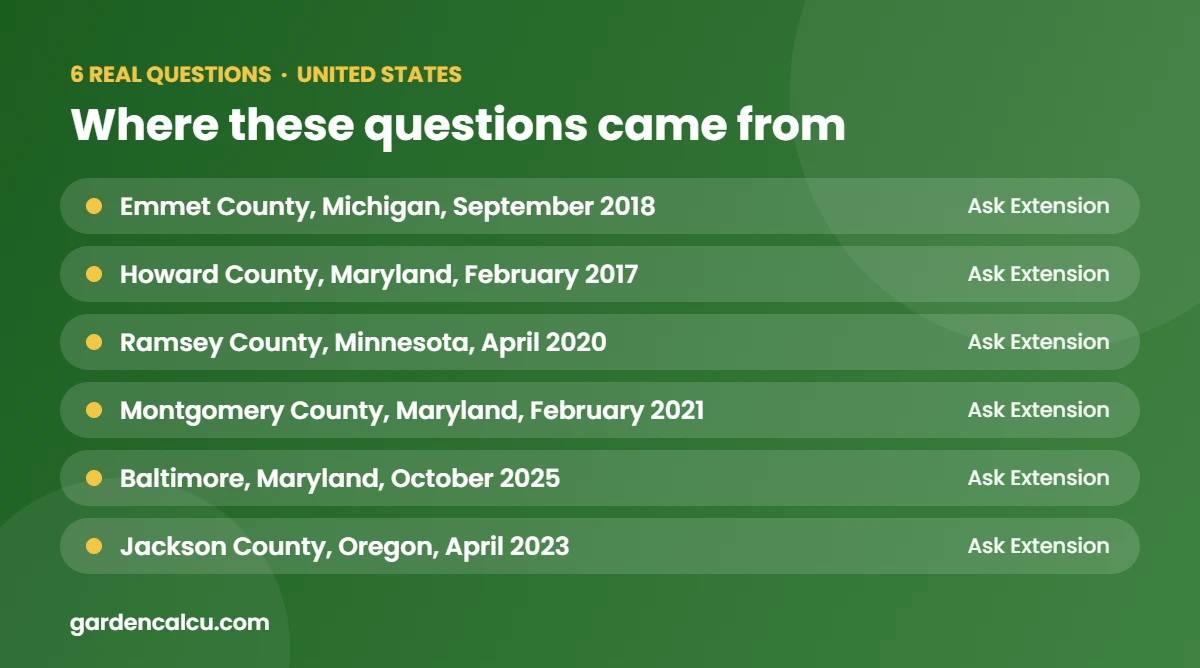
This guide is built from six real questions that gardeners sent to university Extension services in Michigan, Maryland, Minnesota and Oregon. The depths are the ones the experts gave, and the volumes are worked out so you can check them against your own beds.
Key takeaways
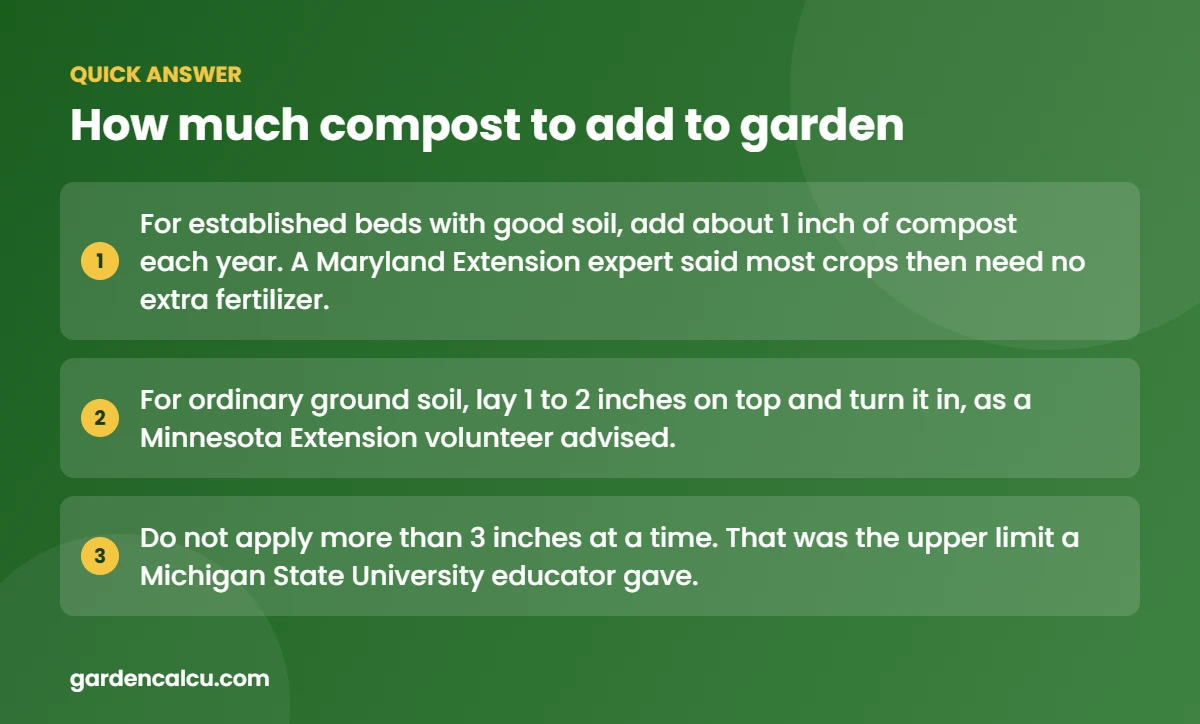
Quick answer to “how much compost to add to garden” in three points.
Real questions gardeners asked
People ask how much compost to add to garden beds from both directions. Some worry they are using too little, and others wonder if more is always better. We read six real questions and the replies, and summarized each in our own words with a link to the original.
“Apply Compost to Garden in Fall?”
The question: A county recycling program that makes compost wanted to give residents good advice. They had seen rates of 2, 3 and 4 inches and asked which was right, and whether to work it in or leave it on top.
What the expert said: The Michigan State University Extension educator said fall is a wonderful time to apply compost. For perennials and woody plants, top dressing is the best method, and nature will quickly make it part of the active top layer of soil. She would not use more than three inches, but any smaller amount would be helpful.
“Is it necessary to add organic fertilizer if I’m adding lots of compost”
The question: A gardener with raised beds filled half with compost and half with topsoil had good crops and asked if adding organic fertilizer on top would make a difference or be too much.
What the expert said: The expert called a 50/50 mix a great one. Most crops will not need extra nutrients, and the bed will be fine with an additional inch of compost each year. The only weak spot can be early spring, when cold soil slows the microbes that release nutrients.
“How much compost is too much?”
The question: “People say the more compost the better.” A gardener asked whether vegetables can be grown in 100 percent compost, or whether half compost and half plain black dirt would be better.
What the expert said: The volunteer said compost is not soil. It is an organic amendment, and plants need soil. For dirt from the ground, lay an inch or two of compost over the top and turn it in with a shovel or hoe.
“Adding compost to garden beds”
The question: A gardener whose beds were covered in wood mulch asked whether to rake the mulch aside and put compost underneath, and if early March was a good time.
What the expert said: Yes to both. The University of Maryland Extension expert said to move the mulch so the compost is spread directly on the soil. March is a good time, but do not do it while the ground is frozen.
“Do I mulch old tomato plants into my Raised Bed Garden or remove the dead plants?”
The question: A raised bed gardener asked whether to add compost on top in fall or wait until spring.
What the expert said: Add it whenever is most convenient, the expert said. Fresher, less aged compost is best applied in fall, because it has all winter to break down and blend into the soil while acting as a mulch that limits nutrient loss.
“What to add as organic matter to a vegetable garden”
The question: A gardener wanted to add organic matter without adding too much wood, and asked how to know how much to use.
What the expert said: The expert said wood chips take too long to break down to help this year. Organic matter for soil usually means thoroughly composted manures. Never use fresh manure in a garden. Bagged products have done the ageing for you and should be used as their instructions say.
How much compost to add to garden beds, by situation
Put the answers together and you get a short table.
Situation | Compost depth | How to apply | From |
|---|---|---|---|
Established bed, good soil | About 1 inch a year | Spread on top | Maryland answer, 2017 |
Ordinary ground soil | 1 to 2 inches | Turn into the soil | Minnesota answer, 2020 |
Perennials, shrubs, trees | Up to 3 inches | Top dress, do not dig in | Michigan answer, 2018 |
Any bed, maximum | 3 inches at one time | Any smaller amount still helps | Michigan answer, 2018 |
New raised bed | Part of the soil mix, not all of it | Blend with topsoil | Maryland and Minnesota answers |
The pattern is easy to remember. One inch maintains. Two inches improves. Three inches is the ceiling.
Turning inches into cubic feet and bags
Compost is sold by volume, in bags marked in cubic feet or in bulk by the cubic yard.
Worked example: a vegetable plot 10 x 20 ft is 200 square feet. For 1 inch: 200 x 1 ÷ 12 = 16.7 cubic feet, which is 0.62 cubic yard or seventeen 1-cubic-foot bags. For 2 inches, double it: 33.3 cubic feet, or 1.23 cubic yards.
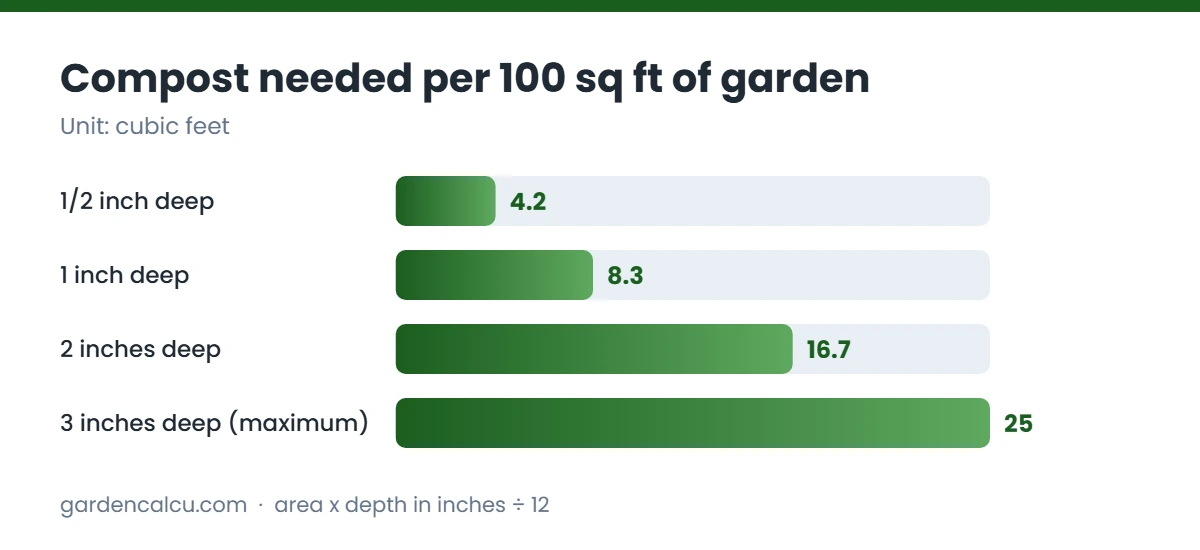
Chart for “how much compost to add to garden”: cubic feet of compost per 100 square feet at each depth.
Bed or plot | Area | 1 inch | 2 inches | 3 inches |
|---|---|---|---|---|
4 x 4 ft bed | 16 sq ft | 1.3 cu ft | 2.7 cu ft | 4 cu ft |
4 x 8 ft bed | 32 sq ft | 2.7 cu ft | 5.3 cu ft | 8 cu ft |
10 x 10 ft | 100 sq ft | 8.3 cu ft | 16.7 cu ft | 25 cu ft |
10 x 20 ft | 200 sq ft | 16.7 cu ft | 33.3 cu ft | 50 cu ft |
20 x 30 ft | 600 sq ft | 50 cu ft (1.85 cu yd) | 100 cu ft (3.7 cu yd) | 150 cu ft (5.6 cu yd) |
Tip: The Raised Bed Soil Calculator works for compost as well. Enter the bed length and width and use the compost depth as the depth. It returns cubic feet, cubic yards and bags.
Once you pass about one cubic yard, a bulk delivery is usually cheaper than bags. Our guide to how much soil for a raised bed explains the bags versus bulk comparison.
Can you add too much compost?
Yes. The Minnesota gardener had heard that more compost is always better. The volunteer’s answer was that compost is an amendment, not a growing medium. Plants need soil.
There are practical reasons behind the limit.
This is why the Michigan educator capped a single application at three inches, and why the Maryland expert was happy with one inch a year on a bed that was already half compost.
Watch out: If you have been adding several inches of compost every year, get a soil test before adding more. It will show whether phosphorus or salts have climbed too high.
On top or dug in?
Both methods appear in the Extension answers, and they suit different places.
In an established raised bed that is already loose, spreading compost on the surface and letting worms and rain carry it down is enough.
When to add compost: fall or spring?
Either season works. The Extension answers lean slightly toward fall for one reason. Compost spread in fall has months to settle in.
If you are doing a fall cleanup anyway, add the compost as the last step. See how to prepare garden for winter for the full sequence.
Work out your compost volume
Enter the bed length and width, and use your compost depth as the depth. The calculator gives cubic feet, cubic yards and bags.
Does compost replace fertilizer?
Often, but not always. The Maryland gardener with a 50/50 compost and topsoil mix was told most crops would not need extra nutrients, as long as an inch of compost goes on each year.
The expert noted one exception. In early spring the ground may not be warm enough for soil microbes to release nutrients from compost, so early crops can be slow. A soil test showing low phosphorus or potassium is another reason to supplement.
Compost releases nutrients slowly. Heavy feeders such as tomatoes and corn in ordinary soil may still benefit from a light fertilizer during the season. The Fertilizer Calculator helps with rates.
What counts as good compost?
Leaf compost, yard waste compost, mushroom compost and composted manure are all sold bagged. For choosing a soil mix as a whole, see best soil for vegetable gardens.
Common mistakes
Frequently asked questions
Short answers to the questions that come up most often.
Quick recap
How much compost to add to garden beds comes down to three numbers: 1 inch a year to maintain good soil, 1 to 2 inches to improve ordinary soil, and 3 inches as the most to apply at once.
Multiply your bed area by the depth in inches and divide by 12 for cubic feet. Spread it on the soil, not on top of mulch, and remember that compost improves soil but does not replace it.
Get your exact number
Enter your bed size and compost depth, and the calculator converts it to cubic feet, cubic yards and bags.
Related guides
Sources
The facts in this guide to “how much compost to add to garden” come from these university Extension pages and public questions: