
Prepare Garden for Winter: 9 Easy Fall Cleanup Steps
To prepare garden for winter, pull out spent and diseased plants, clear the weeds, test the soil, spread compost and cover every bare bed with mulch or a cover crop. Do it after the first frosts and before the ground freezes.
That is the whole job in one sentence. What gardeners actually ask about are the judgment calls. Can dead tomato plants be chopped into the bed? Is a tarp a good idea? Should compost go on now or in spring? Is it wrong to leave everything standing until March?
This guide is built from six real questions sent to university Extension services in Maryland, Michigan, Minnesota, Oregon and Delaware. The steps below follow the experts’ answers, and the amounts of compost and mulch are worked out so you can check them.
Key takeaways
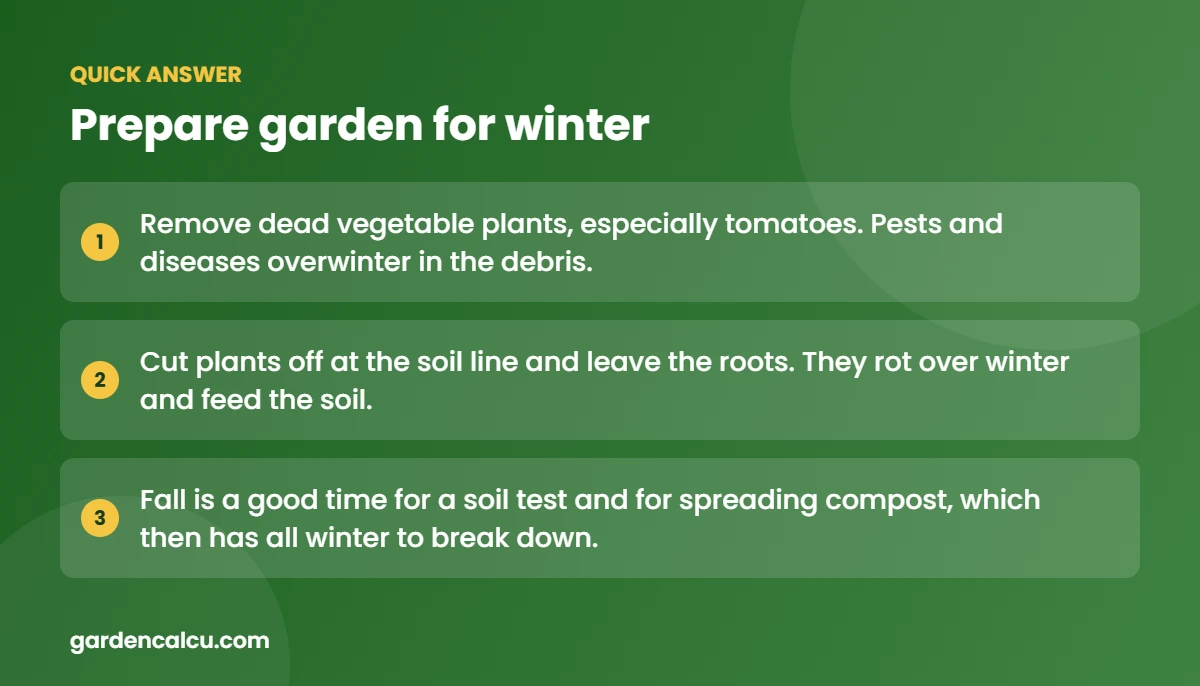
Quick answer to “prepare garden for winter” in three points.
Real questions gardeners asked
How to prepare garden for winter is one of the most common fall questions Extension volunteers receive. We read six of them, from October through February, and summarized each in our own words with a link to the original.

“Do I mulch old tomato plants into my Raised Bed Garden or remove the dead plants?”
The question: A gardener with a small raised bed asked whether to chop old tomato plants into the soil or remove them, whether to add compost now or in spring, and how to prepare the bed for best results next year.
What the expert said: Remove them. Tomatoes often end the season with one or more diseases, the expert said, so take out the plants and any fallen leaves to prevent early infection next year. There is no need to dig out the roots. Snip at the soil line and they will break down. Compost can go on whenever is convenient, and fall gives it all winter to blend into the soil while acting as a mulch.
“Winterization of raised vegie garden beds”
The question: A gardener asked how to winterize raised vegetable beds and whether to cover them with a breathable tarp or plastic.
What the expert said: Only cover with a tarp or plastic if the bed has more weeds than plants, the expert said, and even then cardboard is a better barrier. Start by removing all weeds, debris and plants to reduce homes for overwintering insects and diseases. You can then work organic matter into the bed. Herbs can be covered with mulch or evergreen branches after the first frost.
“Winterizing treatment for raised beds”
The question: A gardener with several raised beds asked what to apply in fall to fortify the soil for spring planting.
What the expert said: Clean up old plants first, since plant skeletons can harbor pests and disease. If no fall crop is growing, sow a cover crop to add nutrients and improve soil structure. The expert listed fall rye, crimson clover, field peas, hairy vetch, and oats or barley.
“Prepping my garden for winter”
The question: After the first freezing nights, a gardener asked whether to cut the plants down now, with lilies still flowering.
What the expert said: There are pros and cons to fall and spring cleanup, the volunteer said. After a few frosty nights, remove annuals and cut back the tops of some tall perennials. Foliage browned by frost can come out, which reduces the chance for fungi and insects to overwinter. For peonies, which get botrytis blight, fall removal of the old foliage should be a priority.
“Winter prep vegetable garden”
The question: A backyard gardener asked in late January if there was anything specific to do at that time of year, especially with compost.
What the expert said: Cleanup is very important because pests and diseases overwinter in debris and in the ground, the expert said. It was too late for cover crops, which their demonstration garden uses to keep down weeds and add organic matter. A mild winter week is a perfect time for a soil test, which matters most for raised beds because they lose nutrients faster than ground beds.
“Timing and methodology for removing garden vegetable matter after harvest”
The question: A couple had been leaving all their vegetable plants standing until spring, then composting the tops and leaving the roots. They wondered if that was a mistake.
What the expert said: The expert said it mirrors how nature handles plants, with one exception. If the plants had a disease such as blight or mildew, the spores stay in the soil for next year. That is one reason to rotate vegetable families to a different bed on a three or four year cycle.
When to prepare garden for winter
Start once frost has finished the summer crops and finish before the soil freezes hard. In much of the country that means October and November. The Minnesota answer gives a simple trigger: after a few frosty nights.
If you are not sure when that is for you, look up your first frost date and plan the cleanup for the two or three weeks after it. Cover crops are the exception. They have to be sown earlier, while there is still warmth to sprout the seed.
The 9 steps
The sections below explain the steps that raise questions.
Remove dead plants, but leave the roots
Every expert started with cleanup, and for the same reason. Old stems and leaves are where next year’s problems spend the winter. The Delaware expert said pests and diseases overwinter in debris and in the ground. The Oregon expert called dead plants skeletons that harbor pests.
Tomatoes are the clearest case. By October most tomato plants carry at least one leaf disease. The Maryland expert told the Baltimore gardener to take out the plants and every fallen leaf.
You do not need to rip out the root ball. Snip the stem at or just above the soil line. The roots die over winter and add organic matter as they decompose, and the soil structure stays intact.
Watch out: Healthy plant tops can go in the compost bin. Anything with spots, mildew or blight should not, unless your pile gets properly hot. Otherwise you are saving the disease for next year.
Is it wrong to leave everything until spring?
Not always. The couple who asked that question were told their habit copies nature. Standing stems also shelter beneficial insects, which is why the Minnesota volunteer described pros and cons on both sides.
A fair rule is to split the garden. Clear the vegetable beds in fall, because vegetable diseases carry over. In flower borders, cut back plants that had disease, such as peonies and phlox, and leave healthy seed heads and stems for wildlife until spring.
Test the soil and add compost
Fall and winter are good times for a soil test. Labs are less busy, and you have months to act on the results. The Delaware expert pointed out that testing matters most for raised beds, which leach nutrients faster than beds in the ground.
Then feed the soil. The Maryland expert said compost can go on whenever is convenient, but fall has an advantage. The compost has all winter to break down and blend in, and meanwhile it acts as a mulch that stops nutrients washing away.
How much? A layer 1 to 2 inches deep is typical. For a 4 x 8 ft bed, 1 inch of compost is 32 x 1 ÷ 12 = 2.7 cubic feet. Two inches is 5.3 cubic feet, a little under three 2-cubic-foot bags.
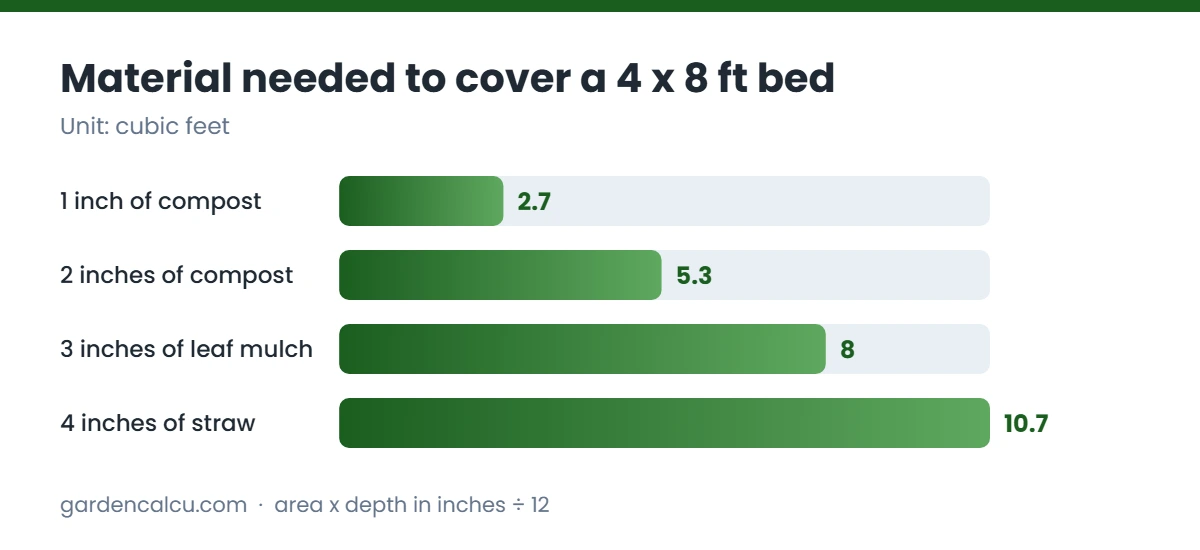
Chart for “prepare garden for winter”: cubic feet of compost or mulch needed to cover a 4 x 8 ft bed.
Bed size | 1 in compost | 2 in compost | 3 in leaf mulch |
|---|---|---|---|
4 x 4 ft | 1.3 cu ft | 2.7 cu ft | 4 cu ft |
4 x 8 ft | 2.7 cu ft | 5.3 cu ft | 8 cu ft |
4 x 12 ft | 4 cu ft | 8 cu ft | 12 cu ft |
10 x 10 ft | 8.3 cu ft | 16.7 cu ft | 25 cu ft |
Tip: The Mulch Calculator works for compost too. Enter the bed size and the depth, and it gives cubic feet and bags. For filling new beds, see how much soil for a raised bed.
Cover the soil: cover crop or mulch
Bare soil loses nutrients to winter rain and grows a carpet of weeds by March. There are two ways to cover it.
Option 1: a cover crop
A cover crop is a plant grown to protect and feed the soil, not to eat. The Oregon expert listed fall rye, crimson clover, field peas, hairy vetch, and oats or barley. A North Carolina answer to a gardener with two 4 x 4 beds recommended barley with crimson clover, sown from mid-September to early November and turned into the soil in early spring.
Timing is the catch. A cover crop needs warmth to sprout. By late January, as the Delaware expert said, it is too late. A Michigan educator also advised against hairy vetch in gardens, because if wet spring weather stops you from killing it on time it can become a weed.
Option 2: mulch
If you missed the cover crop window, mulch does the job. Spread about 3 inches of shredded leaves or straw over the bed. Our guide to using leaves as mulch covers depths, and how much mulch do I need covers the arithmetic.
What about a tarp, plastic or cardboard?
The Michigan expert was clear. Cover with a tarp or plastic only if the bed is unruly, meaning more weeds than plants. Even then, cardboard is the better weed barrier. It blocks light, lets water through and rots down by spring.
How much compost or mulch for your beds?
Enter your bed length, width and the depth you want. The calculator gives the cubic feet and bags of compost or mulch to buy.
Protect what stays in the ground
Rotate next year’s crops now
Winter prep is also the moment to plan rotation. The expert who answered the couple’s question recommended moving each vegetable family to a different bed on a three or four year cycle. If broccoli grew in one bed this year, its relatives should go elsewhere next year.
Sketch the beds while you can still see what grew where. A phone photo taken in October saves a lot of guessing in April.
Common mistakes
Frequently asked questions
Short answers to the questions that come up most often.
Quick recap
To prepare garden for winter, clear out spent and diseased plants, weed, test the soil, spread an inch or two of compost and cover the bed with a cover crop or 3 inches of mulch.
Leave roots in the ground, skip the plastic unless weeds have taken over, and note where each crop grew so you can rotate next year. An hour in fall saves several in spring.
Get your exact number
Measure each bed and the calculator shows how many cubic feet or bags of mulch and compost you need to cover it.
Related guides
Sources
The facts in this guide to “prepare garden for winter” come from these university Extension pages and public questions: