
How Much Manure to Add to Garden: 5 Safe Rules and Rates
How much manure to add to garden beds: for well-composted manure, about 40 to 60 pounds per 100 square feet worked in before planting, or a layer no more than an inch or two deep. Fresh manure is a different matter and should not go on a vegetable garden within 90 to 120 days of harvest.
Manure is a soil builder first and a fertilizer second. Cow manure is only about half a percent nitrogen, so it takes a great deal to feed a crop. Its real value is organic matter. Its real risks are salts if you use too much and bacteria if you use it fresh.
This guide is built from five real questions sent to university Extension services in Kentucky, Washington, Texas, Michigan and Oregon. The experts cover bagged and farm manure, chicken and cow, and the waiting rules that keep food safe.
Key takeaways
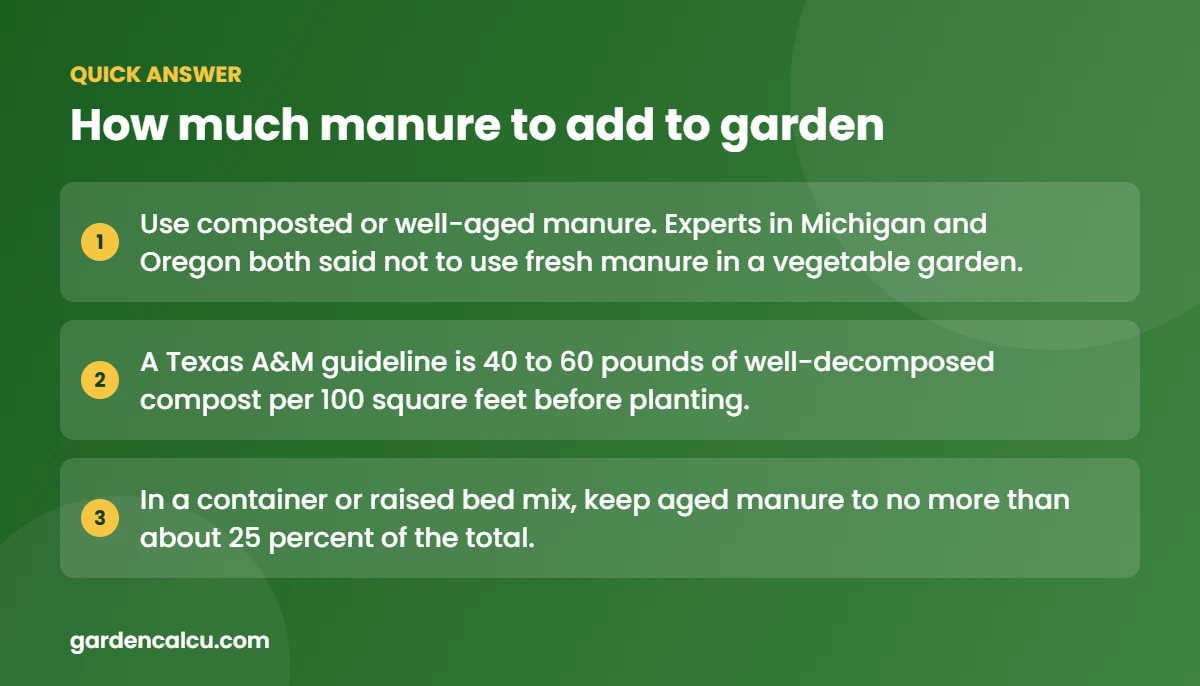
Quick answer to “how much manure to add to garden” in three points.
Real questions gardeners asked
People who ask how much manure to add to garden soil usually also want to know if it is safe. We read five real questions and the experts’ replies. Here is each one in our own words, with a link to the original.

“Chicken manure”
The question: A gardener asked if year-old chicken manure could be used in a 2 x 8 ft vegetable container filled with potting mix, having heard about E. coli, and how much to use.
What the expert said: With poultry manure, salmonella is the concern, the expert said, and it has to be assumed present unless the manure was properly hot-composted. Make aged manure a fairly small share of the mix, no more than about 25 percent. Manure that has not been aged is top-dressed lightly, no more than an inch or two, and worked in. In the first year, grow crops whose fruit sits well above the soil, such as tomatoes, peppers and beans, and avoid root and low-growing crops.
“Using Chicken Manure as side dressing”
The question: A gardener applied bagged composted chicken manure in mid-June, then read that manure requires a 90 day wait before harvesting trellised crops and 120 days for crops touching the soil. Did that apply?
What the expert said: If the manure was composted correctly there should not be a problem, the expert said, and harvest can go ahead. The waiting periods are for fresh manure.
“Is cow manure a safe fertilizer for a vegetable garden?”
The question: A gardener asked if a bagged composted cow manure product was safe to use on vegetables.
What the expert said: Yes, it is safe, the expert said, quoting Texas guidance. The ideal vegetable soil is very high in organic matter. Before planting, apply well-decomposed compost at 40 to 60 pounds per 100 square feet. Manure can be used in place of dry fertilizer, but manures vary widely in nutrients and salt content, so take care not to apply too much.
“Soil Test Results 72A56A-How do I adjust for using fresh cow manure”
The question: With a soil test in hand, a gardener asked how much fresh cow manure to apply to a 60 x 100 ft plot before sowing cover crops.
What the expert said: Do not use fresh manure, the expert said. It will not blend into the soil and stays in clumps where seeds do not grow. Use composted manure that mixes easily. Cow manure is about half a percent nitrogen, a third of a percent phosphorus and half a percent potassium, not even 1 percent of anything. You would need so much to meet the soil test that it could not be turned under. It adds organic matter but few nutrients.
“What to add as organic matter to a vegetable garden”
The question: A gardener wanted to add organic matter and asked how to know how much to use.
What the expert said: When sources talk about adding organics, the expert said, they usually mean manures that have been thoroughly composted. Never use fresh manures in a garden. Horse manure, for example, should be piled for a long time before use. Bagged products have done the ageing for you and should be used as their instructions direct.
Composted, aged and fresh: know which you have
The amount you can use and the wait before harvest both depend on this.
Type | What it is | Safe to use on vegetables? |
|---|---|---|
Composted manure | Hot-composted so the pile reached high temperatures for a set time. Most bagged products. | Yes, with no waiting period |
Aged manure | Sat in a pile for months or years without managed heating | Yes, but treat as possibly carrying bacteria |
Fresh manure | Straight from the animal, with or without bedding | Only with a 90 to 120 day wait before harvest |
The Kentucky expert made the point clearly. Unless manure has been properly composted, with temperatures recorded and held, you have to assume it still carries pathogens. Most backyard piles are aged, not composted.
Rule 1: how much composted manure to add
The Texas guideline is the simplest to use: 40 to 60 pounds of well-decomposed compost per 100 square feet, applied before planting and worked into the soil.
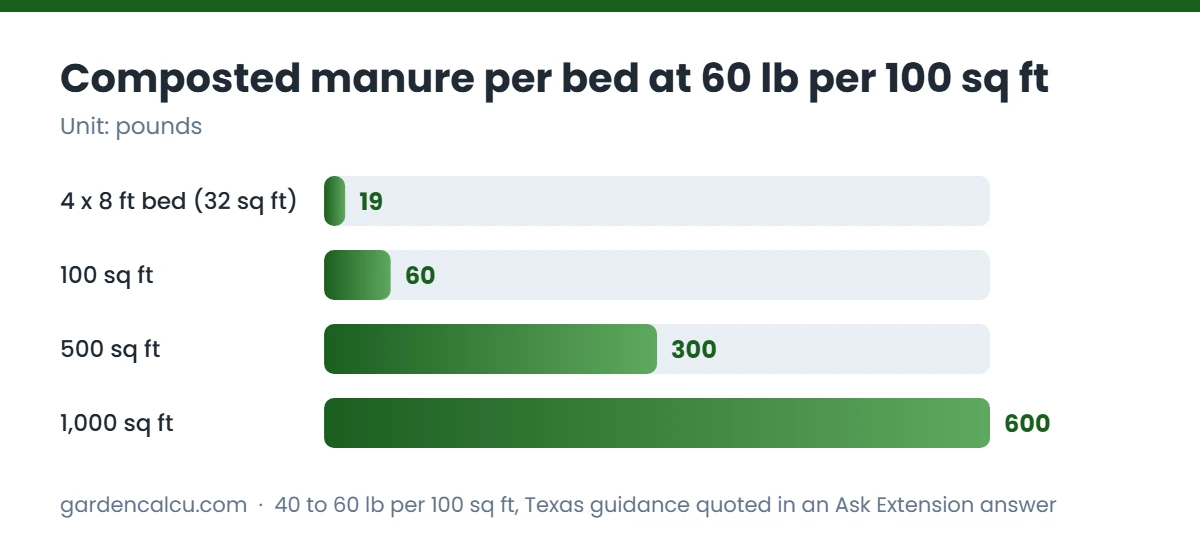
Chart for “how much manure to add to garden”: pounds of composted manure at the upper Texas rate of 60 pounds per 100 square feet.
Bed or garden | Square feet | At 40 lb per 100 sq ft | At 60 lb per 100 sq ft | 40 lb bags (upper rate) |
|---|---|---|---|---|
4 x 4 ft bed | 16 | 6 lb | 10 lb | 1 |
4 x 8 ft bed | 32 | 13 lb | 19 lb | 1 |
100 sq ft | 100 | 40 lb | 60 lb | 2 |
500 sq ft | 500 | 200 lb | 300 lb | 8 |
1,000 sq ft | 1,000 | 400 lb | 600 lb | 15 |
Worked example: a 4 x 8 ft raised bed is 32 square feet. At 60 pounds per 100 square feet, 32 ÷ 100 x 60 = 19 pounds, about half of a 40-pound bag. The Michigan gardener’s 60 x 100 ft plot is 6,000 square feet. At the same rate it would take 3,600 pounds, which is a truckload, not bags.
By depth, the same amount is a thin layer. The Kentucky answer’s ceiling for un-aged manure was an inch or two, and that is a sensible ceiling for composted manure as well. For volumes by depth, see how much compost to add to garden.
In containers and raised bed mixes
When manure is an ingredient in a mix, the Kentucky rule of thumb is no more than about 25 percent. For the 2 x 8 ft container in that question, filled 12 inches deep, the mix is 16 cubic feet, so no more than 4 cubic feet should be manure.
Rule 2: do not use fresh manure
Two experts said this outright, for two different reasons.
If fresh manure is what you have, the safe use is to spread it in fall on ground that will not be harvested until the following summer, or to compost it first.
Rule 3: respect the 90 and 120 day wait
The Washington gardener had read the standard food safety guideline for raw manure. It comes from the US National Organic Program and is widely used by Extension services.
Crop | Wait between applying fresh manure and harvest |
|---|---|
Edible part does not touch the soil: staked tomatoes, trellised beans, sweet corn | At least 90 days |
Edible part touches the soil or grows in it: lettuce, carrots, potatoes, strawberries, melons | At least 120 days |
Properly composted manure | No wait |
Worked example: lettuce you plan to cut on June 15 needs any fresh manure applied by February 15 at the latest, 120 days earlier. In practice that means applying in fall.
The Kentucky expert added a practical version for aged manure of uncertain history. In the first year after adding it, stick to crops that fruit well above the soil, such as tomatoes, peppers and pole beans, and avoid lettuce, melons, carrots, potatoes, onions and radishes.
Watch out: Never side-dress growing vegetables with fresh manure, and never use manure from dogs, cats or pigs in a food garden. Wash hands and all produce after working with any manure.
Rule 4: do not rely on manure as your only fertilizer
The Michigan answer contains the numbers. Cow manure is about 0.5 percent nitrogen, 0.33 percent phosphorus and 0.5 percent potassium.
Worked example: a soil test asks for 4 pounds of nitrogen per 1,000 square feet. At 0.5 percent, that is 4 ÷ 0.005 = 800 pounds of cow manure per 1,000 square feet, and only part of that nitrogen becomes available in the first year. The expert’s verdict was that you would need so much you could not turn it under.
Manure | Relative strength | Notes |
|---|---|---|
Cow | Low, about 0.5-0.3-0.5 | Mild. Mainly organic matter. |
Horse | Low | Not high in nitrogen. Often weedy unless well composted. |
Chicken and other poultry | Higher | Strongest of the common manures. Easy to overdo. |
Bagged composted blends | Low and consistent | Follow the bag |
So use composted manure to build the soil, and make up the nutrients a soil test calls for with fertilizer. The Fertilizer Calculator converts a recommendation into pounds of product, and what do fertilizer numbers mean explains the grades.
Rule 5: watch the salts
The Texas guidance warns that manures vary widely in salt content and that too much is harmful. Poultry manure and feedlot manure are the saltiest.
Work out what else your soil needs
Enter your garden area and the nutrients your soil test recommends. The calculator shows the pounds of fertilizer to add alongside manure or compost.
When to apply
Which animals
Cow, horse, sheep, goat, rabbit and poultry manure are all used in gardens once composted. Rabbit manure is often described as mild enough to use more freely, but the same food safety rules apply to any manure that has not been hot-composted.
Ask about horse manure and hay. Some pasture herbicides pass through the animal and stay active in manure and compost for a long time, damaging tomatoes, beans and other sensitive crops. A reliable source can tell you what was sprayed on the hay or pasture.
Common mistakes
Frequently asked questions
Short answers to the questions that come up most often.
Quick recap
How much manure to add to garden beds: 40 to 60 pounds of composted manure per 100 square feet, once a year, or no more than a quarter of a container mix. Use composted, not fresh.
If the manure is not fully composted, apply it in fall and observe the 90 and 120 day waits. Count on manure for organic matter and on a soil test and fertilizer for nutrients.
Get your exact number
Enter your area and soil test numbers, and the calculator gives the pounds of fertilizer to apply with your manure or compost.
Related guides
Sources
The facts in this guide to “how much manure to add to garden” come from these university Extension pages and public questions: