How Much Soil for a Raised Bed? Bags, Cubic Yards and Cost
To work out how much soil for a raised bed you need, multiply length by width by depth, all in feet. A 4 x 8 ft bed filled 12 inches deep needs 32 cubic feet of soil, which is 1.19 cubic yards or sixteen 2-cubic-foot bags.
That is the whole answer for one bed. The harder parts are the ones people actually write in about: bags or a bulk delivery, what it will cost, and whether logs and leaves in the bottom are a smart way to save money.
This guide is built from six real questions that US gardeners sent to university Extension experts, all circling the same worry: how much soil for a raised bed is enough, and how to pay less for it. The numbers come from those answers and from Extension fact sheets, and every example shows the arithmetic.
Key takeaways
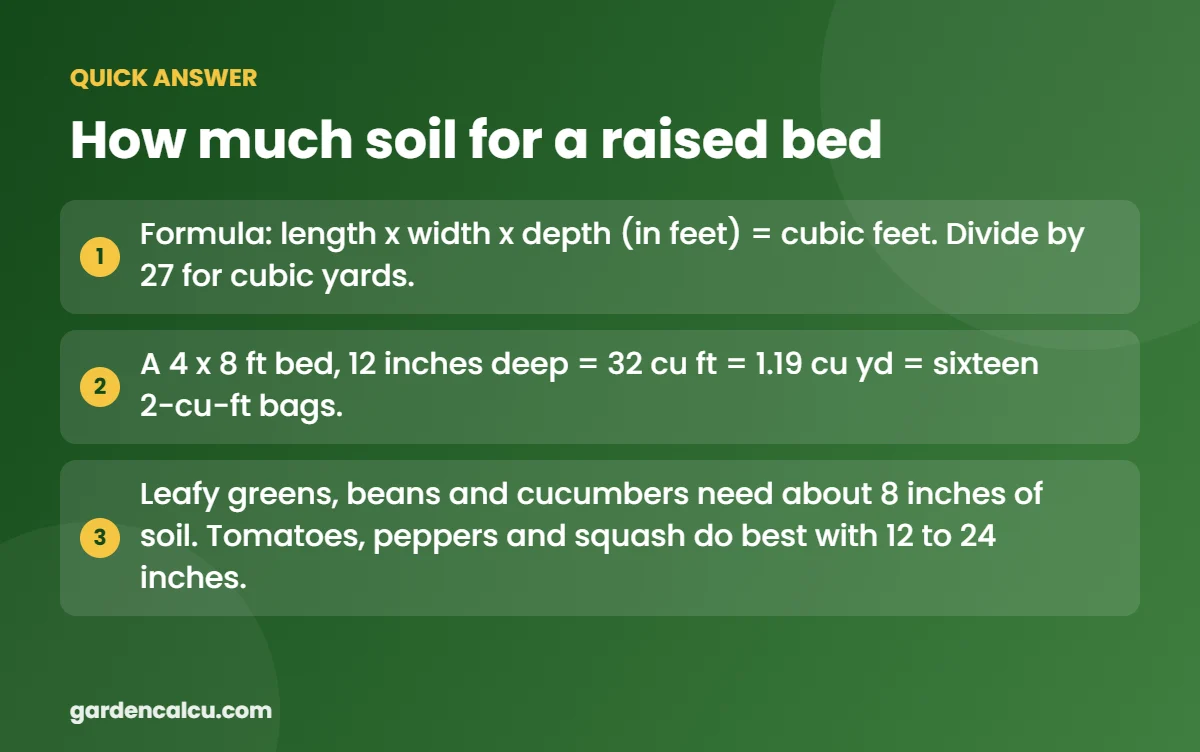
Quick answer to “how much soil for a raised bed” in three numbers.
Real questions gardeners asked
Every season people type “how much soil for a raised bed” into a search box, and many of them also ask it on public gardening Q&A boards. This guide is built from real questions posted by people in the United States. We read each one, along with the replies. Here is what they asked, in our own words, with a link to every original question.
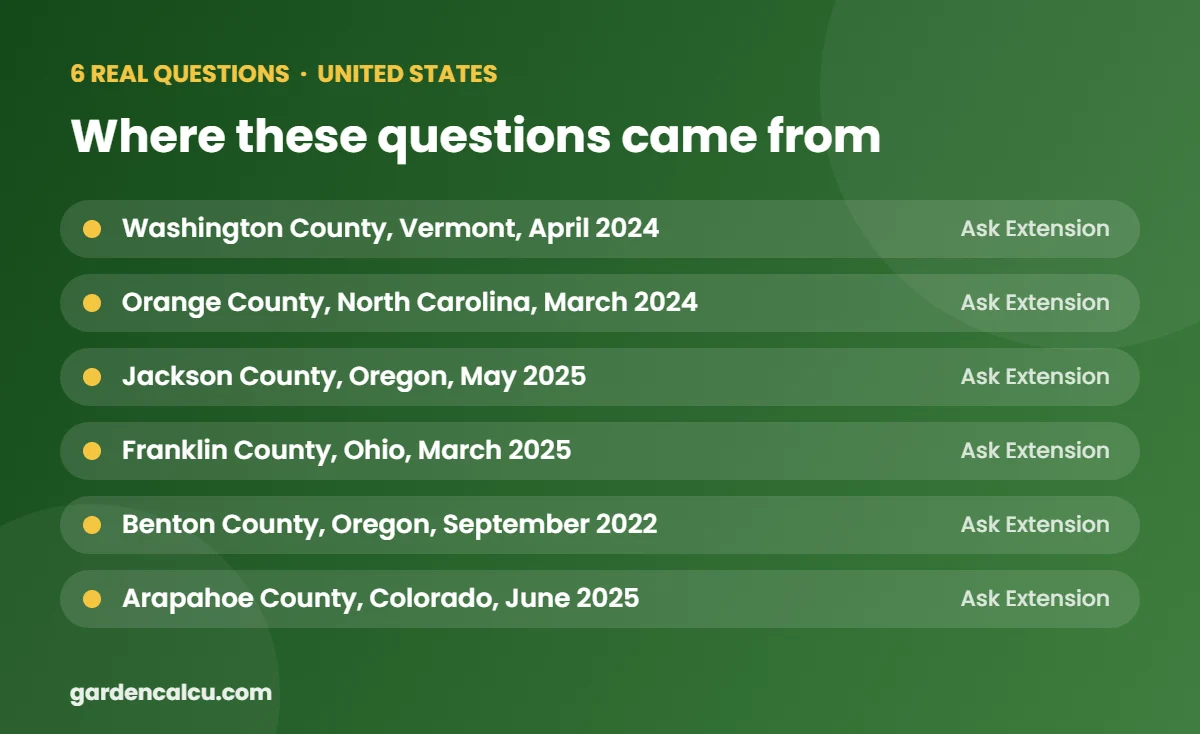
“Filling raised beds on a budget”
The question: A first-time raised bed gardener said they could not afford the $600 to $800 it would take to fill 3 yards with organic soil and compost. They asked whether layering twigs and leaf mulch in the bottom was a sensible way to cut the cost.
What the expert said: A UVM Extension Master Gardener volunteer said yes and named the method: hugelkultur, where logs, branches, twigs and grass go in the bottom to reduce the soil needed. She warned that the material breaks down and changes over time, and suggested a soil test to guide later amendments.
“Soil for raised beds”
The question: A gardener putting in four large raised beds needed about 100 cubic feet of soil. They asked what kind of soil to buy in bulk and how to be sure it was not contaminated.
What the expert said: The expert said 100 cubic feet is 3.7 cubic yards, so order about 4. He advised a topsoil and compost blend instead of topsoil alone, noted the county sold compost in bulk for about $40 per yard, and said topsoil weighs about 2,000 lb per cubic yard and compost about 1,000 lb.
“What’s the best way to fill in raised beds?”
The question: Someone helping a friend fill five galvanized beds, each 6 x 3 x 2 ft, wanted a low-cost way to do it. They had heard conflicting advice about wood rounds and sticks versus straw in the bottom.
What the expert said: The expert recommended layering: logs, branches and leaves at the bottom, then soil, with well-rotted compost for nutrients. Cardboard underneath is fine for weeds. Avoid gravel, and expect to add compost as the lower layers break down.
“Raised Beds for the first time!”
The question: A new gardener bought three galvanized beds, each 8 ft x 2 ft and 17 inches deep. They asked whether logs, sticks and wood chips in the bottom were needed at that depth and what ratio of wood to soil to use.
What the expert said: The expert said wood in the bottom works and suggested asking tree removal companies for material. The soil on top should be about 70% soil and 30% compost, at least 8 inches deep for leafy greens and cucumbers and 12 to 24 inches for peppers, tomatoes and squash.
“Soil for garden bed and front yard”
The question: A gardener with a vinyl bed 48 inches long, 48 inches wide and 11 inches high asked how much soil it would take and whether to fill it in fall or wait for spring.
What the expert said: The expert put it at about 15 cubic feet, roughly seven 2-cubic-foot bags of garden soil (not potting soil). He suggested waiting until late March or early April so winter rain would not wash nutrients out.
“What do I top off my raised beds with?”
The question: A gardener with one 4 x 2 ft bed said the soil settles every year. He had been refilling it with pure compost and wondered if topsoil with a compost top dressing would be a better balance.
What the expert said: The expert recommended topping up with topsoil from the yard or bagged garden soil rather than compost alone, and checking bagged products for salt content. She also suggested mixing the bed soil into the ground below.
Those are the real cases. The rest of this guide answers “how much soil for a raised bed” step by step, with the numbers the experts gave.
How much soil for a raised bed: the simple formula
University of Georgia Extension gives the method in one line: multiply length by width by height to get cubic feet, then divide by 27 to get cubic yards. The only trick is to convert inches to feet first.
Worked example: a 4 x 8 ft bed, 12 inches deep. 4 x 8 x 1 = 32 cubic feet. 32 ÷ 27 = 1.19 cubic yards. In metric that is about 0.9 cubic meters.
A real one: an Oregon gardener asked about a bed 48 x 48 inches and 11 inches high. That is 4 x 4 x 0.92 = 14.7 cubic feet. The Extension expert rounded it to about 15 cubic feet.
Tip: Skip the arithmetic: type your bed size into the Raised Bed Soil Calculator and it gives cubic feet, cubic yards and bag counts in one step.
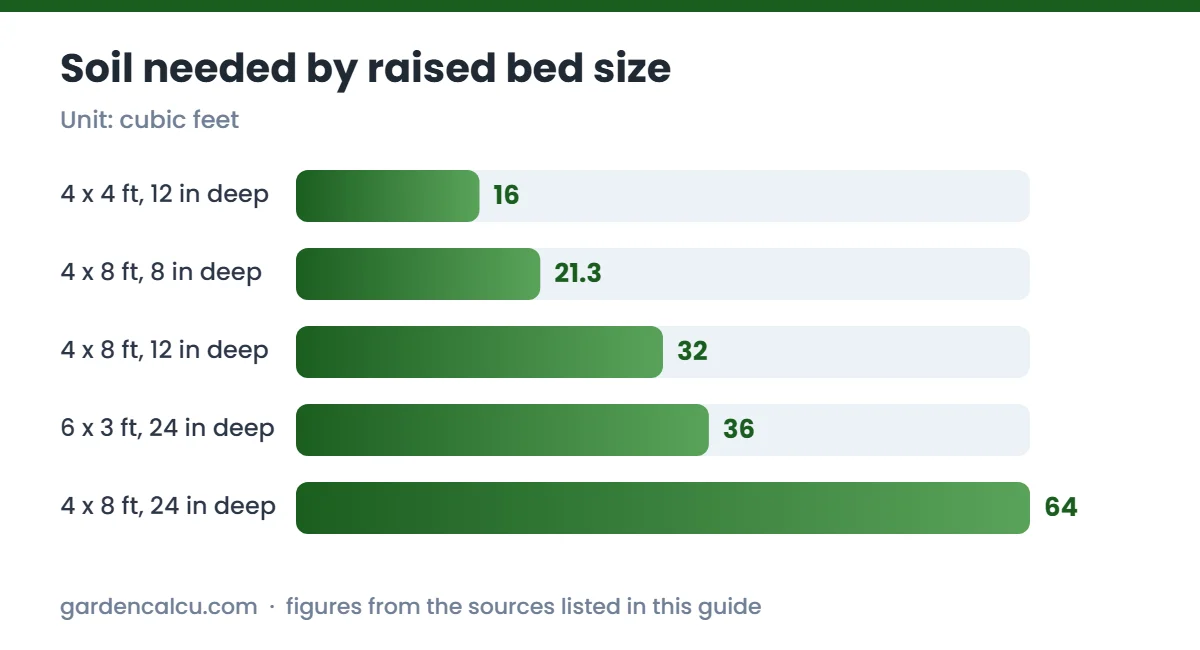
Chart for “how much soil for a raised bed”: Soil needed by raised bed size, in cubic feet.
Soil needed for common raised bed sizes
Most questions come down to a handful of bed sizes. This table uses the same formula. Bag counts are rounded up to whole bags.
Bed size (L x W x depth) | Cubic feet | Cubic yards | 2-cu-ft bags | 1.5-cu-ft bags |
|---|---|---|---|---|
4 x 4 ft x 12 in | 16 | 0.59 | 8 | 11 |
4 x 8 ft x 8 in | 21.3 | 0.79 | 11 | 15 |
4 x 8 ft x 12 in | 32 | 1.19 | 16 | 22 |
8 x 2 ft x 17 in | 22.7 | 0.84 | 12 | 16 |
6 x 3 ft x 24 in | 36 | 1.33 | 18 | 24 |
4 x 8 ft x 24 in | 64 | 2.37 | 32 | 43 |
How deep does the soil need to be?
Depth changes the total more than anything else. University of Maryland Extension says leafy greens, beans and cucumbers need about 8 inches of soil, while peppers, tomatoes and squash do best with 12 to 24 inches.
So a salad bed can be filled 8 inches deep and use a third less soil than a 12-inch fill. If you are planning what to grow first, our guide to starting a vegetable garden and the tomato planting guide help you match crops to bed depth.
Skip the math
Enter your bed’s length, width and depth and it works out the cubic feet, cubic yards and number of bags of soil to buy.
How much soil for a raised bed in bags vs. bulk cubic yards
University of Illinois Extension sums up the two ways soil is sold: in bulk by the cubic yard, and in bags by the cubic foot. One cubic yard is 27 cubic feet, so it equals 13.5 bags of 2 cubic feet or 18 bags of 1.5 cubic feet.
Bags sold by weight are harder. In a Michigan Ask Extension answer, an MSU volunteer figured a 40-pound bag of topsoil at roughly 0.75 cubic feet. At that size, a 32-cubic-foot bed takes 43 bags.
When bulk makes more sense
One small bed is a bag job. The Oregon gardener with the 15-cubic-foot bed was told to buy about seven 2-cubic-foot bags. Seven bags is 14 cubic feet, so an eighth bag fills it to the brim.
Several beds are a bulk job. The North Carolina gardener needed 100 cubic feet for four beds. That is 100 ÷ 27 = 3.7 cubic yards, or 50 bags of 2 cubic feet, so the expert told him to order about 4 yards.
Watch out: Check the weight before you haul bulk soil yourself. The same expert said topsoil weighs about 2,000 lb per cubic yard and compost about 1,000 lb, and that a standard pickup safely carries about 1,000 lb. One yard of topsoil is two trips, or a delivery.
What it costs to fill a raised bed
Prices vary a lot by region and product, so treat these as real examples, not a national price list. They are the figures that came up in the questions and sources we opened.
The gap between those numbers is the lesson. Compost from a county or municipal site can be a fraction of the cost of a bagged premium mix, and it is worth one phone call to find out.
To budget your own project, first work out how much soil for a raised bed of your size, in cubic yards, then multiply by the local price. For the 4 x 8 ft, 12-inch bed: 1.19 cubic yards x $40 = about $48 in bulk compost, before delivery and before the topsoil that goes with it.
How to fill a raised bed cheaply with logs and leaves
Three of the six gardeners asked the same thing: can I put wood and leaves in the bottom? In Vermont, Oregon and Ohio, the Extension answer was yes. The method is called hugelkultur, and it changes how much soil for a raised bed you have to buy.
Oklahoma State University Extension says the raised bed version needs a bed at least 17 inches tall. You fill approximately the lower half with the woody material and the upper half with soil.
The layer order, bottom to top
Worked example: the Oregon friend had five beds, each 6 x 3 x 2 ft. That is 36 cubic feet per bed and 180 cubic feet in total, or 6.67 cubic yards. With wood in the lower half, the soil order drops to 90 cubic feet, or 3.33 cubic yards.
That still leaves 12 inches of soil on top, which is enough for tomatoes and peppers by the Maryland numbers. The Ohio beds at 17 inches are right at the minimum height, so about 8 inches of wood and 9 inches of soil suits greens and cucumbers.
Watch out: Oklahoma State says to avoid black walnut, rot-resistant wood like cedar, freshly cut wood that sprouts easily, and railroad ties or painted lumber. It also says plants may need extra nitrogen in the first few seasons while the wood breaks down.
Do not use gravel as filler. The Oregon expert advised against inorganic material in the bottom because it may hinder root development.
What soil mix to put in the bed
Knowing how much soil for a raised bed is only half the order. The mix is the other half, because most suppliers sell topsoil and compost separately. University of Minnesota Extension says the ideal raised bed mix is around two-thirds to one-half topsoil and one-third to one-half plant-based compost.
University of Maryland Extension gives a similar range: compost to topsoil at 1:2 or 1:1. The Ohio expert landed in the same place with 70% soil and 30% compost.
Worked example: for a 32-cubic-foot bed at two-thirds topsoil and one-third compost, order about 21 cubic feet of topsoil and 11 cubic feet of compost. In 2-cubic-foot bags that is 11 bags of topsoil and 6 bags of compost.
Tip: Ask a bulk supplier what is in the product before you pay. University of Georgia Extension notes that topsoil is unregulated and may contain chunks of bark and weed seeds, and the North Carolina expert warned about fill dirt mixed with compost being sold as topsoil.
Soil settling: why the level drops and how to top up
A full bed will not stay full. University of Georgia Extension explains that compost keeps decomposing, so you will need to add more over time. Beds with wood in the bottom sink more, and Oklahoma State says to add compost or topsoil each year to keep the planting depth.
We did not find an Extension source that gives a fixed settling percentage, so we will not invent one. The practical move is to measure the drop in spring and refill that amount.
Worked example: a 4 x 8 ft bed has 32 square feet of surface. Each inch of settling is 32 ÷ 12 = 2.67 cubic feet. A 2-inch drop takes 5.3 cubic feet, which is three 2-cubic-foot bags.
What you top up with matters. The Colorado gardener had been refilling with pure compost every year, and the expert steered him to topsoil or bagged garden soil instead. A layer of mulch on top slows drying between refills, and the mulch calculator sizes that for you.
Run the numbers again each spring with the raised bed soil calculator. Enter the bed size and only the inches you need to add, and it returns the top-up amount in bags.
Frequently asked questions
Short answers to the questions people ask most about “how much soil for a raised bed”.
Quick recap
The short version of “how much soil for a raised bed”: Formula: length x width x depth (in feet) = cubic feet. Divide by 27 for cubic yards.
For your own garden, the Raised Bed Soil Calculator does the math in a few seconds. Check its answer against the real examples above.
Get your exact number
Enter your bed’s length, width and depth and it works out the cubic feet, cubic yards and number of bags of soil to buy.
Sources
The numbers in this guide to “how much soil for a raised bed” come from these university Extension and official pages: